Showing posts with label Robert Louis Stevenson. Show all posts

Wednesday, February 12, 2014

We're All Friends Here!


The more I read about the lives of writers in London in the 1890s, the more interconnected they seem. I feel compelled to sit down one of these days and make a tree of who was friends with who.

I knew that Bram Stoker was friends with Oscar Wilde and that they were both friends with Arthur Conan Doyle (Sherlock Holmes), but I didn't know that Doyle was friends with J.M. Barrie (Peter Pan).


Barrie even asked Doyle to do some editing on one of his plays (if you are a writer today, that probably sounds familiar).

Barrie was pen pals with Robert Louis Stevenson. When he opened the mail box in front of his house, he might have bumped into George Bernard Shaw because they were neighbors.

As his marriage crumbled in the 1900s, Barrie got support and advice from his good friend, H.G. Wells (War of the Worlds). They both knew Thomas Hardy, but not very well.

If anyone knows of a family-tree style map of the friendships between writers in London in the 1890s, let me know? Otherwise, I might have to make one myself!

Note: The date on this post was changed when I made a minor edit to add in the closing line that I now try to leave on all my posts. It was a reminder that I still haven't got around to mapping out the friendships between writers, which is largely because they were too many. Writers in the 1890s were so well connected that they knew each other even if they lived in different cities or countries, like Walt Whitman and Bram Stoker. This sense of community, though it reminds me of the online communities we create today, was, for the most part, due to a stronger inclination toward letter writing and attendance at literary events. However, I still think that a community of writers is a community worth celebrating!

Follow me on Twitter @TinyApplePress and like the Facebook page for updates!

Tuesday, December 17, 2013

An 1890s Christmas Spectacular

In the 1890s, the Illustrated London News' Christmas Supplement should have been called a Christmas Spectacular because it offered a range of spectacular stories from the outstanding writers of its day. Because it's almost Christmas, I'm including online links to the best of these stories throughout my post, just for you!

Established in 1842, the Illustrated London News was the world's first illustrated weekly news magazine. Sadly, it surrendered to online media in 2003. Most British histories of Christmas rely on the early Christmas Supplements for information about Victorian Christmas. After looking over them myself, I've found that the Christmas Supplement was overly concerned with how many "Englishmen" were spending the holidays abroad, though that mingled well with Empire, another popular theme.

The covers on their own attest to Victorian ideas of Christmas. Most of them feature women, who represent family and home life. Most of these women look like they are just freezing cold, but the stories, oh the stories, you could warm up reading those by a fire!


She doesn't look very happy about Christmas, but she is holding mistletoe. Maybe that's her sexy face?

One of the features that year was "Mrs Hauksbee Sits Out: An Unhistorical Extravaganza" by Rudyard Kipling.


The 1891 Christmas Supplement brought us Thomas Hardy's "The son's Veto" and J.M. Barries's " The Inconsiderate Waiter."


I can only say that with stories like these, the production value should go up, and it does in 1892. They also changes illustrators for the cover art.


Kipling published "The Bridge Builder" in the 1893 Christmas Supplement.


The cover girl of number 1894 looks like she's been drinking Coca-Cola!


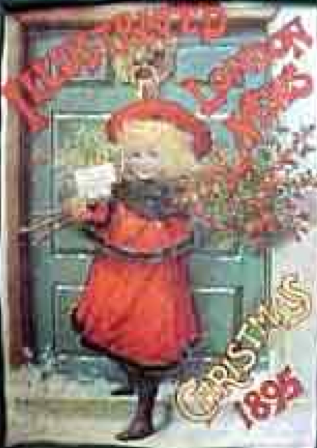
The Christmas Supplement of 1895 presented Robert Louis Stevenson's The Great North Road.


Number 1896 saw a return of Thomas Hardy with A Committee-Man of 'The Terror'. The Victorian Web has more on this story and this edition here.


Walter Besant, the author responsible for putting Edmund Gosse in charge of seating at a dinner party, published in the 1897 Christmas Supplement.


In 1898, Im beginning to resent all of these outdoor images of Victorian Christmases. My favourite Christmas memories are all about being warm and toasty inside!


Which brings us to the end of the 1890s. This English cover girl is bundled up like a snow angel, reminding readers that snow is an essential part of an English Christmas. Without snow, what reason was there to bundle up by a fire? Without a fire, how could you roast chestnuts? In the 1890, an editor mourned for those poor people in the colonies: "I can't for the life of me conceive how our Australian kinsmen can contrive to keep Christmas under a sultry sky, which renders such a fire a physical impossibility."

Follow me on Twitter @TinyApplePress and like the Facebook page for updates!

Sunday, December 8, 2013

London Fog

 
It was by this time about nine in the morning, and the first fog of the season. A great chocolate-coloured pall lowered over heaven, but the wind was continually charging and routing these embattled vapours; so that as the cab crawled from street to street, Mr. Utterson beheld a marvellous number of degrees and hues of twilight; for here it would be dark like the back-end of evening; and there would be a glow of a rich, lurid brown, like the light of some strange conflagration; and here, for a moment, the fog would be quite broken up, and a haggard shaft of daylight would glance in between the swirling wreaths. - Robert Louis Stevenson (1886)
Fog, fog, fog! All through Victorian literature, we have fog. It can be creepy, romantic, foreboding, a plot device, but it was also a deadly. In the Strange Case of Dr Jekyll and Mr Hyde, Stevenson beautifully describes the fog in London in the 1880s, which was really the toxic mixture of fumes that comprised the early stages of the Great Smog that would lead to the Clean Air Act (1956).

Even Punch took on the terror of the fog!

The fog, which was more like smog, got worse in December. It was bad all winter because, combined with the toxic clouds from the city’s factories, people used coal in their fires to keep warm. Together, they created a toxic mix of sulphur dioxide and combustion particles.

Reeking of coal tar, a fog filled parts of London in 1873, raising the death rate by 40%. The fog most commonly claimed the lives of people with respiratory ailments, the young, and the old, but it was also especially hard in poor neighbourhoods, where the wind brought smoke from factories in addition to what came out of people’s fireplaces. Mix that smoky death with the icy weather and improper clothing/nutrition... well, you get the point.


In December 1891 and December 1892, it felt like the sun never rose in certain parts of the city. Thousands died. People were horrified. Yet, no one did anything about it. It was as if it were an accepted part of London life. Londoners were called “Pea-Soupers” and London was called “the Smoke,” like this was just something you could expect from the city.

Of course, Oscar Wilde hides Dorian Gray in the fog:
He was walking home about eleven o'clock from Lord Henry's, where he had been dining, and was wrapped in heavy furs, as the night was cold and foggy. At the corner of Grosvenor Square and South Audley Street, a man passed him in the mist, walking very fast and with the collar of his grey ulster turned up. He had a bag in his hand. Dorian recognized him. It was Basil Hallward. A strange sense of fear, for which he could not account, came over him. He made no sign of recognition and went on quickly in the direction of his own house.
But Hallward had seen him. Dorian heard him first stopping on the pavement and then hurrying after him. In a few moments, his hand was on his arm.
"Dorian! What an extraordinary piece of luck! I have been waiting for you in your library ever since nine o'clock. Finally I took pity on your tired servant and told him to go to bed, as he let me out. I am off to Paris by the midnight train, and I particularly wanted to see you before I left. I thought it was you, or rather your fur coat, as you passed me. But I wasn't quite sure. Didn't you recognize me?"
"In this fog, my dear Basil? Why, I can't even recognize Grosvenor Square. I believe my house is somewhere about here, but I don't feel at all certain about it."
Follow me on Twitter @TinyApplePress and like the Facebook page for updates!