In her essay: Phonograph, Shorthand, Typewriter: High Performance Technologies in Bram Stoker's Dracula, Leanne Page examines the influence of writing machines on Victorians. Stenographic writing is another term for shorthand, something that dramatically pre-dates Stoker, but was being innovated through the Victorian love of the machine.
In Dracula, Mina writes:
I feel so grateful to the man who invented the "Traveller's" typewriter, and to Mr. Morris for getting this one for me. I should have felt quite astray doing the work if I had to write with a pen.
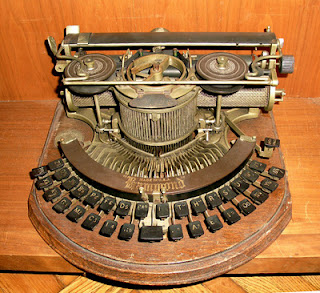
Those of us, who can even remember typewriters, imagine something with a qwerty ketboard that packs up, like a suitcase, but portable typewriters, at the time Dracula was published in 1897, looked more like this:

Page includes an ad for the above typewriter in her essay:

Another "portable" typewriter, from Page's essay that somes closer to what we imagine, looks like this:
Yet, as a writer, I rely more heavily on technology for my work than Bram Stoker did for his. Every word, all of my notes happen on my lap top, iPad or phone. Although, Stoker's characters practiced shorthand; used typewriters and a gramophone to record their diaries, the original manuscript of Dracula was written in Stoker's own hand. Essentially, Stoker advocated the use of technology for writing, but didn't practice it himself.
I wonder whether other writers or other kinds of writers employed this technology in the 1890s. Would a journalist be more inclined to actually compose his or her work on one of these types of writing machines or would the typeface composition have been left entirely to the realm of the printers?
Follow me on Twitter @TinyApplePress and like the Facebook page for updates!

