Tuesday, July 28, 2015

Top 10 Wildean Insults


Known for his wit, many of Oscar Wilde's insults are too convoluted to throw out during an argument, but these one-liners have got you covered!

  1. Good novelists are much rarer than good sons (On a New Book on Dickens). This is number one because, whether you are a novelist, a son, or both, this is mean.
  2. Like most artificial people he had a love of nature (Pen, Pencil, and Poison). It is far more genuine to admit that you hate camping, then go to the movies instead. 
  3. Nothing is so dangerous as being too modern. One is apt to grow old-fashioned quite suddenly (An Ideal Husband). I love that one for what it says about those who bought the first iPod, or iPhone, and how proud I was to own the first Sony discman.
  4. There is no reason why a man should show his life to the world. The world does not understand things (De Profundis). I almost left this out because it seems to insult the world. In context it is about the love that dare not speak its name and the reason Oscar Wilde went to prison, but it is true of many people who tweet, or instagram every moment of their day. Someone once beautifully called such  behaviour remembering the present. Yet, Twitter and Instagram are full of haters and looking for validation that way is idiotic.
  5. Whenever people agree with me, I always feel I must be wrong (Lady Windermere's Fan). It's funny if you know that sensation or hearing the words you want to hear and realizing not only how stupid those words sound, but also how stupid you were for wanting to hear them.
  6. I never saw anybody take so long to dress, and with such little result (The importance of Being Earnest). Reminds me of a guy I dated once who spent ages adjusting the way his t-shirt fell around the waistband of his jeans.
  7. Books of poetry by young writers are usually promissory notes that are never met (On Yeats' 'The Wandering of Oisin'). This one just gives me the biggest Lily Allen smile.
  8. Nothing makes one so vain as being told that one is a sinner (The Picture of Dorian Gray). Sometimes people really do seem to seek applause, when they are asking for forgiveness. 
  9. It is only the intellectually lost who ever argue (The Picture of Dorian Gray). I would do well to remember this when perusing reader comments on the internet.
  10. Morality is simply the attitude we adopt towards people whom we personally dislike (An Ideal Husband). I find few things less attractive than people who condemn the lives of other people.
Follow me on Twitter @TinyApplePress and like the Facebook page for updates!

If you have enjoyed the work that I do, please support my Victorian Dictionary Project!

Sunday, May 10, 2015

Poe is nowhere, but Bram Stoker's mother is everything!

Charlotte Matilda Blake Thornley Stoker
I was going to write a blog post today about the mothers of writers in London in the 1890s, but I found this passage in Barbara Belford's biography of Bram Stoker that I think says it all. To me, this passage shows that, when things are looking down, when you are faced with criticisms and your endeavours are not as successful as you hope, mothers often know best.

Stoker borrowed money to publish Dracula, which didn't make him much money (in his lifetime) and got pretty dismal reviews - even from his friends.
Fortunately authors have mothers. "My dear, it is splendid," gushed Charlotte Stoker, "a thousand miles beyond anything you have written before, and I feel certain will place you very high in the writers of the day - the story and style being deeply sensational, exciting and interesting." To his mother, Stoker had surpassed all competitors. "No book since Mrs Shelley's 'Frankenstein' or indeed any other at all has come near yours in originality, or terror - Poe is nowhere," she wrote. "I have read much but I never met a book like it at all. In its terrible excitement it should make a widespread reputation and much money for you." Unfortunately it did neither during Stoker's lifetime. If Dracula had been published in 1818 at the same time as Frankenstein, instead of at the height of literary realism and naturalism, it would have been a Romantic milestone. Source
Thank you for always being so supportive of me, mom. We writers need moms like you.

Follow me on Twitter @TinyApplePress and like the Facebook page for updates!

If you have enjoyed the work that I do, please support my Victorian Dictionary Project!

Tuesday, May 5, 2015

Poop in (Victorian) Beards

Nowadays, when you mention the long beard trend, most people immediately think of hipsters; I still think of the Victorians. With the news this week that these hipster beards harbour the kind of bacteria found in fecal matter, I rolled my eyes and thought about other problems the Victorians had with poop.


Essentially, overpopulation in the City of London caused the Times to speculate in 1894 that by 1950 the horse poop in the streets would be nine feet deep. It was the full-time occupation of the city's block boys to keep the streets free of manure. If you are worried about your beard filling up with poo as you go about your business today, imagine how crappy Bram Stoker's beard was!


In spite of the fact that Stoker took a bath every night before bed, the Victorians aren't remembered for their excellent hygiene, or medical care. Although they weren't known for their especially long life spans, walking around with poop all over their faces isn't what was killing them.

Before you throw hygiene to the wind and embrace the notion of getting poop on your face, remember that a basic understanding of science may be lacking in populations that resist learning about evolution (namely much of the Southern United States and people in the nineteenth century). It wasn't actual poop that they found in the beards of men in Albuquerque, it was the kind of bacteria found in the stomach and in poop. If you don't have enough, or the right kinds of these bacteria, you may develop ulcerative colitis and other gastrointestinal conditions, which are sometimes even treated with a fecal transplant (they take the poop bacteria from the tummy of a healthy person and put it into the tummy of a sick person).

If you are a hipster, be like Stoker. Enjoy your beard, but wash it often. Irregardless of whether you have a beard, no one is going to want to kiss you if you don't take a bath.

Follow me on Twitter @TinyApplePress and like the Facebook page for updates!

If you have enjoyed the work that I do, please support my Victorian Dictionary Project!

Tuesday, April 28, 2015

The Victorian (and pre-Victorian) Pug Cult

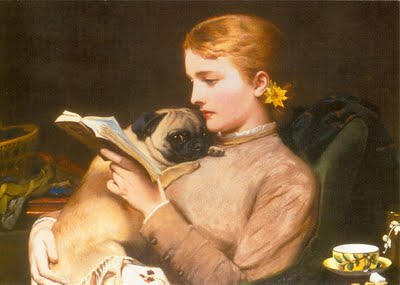
"Blonde and Brunette" by Charles Burton Barber
The rise of the pug cult is popularly traced back to when the British found pugs in the Chinese Imperial Palace during their invasion of China in 1860 and brought them back to England, where black pugs, in particular were made popular by someone called Lady Brassey. "Lady Brassey" probably refers to the travel writer and Baroness, Anna Brassey, who died in 1887. Though it is said she presented a black pug at the Maidstone show in 1886, just a year before her death.

Soon after Brassey made them cool, Queen Victoria became fond of the breed. She had several and it was through her involvement in breeding pugs that the Kennel Club was established in 1873. It was, consequently, a pug who won the first best in show of the Westminster Kennel Club in 1877.

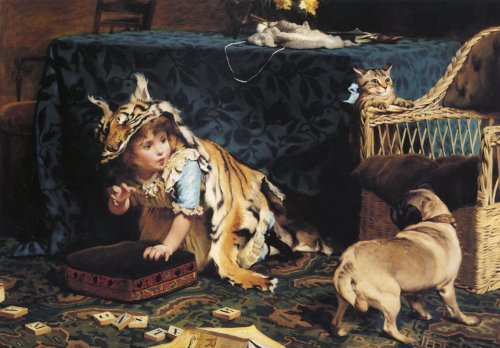
Dog fancying is linked to the Victorian cult of domesticity, supported by the Queen, who commissioned a painter, specifically Charles Burton Barber, to capture her beautiful dogs (and others) on canvas.

"A Monster" by Charles Burton Barber
According to one blogger, other artists followed suit with amazing results:


I've been wearing mostly jeans, and one blazer has already had a few threads pulled since I got my own little brindle pug a few weeks ago, so I am astonished at that dress. All of the pictures above depict scenes of feminine domestic bliss in the typical Victorian fashion: women and children in household settings with their pets. But, as with everything in the nineteenth century, nothing was as simple as it seemed.


Before Victorian England embraced them, pugs were part of a very masculine culture in continental Europe and this is where it gets really weird.


The Mops-Orden (German for the "Order of the Pug" was a Catholic para-Masonic society that was supposedly founded by Klemens August of Bavaria in 1740 to bypass a papal bull. To the Order of the Pug, the pug represented loyalty, trustworthiness and steadiness, whereas now they are known primarily for their flat faces and love of cheese. Those who belonged to the Order of the Pug were called Mops (Pugs). New members underwent an initiation process that involved wearing a dog collar and behaving, in various ways, like a dog: scratching at the door to get in and kissing a porcelain pug's bum.

The secrets of the Order of the Pug were exposed in Amsterdam in 1745, but it took three years for anyone to ban them (maybe it took that long for them to take it seriously). However, it is rumoured that the Order was active until 1902.

A Pug by Carl Reichert (1836-1918)
Before the British Invasion in 1860, pugs were imported to the European continent by the Dutch East India Company. The dogs have a long history in China and are considered one of the oldest and most loyal breeds, housed only in Tibetan Monasteries and by members of the Chinese Imperial household.

Aside from Queen Victoria's pugs, Minka, Venus, Rooney, Olga, Fatima and Pedro, the most famous pug in European history is probably a little guy, called "Pompey," who, contrary to Monty Python lore, expected the Spanish Inquisition and alerted his master the Prince of Orange William the Silent to their arrival in 1572, thereby saving his life.

So while it is popular to trace the pug cult back to Queen Victoria and Lady Brassey, it has most certainly been around a lot longer than that!

Queen Victoria and one of her pugs.
Follow me on Twitter @TinyApplePress and like the Facebook page for updates!

If you have enjoyed the work that I do, please support my Victorian Dictionary Project!

Friday, April 24, 2015

Humans of London (in the 1890s)

Who isn't occasionally inspired by Humans of New York? Since I've taken a little break from writing recently and been playing with Photoshop, I thought I would share what I've come up with.


These are writers in London in the 1890s (if they had Facebook and someone got inspired by Humans of New York).


Follow me on Twitter @TinyApplePress and like the Facebook page for updates!

If you have enjoyed the work that I do, please support my Victorian Dictionary Project!
Monday, April 6, 2015

Cartographic Fictions and the Poverty of Digital Archives


In Chuck Palahniuk's Fight Club (1996), the protagonist lives on a paper street, but did you know that paper streets have actually been used as cartographical traps to catch plagiarism? Gizmodo shared an excellent article on this today, outlining the ways in which some of these "trap streets" and imaginary places have actually lead to the creation of real places in the locations where they were mapped to catch intellectually lazy cartographers. I loved this idea and had to find out more about it.

"Trap streets" differ from "paper streets" in that they are deliberate misrepresentations. "Paper streets" and "paper towns" are imagined streets that someone actually plans on creating, irregardless of whether they will ever be constructed. Paper streets and towns are what developers lay out, after purchasing the land, but as we all know, sometimes those plans can fall through and cartographers have been known to include the still imaginary places on maps as traps for other cartographers.

Trap streets are a fascinating, but ultimately pointless, trade secret. Cartographers almost universally deny using them. Although the practice started to deter copyright infringement, trap streets are not copyrightable because "the existence, or non-existence, of a road is a non-copyrightable fact." Yet, the practice is only just beginning to die out.

Map aficionados treat the fake places that only exist on maps as Copyright Easter Eggs. Now that we've entered the era of digital imaging and mapping, these fake places are quickly being weeded out. Perhaps, the most famous example of this is Moat Lane.

Moat Lane in Finchley, North London was only recently removed from Google Maps, after first appearing in the TeleAtlas directory, a primary reference for Google Maps. Satellite view revealed treed yards and a house where the street was supposed to be.

This is Google's Street View of the place Moat Lane supposedly was.
Illustrating the ubiquitous and democratic nature of the digital world, TeleAtlas is now a subsidiary of the GPS mapping company TomTom. Mapping errors go through a system called Tele Atlas Map Insight, which enables users to improve the maps by reporting and correcting errors bypassing the customer and technical support teams of the manufacturers that use TeleAtlas maps.

More accurate maps are undoubtedly important, but these systems for correcting them illustrate the poverty of digital archives in the modern world. Trap streets are rapidly disappearing from the maps we use everyday without a trace. The corrections are leaving little to no record of how initial "errors" occurred, or why the corrections were made. The need to alter the written records of the past was a testament to the authenticity of archives, leaving a literal paper trail for historians. Digital archives leave no such paper trail. After all, who wants to leave behind a record of their mistakes?

Here's a link to another great article on this subject.


Monday, March 30, 2015

Lady Meux and Egyptology

Portrait by James Abbott McNeill Whistler
Lady Meux typifies the type of 1890s woman I adore most of all. She was eccentric, incredibly wealthy, and had such a shifty past that "respectable" people wouldn't talk to her, but the Prince of Wales was happy to party with her at her house. When she had her portrait done, she hired James Whistler. What I don't like about her, or any of the figures that I've uncovered from this period so far, is the inclination to horde the artifacts that England was pillaging from other parts of the world, like the Americas, but especially Egypt.
"When an artifact is stolen, it is separated from the archaeological and historical context that is an essential aspect of its value. The looting of Egypt's antiquities dates back to ancient times--there are now more standing obelisks in Rome than there are in Egypt." Source
Today, I started stumbling upon books about the collection of Egyptian antiquities that Lady Meux kept at Theobalds House. You can see one for free on archive.org. The book pays careful attention to symbolism, translation, and funeral practices because Lady Meux kept the physical remains of ancient Egyptians and their coffins at her house.

From Kurna; Coffin of An-Heru; XIth Dynasty, about 2600.
Coffin of an Unnamed Priest of Amen-Ra, with
Mythological Scenes and Explanatory Inscriptions.
Qebhsennuf, Tuamutef, Hapi, and Mestha;from Thebes;
Set of Canopic Jars; XVIIIth Dynasty, about B.C. 1550.
Lady Meux's collection was so extensive that the legendary Egyptologist Wallis Budge only managed to catalogue part of it, some 1,700 parts, and he dedicated The Book of Paradise to her.

When she died, she tried to will the collection to the British Museum, but they declined and it was sold off instead. During her lifetime, Egyptians made it known to the English that many of the things their archeologists were taking were valuable to them. In Lady Meux's defence, when she learned that five of her Ethiopic manuscripts were missed by Ethiopians, she left them in her will to Emperor Menelik.

I do not know what the legal status the items from Lady Meux's collection, but I do know that the permission of the Egyptian government has been required for all archaeological excavations since 1869. Illegally excavated antiquities are also to be considered Egypt's national property. And Oscar Wilde's father reportedly bragged about having personally acquired his antiquities "before all the archeology started."

Follow me on Twitter @TinyApplePress and like the Facebook page for updates!

If you have enjoyed the work that I do, please support my Victorian Dictionary Project!