Monday, January 28, 2013

Traveling Along Fleet Street

I found this picture on Flickr. It's a view of Fleet Street in the 1890s.


Upon closer examination (or rather by taking a few steps back in the photo below), what looks like tents along the sidewalk on the left side actually appear to be the awnings of various shops.


We can already see the electric lights; before the end of the decade, London would have it's first electric taxis, which were, for obvious reasons, referred to as horseless carriages.


It's funny to think how much the street must have changed in such a short time. Those early electric taxis were set up so that the passenger could cover up the windows because many people wanted to ride in them, but didn't want to make a spectacle out of themselves.

I'm thinking about this place because, as I mentioned in my previous entry, Fleet Street was the location of news reporting. Highly imperialistic tones characterize journalistic writing of the era. With all of these changes happening and the architecture in the background, it is easier to see why. Today, as writers, we are told to write about what we know. Newspaper journalists in the 1890s knew this place well.

Sunday, January 27, 2013

First Lady of Fleet Street

Fleet Street was already known in London of the 1890s as the haunt and workplace of news reporters. By the 1890s, journalism was beginning to be an "acceptable" career for women. Perhaps, the most exceptional of these early women journalists was Rachel Beer, who has been made the subject of a book that acknowledges her contributions.


Beer won her place in journalism history by capturing the world exclusive of Count Esterhazy's forgery of the letters in the Dreyfus Affair. Beer was born into the famous Sasoon family and, although she always remained proud of her Jewish roots, she faced prejudice throughout her life and career. She converted to Anglicanism when she married Frederick Beer, whose influence in the publishing industry admittedly afforded many of the opportunities that led to her success.

Still, it takes amazing strength of character in the face of so many obstacles to achieve all she did.

The following is a 2011 Guardian review of the book about her life: First Lady of Fleet Street.
Next month sees the publication of a book about the remarkable Rachel Beer, the woman who famously edited the Sunday Times and The Observer simultaneously.
As the title indicates, she was First Lady of Fleet Street because she was the first female editor of national newspapers.
It helped that they were owned by her financier husband, Frederick, but she proved to be a woman of enormous energy, writing with equal enthusiasm for each paper for several years in the 1890s.
When editing The Observer she was credited with overseeing what would now be called, rightly, a 'world exclusive' - the revelation in 1896 that the document that had been used to convict the French military officer Alfred Dreyfus for treason was a forgery by his fellow officer.
Beer was regarded as both a rebel and a pioneer. At a time when women were still denied the vote, she was barred from frequenting the London clubs that fed her rival male editors with political gossip and also from the press gallery of the House of Commons.
Undaunted, she raised her formidable voice on national and foreign politics as well as taking a controversial stand on social and women's issues.
She was wealthy in her own right, as the scion of the Sassoon family that had amassed a fortune in Indian opium and cotton. Her marriage to Frederick Beer brought together two wealthy dynasties.
But it also brought her strife because her husband's father abandoned the Jewish religion, which led to Rachel being disowned by many of her proudly Jewish family. When her husband died, her family conspired to have her certified.
No wonder the book's sub-title refers to "the fortune and tragedy of Richael Beer". It was written by Yehuda Koren and Eilat Negev, and is due to be published on 24 April.
The book is available through Random House for $30.00.

Follow me on Twitter @TinyApplePress and like the Facebook page for updates!

Saturday, January 26, 2013

Stenographic Writing

The novel, Dracula uses developing forms of storying in the 1890s, like the typewriter, the gramophone, long-distance telephone lines, and undersea telegraph cables. Dracula also appeared about the same time the first steampunk novels were being produced, while joining in with the Victorian era's celebration of technology through its love of the machine.

In her essay: Phonograph, Shorthand, Typewriter: High Performance Technologies in Bram Stoker's Dracula, Leanne Page examines the influence of writing machines on Victorians. Stenographic writing is another term for shorthand, something that dramatically pre-dates Stoker, but was being innovated through the Victorian love of the machine.

In Dracula, Mina writes:
I feel so grateful to the man who invented the "Traveller's" typewriter, and to Mr. Morris for getting this one for me. I should have felt quite astray doing the work if I had to write with a pen.
Those of us, who can even remember typewriters, imagine something with a qwerty ketboard that packs up, like a suitcase, but portable typewriters, at the time Dracula was published in 1897, looked more like this:


Page includes an ad for the above typewriter in her essay:


Another "portable" typewriter, from Page's essay that somes closer to what we imagine, looks like this:


Yet, as a writer, I rely more heavily on technology for my work than Bram Stoker did for his. Every word, all of my notes happen on my lap top, iPad or phone. Although, Stoker's characters practiced shorthand; used typewriters and a gramophone to record their diaries, the original manuscript of Dracula was written in Stoker's own hand. Essentially, Stoker advocated the use of technology for writing, but didn't practice it himself.

I wonder whether other writers or other kinds of writers employed this technology in the 1890s. Would a journalist be more inclined to actually compose his or her work on one of these types of writing machines or would the typeface composition have been left entirely to the realm of the printers?

Follow me on Twitter @TinyApplePress and like the Facebook page for updates!

Wednesday, January 23, 2013

Not that Shakespeare!

There's no denying the men's club aspect to the culture of writers in London, during the 1890s. Even the Bohemian arts movement excluded women in London in ways that women were included in France. This, however, doesn't mean that women didn't participate! One example is Olivia Shakespear.

In the 1890s, Shakespear was a novelist and she didn't just sit at home writing novels under a pseudonym. Shakespear used her real name on all of her publications. She got out of the house, was active in London's writerly circles, most notably with William Butler Yeats.


Shakespear and Yeats met on 16 April 1894, at the launch party for the Yellow Book. Shakespear captivated Yeats instantly. Of the occasion, he wrote in his memoirs:
At a literary dinner where there were fifty or sixty guests I noticed opposite me, between celebrated novelists, a woman of great beauty. Her face had a perfectly Greek regularity, though her skin was a little darker than a Greek's would have been and her hair was very dark. She was exquisitely dressed with what seemed to me very old lace over her breast, and had the same sensitive look of distinction I had admired in Eva Gore-Booth. She was, it seemed, about my own age, but suggested to me an incomparable distinction.
After that night, the two became great friends, who would share literary ideas and notions. Though they were both married, in time, they also became lovers. This romance, of course was always overshadowed by Yeats' obsession with Maud Gonne, who he met in 1889 and pursued for decades. Consequently, Shakespear's affair with Yeats was probably overwhelming intellectual. They made many friends through this affair as well. Shakespear introduced Yeats to Ezra Pound in May 1909.


Shakespear shouldn't have been having an affair anyway. Shakespear was Olivia's married name. Her maiden name was Tucker. There doesn't appear to be any relation to the bard.

Follow me on Twitter @TinyApplePress and like the Facebook page for updates!

Tuesday, January 22, 2013

Bram Stoker on Abraham Lincoln

I never would have guessed that Bram Stoker was an Amerophile, but he was. He aspired to learn the histories of all the American presidents and research Abraham Lincoln extensively. I think he was attracted to Lincoln by the name. I know I'm always pretty stoked to meet someone with the same first name as myself - and I think I'd still be stoked if my first name were more common.

I was surprised to find this out about Stoker because we remember writers for their successes. I find Stoker's relationship to Lincoln interesting because it’s a writer's failures that make him/her human. Also, doing my own writing and research, it's sometimes comforting to know that even "great" writers weren't always a success.

Did I mention that Stoker wasn't a successful Loncoln scholar? No one ever thinks of him as an Amerophile because he didn't have much success as one. Moreover, I think thins might have caused him a bit anxiety and trepidation as he prepared to meet one of his favorite writers, Walt Whitman - an American. 


In 1887, Bram researched and prepared a lecture on Lincoln, which he practiced, with some success, in England, before delivering it in the United States, where he was to later meet his idol, Walt Whitman. When he met Whitman, also a fan of Lincoln, he said nothing about his lecture. Historians speculate this is because he was embarrassed, after receiving a terrible review in the New York Times.
Less than 100 people listened to a lecture by Bram Stoker yesterday afternoon in Chickering Hall, the subject being 'Abraham Lincoln.' 
Mr. Stoker has delivered this lecture with great acceptance before unenlightened English audiences, and his utterances have been highly commended by the semi-educated English press. 
On this side of the water, however, where Abraham Lincoln lived and died, and where American history is taught in public schools, a historical review of the life and times of the martyr-President, even when presented by Mr. Henry Irving's manager, is apt to fall flat. : General Horace Porter, who was an apparently interested auditor, congratulated Mr. Stoker at the conclusion of the lecture, and Major Pond, as he gazed sadly around the vast array of empty seats, said: "Well, I didn't expect any thing else. This lecture was advertised just as extensively as the readings of Charles Dickens or the talk of Max O'Reil. I spent just as much money on it. Mr. Stoker showed me some very flattering notices of his lecture clipped from the English press. So I said to him one day, 'Why don’t you deliver that lecture in New York, Stoker!' 
The fact is," said the Major, reflectively, "nobody cares to listen to a lecture on Abraham Lincoln in this country." 
We can understand, if Bram was embarrassed after reading that, knowing his hero likely read it too before their meeting. Swallowing his pride, Bram and Whitman became friends.

Bram made frequent trips to the United States, but arrived a little too late in 1894 to see Whitman for the last time. On this visit, however, he learned that Whitman had left something behind for him: an envelope with the original notes from his own American lecture on Abraham Lincoln, dated April 15, 1886. With this, was a letter that said: “Enclosed I send a full report of my Lincoln Lecture for our friend Bram Stoker.”

23 April 2014

To this, I would like to add that my opinions here were based on limited research, using source materials created in the United States. I think that I, like the others I was reading before, had trouble finding a primary source on Stoker's Lincoln Lectures. Such a source may be found in: Robert J. Havlik's “Bram Stoker’s Lecture on Abraham Lincoln,” Irish Studies Review 10:1 (April 2002).

I'm yet to find any reviews of Stoker's Lincoln Lectures in London, but suspect that research based on the American reviews is inclined to mimic the mocking tone of those reviews. Stoker's interest in Lincoln was actually fuelled by Whitman and borrowed from Whitman's research into Lincoln's assassination. Reading the Stoker essay, presented by Havlik, I found Stoker's thoughts to be balanced and elegantly presented.

Follow me on Twitter @TinyApplePress and like the Facebook page for updates!

Monday, January 21, 2013

Talking to the Dead

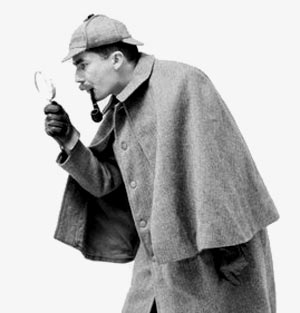
Do you believe in ghosts? Sir Arthur Conan Doyle did! The idea of communicating with the dead fascinated him and leaves me puzzling over how to reconcile a personality of a person that loved logic, held scientific degrees, and still believed in ghosts.

Still married to his first wife, the creator of Sherlock Holmes met and fell in love with a spiritual medium in 1897. Her name was Jean Elizabeth Leckie. The couple married in 1907, after the death of Arthur's first wife.

Doyle had complete faith in Jean's skills as a medium. He really believed she was psychic, could predict future events, and speak with the dead. His faith was evidenced by the fact that he would later offer her services to Harry Houdini to help him contact his deceased mother.

How do I reconcile Doyle's mysticism from the logic based aspects of his personality, that I believed helped him to write Sherlock Holmes, when they seem like an utter abandonment of rational thought?

It's difficult to understand anything when you take it out of context. Many of our respected writers of the 1890s belonged to the Hermetic Order of the Golden Dawn. This was a decade when the public wanted the assistance of psychic Robert James in solving the case of Jack the Ripper. What interests me about this aspect of Arthur Conan Doyle is that none of his spiritualism worked into the solutions of Sherlock Holmes' cases; instead, Arthur preferred to write about problems that could be solved in this world.

Upon reflection, and after a visit to Wonders & Marvels, I would add that, maybe, Sherlock Holmes does hold the key to understanding his author's belief in the unbelievable.

The character, Sherlock Holmes, was based on a professor that Arthur knew in school, who had amazing powers of deduction. Arthur was captivated by the way that he could see things no one else could see just by looking at what was right in front of him. Maybe Arthur was fascinated by all unbelievable things, but saw that the most unbelievable things are right in front of us!

Follow me on Twitter @TinyApplePress and like the Facebook page for updates!

Friday, January 18, 2013

Rational Dress

Thanks to Franny Moyle, I've come to see Oscar Wilde's wife as a far more complex character in the lives of writers in the 1890s. A writer in her own right, Constance Wilde wrote extensively on healthy fashions for women and published children's stories. She actively participated in the Rational Dress Society, attending meetings, exhibitions, as well as displaying her own creations (her wedding dress was on display to the public before she was married and what she wore to the theatre and parties was often the described in the press).

Many of the women involved in the artistic and writing communities of the 1890s were involved in the Rational Dress Society or the Artistic Dress Movements, including Bram Stoker's wife, Florence Stoker. Oscar Wilde promoted its ideals, during his tenure at the Woman's World. The Rational Dress Society was an organization founded in 1881 in London. It described its purpose thus:
The Rational Dress Society protests against the introduction of any fashion in dress that either deforms the figure, impedes the movements of the body, or in any way tends to injure the health. It protests against the wearing of tightly-fitting corsets; of high-heeled shoes; of heavily-weighted skirts, as rendering healthy exercise almost impossible; and of all tie down cloaks or other garments impeding on the movements of the arms. It protests against crinolines or crinolettes of any kind as ugly and deforming….[It] requires all to be dressed healthily, comfortably, and beautifully, to seek what conduces to birth, comfort and beauty in our dress as a duty to ourselves and each other.

Like the New Woman, these fashion forward women were often subject to ridicule. Commentary in the press about how Constance Wilde dressed reflected these criticisms.


Nonetheless, criticism made it hard to change the way most women dressed everyday and the Rational Dress Society's greatest triumphs were in the area of undergarments and athletic wear.


Follow me on Twitter @TinyApplePress and like the Facebook page for updates!