Showing posts with label feminism. Show all posts

Monday, November 23, 2015

Victorian Teenagers Gone Wild

The girl in the top left corner
has a mischievous face.
Throughout history, teenagers have rebelled against their parents. Popular psychology maintains that youthful rebellion helps young people build their own identity, separate from their parents. It happens in every class, culture, and race, so of course it happened in the Victorian Era.

You may say: "but Victorians were so proper!"
"Myths about the Victorian family are almost as numerous as those about the American West. Many regard the institution as a model for modern life, full of dutiful children and loving parents. Others see it as an example to avoid -- rigidly patriarchal, unloving, and riddled with class and gender restrictions. Both views, though too generalized, contain some truth, partly because of the tremendous variety of family lives during Queen Victoria's reign. Good or bad, families were the most important factor in a child's success in life" - Ginger S Frost.
 Even today, we tend to attribute the tendency to rebel with trouble in the individual, sometimes linking rebellious behaviour with the early signs of a psychopathic personality. Though teen rebellion often seems selfish, fed by boredom and glib, it generally has nothing to do with those traits in the person, but more to do with what one is rebelling against.


Young middle and upper-class Victorians became social reformers, committed to mending the injustices perpetrated by their society and sometimes within their own families. Young Victorians, like Bram Stoker, became aware of the problems associated with alcoholism and other addictions. The era saw the rise of the suffragette and educational reforms to help the poor. Of course, some young women started smoking and drinking to irritate their parents and some young men dressed below their station, so they could sneak into the poorer neighbourhoods for a bit of slumming - not all rebels are altruistic. We all had that friend who made us aware of broader social problems by personifying them.

1909 woman smoking opium.
Although teen rebellion was wide-spread, two particular people come to mind, when I think of 1890s writers, who were rebellious teenagers: Edmund Gosse and Constance Wilde.

Philip Henry Gosse with his son Edmund (1857).
Frontispiece to the first edition of Father and Son.
Obviously, Gosse comes to mind because of his memoir, Father and Son (1907), which bore the subtitle: "a study of two temperaments." His father, Philip Henry Gosse was a deeply religious scientist, who rejected the theories of his contemporary, Charles Darwin. In Father and Son, Gosse focuses on his father's rejection of the theory of evolution and his own coming of age through the rejection of his father's religion.
My own state, however, was, I should think, almost unique among the children of cultivated parents. In consequence of the stern ordinance which I have described, not a single fiction was read or told to me during my infancy. The rapture of the child who delays the process of going to bed by cajoling 'a story' out of his mother or his nurse, as he sits upon her knee, well tucked up, at the corner of the nursery fire—this was unknown to me. Never in all my early childhood did anyone address to me the affecting preamble, 'Once upon a time!' I was told about missionaries, but never about pirates; I was familiar with hummingbirds, but I had never heard of fairies—Jack the Giant- Killer, Rumpelstiltskin and Robin Hood were not of my acquaintance; and though I understood about wolves, Little Red Ridinghood was a stranger even by name. So far as my 'dedication' was concerned, I can but think that my parents were in error thus to exclude the imaginary from my outlook upon facts. They desired to make me truthful; the tendency was to make me positive and sceptical. Had they wrapped me in the soft folds of supernatural fancy, my mind might have been longer content to follow their traditions in an unquestioning spirit.
As Gosse grew up to be a poet, it's safe to say that his life was formed through his parents' teachings - though not in the ways that they intended.

Constance Lloyd
(before she married Oscar Wilde).
Constance Wilde had a terrible relationship with her mother. Franny Moyle, Constance's biographer, called Constance's mother "a selfish and difficult woman." Her mother's conduct toward Constance may be characterized as abusive. It was a relationship that Constance survived through forming a rich internal life and getting away to school by taking classes at the University of London. The 1871 and 1881 censuses describe Constance as a scholar. As was the case with Gosse, Constance's rebellion was ideological, but also deeply personal.

The outfit that Constance is pictured in above was typical of young aesthetes in her day, which was viewed as both a fashion and an intellectual movement - almost the way that hippies, or people who only wear vegan clothing can be viewed as participating in both a fashion and intellectual (or moral) movement. Constance's brother mocked her dresses and the rest of her family, including an eventual step-sister, encouraged her to dress more like them. But Constance married the Prince of the Aesthetic Movement and realized her independence through marriage - a trope in young Victorian women's lives.

Gosse and Constance's stories critique the Victorian Era as a whole and represent examples of positive social changes (women's education and learning in general), but not all teenage rebellions go so well.

Teen pregnancies are often used as a symbol of teenagers gone wild, so it is worth noting here that during Queen Victoria's reign the rate of premarital pregnancies hovered around 20%, according to Eurostat. It's likely that number was much higher. Yet, there is something twisted about viewing sex as an act of rebellion.

Boys marching out of the London Foundling Hospital for the last time (1926).
For more on the London Foundling Hospital, click here.
The "fallen woman" was a blanket term that Victorians applied to any unmarried woman with sexual knowledge of any sort. This term covered rape victims, prostitutes, and unwed mothers alike; in some families, it might even be applied to a woman who read French novels.

The "new woman" represented another kind of rebellion, closer to what young Constance Wilde was up to.  This term was popularized by Henry James in the 1870s and referred to an emerging feminist ideal.
"In Victorian England, as men clung to the sanctity of the patriarchy, they were increasingly becoming more and more frightened of their own women. Bram Stoker capitalized on this fear in his iconic novel, Dracula. In 1897, a "New Woman" was emerging in Victorian society, coinciding with the women's suffrage movement throughout England. This New Woman, riddled with feminist awareness, would be the cause of fodder for Stoker's heroine, Mina Harker. Because this New Woman was aspiring to be independent of patriarchal male dominance, (or had already obtained said independence) to the old guard of Victorian society, she was viewed as perverse. The New Woman was a mutation of the woman the patriarchal society wanted her to be. The New Woman's strides towards economic and sexual changes in society as a whole should be viewed as terrifying. Stoker takes these beliefs, and applies them to his female characters in Dracula" - source.
Even Bram Stoker's wife might have been viewed in terms of the new woman for her interest in aesthetic, also called "hygienic," dress, she ran in the same circle of women as Constance and even once dated Oscar Wilde.

"New Woman — Wash Day" (1901)
Oscar Wilde's youthful romance with the future Mrs Stoker was also a kind of young rebellion because she was penniless, while he came from an upper-class family, whose fortune was waning.

There were lots of ways for young men to rebel, especially in the 1890s. Any society that oppresses one group, the way that Victorians repressed women, also represses the dominant group by making the perceived characteristics of the oppressed group taboo. Oscar Wilde rebelled by incorporating long hair and feminine characteristics into his interpretation of aestheticism.

Young people help refresh the human population, getting rid of the old ideas that aren't working anymore.

Follow me on Twitter @TinyApplePress and like the Facebook page for updates!

Sunday, January 18, 2015

Oscar Wilde's Underpants

Fashion is a form of ugliness so intolerable that we have to alter it every six months. - Oscar Wilde
In an effort to shame me for my addiction to Cosmo, an old friend of mine used to love to throw this quote at me. He never really understood what it was that the Wildes hated about 'fashion.' It wasn't that they didn't want to look good. Both Oscar and Constance REALLY wanted to look good - they even called their meticulously decorated home 'House Beautiful.' Both Oscar and Constance edited women's magazines. Wilde even promoted a particular brand of underwear, but I'll get to that.

To the Wildes, and most of the cool people in their generation, fashion had victims. The most obvious were the workers that the industry exploited. By the 1880s, opponents of the fashion industry began including animals and birds as victims of the fashion industry because they were (are still) killed for their skin and feathers. The people, especially the women, who gave in to the seductive power of the mainstream fashion industry of the 1880s and 90s were also victims, according to the Rational Dress Society.

Constance was the mouthpiece of the Rational Dress Society, as editor of 'The Rational Dress Society Gazette.' Both she and Oscar were well-known for their support of Rational Dress, also called "Hygienic Dress," which made them persuasive spokespeople for alternative fashion designers. It was in this capacity that Oscar Wilde promoted Dr Jaeger's Hygienic Woolen Underwear, which in turn became the underwear of choice for intellectuals and aesthetes in the 1890s.

A Dr Jaeger imitator in Winnipeg (1907).
Dr Jaeger's became so popular that there were imitators, who claimed to be manufacturing underwear using the Dr Jaeger system, or would simply call their under Jaeger Underwear.

So, it wasn't that Oscar hated fashion. He mostly just hated the unethical practices of the fashion industry.

Follow me on Twitter @TinyApplePress and like the Facebook page for updates!

If you have enjoyed the work that I do, please support my Victorian Dictionary Project!

Thursday, October 9, 2014

1890s Witches


Sir Arthur Conan Doyle protested the harassment of mediums by comparing it to the antiquated persecution of witches. In 1897, Sigmund Freud said he understood "the stern therapy of the witches’ judges," as he learned more about cults, particularly sex cults.


Sex cults were an offshoot of a Victorian obsession with magic. The Victorian obsession with ancient magic and spiritualism was far more mainstream than most people imagine, and included a long list of writers and celebrities, who participated in the Hermetic Order of the Golden Dawn, including Bram Stoker, and Constance Wilde.

Unlike one writer, I think it's safe to say that, although he believed in ghosts and fairies, Conan Doyle didn't believe in, condone, or support witches. However, Joe Revill does identify an interesting current of 1890s writing on the subject of witches.
Karl Pearson

Woman as Witch: Evidences of Mother-Right in the Customs of Mediaeval Witchcraft. A lecture given to the Somerville Club by Karl Pearson, 1891 outlines Pearsons belief that witchcraft was actual magic, and that "the confessions wrung from poor old women in the torture chambers of the Middle Ages have a real scientific value for the historian of a much earlier social life." Pearson was a professor of Applied Mathematics at the University College London, and would carry on theorizing, lecturing, and writing about witches throughout the 1890s.

In Woman as Witch, Pearson makes the connection between the history of witchcraft's relevance to contemporary interests in the status of women. Don't start calling him a suffragette just yet. His view of men and women throughout history was very specific, and served to reinforce Victorian ideas about gender.
The woman as depositary of family custom and tribal lore, the wise-woman, the sibyl, the witch, would hand down to her daughters the knowledge of the religious observances, of the power of herbs, the mother-lore in the mother tongue, possibly also in some form of symbol or rune such as a priestly caste love to enshroud their mysteries in. The symbols of these goddesses would be the symbols of woman’s work and woman’s civilisation, the distaff, the pitchfork, and the broom, not the spear, the axe, and the hammer. Since agriculture in its elements is essentially due to women, hunting and the chase characteristic of men, the emblems of early agriculture would also be closely associated with the primitive goddess. - Karl Pearson
Pearson definitely believed that Joan of Arc was a witch. However, he did not condone the use of witchcraft, or goddess worship, among his contemporaries, considering it primitive and savage. He painted this image of the witch:
We have accordingly to look upon the witch as essentially the degraded form of the old priestess, cunning in the knowledge of herbs and medicine, jealous of the rights of the goddess she serves, and preserving in spells and incantations such wisdom as early civilisation possessed.
Sir Laurence Gomme
Laurence Gomme's Ethnology in Folklore (1892) others witchcraft, the way that Dracula does vampirism, by painting it as a pre-enlightened set of beliefs still held foreign (and 'backwards') cultures. A tantalizing concept for a work of fiction that seeks to frighten its readers, but an isolating approach to cultural studies. Gomme, didn't believe England was safe from witches, any more than Van Helsing thought they were safe from vampires.
The demonism of savagery is parallel to the witchcraft of civilisation in the power which votaries of the two cults profess, and are allowed by their believers to possess, over the elements, over wild beasts, and in changing their own human form into some animal form, and it will be well to give some examples of these powers from the folklore of the British Isles. - Laurence Gomme
Ethnology in Folklore is a terrible read, though it provides an interesting study in the history of race, and frequently sites Jacob Grimm (of the Brothers Grimm) for his work on teutonic mythology. Most notably, Gomme's witches have the power to turn into animals, though their power has been diminishing over the centuries, and by the 1890s they could only turn into small (mostly harmless) animals.

Gomme's writing, however, makes it easier to see why some might think Conan Doyle believed in witches, as it links them directly to fairy magic (with the help of Grimm, of course).

Matilda Joslyn Gage
Although she was writing in the States, Matilda Joslyn Gage must be included among the writers, who wrote about witchcraft in the 1890s. In Women, Church and State (1893), she became one of the first writers to identify Christianity's impediments to women's equality. Gage demonstrated how religious doctrine is (even still) used to justify depriving women of civil, human, economic and political rights, even denying women the right to worship alongside men.

In Women, Church, and State, the historical persecution of witchcraft is identified as one of Christianity's tools for oppressing women for having any kind of knowledge, power, or autonomy. Gage also identifies ways in which her contemporaries recoiled from anything associated with witchcraft.
So firmly did the diabolical nature of the black cat impress itself upon the people, that its effects are felt in business to this day, the skin of black cats being less prized and of less value in the fur market than those of other colors. A curious exemplification of this inherited belief is found in Great Britain. An English taxidermist who exports thousands of mounted kittens each year to the United States and other countries, finds the prejudice against black cats still so great that he will not purchase kittens of this obnoxious color. In the minds of many people, black seems ineradicably connected with sorcery. - Matilda Joslyn Gage
Interestingly, the way that Gage understood witch lore in the 1890s, witches were supposed to be able to fly on animals or bits of wood, whereas in contemporary witch lore, we only image witches flying about on brooms. What is the significance of those brooms in relation to gender? Does it indicate that women are oppressed now in ways we weren't back then?

Aradia, title page.
In 1899, Charles G Leland published a book about witchcraft, as a kind of gospel text, Aradia, or the Gospel of the Witches. In Aradia, Leland claims to convey the traditions of Italian witchcraft as conveyed him by his witch informant, Maddalena. The accuracy of the book is debatable, but it has been influential.

Because Wicca is a real religion today, I would trust the testimony of Wiccans as to whether Aradia is an accurate representation of the craft. The number of self-identified Wiccans in the USA has risen from 8,000 in 1990 to 342,000 in 2008 (interestingly, 75% of these are women). It shouldn't be as hard for us to find someone to ask as it was for Leland.

Leland provided a photograph of his witch informant, as a young fortune teller, making me feel that he wasn't protecting her identity very carefully, or else... he had someone else pose for the photo.

Maddalena, as a young fortune teller.
In the 1890s, as today, witchcraft is generally lumped in with superstition and the occult. While people wrote about witchcraft in the 1890s, witchcraft was still practiced, even in the distorted sense of women providing 'magic' or 'homeopathic' remedies. Oscar Wilde's mother had a woman living with her called 'Mrs Faithful,' who could make a powder that would 'cure' pregnancy.

In Women, Church, and State, Gage sites an American 1867 case of persecuting witchcraft, in which a woman used a few drops of cat's blood to help an ailing child. Compare that unproven remedy to what her contemporaries were buying from Victorian Druggists (cocaine, heroine, antimony, strychnine, etc.), and it becomes harder to argue that "witch" wasn't a word that was just being thrown around to hurt women for having any sort of knowledge, or independence (however weird, I mean... cat's blood? Really...).

Throughout October 2014, I will be sharing the halloween-themed stories of 1890s London. Check back often!

Follow me on Twitter @TinyApplePress and like the Facebook page for updates!

If you have enjoyed the work that I do, please consider supporting my Victorian Dictionary Project!

Friday, September 20, 2013

Do Women Wear Pants because of Oscar Wilde?


I posted a quote from a blog that humourously implied that women wear pants because of Oscar Wilde and the aesthetic movement. I still think that's a clever bit of writing and you can see the part I quoted in this post here. Do I think that if it weren't for Oscar Wilde I wouldn't be able to wear pants in public? To say that I did would be a bit of an exaggeration.

Anyone who thinks my collection of trousers would belong to my husband, if it weren't for Oscar Wilde, is overlooking the daring and hard work of so many courageous women. I wrote about Rational Dress, like it were some kind of ambiguous headless entity, when it had many heads and courageous hearts.

Lady Haberton created the divided skirt and didn't go away quietly when she was refused service at an inn for wearing one.

Mary Eliza Haweis was a scholar and an author, who wrote primarily for other educated women. Her research focused on Chaucer and her obituary in the Illustrated News of 3 December 1898 is impressive:
Just who was Mary Eliza Joy Haweis? Wife of philandering preacher and music aficionado Hugh Reginald Haweis; mother of three semi-estranged children; daughter of failed artist Thomas Musgrove Joy; hostess of fancy dress balls; restorer of historic houses; member of the Suffragettes; and author of Flame of Fire, another "foolish effusion with which women writers attack the eternal marriage question." But Haweis was also "an enthusiastic student of Chaucer," whose works were "educationally valuable," "original in plan and conception," and "mine[s] of poetic beauty and most scholarly explanation." She tackled bookish issues—Chaucer's final -e, his accent, and his meter—and she ferreted out academic rumors and pieced together what scholarship she could verify on the poet's life. She wrote in support of the abortive Chaucer concordance that predated John S. P. Tatlock and Arthur G. Kennedy's, and she corresponded with F. J. Furnivall and Sir Israel Gollancz on matters of medieval concern. She researched medieval paintings to make her own illustrations for the Canterbury Tales correct, and she identified the seal of Thomas Chaucer, reproducing it exactly from the miscellanea at the British Museum and from MS Cotton Julius C.vii. Her recorded evidence, gleaned from manuscript rolls and records, is not always chronicled elsewhere. She was the first Chaucerian/art historian to link Chaucer's poetry to existing paintings and drawings, observing that "Chaucer and his contemporaries are as careful as Van Eyck in realizing an exact and brilliant picture, and in trying to put it before our eyes as definitely as they saw it themselves."

The actress, Charlotte Carmichael Stopes wrote one of the most definitve books of the British Women's Suffrage Movement, British Freewomen: Their Historical Privilege (1894). She was a Shakespeare scholar, almost to the same extent that Haweis studied Chaucer. In 1889, Stopes famously staged a coup at a meeting of the British Association for the Advancement of Science in Newcastle upon Tyne, by unexpectedly adding Rational Dress to the programme. Nationwide newspapers reported Stopes's speech, spreading the notion of Rational Dress.

Much the way that our contemporaries refuse to acknowledge the ongoing War on Women worldwide, women, who supported and/or practiced Rational Dress, were subject to ridicule.


While I do feel that Oscar Wilde supported this movement in the Woman's World, I suspect that was partly due to the fact that his mother was a feminist and he married an active member of the Rational Dress Society. In other words, he did nothing to stop women from wearing pants, but I don't think his efforts were terribly significant compared to the work of all these other women.

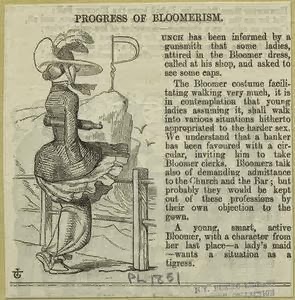
I also can't finish without saying that I love the term "Bloomerism." Victorians were excellent at making up new words.

Follow me on Twitter @TinyApplePress and like the Facebook page for updates!

Thursday, September 19, 2013

The Sweetest Violet in England was a Bad Girl!

Isobel Violet Hunt
Courtesy the Dame Laura Knight Trust

This writer from the 1890s just barely escaped the honour of being Mrs. Oscar Wilde, though she claimed to enjoy pursuing men that others were surprised that she would want. Violet Hunt claimed to especially like older married men, but the love of her life, Ford Maddox Ford, was ten years younger.


Compared to her male contemporaries, Hunt was a prolific writer. She outwrote Oscar Wilde and Bram Stoker combined, just with her list of novels and biographies of famous women. Her novels, A Maiden's Progress (1894) and A Hard Woman (1895) epitomized the New Woman in writing. She helped Ford establish the English Review in 1908. That's the same Ford with whom she started a romantic relationship with when she was 46.
Ford was thirty-five, tall and thin and fair-haired, with a blond mustache that failed to conceal defective front teeth and a mouth that always hung open. Rather gaunt, he had not yet ballooned into what Wyndham Lewis would call a 'flabby lemon and pink giant, who hung his mouth open as though he were an animal at a zoo inviting buns - especially when ladies were present.' - Barbara Belford
Having just discovered her, I'm in love with Hunt and her taste in men. She never married, but had many affairs, including a relationship with H.G. Wells. Lots of people loved her when they first met her, enabling her to make very influential friends and fostering her reputation as an excellent hostess of literary salons. She was like that bad girl all of us good girls want as our best friend, so that we can call on her for a wild time when we get bored of behaving ourselves.

Did I mention that Ford was married? If that weren't awful enough, she started calling herself Mrs. Ford, which lead to the end of her friendship with Henry James. In her diaries, she describes it as incident, like unfriended her over dinner, but James was a pretty conservative fellow.

Hunt is most famous for her diaries, which I'm yet to read, but appear at the end of her list of works here. I like finding old texts for free online, so I'll share a link to it when I am able to track one down.

Follow me on Twitter @TinyApplePress and like the Facebook page for updates!

Sunday, May 26, 2013

Anarchy, Pottery, and Nice Clothes

When we think of anarchy today, we think of someone who occupies a park, rather than someone who spends ages finely decorating his house before moving into it. Indeed, anarchy, today, is an ambiguous shape-shifting subject that changes from its uber intellectualized to something extremely subversive and counter-culture in the modern youth movement. However, while some Wildean scholars hesitate to draw the link between Oscar Wilde and anarchy, such a link exists - even if it is as tenuous as modern understandings of what anarchy means.

The Soul of a Man Under Socialism (1891) expounds Oscar Wilde's libertarian socialist (anarchist) worldview. There are loads of resources out there that analyze it, so I won't waist your time with it here. What interests me is how Oscar Wilde lived his views. He didn't attend protests and didn't write much on libertarian socialism after 1891. His focus was on the aesthetic movement and his life as an artist. As such, he saw himself as a leader of a sociopolitical movement, the aesthetic movement.

Though it's hard to imagine the links today, the minds of Victorian thinkers, like Wilde, linked anarchy, libertarianism, socialism, and other progress-based social-based political ideologies were linked to decadence. John Barlas (Evelyn Douglas) linked his anarchism to the decadence of Algernon Charles Swinburne in particular.

John Barlas and Swinburne both fit into the category of Writers in London in the 1890s. Algernon Charles Swinburne was a poet, playwright, novelist, and critic. Inventor of the roundel form, he wrote several novels and contributed to the Eleventh Edition of the Encyclopædia Britannica. Swinburne was nominated for the Nobel Prize in Literature in every year from 1903 to 1907 and again in 1909. H.P. Lovecraft felt that Swinburne was the only real poet in England, after the death of Edgar Allan Poe. Wilde once said that Swinburne was "a braggart in matters of vice, who had done everything he could to convince his fellow citizens of his homosexuality and bestiality without being in the slightest degree a homosexual or a bestialiser."

John Barlas was a long time friend of Wilde and his crowd, but, by the 1890s, he was one of those friends kept on the periphery. Interestingly, Oscar Wilde bailed him out of jail after an incident on 31 December 1891.

On that New Year's Eve, Barlas went to the Palace of Westminster and fired a revolver outside the Speaker's House, declaring: "I am an anarchist! What I have done is to show my contempt for the House of Commons." After more than two weeks in jail, it was through Constance that Oscar Wilde was reached to post a bond as surety for Barlas's good behavior.

According to David Lowe's book: John Barlas: Sweet Singer and Socialist (1915), en route, Henry Hyde Champion, secretary of the Social Democratic Federation and the publisher of Bernard Shaw's first novel, Cashel Byron's Profession (1886), informed Wilde that Barlas suffered from the delusion that he was a reincarnated figure from the Bible and believed that others recognized his significance by crossing their hands reverently as he passed. Wilde reportedly said to Champion: "My dear fellow, when I think of the harm the Bible has done, I am quite ashamed of it."

In response to Barlas's letter of gratitude for the bond, Wilde wrote that:
Whatever I did was merely what you would have done for me or for any friend of yours whom you admired and appreciated. We poets and dreamers are all brothers. I am so glad you are feeling better...
And just like brothers or sisters or anarchists today, these anarchists, among the Writers in London in the 1890s, were as diverse as anarchists that you might meet today. Even though Oscar Wilde wrote and lectured (before Barlas was arrested) that:
Individualism, then, is what through Socialism we are to attain to. As a natural result the State must give up all idea of government. It must give it up because, as a wise man once said many centuries before Christ, there is such a thing as leaving mankind alone; there is no such thing as governing mankind. All modes of government are failures. Despotism is unjust to everybody, including the despot, who was probably made for better things. Oligarchies are unjust to the many, and ochlocracies are unjust to the few. High hopes were once formed of democracy; but democracy means simply the bludgeoning of the people by the people for the people. It has been found out. I must say that it was high time, for all authority is quite degrading. It degrades those who exercise it, and degrades those over whom it is exercised.
Wilde had no intention of overthrowing the State and he had a deep and abiding respect for due process through the legal system. During his trials, his radical Irish Nationalist mother assured him repeatedly that their position in society would assure that he would not be found guilty of any crime. While Wilde's friends and even the judge encouraged him to flee, during his own trials, Oscar stayed and was inarguably broken by it.

If his political views weren't reflected in how Wilde died, he certainly felt that they were reflected in how he lived. Compared to his contemporaries, like Bram Stoker, I feel that Wilde was a feminist because he used Women's World magazine to support Constance Wilde's feminist ideas and incorporated healthy or rational dress into the aesthetic movement.

A strong part of the aesthetic movement was about individualism, for Wilde. Self-governance was one extension of that individualism; the freedom of women was another extension. The freedom of workers was part of it as well, for through his mentor, John Ruskin, Wilde incorporated aspects of the Arts and Crafts Movement into the aesthetic movement. The Arts and Crafts Movement is reflected in women's art, in the aesthetic movement, especially pottery. Wilde's marriage to Constance, indeed, was intended to be an example of aesthetic life and the liberties Constance took, with Oscar's blessings and encouragement, were seen by other as scandalous as well as liberating.