Showing posts with label poetry. Show all posts

Sunday, November 23, 2014

1890s Literary Hostesses

The literary hostess is a figure, who pops up repeatedly in the biographies of all my 1890s writers. Married, or unmarried, she was usually, but not always a woman of means, who loved literature, and the arts. Her motivation for hosting the great writers of the day ranged from simple interest, to loving a particular writer, or even trying to advance her own writing career. A literary hostess might have also been an author in her own right, but she also helped to build the community of writers in London in the 1890s.

'A Five O'Clock Tea' (1893).
In his poem, "Slightly Foxed," William Plomer writes about the life of the husband of Gloria Jukes, an 1890s literary hostess.
Ignored in her lifetime, he paid for her fun
And enjoyed all the fuss. When she died he was done.
He sold up the house and retired from the scene
Where nobody noticed that he’d ever been.
His memoirs unwritten (though once he began ‘em)
He lives on a hundred and fifty per annum
And once in the day totters out for a stroll
To purchase the Times, two eggs and a roll.
Up to now he has paid for his pleasures and needs
With books he had saved and that everyone reads,
Signed copies presented by authors to Gloria
In the reign of King Edward and good Queen Victoria.
They brought in fair prices but came to an end,
Then Jukes was reduced to one book-loving friend [...]
Roger D. Sell accurately describes it as "a poem about the fickleness, bitchiness and transience of metropolitan literary circles." All of which are qualities the imagination, however unfairly, immediately transfers onto the literary hostess herself.

Louise Chandler Moulton
Louise Chandler Moulton was an American poet, writer, critic, and outstanding literary hostess. Willis J. Buckingham writes:
Few American women were more widely known as writers, and none was so conspicuous and active as a literary hostess, both at home and in England, as Louise Chandler Moulton. Living in each city for half the year, she presided over notable weekly salons in Boston and London for several decades. She knew everyone, from Longfellow and Emerson to Ezra Pound. Her poems, travel sketches, and literary letters, were widely admired. Her own verse was superficially like Dickinson's in being highly personal, brief, and frequently concerned with unfulfilled love and the transience of life. In its graceful, faded diction and utterly conventional pressed-rose melancholy, her verse was eminently suited to popular taste.
The life of the literary hostess, and author, as Moulton lived it, illustrates how a life of letters in the 1890s needn't be a solitary life at all. Their writers groups were fine salons in major cities, organized by women.

Some of these women have also been characterized as the "Grand Dames" of the 1890s, rich women, who served as patrons of the arts, like Annie Horniman and Lady Ottoline Morrell.

Lady Ottoline Morrell (1912)
Lady Ottoline didn't really become a literary hostess until after the turn of the century, but I couldn't resist including her sassy picture here, and taking a moment to note the kind of influence a woman like her could have on literature. She had an open marriage, and carried on many love affairs, while caring for the many children her husband had through his extramarital relationships. Among many others, her lovers included the philosopher Bertrand Russel, and the historian Roger Fry. Lady Ottoline is said to have been immortalized in literature through the characters of Mrs Bidlake in Aldous Huxley's Point Counter Point, Hermione Roddice in H.D. Lawrence's Women in Love, and as Lady Chatterly, among many others.

Lady Jane Francesca Agnes Wilde a.k.a. 'Speranza.'
Oscar Wilde was raised by one of the greatest literary hostesses of the late-nineteenth century, though his mother's salons began to peter off in the 1890s, due to her old age and failing health. It's said that once someone asked Speranza how she attracted such interesting people to her salons, and she replied: "By interesting them, of course!"

Speranza's salons were said to be crammed full of famous people from the time her sons were children. She entertained celebrities and writers by candlelight, and liked to keep the atmosphere dark because it encourage "bawdy talk."

Speranza is another one of those literary hostesses, who was an incredibly successful author in her own right. At one point in her life, she was considered Ireland's National Poetess.

I once called Hall Caine's wife, Mary, an unlikely archivist, but the truth seems to be that the women of London's literary circle in the 1890s were the keeper of records, and the organizers of events, as much, if not more than, their male counterparts. Perhaps, for some, it was because they needed these literary connections to get their work published, but so did the male writers. That's why so many attended their parties and salons.

Follow me on Twitter @TinyApplePress and like the Facebook page for updates!

If you have enjoyed the work that I do, please consider supporting my Victorian Dictionary Project!

Saturday, May 11, 2013

The Most Valuable Poem in the World?


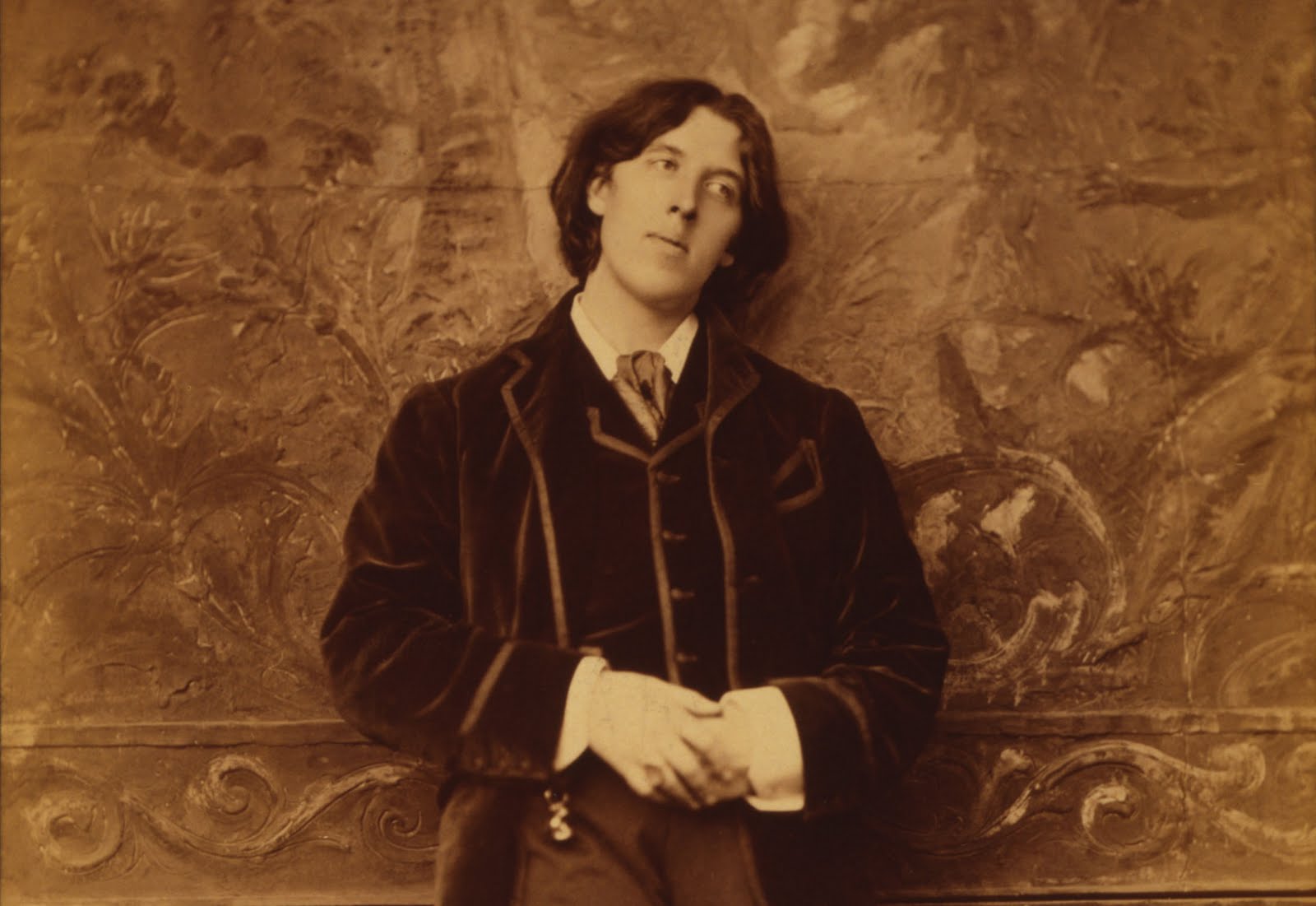
This week a poem that Oscar Wilde wrote in college sold for almost €80,000. Aside from the bitter irony that, in the latter part of the 1890s, Wilde was so desperately poor that he sometimes could not afford to eat dinner at all and relied on free meals, I think it's excellent that his poetry is so valuable at this point in the history of homosexuality. I'm not sure, however, that the poem itself has anything to do with homosexuality, but it does present an early version of a theme that would reoccur in Wilde's writing on love.

The poem was called, "Heart's Yearnings" and was written in 1873.

Heart's Yearnings

Surely to me the world is all too drear,
To shape my sorrow to a tuneful strain,
It is enough for wearied ears to hear
The Passion-Music of a fevered brain,
Or low complainings of a heart's pain.

My saddened soul is out of tune with time,
Nor have I care to set the crooked straight,
Or win green laurels for some pleasant rhyme,
Only with tired eyes I sit and wait
The opening of the Future's Mystic Gate.

I am so tired of all the busy throng
That chirp and chatter in the noisy street,
That I would sit alone and sing no song
But listen for the coming of Love's feet.
Love is a pleasant messenger to greet.

O Love come close before the hateful day,
And tarry not until the night is dead,
O Love come quickly, for although one pray,
What has God ever given in thy stead
But dust and ashes for the head?

The message of this poem is simple; he hopes to fall in love before he dies. The idea of waiting for Love has always appeared in art. Yet, the line I like best is: "My saddened soul is out of tune with time." Wilde often felt out of tune with time, in love, art, and other matters. Here, I think that line means that he's sad about love before love has given him the chance to be sad about it. It makes me think of a line in a song by Bjork: "I miss you, though I haven't met you yet."

Still, the price this poem sold for works out to €220 per word and more than three times the price that a poem by Yeats sold for at the same auction, making it the most valuable poem in the world - not long after the U.K. legalized same-sex marriage. The context of this sale gives an entirely different resonance to the idea that Wilde's "saddened soul [was] out of tune with time," whether he was writing about homosexuality at the time or not.

Because I am a person interested in all of the minute details of these writers' lives, my remaining question about the poem is whether or not this was before he met Florence Balcombe. I've been searching for the dates of their relationship, but can't seem to pin it down. Let me know, if you know and I will update this post, when I have that information.

Follow me on Twitter @TinyApplePress and like the Facebook page for updates!

Wednesday, February 13, 2013

For Love and Ireland


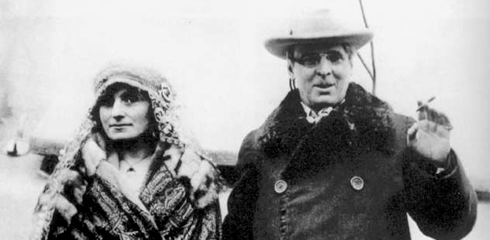
W.B. Yeats joined the Irish nationalist cause as much for his love of Maud Gonne, a beautiful young Irish feminist, as he did for his politics. Though Gonne liked and admired Yeats, this was a story of unrequited love.

The pair met on 30 January 1890. Biographies on Yeats call Gonne "an actress whose great beauty would haunt (Yeats) for the rest of his life." Her passionate work for the nationalist cause in Ireland and her reckless destructiveness in pursuit of her political goals plagued Yeats. Thought he tried to support those goals in his own way.

Yeats focused on drama, trying to spark a revival of Irish literature and culture. Gonne liked this, but regularly refused to marry him (between 1890 and 1901) and they remained close friends through many estrangements, including her marriage to Major John MacBride. In his poetry, Yeats compared her to Helen of Troy, whose capriciousness led to the destruction of a civilization.

In her autobiography, Gonne wrote a great deal about Yeats, including the following:
While we were still at dinner Willie Yeats arrived to see me and we all went into the drawing-room for coffee. Kathleen (Gonne) and I sat together on a big sofa amid piles of soft cushions. I was still in my dark clothes with the black veil I always wore when travelling instead of a hat, we must have made a strange contrast. I saw Willie Yeats looking critically at me and he told Kathleen he liked her dress and that she was looking younger than ever. I was on that occassion Kathleen remarked that it was hard work being beautiful, which Willie turned into his poem Adam's Curse.
Gonne actually includes the poem in its entirety here, but I trust that you can look it up, if you haven't read it.

Next day when he called to take me out to pay my customary visit to Lia Fail, he said:
"You don't take care of yourself as Kathleen does, so she looks younger than you; your face is worn and thin; but you will always be more beautiful, more beautiful than anyone I have known. You can't help that. Oh Maud, why don't you marry me and give up this tragic struggle and live a peaceful life? I could make such a beautiful life for you among artists and writers who would understand you."
"Willie, are you not tired of asking that question? How often have I told you to thank the gods that I will not marry you. You would not be happy with me."
"I am not happy without you."
"Oh yes, you are, because you make beautiful poetry out of what you call your unhappiness and you are happy in that. Marriage would be such a dull affair. Poets should never marry. I will tell you one thing, our friendship had meant a great deal to me; it has helped me often when I needed help, needed it perhaps more than you or anyone ever knew, for I never talk or even think of these things."
Like Gonne, I believe that some loves are meant to inspire and carry a person through hard times. Indeed, we should be grateful for every love we've ever had in our lives, no matter how happy or unhappy they make us.

Follow me on Twitter @TinyApplePress and like the Facebook page for updates!