Showing posts with label friendship. Show all posts

Wednesday, February 12, 2014

We're All Friends Here!


The more I read about the lives of writers in London in the 1890s, the more interconnected they seem. I feel compelled to sit down one of these days and make a tree of who was friends with who.

I knew that Bram Stoker was friends with Oscar Wilde and that they were both friends with Arthur Conan Doyle (Sherlock Holmes), but I didn't know that Doyle was friends with J.M. Barrie (Peter Pan).


Barrie even asked Doyle to do some editing on one of his plays (if you are a writer today, that probably sounds familiar).

Barrie was pen pals with Robert Louis Stevenson. When he opened the mail box in front of his house, he might have bumped into George Bernard Shaw because they were neighbors.

As his marriage crumbled in the 1900s, Barrie got support and advice from his good friend, H.G. Wells (War of the Worlds). They both knew Thomas Hardy, but not very well.

If anyone knows of a family-tree style map of the friendships between writers in London in the 1890s, let me know? Otherwise, I might have to make one myself!

Note: The date on this post was changed when I made a minor edit to add in the closing line that I now try to leave on all my posts. It was a reminder that I still haven't got around to mapping out the friendships between writers, which is largely because they were too many. Writers in the 1890s were so well connected that they knew each other even if they lived in different cities or countries, like Walt Whitman and Bram Stoker. This sense of community, though it reminds me of the online communities we create today, was, for the most part, due to a stronger inclination toward letter writing and attendance at literary events. However, I still think that a community of writers is a community worth celebrating!

Follow me on Twitter @TinyApplePress and like the Facebook page for updates!

Thursday, September 19, 2013

The Sweetest Violet in England was a Bad Girl!

Isobel Violet Hunt
Courtesy the Dame Laura Knight Trust

This writer from the 1890s just barely escaped the honour of being Mrs. Oscar Wilde, though she claimed to enjoy pursuing men that others were surprised that she would want. Violet Hunt claimed to especially like older married men, but the love of her life, Ford Maddox Ford, was ten years younger.


Compared to her male contemporaries, Hunt was a prolific writer. She outwrote Oscar Wilde and Bram Stoker combined, just with her list of novels and biographies of famous women. Her novels, A Maiden's Progress (1894) and A Hard Woman (1895) epitomized the New Woman in writing. She helped Ford establish the English Review in 1908. That's the same Ford with whom she started a romantic relationship with when she was 46.
Ford was thirty-five, tall and thin and fair-haired, with a blond mustache that failed to conceal defective front teeth and a mouth that always hung open. Rather gaunt, he had not yet ballooned into what Wyndham Lewis would call a 'flabby lemon and pink giant, who hung his mouth open as though he were an animal at a zoo inviting buns - especially when ladies were present.' - Barbara Belford
Having just discovered her, I'm in love with Hunt and her taste in men. She never married, but had many affairs, including a relationship with H.G. Wells. Lots of people loved her when they first met her, enabling her to make very influential friends and fostering her reputation as an excellent hostess of literary salons. She was like that bad girl all of us good girls want as our best friend, so that we can call on her for a wild time when we get bored of behaving ourselves.

Did I mention that Ford was married? If that weren't awful enough, she started calling herself Mrs. Ford, which lead to the end of her friendship with Henry James. In her diaries, she describes it as incident, like unfriended her over dinner, but James was a pretty conservative fellow.

Hunt is most famous for her diaries, which I'm yet to read, but appear at the end of her list of works here. I like finding old texts for free online, so I'll share a link to it when I am able to track one down.

Follow me on Twitter @TinyApplePress and like the Facebook page for updates!

Wednesday, February 13, 2013

For Love and Ireland


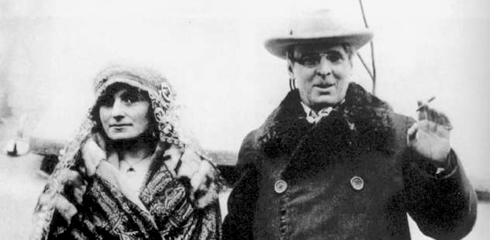
W.B. Yeats joined the Irish nationalist cause as much for his love of Maud Gonne, a beautiful young Irish feminist, as he did for his politics. Though Gonne liked and admired Yeats, this was a story of unrequited love.

The pair met on 30 January 1890. Biographies on Yeats call Gonne "an actress whose great beauty would haunt (Yeats) for the rest of his life." Her passionate work for the nationalist cause in Ireland and her reckless destructiveness in pursuit of her political goals plagued Yeats. Thought he tried to support those goals in his own way.

Yeats focused on drama, trying to spark a revival of Irish literature and culture. Gonne liked this, but regularly refused to marry him (between 1890 and 1901) and they remained close friends through many estrangements, including her marriage to Major John MacBride. In his poetry, Yeats compared her to Helen of Troy, whose capriciousness led to the destruction of a civilization.

In her autobiography, Gonne wrote a great deal about Yeats, including the following:
While we were still at dinner Willie Yeats arrived to see me and we all went into the drawing-room for coffee. Kathleen (Gonne) and I sat together on a big sofa amid piles of soft cushions. I was still in my dark clothes with the black veil I always wore when travelling instead of a hat, we must have made a strange contrast. I saw Willie Yeats looking critically at me and he told Kathleen he liked her dress and that she was looking younger than ever. I was on that occassion Kathleen remarked that it was hard work being beautiful, which Willie turned into his poem Adam's Curse.
Gonne actually includes the poem in its entirety here, but I trust that you can look it up, if you haven't read it.

Next day when he called to take me out to pay my customary visit to Lia Fail, he said:
"You don't take care of yourself as Kathleen does, so she looks younger than you; your face is worn and thin; but you will always be more beautiful, more beautiful than anyone I have known. You can't help that. Oh Maud, why don't you marry me and give up this tragic struggle and live a peaceful life? I could make such a beautiful life for you among artists and writers who would understand you."
"Willie, are you not tired of asking that question? How often have I told you to thank the gods that I will not marry you. You would not be happy with me."
"I am not happy without you."
"Oh yes, you are, because you make beautiful poetry out of what you call your unhappiness and you are happy in that. Marriage would be such a dull affair. Poets should never marry. I will tell you one thing, our friendship had meant a great deal to me; it has helped me often when I needed help, needed it perhaps more than you or anyone ever knew, for I never talk or even think of these things."
Like Gonne, I believe that some loves are meant to inspire and carry a person through hard times. Indeed, we should be grateful for every love we've ever had in our lives, no matter how happy or unhappy they make us.

Follow me on Twitter @TinyApplePress and like the Facebook page for updates!