Showing posts with label H.G. Wells. Show all posts

Thursday, September 4, 2014

H.G. Wells and the OED

In honor of my side project, the Dictionary of Victorian Insults & Niceties, this post explores H.G. Wells contributions to the English language.

According to the Oxford English Dictionary, Wells is responsible for adding 53 words to the language, and he is sited excessively for demonstrating new or inventive uses of existing words. The most notable are as follows, in alphabetical order (of course!):

atomic bomb "Never before in the history of warfare had there been a continuing explosive; indeed, up to the middle of the twentieth century the only explosives known were combustibles whose explosiveness was due entirely to their instantaneousness; and these atomic bombs which science burst upon the world that night were strange even to the men who used them." - The World Set Free (1914)

Wells learned physics by reading William Ramsay, Ernest Rutherford, and Frederick Soddy; who uncovered the disintegration of uranium. Soddy, himself, was impressed after reading Wells' novel, which might have even influenced the development of nuclear weapons. Wells's "atomic bombs" are no stronger than high explosives that existed at the time, and are crude devices in comparison.

eggless "Nor can we tell here at any length how these mournful spinsters, the two surviving hens, made a wonder of and a show, spent their remaining years in eggless celebrity." - The Food of the Gods and How It Came to Earth (1904)

This novel is mostly remembered through its 1976 film adaptation.

gong (the verb) "He has just gonged, no doubt to order another buttered tea~cake!" - The Strand (1903)

inacta "Edward Albert attempted an ironical whistle, but Mrs Butter held her position, intacta." - You Can't Be Too Careful (1941)

This word is a short form of the Latin virgo intacta,  meaning a woman of tremendous chastity, but used as an adjective to mean she was unaffected.

leftish "At first they served only for amiable exchanges between the writers of the same and different countries, but the violent persecution of Jewish and leftish writers in Germany, and an attempt to seize and use the Berlin Pen Club for Nazi propaganda, raised new and grave issues for the organization." - An Experiment in Autobiography (1934)

Monkeys on parade (1950s?).
monkey parade "These twilight parades of young people, youngsters chiefly of the lower middle-class, are one of the odd social developments of the great suburban growths—unkindly critics, blind to the inner meanings of things, call them, I believe, Monkeys' Parades—the shop apprentices, the young work girls, the boy clerks and so forth, stirred by mysterious intimations, spend their first-earned money upon collars and ties, chiffon hats, smart lace collars, walking-sticks, sunshades or cigarettes, and come valiantly into the vague transfiguring mingling of gaslight and evening, to walk up and down, to eye meaningly, even to accost and make friends." - New Machiavelli (1910)

The New Machiavelli (1911) was serialized in The English Review in 1910. Because was about Wells's love affair with Amber Reeves, and satirized popular personalities, it was "the literary scandal of its day."

pre-atomic "The atomic bombs had taken him by surprise and he had still to recover completely from his pre-atomic opinions."  - The World Set Free (1914)

Well, if he was going to invent the literary atomic bomb...

teetotally "I lived through my Bohemian days as sober as Shaw if not nearly so teetotally." - An Experiment in Autobiography (1934)

'Teetotatally' sounds like something the class of Clueless would have said, if they were set in the 1890s.

time traveller "‘There,’ said the Time Traveller, ‘I am unable to give you an explanation. All I know is that the climate was very much warmer than it is now.’" - National Observer (18 April 1894)

And of course...

time travelling "Time travelling: possibility or paradox." - National Observer (17 March 1894)

utopographer "The Utopographer in the Garden." - Meanwhile (1927)

This means someone who describes a utopia.

The Dictionary of Victorian Insults & Niceties has its own blog now, and will only include words invented before 1900, but I thought these words were worth looking at anyway!

Follow me on Twitter @TinyApplePress and like the Facebook page for updates!

Wednesday, June 18, 2014

The Triumphs of a Taxidermist

I usually love the macabre, but my husband thinks taxidermy is appalling. After reading H.G. Wells' The Triumphs of a Taxidermist (1894), I have to agree with him.

The Golden Age of Taxidermy began with the Great Exhibition of 1851 in London. An English ornithologist, John Hancock created a display of birds that won much praise all around, but especially in scientific circles. The public was hooked.

Great Auk and egg, as you will read about in "The Triumphs of a Taxidermist."
Like pop art a hundred years later, taxidermy birds began popping up in middle-class homes. Queen Victoria even amassed a collection. 

Of course, taxidermy was not limited to birds. Anthropomorphic taxidermy sought to express the whimsy of the time, by dressing and posing animals as humans. Taxidermists, like Walter Potter, created dioramas that were celebrated in artistic circles... though, it appears, not by 1890s writers, critical of English society.

Walter Potter's Rabbit School
The future Wells envisions for a talented taxidermist is horrifying and certainly develops the shrinking divide between human and animal within the art form. When Oscar Wilde criticizes his contemporaries in his fiction, we laugh, but reading this story makes me feel that Wells was forced to live among some truly horrid people. Brace yourself and read on.
THE TRIUMPHS OF A TAXIDERMIST 
Here are some of the secrets of taxidermy. They were told me by the taxidermist in a mood of elation. He told me them in the time between the first glass of whisky and the fourth, when a man is no longer cautious and yet not drunk. We sat in his den together; his library it was, his sitting and his eating-room--separated by a bead curtain, so far as the sense of sight went, from the noisome den where he plied his trade. 
He sat on a deck chair, and when he was not tapping refractory bits of coal with them, he kept his feet--on which he wore, after the manner of sandals, the holey relics of a pair of carpet slippers--out of the way upon the mantelpiece, among the glass eyes. And his trousers, by-the-bye--though they have nothing to do with his triumphs--were a most horrible yellow plaid, such as they made when our fathers wore side-whiskers and there were crinolines in the land. Further, his hair was black, his face rosy, and his eye a fiery brown; and his coat was chiefly of grease upon a basis of velveteen. And his pipe had a bowl of china showing the Graces, and his spectacles were always askew, the left eye glaring nakedly at you, small and penetrating; the right, seen through a glass darkly, magnified and mild. Thus his discourse ran: "There never was a man who could stuff like me, Bellows, never. I have stuffed elephants and I have stuffed moths, and the things, have looked all the livelier and better for it. And I have stuffed human beings--chiefly amateur ornithologists. But I stuffed a nigger once. 
"No, there is no law against it. I made him with all his fingers out and used him as a hat-rack, but that fool Homersby got up a quarrel with him late one night and spoilt him. That was before your time. It is hard to get skins, or I would have another. 
"Unpleasant? I don't see it. Seems to me taxidermy is a promising third course to burial or cremation. You could keep all your dear ones by you. Bric-a-brac of that sort stuck about the house would be as good as most company, and much less expensive. You might have them fitted up with clockwork to do things. 
"Of course they would have to be varnished, but they need not shine more than lots of people do naturally. Old Manningtree's bald head...Anyhow, you could talk to them without interruption. Even aunts. There is a great future before taxidermy, depend upon it. There is fossils again...." 
He suddenly became silent. 
"No, I don't think I ought to tell you that." He sucked at his pipe thoughtfully. "Thanks, yes. Not too much water." 
"Of course, what I tell you now will go no further. You know I have made some dodos and a great auk? No! Evidently you are an amateur at taxidermy. My dear fellow, half the great auks in the world are about as genuine as the handkerchief of Saint Veronica, as the Holy Coat of Treves. We make 'em of grebes' feathers and the like. And the great auk's eggs too!" 
"Good heavens!" 
"Yes, we make them out of fine porcelain. I tell you it is worth while. They fetch--one fetched L300 only the other day. That one was really genuine, I believe, but of course one is never certain. It is very fine work, and afterwards you have to get them dusty, for no one who owns one of these precious eggs has ever the temerity to clean the thing. That's the beauty of the business. Even if they suspect an egg they do not like to examine it too closely. It's such brittle capital at the best. 
"You did not know that taxidermy rose to heights like that. My boy, it has risen higher. I have rivalled the hands of Nature herself. One of the genuine great auks--" his voice fell to a whisper--"one of the genuine great auks was made by me. 
"No. You must study ornithology, and find out which it is yourself. And what is more, I have been approached by a syndicate of dealers to stock one of the unexplored skerries to the north of Iceland with specimens. I may--some day. But I have another little thing in hand just now. Ever heard of the dinornis? 
"It is one of those big birds recently extinct in New Zealand. 'Moa' is its common name, so called because extinct: there is no moa now. See? Well, they have got bones of it, and from some of the marshes even feathers and dried bits of skin. Now, I am going to--well, there is no need to make any bones about it--going to forge a complete stuffed moa. I know a chap out there who will pretend to make the find in a kind of antiseptic swamp, and say he stuffed it at once, as it threatened to fall to pieces. The feathers are peculiar, but I have got a simply lovely way of dodging up singed bits of ostrich plume. Yes, that is the new smell you noticed. They can only discover the fraud with a microscope, and they will hardly care to pull a nice specimen to bits for that. 
"In this way, you see, I give my little push in the advancement of science. 
"But all this is merely imitating Nature. I have done more than that in my time. I have--beaten her." 
He took his feet down from the mantel-board, and leant over confidentially towards me. "I have created birds," he said in a low voice. "New birds. Improvements. Like no birds that was ever seen before." 
He resumed his attitude during an impressive silence. 
"Enrich the universe; rather. Some of the birds I made were new kinds of humming birds, and very beautiful little things, but some of them were simply rum. The rummest, I think, was the Anomalopteryx Jejuna. Jejunus-a-um--empty--so called because there was really nothing in it; a thoroughly empty bird--except for stuffing. Old Javvers has the thing now, and I suppose he is almost as proud of it as I am. It is a masterpiece, Bellows. It has all the silly clumsiness of your pelican, all the solemn want of dignity of your parrot, all the gaunt ungainliness of a flamingo, with all the extravagant chromatic conflict of a mandarin duck. Such a bird. I made it out of the skeletons of a stork and a toucan and a job lot of feathers. Taxidermy of that kind is just pure joy, Bellows, to a real artist in the art. 
"How did I come to make it? Simple enough, as all great inventions are. One of those young genii who write us Science Notes in the papers got hold of a German pamphlet about the birds of New Zealand, and translated some of it by means of a dictionary and his mother-wit--he must have been one of a very large family with a small mother--and he got mixed between the living apteryx and the extinct anomalopteryx; talked about a bird five feet high, living in the jungles of the North Island, rare, shy, specimens difficult to obtain, and so on. Javvers, who even for a collector, is a miraculously ignorant man, read these paragraphs, and swore he would have the thing at any price. Raided the dealers with enquiries. It shows what a man can do by persistence--will-power. Here was a bird-collector swearing he would have a specimen of a bird that did not exist, that never had existed, and which for very shame of its own profane ungainliness, probably would not exist now if it could help itself. And he got it. He got it. 
"Have some more whisky, Bellows?" said the taxidermist, rousing himself from a transient contemplation of the mysteries of will-power and the collecting turn of mind. And, replenished, he proceeded to tell me of how he concocted a most attractive mermaid, and how an itinerant preacher, who could not get an audience because of it, smashed it because it was idolatry, or worse, at Burslem Wakes. But as the conversation of all the parties to this transaction, creator, would-be preserver, and destroyer, was uniformly unfit for publication, this cheerful incident must still remain unprinted. 
The reader unacquainted with the dark ways of the collector may perhaps be inclined to doubt my taxidermist, but so far as great auks' eggs, and the bogus stuffed birds are concerned, I find that he has the confirmation of distinguished ornithological writers. And the note about the New Zealand bird certainly appeared in a morning paper of unblemished reputation, for the taxidermist keeps a copy and has shown it to me.
Follow me on Twitter @TinyApplePress and like the Facebook page for updates!

Wednesday, February 12, 2014

We're All Friends Here!


The more I read about the lives of writers in London in the 1890s, the more interconnected they seem. I feel compelled to sit down one of these days and make a tree of who was friends with who.

I knew that Bram Stoker was friends with Oscar Wilde and that they were both friends with Arthur Conan Doyle (Sherlock Holmes), but I didn't know that Doyle was friends with J.M. Barrie (Peter Pan).


Barrie even asked Doyle to do some editing on one of his plays (if you are a writer today, that probably sounds familiar).

Barrie was pen pals with Robert Louis Stevenson. When he opened the mail box in front of his house, he might have bumped into George Bernard Shaw because they were neighbors.

As his marriage crumbled in the 1900s, Barrie got support and advice from his good friend, H.G. Wells (War of the Worlds). They both knew Thomas Hardy, but not very well.

If anyone knows of a family-tree style map of the friendships between writers in London in the 1890s, let me know? Otherwise, I might have to make one myself!

Note: The date on this post was changed when I made a minor edit to add in the closing line that I now try to leave on all my posts. It was a reminder that I still haven't got around to mapping out the friendships between writers, which is largely because they were too many. Writers in the 1890s were so well connected that they knew each other even if they lived in different cities or countries, like Walt Whitman and Bram Stoker. This sense of community, though it reminds me of the online communities we create today, was, for the most part, due to a stronger inclination toward letter writing and attendance at literary events. However, I still think that a community of writers is a community worth celebrating!

Follow me on Twitter @TinyApplePress and like the Facebook page for updates!

Monday, August 12, 2013

Degeneration, Decadence & Drink


First published as Entartung (1892), Max Nordau’s major work was published in English as Degeneration in 1895. In Degeneration, Nordau transfers Bénédict Augustin Morel’s notion of degeneracy to the arts circles of his time, suggesting that authors and artists are as degenerate as criminals, prostitutes and lunatics.


Some of what we call fin-de-siècle decadence, Nordau called degeneration. This decadence was also on trial in 1895, along with anything else that had to do with Oscar Wilde. Decadence and degeneration are two of the major themes that I'm most interested in the artists and writers of the 1890s. It permeated every aspect of the aesthetic life from fashion to diet to decorating and consumption. Nordau observed this in Degeneration, which, historian, Steven E. Ascheim describes as:
...a veritable diatribe of cultural criticism that characterized virtually every modernist fin-de-siecle current as a symptom of exhaustion and inability to adjust to the realities of the modern industrial age.

I can't imagine fully tackling all of Nordau's views on the aesthetic movement in a single blog post. Nor am I interested in fleshing out the coincidental timing of the release of Nordau's work in London with regards to Wilde's trials, though I find it interesting enough to note and wish to further add that Nordau actually mentions Wilde in his work, asserting that Wilde considered himself above morality. Here, however, I intend to just lightly touch on some of Nordau's ideas, as well as what Wilde, Bram Stoker and H.G. Wells had to say, about why writers drank.


The full-text of Degeneration is available here and I'll begin with a quote from it. Nordau writes:
WE have recognised the effect of diseases in these fin-de-siecle literary and artistic tendencies and fashions, as well as in the susceptibility of the public with regard to them, and we have succeeded in maintaining that these diseases are degeneracy and hysteria. We have now to inquire how these maladies of the day have originated, and why they appear with such extraordinary frequency at the present time. Morel, the great investigator of degeneracy, traces this chiefly to poisoning. A race which is regularly addicted, even without excess, to narcotics and stimulants in any form such as fermented alcoholic drinks, tobacco, opium, hashish, arsenic which partakes of tainted foods (bread made with bad corn, which absorbs organic poisons (marsh fever, syphilis, tubercu-losis, goitre), begets degenerate descendants who, if they remain exposed to the same influences, rapidly descend to the lowest degrees of degeneracy, to idiocy, to dwarfishness, etc. That the poisoning of civilized peoples continues and increases at a very rapid rate is widely attested by statistics.

When I read that, I can't help but feel there is something very modern about it. If we didn't feed our children gluten or non-organic dairy, if we didn't smoke or drink, we wouldn't have problems with ADHD and depression. Of course, I think there's some (just a little bit of) wisdom in Nordau's words. I don't want to eat arsenic tainted food and drugs are bad for you, but I hesitate. Are drinking and drugs a symptom or the problem?

Nordau says:
The drinker (and apparently the smoker also) begets enfeebled children, hereditarily fatigued or degenerated, and these drink and smoke in their turn, because they are fatigued.
Fatigued, respiratory conditions and fetal alcohol syndrome, I say potato and Nordau says patatto. But then, I love Victorian words for alcoholism and alcoholics. Nordau throws in a little misogyny for good measure.
The erotomaniac 'degenerate' stands in the same position to the woman as a dipsomaniac to intoxicating drinks. Magnan has given an appalling picture of the struggles waged in the mind of a dipsomaniac by the passionate eagerness for the bottle, and the loathing and horror of it.
Now, I've been mocking Nordau, but the essence of what he says in that last quote is ahead of its time - that is until later when he equates "dipsomania" or "madness for drink" with all of the other madnesses of his time, including: "aichmophobia" the fear of pointed objects; "arithmomania" the madness for numbers; and "oniomania" a madness for buying (I really like that last one). Though the Victorians had their crazies and their teatotallers, they didn't really understand alcoholism or addiction as a disease. In the quote above, Nordau recognizes the struggle of addiction, as if he sat in on one of today's AA meetings. Only a few doctors in the 1890s, mostly working with Dr. Norman Shanks Kerr (1834-1899) thought of abstinence from alcohol as a cure for "dipsomania."

Kerr was recognized in London as an avid support of the Temperance Movement and was a strict teatotaller. His was the radical idea that the only permanent cure for sever alcohol withdrawal (delirium tremens) was to stop drinking permanently. Oh course, he still treated the symptoms of alcohol withdrawal with opium, but who's perfect?

Wilde preferred opium to alcohol, but understood that:
Alcohol, taken in sufficient quantities, may produce all the effects of drunkenness.
Nordau felt that:
Oscar Wilde apparently admires immorality, sin and crime.
Nordau, somewhat rightly, believed that Wilde achieved more through his personality than through any effort or work. Nordau recognized Wilde as the representative of the Aesthetic Movement in England. Meanwhile, in The Picture of Dorian Gray, Oscar Wilde writes:
Beer, the Bible, and the seven deadly virtues have made our England what she is.

W.B. Yeats said:
The problem with some people is that when they aren't drunk, they're sober.
H.G. Wells advised against taking alcohol regularly and compared it to polite conversation:

Speech, no doubt, is a valuable gift, but at the same time it is a gift that may be abused. What is regarded as polite conversation is, I hold, such an abuse. Alcohol, opium, tea, are all very excellent things in their way; but imagine continuous alcohol, an incessant opium, or to receive, ocean-like, a perennially flowing river of tea! That is my objection to this conversation: its continuousness.
In my research, I got onto this topic in response to the question: why do writers drink (there's a new book about it and here's a review). But Wells gives me no reason to assume that writers drink with more enthusiasm than anyone else. Bram Stoker's first book, The Primrose Path, is a moralistic romance novel about a protagonist who succumbs to alcoholism and eventually lets it ruin his life. Stoker was known to have practiced moderation in all things. Perhaps, the question I better ask might be: why would writers drink.
When I talk to other writers, artists and even academics, the guilty truth we share is that it feels like we are living the dream. Wells reinforces that notion In a Modern Utopia (1905):
The conditions of physical happiness will be better understood in Utopia, it will be worth while to be well there, and the intelligent citizen will watch himself closely. Half and more of the drunkenness of earth is an attempt to lighten dull days and hopelessly sordid and disagreeable lives, and in Utopia they do not suffer these things. Assuredly Utopia will be temperate, not only drinking, but eating with the soundest discretion
And yet, inside that passage there is a certain hedonism. Is it hedonistic to have all of what you want?
Good heavens, my dear boy, don't look so tragic! The secret of remaining young is never to have an emotion that is unbecoming. Come to the club with Basil and myself. We will smoke cigarettes and drink to the beauty of Sibyl Vane. She is beautiful. What more can you want?
In that passage from The Picture of Dorian Gray, we have hedonism in the form of drinking, smoking and the pursuit of sex. We have the idea that getting what you want should make you happy. Does having everything you want and not being happy make you feel guilty? Do people drink because they are unhappy?

I digress for fear of running into a long meditation on happiness and self-medication. Self-medicating is, I think, what Nordau felt the degenerate thought he or she was doing by drinking. He just found artists more despicable for finding it beautiful.

To that effect he says:
When Raffaelli paints shockingly degraded absinthe-drinkers in the low drinking dens of the purlieus of Paris, we clearly feel his profound pity at the sight of these fallen human beings, and this emotion we ex-perience as a morally beautiful one. In like manner we have not a momentary doubt of the morality of the artist's emotions whenwe behold Callot's pictures of the horrors of war, or the bleeding, purulent saints of Zurbaran, or the monsters of Breughel van der Holle, or when we read the murder scene in Dostojevsky's Raskolnikow. These emotions are beautiful. Sympathy with them gives us a feeling of pleasure. Against this feeling the displeasure caused by the repulsiveness of the work cannot prevail. When, however, the work betrays the indifference of the author to the evil or ugliness he depicts, nay, his predilection for it, then the abhorrence provoked by the work isintensified by all the disgust which the author's aberration of instinct inspires in us, and the aggregate impression is one of keenest displeasure. Those who share the emotions of the author, and hence are with him attracted and pleasurably excited by what is repugnant, diseased and evil, are the degenerate.
Follow me on Twitter @TinyApplePress and like the Facebook page for updates!

Thursday, July 18, 2013

The Savoy Hotel


Though many writers in the 1890s were starving artists to be sure, some writers grew very wealthy. Oscar Wilde is certainly an example of that kind of success and the lifestyle that went with it, though, to some degree, that was by design when it came to the Savoy Hotel in London.


Not only is the Savoy Hotel a landmark in the history of writers in London in the 1890s, it is also an important place in the history of luxury hotels. In the hotel industry, "everything that’s happened in high-end hotels since the 1890s is arguably just a variation on a theme introduced by César Ritz, the Savoy’s original general manager, who counts electric lights and en-suite bathrooms among his hospitality innovations." I call that putting on the ritz!

Ritz's innovations attracted the rich and famous, which, despite the myth of the starving artist, included many members of the arts communities.

Claud Monet's Waterloo Bridge series was painted in room 618 in 1901.


This lithograph by James Whistler represents the view from his room at the Sovoy Hotel in 1896.


Sarah Bernhardt, H. G. Wells, George Bernard Shaw, and future Kind Edward V11 were also early guests, after the hotel opened in 1889. Though due the scandalous trial, Lord Alfred Douglas and Oscar Wilde are arguably the most well-known occupants of this period.

Ever the critic, Wilde wasn't as awe-struck or impressed with the hotel, in spite of how hard Ritz and his staff worked to accommodate its influential and often choosy guests. The Savoy Hotel kept records of guests’ particular preferences in order to provide them in advance. The staff made hospitality history as the first to photograph a guest's toiletries so they might arrange them accordingly in his washroom. The staff provided a fireproof eiderdown to another guest, who liked to smoke in bed. Wilde, however, scoffed at the very idea cold and hot indoor plumbing at the Savoy:
What is it good for? If I want hot water, I call for it.
The grounds of the Savoy Hotel have a long history of decadence, dating back to 1126 when Peter, Count of Savoy, built his palace there (also called Savoy). The Savoy Palace became the greatest house in England, during medieval times, known as a centre for art and culture. Geoffrey Chaucer began writing his Canterbury Tales, while in residence there. During its lifetime, the Savoy Palace housed the Dukes of Lancaster. The youngest son of King Edward III was living there, when it was destroyed in the peasants revolt of 1381.


Six-hundred years later, Richard D’oyly Carte opened the Savoy theatre on the site, as a showcase for the works of Gilbert and Sullivan. Gilbert and Sullivan's operas proved to be such a success, that D'oyly Carte built the Savoy Hotel next door in 1889 - enter our writers!

Wilde's connections to Gilbert and Sullivan were numerous and D'oyly Carte had organized his 1881 American Tour. They all wanted Wilde, the celebrity aesthete and socialite, as a patron at the Savoy and an all-purpose party guest. Sadly, we know so much about Wilde's days at the Savoy Hotel because they were recounted for his damning trials.

His homosexual affair with Lord Alfred ‘Bosie’ Douglas brought his flamboyant lifestyle at The Savoy to a bitter end. He had taken adjoining rooms on the third floor for himself and Lord Douglas. After a ‘wilde’ time, Douglas left the hotel and Wilde moved into a suite overlooking the river. He then wrote to Douglas: ‘Dearest of Boys, Your letter was delightful, red and yellow wine to me; but I am sad and out of sorts. I must see you soon. You are the divine thing I want, the thing of grace and beauty. My bill here is £49 for a week. I fear I must leave—no money, no credit, and a heart of lead.’
Bosie’s father took his son’s homosexual relations with Wilde as a personal affront and instituted legal proceedings. In one of the most sensational trials of the 19 century, Oscar Wilde was charged in 1895 with committing acts of ‘gross indecency’ with a string of young men. A handful of Savoy employees were among the key witnesses for the prosecution.
Wilde was found guilty and sentenced to two years’ hard labour. Thus, the hotel lost one of its most flamboyant guests. After his release from prison, Wilde left England and wandered around Europe for what were to be the last three years of his life. He died in 1900, at another hotel, the Hotel d’Alsace in Paris.
This - his last - hotel stay brought us his famous comment: “This wallpaper will be the death of me: one of us will have to go.” http://www.famoushotels.org/article/1189

Follow me on Twitter @TinyApplePress and like the Facebook page  for updates!

Friday, June 7, 2013

Contemporary Writers in the 1890s Part 2: William Gibson

This was sort of the first one that I wanted to post in my series of Contemporary Writers in London in the 1890s because I wrote all of my graduate work on William Gibson, especially Pattern Recognition. Now, I present to you William Gibson and H.G. Wells, as they would have appeared in an imaginary late-Victorian newspaper.


Follow me on Twitter @TinyApplePress and like the Facebook page for updates!

Friday, April 12, 2013

War of the Worlds Book Cover Collection

Ever go for a walk with someone, maybe your brother, and start talking about something crazy, like what if aliens or zombies descended on the scene. What would you do? Where would people hide? How would you survive? H.G. Wells had just that sort of walk, actually with his brother, and it resulted in The War of the Worlds (1898).

It's so fun to think that idle talk about martians landing in Surrey resulted in a book that has never been out of print and is one of the most inspirational novels of all time. The book cover collection is a testament to that fact, which is sincerely worth a look (click here). Here are just a few of my favorites:

Folio Society, London, 2004, English

Gong Ye Chu Ban She, Hong Kong, 2004, Chinese

Editora Sextante, Brazil, 2000, Portuguese

Khudozhestvennaya Literatura, Moscow, 1983, Russian

Marvel Comics, Editora de Periódicos S.C.L. (La Prensa), 1981, Spanish
1976 Marvel Classics edition 
Contact, 1971, Dutch
Lancer Books, Inc., 1967.
1960 cover by Edward Gorey.
Some of Gorey's illustrations are here.

Molodaya Gvardiya, Moscow, 1956, Russian

Editora Latino Americana, Mexico, 1951, Spanish

State Publishing House of the RSFSR People's 
Commissariat of Children's Literature, 1945, Russian

1927 reprint in Amazing Stories.

Again, for the complete collection, visit: http://drzeus.best.vwh.net/wotw/

Follow me on Twitter @TinyApplePress and like the Facebook page for updates!

Wednesday, March 13, 2013

The Bodley Head


When I think of controversial books in the 1890s, Dracula and The Picture of Dorian Gray are the first to come to mind. I also think of these titles with a sense of sadness because the authors didn't set out to write controversial books and suffered (at least a little bit) as a consequence of their works' publication. Bram Stoker didn't suffer like Oscar Wilde did, but he had to borrow money to publish it and wrote explanatory letters and apologies afterwards.

When I think of controversial books today, items off the bestsellers lists come to mind and, typically, things weren't so different during the most decadent years of the Victorian Era. At least one publisher existed to cater to the book market that thrived on getting mixed reviews: the Bodley Head.

London based, the Bodley Head was founded in 1887 by John Lane and Elkin Mathews to trade in antiquarian books. This meant dealing with an upper-class literary clientele, during the age of aestheticism. By 1894, the Bodley Head began publishing works of 'stylish decadence' that likely catered to the same readers, who bought their antiquarian books.

Some of the titles Lane, Mathews and the Bodley Head are responsible for bringing us represent the tone of the era, like the Yellow Book, while others were ground breaking in their genre, like The Great God Pan by Arthur Machen. Machen's audience denounced The Great God Pan for its sexual and horrific content and it subsequently sold well, going into a second edition.

In 1894, the Bodley Head published The Sphinx by Oscar Wilde and the first edition of A Woman of No Importance, printing 500 copies. Lane and Mathews would go on to work with writers, like H.G. Wells. The firm was still important throughout the 1970s and was sold in 1987 to Random House.

Follow me on Twitter @TinyApplePress and like the Facebook page for updates!

Thursday, February 14, 2013

Love Doodles

H.G. Wells second marriage was unconventional, but I think most things that writers did with their hearts in the 1890s were unconventional. What stands out about this one is that Wells married Amy Catherine Robbins, "Jane," in 1895; the couple had a turbulent, but fun and open marriage until her death in 1927.


Ok, maybe it wasn't fun, but The Picshuas of H.G. Wells: A Burlesque Diary make it difficult to imagine it was all that terrible, when he communicated with her so frequently through cartoons. I'm collecting some of them here for your enjoyment.


Follow me on Twitter @TinyApplePress and like the Facebook page for updates!

Tuesday, January 15, 2013

A Bunch of Hairy Men

Hall Caine's photo in yesterday's post got me thinking about some of the late-Victorian writers' funny faces. Hall's face especially strikes me because, while I think he looks funny with his buggy eyes and dramatic beard, in the 1890s, ladies actually found him handsome!


Facial hair was popular among men in the 1890s. Although we look back on it with jocularity, it's making a bit of a resurgence in recent years (Movember, hockey beards, etc). Even the Edwardians found outrageous styles of facial hair ridiculous. 

Hall Caine (above) and Joseph Conrad (below) wore beards and mustaches, like Kaiser Wilhelm.


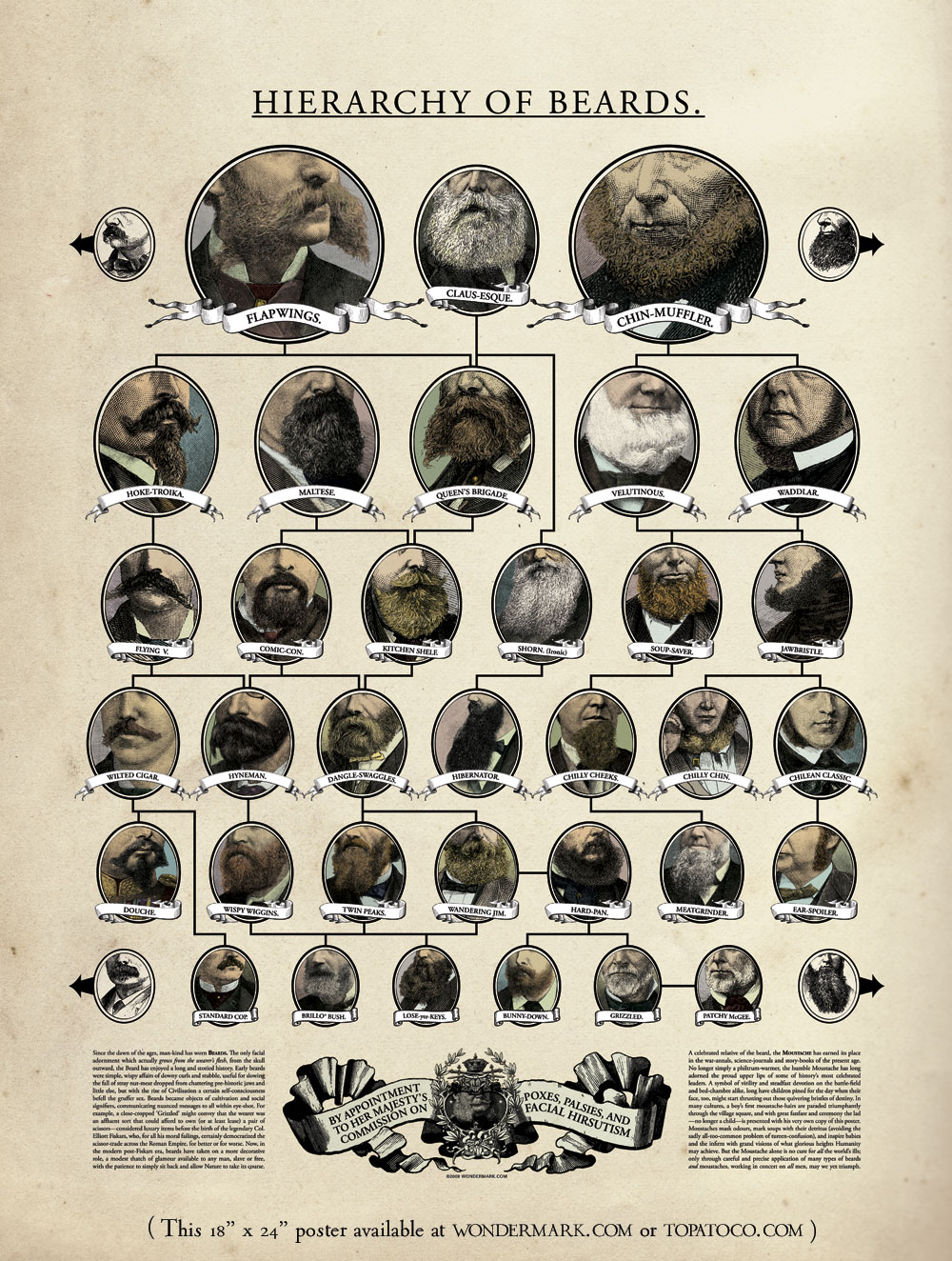
Bram Stoker (above) wore his in a fashion comically referred to as "dangle swaggles" (see picture at bottom).

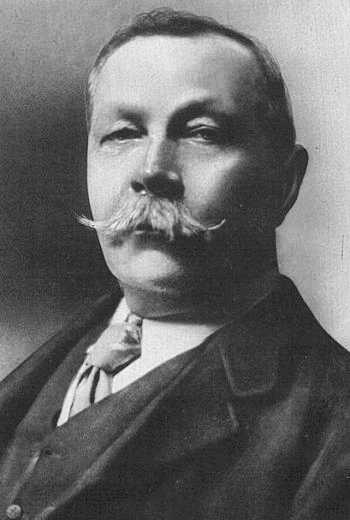
Sir Arthur Conan Doyle, Thomas Hardy, and Ambrose Bierce (all are below) wore matching pointy mustaches that most agreed would make men look more distinguished, a look nowadays people think they can pull off with a pair of non-prescription eyeglasses.


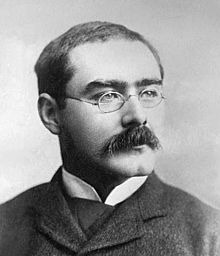
As a young man in the 1890s, H.G. Wells (below) wore something like a walrus, but so did Rudyard Kipling (also below), leading one to speculate that this could have been some hip young thing.


To be fair, there were lots of ridiculous ways for a woman to style her hair that none of these guys would really get away with, but there were many other hairy styles available to men as well.


Though he himself was once a hairy beast, Charles Dickens said it best, when he said:
I am no friend to gentlemen who wilfully affect external oddity, while they are within all dull and commonplace.
Follow me on Twitter @TinyApplePress and like the Facebook page for updates!