Showing posts with label writing. Show all posts

Wednesday, March 2, 2016

Greenaway Vogue


Kate Greenaway was the author and artist of Victorian childhood by the 1890s. She drew the idyllic images of Victorian children that we think of today and she drew many of the images children were looking at. Biographers compare her work and her life to that of Beatrix Potter. During the 1890s, the aesthetic she created was called Greenaway vogue.

Born in 1846, London has since absorbed Hoxton, the romantic community Greenaway grew up in. Her father was a draughtsman and an engraver and her mother ran a dress shop.
"I had such a very happy time when I was a child, " Greenaway is reported as saying in M. H. Spielmann and G. S. Lanyard's 1905 biography Kate Greenaway, "and, curiously, was so very much happier then than my brother and sister, with exactly the same surroundings. I suppose my imaginary life made me one long continuous joy-filled everything with a strange wonder and beauty. Living in that childish wonder is a most beautiful feeling-I can so well remember it. There was always something more-behind and beyond everything-to me. The golden spectacles were very very big." Source.
Greenaway's parents both encouraged her to draw. As a child, her drawings were often inspired by current events, like the Great Indian War of 1857, which affected her imagination deeply and haunted her dreams. Only eleven years old, her drawings from this time depict women and children fleeing. By age seventeen, she worked skillfully with watercolours and ink, and had won many awards for her artwork.

Greenaway attended the Royal Academy of Art in 1858 and continued to establish herself as an artist, inspired by the Pre-Raphelite Brotherhood. She sold her art on greeting cards and was commissioned by numerous publications continuously, especially to illustrate children's books. Fashion and art circles began recognizing her name and she developed a life-long friendship with John Ruskin, but her big break came when she published her own book.

From Under the Window (1879).
Greenaway's first book, Under the Window: Pictures & Rhymes for Children (1879) was her first in the sense that she both wrote and illustrated it. Selling over 100,000 copies, Under the Window was a big success (sold more than 100,000 copies) and gave Greenaway's the break she had been waiting for as a children's book illustrator and author. Under the Window so popular that the term "Greenaway vogue" was coined in its aftermath.

Greenaway paid careful attention to the clothes that children wore in her books. The fashions harkened back to earlier days, before Industrialization in the 1830s. To get the right looks for the children's clothes, Greenaway designed the dresses herself and used dolls, or had children model them for her drawings. Rather than seeing the styles at old fashioned, Greenaway's readers and their parents idealized them, treasuring their simple innocence. This view was reflected in the fashion industry; Liberties of London developed a clothing line directly inspired by Greenaway's art. Clothing and shoe manufacturers approached Greenaway seeking permission to put her name on their products.

Marigold Garden (1885)
During her career, Greenaway illustrated more than 150 books, but Under the Window and Marigold Garden (1885) are the only two for which she provided both the pictures and the text. Under the Window was groundbreaking as one of the earliest designer picture books, and its popularity caused it to be imitated. Other publishers began copying its style within weeks of its release.

Afternoon Tea (1880), by one of
Greenaway's imitators.
From my own childhood, I remember Kate Greenaway's Doll Book (1987). The book provides tips and patterns for making doll clothes inspired by Greenaway's books. I had little sisters and wanted to make clothes for their dolls, even though I was outgrowing dolls by that time. They say that she was one of the three most popular creators of children's books in the late nineteenth century, but I think she was the most influential of her day.

A copy of the book I had as a child.
Follow me on Twitter @TinyApplePress and like the Facebook page for updates!

Friday, April 24, 2015

Humans of London (in the 1890s)

Who isn't occasionally inspired by Humans of New York? Since I've taken a little break from writing recently and been playing with Photoshop, I thought I would share what I've come up with.


These are writers in London in the 1890s (if they had Facebook and someone got inspired by Humans of New York).


Follow me on Twitter @TinyApplePress and like the Facebook page for updates!

If you have enjoyed the work that I do, please support my Victorian Dictionary Project!

Friday, November 7, 2014

Who was Dracula?


Who was Dracula? Ever since the novel was published in 1897, scholars and fans have been trying to answer this question. In honour of Bram Stoker's birthday, I'm sharing a few of the ideas I've heard over the years.

1. Vlad the Impaler.

Vlad the Impaler was the Prince of Wallachia a member of the House of Drăculești, and descended from a member of the Order of the Dragon. The Order of the Dragon was founded to protect Christianity in Eastern Europe. After his death, Vlad became a folk hero in Romania and parts of Eastern Europe for protecting the Romanian population. The nickname "Impaler" is part of the folk legend, that he impaled his enemies on the battle field. During his lifetime, he gained an excessive reputation for cruelty.

Vlad III Prince of Wallachia

In Dracula: Sense and Nonsense (2005), Elizabeth Miller argues that Vlad the Impaler was not the inspiration for the famous vampire. Because we didn't have access to Stoker's notes until fairly recently, many myths about the novel were created through speculation, and this was one of them.

Bram Stoker's Dracula (1992)
It's still very appealing to the imagination, and permeates films about vampires, including Bram Stoker's Dracula (1992).
Sir Henry Irving

2. Sir Henry Irving.

Irving was one of the most famous actors in the world in Stoker's day, and he was Stoker's boss, the owner of the Lyceum Theatre, where Stoker worked between 1878 and 1898. Stoker adored Irving, modeled many of his own opinions after Irvings, claiming in Irving's biography to have been able to speak with the same mind as Irving.

Strong arguments have been advanced that Irving was Stoker's real-life inspiration for Dracula's character, the way that he moved, and commanded all of those around him. Stoker even wanted Irving to play Dracula on the stage. Irving refused.

Irving and Stoker getting into a cab.
3. Oscar Wilde.
Oscar Wilde

If you read my blog, you know who Oscar Wilde was. He and Stoker were long time friends, going back to Dublin, where Stoker stole Wilde's childhood sweetheart, Florence Balcombe.

Theories that advance Wilde as an inspiration for the vampire, usually draw on Wilde's lifestyle, especially his homosexuality, turning vampirism into a metaphor for homosexuality. Stoker was extremely sympathetic toward his friend during his infamous trials of 1895, and may have been homosexual himself, as has been evidenced in his letters to Walt Whitman.

Who do you think inspired the world's most famous vampire?

Follow me on Twitter @TinyApplePress and like the Facebook page for updates!

If you have enjoyed the work that I do, please consider supporting my Victorian Dictionary Project!

Thursday, September 4, 2014

H.G. Wells and the OED

In honor of my side project, the Dictionary of Victorian Insults & Niceties, this post explores H.G. Wells contributions to the English language.

According to the Oxford English Dictionary, Wells is responsible for adding 53 words to the language, and he is sited excessively for demonstrating new or inventive uses of existing words. The most notable are as follows, in alphabetical order (of course!):

atomic bomb "Never before in the history of warfare had there been a continuing explosive; indeed, up to the middle of the twentieth century the only explosives known were combustibles whose explosiveness was due entirely to their instantaneousness; and these atomic bombs which science burst upon the world that night were strange even to the men who used them." - The World Set Free (1914)

Wells learned physics by reading William Ramsay, Ernest Rutherford, and Frederick Soddy; who uncovered the disintegration of uranium. Soddy, himself, was impressed after reading Wells' novel, which might have even influenced the development of nuclear weapons. Wells's "atomic bombs" are no stronger than high explosives that existed at the time, and are crude devices in comparison.

eggless "Nor can we tell here at any length how these mournful spinsters, the two surviving hens, made a wonder of and a show, spent their remaining years in eggless celebrity." - The Food of the Gods and How It Came to Earth (1904)

This novel is mostly remembered through its 1976 film adaptation.

gong (the verb) "He has just gonged, no doubt to order another buttered tea~cake!" - The Strand (1903)

inacta "Edward Albert attempted an ironical whistle, but Mrs Butter held her position, intacta." - You Can't Be Too Careful (1941)

This word is a short form of the Latin virgo intacta,  meaning a woman of tremendous chastity, but used as an adjective to mean she was unaffected.

leftish "At first they served only for amiable exchanges between the writers of the same and different countries, but the violent persecution of Jewish and leftish writers in Germany, and an attempt to seize and use the Berlin Pen Club for Nazi propaganda, raised new and grave issues for the organization." - An Experiment in Autobiography (1934)

Monkeys on parade (1950s?).
monkey parade "These twilight parades of young people, youngsters chiefly of the lower middle-class, are one of the odd social developments of the great suburban growths—unkindly critics, blind to the inner meanings of things, call them, I believe, Monkeys' Parades—the shop apprentices, the young work girls, the boy clerks and so forth, stirred by mysterious intimations, spend their first-earned money upon collars and ties, chiffon hats, smart lace collars, walking-sticks, sunshades or cigarettes, and come valiantly into the vague transfiguring mingling of gaslight and evening, to walk up and down, to eye meaningly, even to accost and make friends." - New Machiavelli (1910)

The New Machiavelli (1911) was serialized in The English Review in 1910. Because was about Wells's love affair with Amber Reeves, and satirized popular personalities, it was "the literary scandal of its day."

pre-atomic "The atomic bombs had taken him by surprise and he had still to recover completely from his pre-atomic opinions."  - The World Set Free (1914)

Well, if he was going to invent the literary atomic bomb...

teetotally "I lived through my Bohemian days as sober as Shaw if not nearly so teetotally." - An Experiment in Autobiography (1934)

'Teetotatally' sounds like something the class of Clueless would have said, if they were set in the 1890s.

time traveller "‘There,’ said the Time Traveller, ‘I am unable to give you an explanation. All I know is that the climate was very much warmer than it is now.’" - National Observer (18 April 1894)

And of course...

time travelling "Time travelling: possibility or paradox." - National Observer (17 March 1894)

utopographer "The Utopographer in the Garden." - Meanwhile (1927)

This means someone who describes a utopia.

The Dictionary of Victorian Insults & Niceties has its own blog now, and will only include words invented before 1900, but I thought these words were worth looking at anyway!

Follow me on Twitter @TinyApplePress and like the Facebook page for updates!

Sunday, August 31, 2014

The Dictionary of Victorian Insults & Niceties

The Dictionary of Victorian Insults & Niceties is a resource for historical fiction author, and lovers of Victorian culture.


This dictionary will differ from other resources that are available by only including words that entered the language during the ninetieth century. In order to be more accessible to authors, it will also be organized by category (adjectives, insults, expressions, niceties, etc.) to make finding the right term easier for the reader.

Writing about a specific period? The year that the word first entered the language will be included with the definition.
chattermag (1844) an overly-talkative woman.
It’s a resource that I would like to be able to offer for free, as a beautifully designed eBook. To make the ebook beautiful and free, I would like to included beautiful and relevant Dickensian-style adverts.

Not only did he teach us how to celebrate Christmas, Charles Dickens helped define the Victorian Era. His novels were first published in instalments, filled with adverts for the products of his day. Victorianists at the University of California, Santa Cruz, even celebrate Dickens’ advertising with an online image gallery.


I would like to mimic those styles in the Dictionary with one magical difference. Because the first edition of the Dictionary will be an ebook, the ads can be electronic, which means that I can link them to my sponsors’ web sites.

For more information, or to be part of this exciting project, contact tinyapplepress@publicist.com

Follow me on Twitter @TinyApplePress and like the Facebook page for updates!

Wednesday, June 18, 2014

The Triumphs of a Taxidermist

I usually love the macabre, but my husband thinks taxidermy is appalling. After reading H.G. Wells' The Triumphs of a Taxidermist (1894), I have to agree with him.

The Golden Age of Taxidermy began with the Great Exhibition of 1851 in London. An English ornithologist, John Hancock created a display of birds that won much praise all around, but especially in scientific circles. The public was hooked.

Great Auk and egg, as you will read about in "The Triumphs of a Taxidermist."
Like pop art a hundred years later, taxidermy birds began popping up in middle-class homes. Queen Victoria even amassed a collection. 

Of course, taxidermy was not limited to birds. Anthropomorphic taxidermy sought to express the whimsy of the time, by dressing and posing animals as humans. Taxidermists, like Walter Potter, created dioramas that were celebrated in artistic circles... though, it appears, not by 1890s writers, critical of English society.

Walter Potter's Rabbit School
The future Wells envisions for a talented taxidermist is horrifying and certainly develops the shrinking divide between human and animal within the art form. When Oscar Wilde criticizes his contemporaries in his fiction, we laugh, but reading this story makes me feel that Wells was forced to live among some truly horrid people. Brace yourself and read on.
THE TRIUMPHS OF A TAXIDERMIST 
Here are some of the secrets of taxidermy. They were told me by the taxidermist in a mood of elation. He told me them in the time between the first glass of whisky and the fourth, when a man is no longer cautious and yet not drunk. We sat in his den together; his library it was, his sitting and his eating-room--separated by a bead curtain, so far as the sense of sight went, from the noisome den where he plied his trade. 
He sat on a deck chair, and when he was not tapping refractory bits of coal with them, he kept his feet--on which he wore, after the manner of sandals, the holey relics of a pair of carpet slippers--out of the way upon the mantelpiece, among the glass eyes. And his trousers, by-the-bye--though they have nothing to do with his triumphs--were a most horrible yellow plaid, such as they made when our fathers wore side-whiskers and there were crinolines in the land. Further, his hair was black, his face rosy, and his eye a fiery brown; and his coat was chiefly of grease upon a basis of velveteen. And his pipe had a bowl of china showing the Graces, and his spectacles were always askew, the left eye glaring nakedly at you, small and penetrating; the right, seen through a glass darkly, magnified and mild. Thus his discourse ran: "There never was a man who could stuff like me, Bellows, never. I have stuffed elephants and I have stuffed moths, and the things, have looked all the livelier and better for it. And I have stuffed human beings--chiefly amateur ornithologists. But I stuffed a nigger once. 
"No, there is no law against it. I made him with all his fingers out and used him as a hat-rack, but that fool Homersby got up a quarrel with him late one night and spoilt him. That was before your time. It is hard to get skins, or I would have another. 
"Unpleasant? I don't see it. Seems to me taxidermy is a promising third course to burial or cremation. You could keep all your dear ones by you. Bric-a-brac of that sort stuck about the house would be as good as most company, and much less expensive. You might have them fitted up with clockwork to do things. 
"Of course they would have to be varnished, but they need not shine more than lots of people do naturally. Old Manningtree's bald head...Anyhow, you could talk to them without interruption. Even aunts. There is a great future before taxidermy, depend upon it. There is fossils again...." 
He suddenly became silent. 
"No, I don't think I ought to tell you that." He sucked at his pipe thoughtfully. "Thanks, yes. Not too much water." 
"Of course, what I tell you now will go no further. You know I have made some dodos and a great auk? No! Evidently you are an amateur at taxidermy. My dear fellow, half the great auks in the world are about as genuine as the handkerchief of Saint Veronica, as the Holy Coat of Treves. We make 'em of grebes' feathers and the like. And the great auk's eggs too!" 
"Good heavens!" 
"Yes, we make them out of fine porcelain. I tell you it is worth while. They fetch--one fetched L300 only the other day. That one was really genuine, I believe, but of course one is never certain. It is very fine work, and afterwards you have to get them dusty, for no one who owns one of these precious eggs has ever the temerity to clean the thing. That's the beauty of the business. Even if they suspect an egg they do not like to examine it too closely. It's such brittle capital at the best. 
"You did not know that taxidermy rose to heights like that. My boy, it has risen higher. I have rivalled the hands of Nature herself. One of the genuine great auks--" his voice fell to a whisper--"one of the genuine great auks was made by me. 
"No. You must study ornithology, and find out which it is yourself. And what is more, I have been approached by a syndicate of dealers to stock one of the unexplored skerries to the north of Iceland with specimens. I may--some day. But I have another little thing in hand just now. Ever heard of the dinornis? 
"It is one of those big birds recently extinct in New Zealand. 'Moa' is its common name, so called because extinct: there is no moa now. See? Well, they have got bones of it, and from some of the marshes even feathers and dried bits of skin. Now, I am going to--well, there is no need to make any bones about it--going to forge a complete stuffed moa. I know a chap out there who will pretend to make the find in a kind of antiseptic swamp, and say he stuffed it at once, as it threatened to fall to pieces. The feathers are peculiar, but I have got a simply lovely way of dodging up singed bits of ostrich plume. Yes, that is the new smell you noticed. They can only discover the fraud with a microscope, and they will hardly care to pull a nice specimen to bits for that. 
"In this way, you see, I give my little push in the advancement of science. 
"But all this is merely imitating Nature. I have done more than that in my time. I have--beaten her." 
He took his feet down from the mantel-board, and leant over confidentially towards me. "I have created birds," he said in a low voice. "New birds. Improvements. Like no birds that was ever seen before." 
He resumed his attitude during an impressive silence. 
"Enrich the universe; rather. Some of the birds I made were new kinds of humming birds, and very beautiful little things, but some of them were simply rum. The rummest, I think, was the Anomalopteryx Jejuna. Jejunus-a-um--empty--so called because there was really nothing in it; a thoroughly empty bird--except for stuffing. Old Javvers has the thing now, and I suppose he is almost as proud of it as I am. It is a masterpiece, Bellows. It has all the silly clumsiness of your pelican, all the solemn want of dignity of your parrot, all the gaunt ungainliness of a flamingo, with all the extravagant chromatic conflict of a mandarin duck. Such a bird. I made it out of the skeletons of a stork and a toucan and a job lot of feathers. Taxidermy of that kind is just pure joy, Bellows, to a real artist in the art. 
"How did I come to make it? Simple enough, as all great inventions are. One of those young genii who write us Science Notes in the papers got hold of a German pamphlet about the birds of New Zealand, and translated some of it by means of a dictionary and his mother-wit--he must have been one of a very large family with a small mother--and he got mixed between the living apteryx and the extinct anomalopteryx; talked about a bird five feet high, living in the jungles of the North Island, rare, shy, specimens difficult to obtain, and so on. Javvers, who even for a collector, is a miraculously ignorant man, read these paragraphs, and swore he would have the thing at any price. Raided the dealers with enquiries. It shows what a man can do by persistence--will-power. Here was a bird-collector swearing he would have a specimen of a bird that did not exist, that never had existed, and which for very shame of its own profane ungainliness, probably would not exist now if it could help itself. And he got it. He got it. 
"Have some more whisky, Bellows?" said the taxidermist, rousing himself from a transient contemplation of the mysteries of will-power and the collecting turn of mind. And, replenished, he proceeded to tell me of how he concocted a most attractive mermaid, and how an itinerant preacher, who could not get an audience because of it, smashed it because it was idolatry, or worse, at Burslem Wakes. But as the conversation of all the parties to this transaction, creator, would-be preserver, and destroyer, was uniformly unfit for publication, this cheerful incident must still remain unprinted. 
The reader unacquainted with the dark ways of the collector may perhaps be inclined to doubt my taxidermist, but so far as great auks' eggs, and the bogus stuffed birds are concerned, I find that he has the confirmation of distinguished ornithological writers. And the note about the New Zealand bird certainly appeared in a morning paper of unblemished reputation, for the taxidermist keeps a copy and has shown it to me.
Follow me on Twitter @TinyApplePress and like the Facebook page for updates!

Tuesday, June 17, 2014

Sherlock Holmes and Retired Copyright

Thanks to a legal battle between author, Leslie Klinger, and the estate of Sir Arthur Conan Doyle, the tales of Sherlock Holmes are now in the public domain. What does that mean?


Works are moved from their protective copyright status to the public domain to balance the public’s interest in open access with the property interest of copyright holders. Overwhelmingly, works in the public domain are so old that their intellectual property rights are no longer applicable. Most of the works discussed in this blog are part of the public domain because enough time has passed since they were first published. Likewise, most of the Sherlock Holmes stories were already in the public domain before Klinger took the estate to court.

Sherlock Holmes became a literary sensation in the 1890s, the thirst for which didn’t dry up when the decade ended. To feed public demand, Conan Doyle continued writing and publishing Sherlock Holmes mysteries until 1927. While most of the Sherlock Holmes canon was moved into the public domain, appearing on public domain web sites, like Project Gutenberg, stories published between 1923 and 1927 were still protected under US copyright law.

The legal status of these last ten Sherlock Holmes stories complicated the legal status of the rest of the Sherlock Holmes stories because characters in fiction are part of a work’s intellectual property. When Klinger published his previous books, inspired by Conan Doyle, she had to pay a fee to his estate. Upon the publication of her second book, she decided to challenge the copyright status and won, thereby moving the complete set of Sherlock Holmes stories into the public domain.


These controls over intellectual property influence the portrayal of characters, who have become classic tropes throughout literature and film. For instance, the Bram Stoker estate tried, but failed to maintain the kind of control over portrayals of Dracula that Conan Doyle’s estate maintained over Sherlock Holmes. As a result, we see rich and varied interpretations of Dracula’s character in literature and film dating back to the 1920s. Conan Doyle’s heirs previously controlled and restricted the ways in which Sherlock Holmes could be interpreted. It will be fascinating to see what happens next!

Follow me on Twitter @TinyApplePress and like the Facebook page for updates!

Monday, May 26, 2014

Gandhi, Vegetarianism, and 1890s London

Grouse or partridge, pheasant, duck, woodcock or snipe; quails from Egypt, fattened in Europe; oysters, swallowed between mouthfuls of bread and butter; Scotch broth; and turtle soup, that is how I generally imagine a "proper" Victorian table. Although decadent, these types of tables were considered unenlightened by a growing number of the English middle- and upper-class, who were adopting vegetarianism. Sadly, Victorian vegetarians consumed some rather dull fare. That would, however, begin to change, as Mahatma Gandhi was in London writing prolifically on the subject of food.

Gandhi arrived in London on 4 September 1888 to begin law school at University College. Though he avoided eating meat and drinking alcohol throughout his life, he didn't join the London Vegetarian Society until 1890-91. Once he did join, he wrote at least twelve articles on vegetarianism for the organization's journal, "The Vegetarian," between 7 February 1891 and 16 April 1892. He didn't stop writing for the Vegetarian after April 1892, but his articles were less frequent, and his next one bore the title: "English Misrule in India."

Gandhi begins with a five-part series: "Indian Vegetarians." The first part outlines reasons behind Indian vegetarianism, including religion, caste, and poverty. Next, Gandhi focuses on the two main daily meals, explaining them for his English readers. In part three, Gandhi really begins to extol the superiority of India's diet over the English. Indian flour, Gandhi explains, "is far superior to the ordinary flour that is used here for the much abused white bread." His concluding paragraph, re the English influence on Indian beverages, includes words that would have greatly appealed to the significance of the English teetotaler's cause.
The most that tea and coffee can do is to cause a little extra expense, and general debility of health when indulged to excess, but one of the most greatly felt evils of the British Rule is the importation of alcohol - that enemy of mankind, the curse of civilization - in some form or another. The measure of the evil wrought by this borrowed habit will be properly guaged by the reader when he is told that the enemy has spread throughout the length and breadth of India, in spite of religious prohibition ; for even the touch of a bottle containing alcohol pollutes the Mahomedan, according to his religion, and the religion of the Hindu strictly prohibits the use of alcohol in any form whatever, and yet alas! the Government it seems, instead of stopping, are aiding and abetting the spread of alcohol.
In part four, Gandhi sets out to destroy the myth that vegetarians are weaker than omnivores. To further the point, in part five, Gandhi describes the life of an Indian shepherd, which is "in many respects, is an ideal mode of life. He is perforce regular in his habits, is out of doors during the greater part of his time, while out he breathes the purest air, has his due amount of exercise, has good nourishing food and last but not least, is free from many cares which are frequently productive of weak constitutions."


Over the next few months, Gandhi writes to educate English vegetarians about Indian vegetarian life. At the time Gandhi was writing, vegetarianism was still in its infancy in London. The Vegetarian Society's was only just founded in 1847. Victorian vegetarians made the break from traditional cuisine for various reasons, such as varied as self-improvement, expense, health concerns, and genuine concerns about animal cruelty. When Gandhi wrote about the foods of India, he was likely expanding the diets of many vegetarian Victorian Londoners.

Typically, vegetarians in London in the 1890s were eating lentil or other bean soups, bread-crumb omelets, boiled onions in butter (seasoned with nutmeg, pepper, and salt), and potatoes made several ways. The things Gandhi could teach them about spices alone must have led to so much invention. 

Until 1903, Gandhi continued to publish articles from abroad with the Vegetarian Society, though his writing would take an important turn. Come back for more on that soon!

Follow me on Twitter @TinyApplePress and like the Facebook page for updates!

Wednesday, May 14, 2014

Tex

In so far as he wished to be remembered at all, it was not as a man of letters, but as a friend, a connoisseur of life, a man of sympathy un-aging and zest unstaled, a lover of simple jests, a laughing philosopher. - Stephen McKenna
Alexander Teixeira de Mattos
A Dutch journalist, literary critic and publisher, Alexander Teixeira de Mattos was best known for his work as a translator. It's unclear how they met or what they had in common, apart from writing and a love for the same woman.

Teixeira moved from Amsterdam to London with his family in 1874 when he was nine years old. There, he studied at the Kensington Catholic Public School, before attending the Jesuit school Beaumont College. Much the way Bram Stoker became involved with the Lyceum, Teixeira became involved with the Independent Theatre Society - only Teixeira didn't become obsessed. He also worked as the London correspondent for a Dutch newspaper, while editing other journals.

Fluent in English, French, German, Flemish, Dutch, and Danish, Teixeira became the official translator of the works of Maurice Maeterlinck, and would go on to translate Émile Zola, Alexis de Tocqueville, Maurice Leblanc, and many others.

In the 1890s, Teixeira was leading a group that sought to translate the canonical works of fiction by Continental authors for the English reading public. There, he oversaw the translation and publication of six banned novels by Émile Zola.

At the turn of the century, he married Willie's widow, Lily, becoming step-father to the most infamous Wilde of the next hundred years.

Follow me on Twitter @TinyApplePress and like the Facebook page for updates!

Monday, March 24, 2014

Wilde's Last Real Friend

The Picture of Dorian Gray recently ranked 27th in the Guardian's list of the 100 best novels. Robert McCrum goes on to explain that Dorian Gray wasn't met with the warmest reception in 1891.
Of all the books in this series, Oscar Wilde's only novel enjoyed by far the worst reception on its publication. The reviews were dreadful, the sales poor, and it was not until many years after Wilde's death that this remarkable work of imagination was recognised as a classic.
While this is all true, I'm writing today to give credit where credit is due. Readers around the world didn't suddenly start rereading Dorian Gray on their own. Wilde's name was tainted by his infamous trials; his descendants still go by the name their mother assumed when she fled the country. His work became tainted by Victorian ideas of homoerotic pornography. Black market pornographers unlawfully used Wilde's name on their books in an effort to sell more copies - even after Wilde's death. Lucky for all of us, Wilde had one good friend who worked tirelessly to preserve Wilde's name as an artist, while maintaining the integrity of his Work.

That friend was Robbie Ross (May 25, 1869 – October 5, 1918), a French-born Canadian.


Ross worked as a journalist and art critic and dealer in London, but is remembered for his relationship with Oscar Wilde, to whom he was a literary executor. Ross was important in his own right as part of the London literary and arts scene in the 1890's and for the remainder of his years. He even mentored Siegfried Sassoon.

Ross grew up in Toronto and Ottawa, but moved to England to study at Cambridge. Ross began his studies in 1888 and even at that young age - in the Victorian Era too - Ross was open about his sexuality. Other students abused him for it, even with the support of one of their professors, Arthur Augustus Tiley.

After catching pneumonia from being dunked in a fountain, Ross demanded an apology. His fellow students complied, but Tiley refused. Rightfully enraged, Ross fought to have Tiley dismissed from the university to no avail. Defeated, Ross left school and came out to his family.

Robert Ross (Age 24)
Ross is widely believed to have been Wilde's first male lover. What is certain is that he became Wilde's last real friend. Ross was no stranger to homophobia, which didn't disappear when he left school. Years before Wilde went to court, the parents of a young man, who had intimate encounters with Ross and Lord Alfred Douglas, hired solicitors to take legal action, but were persuaded not to go to court.

When Wilde was released from prison, Ross was there with emotional and financial support.

Upon Wilde's death, Ross became Wilde's literary executor. Before Wilde went to prison, most of his possessions were sold off in bankruptcy, including the rights to all of Wilde's texts. Ross tracked these down and purchased them. He enlisted others, like Christopher Sclater Millard, to assist in the fight against the black-market trade in pornographic texts fraudulently published under Wilde's name.

With the definitive bibliography intact, Ross gave Wilde's sons the rights to all their father's works along with the money earned from their printing/performance while he was executor.

In 1908, he produced the definitive edition of Wilde's work. Ross hired Jacob Epstein to design Wilde's final resting place, requesting that Epstein add a small compartment to the tomb for Ross’s own ashes.


If it sounds like Ross was a little obsessed with Wilde, then I have misled you. While Ross was doing all of this he led a full and vibrant career in the arts, including management of the Carfax Gallery, a small commercial gallery in London, from 1901-1908. There, he showed artists, like Aubrey Beardsley, William Blake and John Singer Sargent. Ross went on to become the art critic for the Morning Post. During the First World War, Ross mentored a group of primarily homosexual poets and artists, which included Sassoon and Wilfred Owen.

Ross suffered for helping Wilde even in death, and was wickedly harassed by Lord Alfred Douglas (Wilde's Bosie and Ross's former friend), who tried to have him arrested for homosexual conduct.

During the German Spring Offensive (1918), Noel Pemberton Billing, a right-wing Member of Parliament, published an article called: "The Cult of the Clitoris," in which he painted Ross and his circle as the centre of a conspiracy by 47,000 homosexual traitors, who were betraying the nation to the Germans. Maud Allan, an actress who had played Wilde's Salome in a performance authorised by Ross, was identified as a member of the "cult". She unsuccessfully sued Billing for libel, causing a national sensation in Britain.

The incident brought a lot of negative publicity to Ross and his associates.

Later that year, Ross died suddenly, while preparing to travel to Australia, to open an exhibition at the National Gallery of Victoria.

In 1950, on the 50th anniversary of Wilde's death, Ross's ashes were added to Wilde's tomb in Père Lachaise Cemetery in Paris. Now, if you want to get all teared-up like I just did, go watch this video on YouTube that pays tribute to their friendship.

Follow me on Twitter @TinyApplePress and like the Facebook page for updates!

Thursday, February 20, 2014

Immoral Essays by Bram Stoker


I've been slowly reading my way through The Lost Journal of Bram Stoker: The Dublin Years, when I started laughing. One entry, written (I guess) sometime in 1877, reveals a playful imagination in young Stoker, which reminded me of Oscar Wilde. The notes, however, say that "Stoker appears to be imitating Leitch Ritchie, who in Friendship's Offering (1844), plays with a similar set of juxtaposed virtues and vices."

The entry is a simple list of essay titles that Stoker refers back to throughout his journal. They are as follows:

'Immoral Essays'
I. A Defence of Hypocrisy  
II. A Plea for Cannibalism 
III. The Pleasure and Profit of being in debt 
IV. A Word for Liars 
V. The Advantage of Gluttony 
VI. Envy Calmly Considered 
VII. The Virtue of Revenge 
VIII. The Vice of Cleanliness
I really do wish he got around to writing some of these essays. If they inspire any of my readers, please feel free to share your immoral essays here!

Follow me on Twitter @TinyApplePress and like the Facebook page for updates!

Wednesday, February 12, 2014

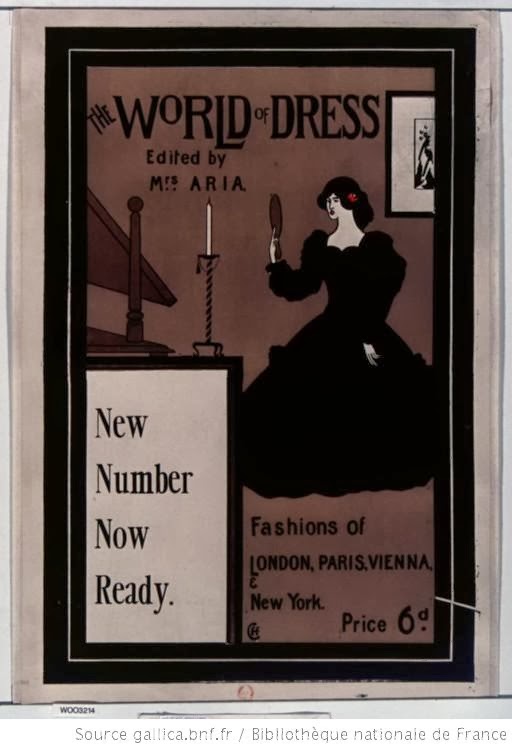
The World of Dress

"It is merely a question of head," said Percy Anderson to me one day, whilst we were discussing some easy method of solving a problem of fancy dress.
And he continued:
"Indeed, I would say that, broadly speaking, of all costume. The fashion of any period is distinguished primarily by the way its wearer dresses her hair.
"And chooses her sleeves," I suggested, and received his approval. 
Thus begins Mrs Aria and Percy Anderson’s Costume: Fanciful, Historical, and Theatrical (1906). Who better to speak on the subject of costume than the gossip columnist and editor of the World of Dress, Mrs Aria, a.k.a. Eliza Davis.

Because clothes are so fascinating, I’ve gone off on this wonderful tangent into late-Victorian fashion magazines, but I actually came across Davis through a more solemn matter. Over the weekend, a friend complained that Oscar Wilde was anti-Semitic. I’ve encountered mutterings about his terrible attitudes before and do not intend to diminish any of them, but thought I would look for his anti-Semitism. What I found was an anti-Semitic passage in The Picture of Dorian Gray, which certainly makes Dorian seem like a bit of a jerk (but he’s supposed to be. That’s the point of how he lives his life.) but it doesn’t say much about Wilde’s own views. Secondary sources defend Wilde by becoming as horrid and cliche as possible: “But... but... but, Wilde had Jewish friends!” Then, I found Davis.

Davis writes a little about Wilde and his brother in her autobiography, My Sentimental Self (1922).
Both Oscar Wilde and Willie Wilde became frequent visitors, and in a public garden which spread its ill-kept lumpish lawn behind our dwelling we often played tennis together : Willie in a shirt showing some desire to be divorced from the top of his trousers, and Oscar in a high hat with his frock-coat tails flying and his long hair waving in the breeze.
Because Willie is the real focus of my research (not that you can tell by reading my blog), I forgot all about his younger brother and started looking into the life of his fashionable, ambitious, and gossipy friend.

Davis was Julia Frankau and Owen Hall’s sister, making the Davises a very writerly family. Her niece would later recall that Davis knew loads of literary icons and collected their autographs for her and her own siblings. Really, I think, Davis was poised for success as a gossip columnist.
Whilst I was working for Hearth and Home I conceived the notion that I must possess and edit a journal of my own. Thus came into existence the monthly magazine known as The World of Dress, destined of course to show all other editors how fashion papers should be conducted. 
Other than Davis’s own opinions of it, I’m unable to find much information on the World of Dress. As is the case with most woman writers of the period, more is written about her love affairs than her work. On the other hand, gossip is gossip and gossip was Davis’s business.
The World of Dress possessed many excellent features from many excellent sources. Fashion news from Paris, Vienna and New York, interviews about dress with famous people. Sir James Linton, Sydney Grundy, Max Pemberton, Mortimer Menpes, Downey, the royal photographer, and lastly and most amusingly Dan Leno gave opinions. Casually Dan Leno declared that he of all men best understood women's clothes because he had worn them for years; and he knew all about them from the inside; the property to secure more laughter for him than anything else in his mirthful career being an old wired bonnet, tapped on and tied with strings. Every time it came off he just tapped it on a different part of his head, and the audience roared.
As illustrated throughout her autobiography and her work on dress, Davis had a healthy sense of humour. Biographers have noted that she and her sister didn’t take shots at Wilde after his tragedy in 1895, but even defended him against the homophobia of their brother.

Margaret D. Stetz wrote a lovely short essay on the relationship between Wilde and the Davises. In an effort to return to what led me along this tangent in my research, I conclude with her thoughts:
In The Picture of Dorian Gray and elsewhere, Wilde produced caricatured portraits of Jews. But in later years, his Jewish literary contemporaries also drew portraits of him, sometimes favorable and sometimes not. What all these differing representations signify about the ‘true’ social attitudes and personal views of those who populated the cosmopolitan artistic circles of late-Victorian London remains a mystery even deeper than the question of why Basil Hallward’s painting of Dorian aged and changed. 
Follow me on Twitter @TinyApplePress and like the Facebook page for updates!

Tuesday, February 4, 2014

50 Random Things about Bram Stoker

Bram Stoker
1. Bram Stoker was a good dancer and especially liked to waltz.

2. Stoker was named after his father, a clerk at Dublin castle, who walked miles every day to work for fifty years.
George Stoker

3. Stoker loved libraries. Who doesn’t?

4. Two of Stoker’s brother’s became doctors.

5. His brother, Dr. George Stoker, came to live with him, after travelling through Eastern Europe. Stoker was writing and researching Dracula at the time. George’s stories about his travels and the people he met might have informed the novel.

6. Stoker stole Oscar Wilde’s first girlfriend.

7.Stoker liked to use the word “weird.”

8. At age twenty-two, Stoker fell in love with the poetry of Walt Whitman and wrote Whitman a fan letter that sparked a great literary friendship.

9. Whitman thought of Stoker as a son: “he has always treated me like a best son.”

10. Whitman’s then-controversial and homoerotic Leaves of Grass was Stoker’s first encounter with the poet. He said: “Needless to say that amongst young men the objectionable passages were searched for and more noxious ones expected.”


11. The young Stoker described himself as follows:
“I am six feet two inches high and twelve stone weight naked and used to be forty-one or forty-two inches round the chest. I am ugly but strong and determined and have a large bump over my eyebrows. I have a heavy jaw and a big mouth and thick lips—sensitive nostrils—a snubnose and straight hair. I am equal in temper and cool in disposition and have a large amount of self control and am naturally secretive to the world. I take a delight in letting people I don’t like— people of mean or cruel or sneaking or cowardly disposition—see the worst side of me.”
12. Stoker was often nervous having conversations in groups, but could speak easily one on one.

13. Stoker attributed his love of writing to a long illness he had in early childhood, which prevented him from even being able to walk. He said his earliest memories were of being carried from place to place and “I was naturally thoughtful and the leisure of long illness gave opportunity for many thoughts which were fruitful according to their kind in later years.”
Charlotte Matilda Blake Thornley Stoker

14. Stoker’s mother was a politically active feminist, who told her sickly son gruesome tales.

15. Although Stoker’s writing often comes across as misogynistic, he writes more complex believable female characters than male characters.

16. His female characters usually have names that begin with the letter M, Maggie, Mina, Mimi, Marjory, Margaret...

17. Stoker usually didn’t write more than a page at a time.

18. In spite of this, Stoker wrote most of his stories very quickly, with the exception of Dracula, which was at least seven years in the making.

19. Although there are many theories on who inspired Dracula, Henry Irving is one of my favourite because Stoker asked him to play Dracula in the theatrical version of his novel. Irving, however, refused.

20. Irving liked to make fun of him for his Irish national pride and support for Home Rule.

21. Stoker always took it personally when Irving made fun of him.

22. When Stoker first met Irving, he helped save him from bankruptcy and said: “no artist can properly attend to his own business.”

23. This led to many years of employment and an elevated position in London Society as Irving’s business manager, but Stoker didn’t always feel so secure in this role and faced the competition and ridicule of a young journalist, later employed by Irving as personal secretary, Louis Frederick Austin.

Henry Irving
24. Austin and Stoker didn’t get along and Austin claimed that Stoker was lying when he said he did most of Irving’s speech writing and press statements for him.

25. Stoker spent most of his career working on the business end of theatre and believed strongly in government subsidies for the arts.
“The strain of ceaseless debt must always be the portion of any one who endeavours to uphold serious drama in a country where subsidy is not a custom. In the future, the State or the Municipality may find it a duty to support such effort, on the ground of public good. Otherwise the artist must pay with shortened life the price of his high endeavour.”
26. Although Stoker wound up devoting most of his time to the theatre, he wanted to move to London to be a writer before he ever met Irving.

27. While living in London, Stoker also managed to earn a law degree.

28. Stoker was a night owl. He enjoyed staying up all night and seeing the dawn break.

29. Stoker always took a bath before going to bed.

30. Stoker liked thinking of himself as large.

31. Stoker preferred home-cooking to eating at restaurants.

Irving and Stoker getting into a cab.
32. Stoker felt it showed poor manners to have a second drink when someone else was buying.

33. Stoker thought brandy was good for your health.

34. Stoker’s son claims his dad got the idea for Dracula from a nightmare he had after eating too much dressed crab.

35. Stoker was interested in mesmerism and the occult sciences. He had strong links to the Hermetic Order of the Golden Dawn.

36. Stoker was fascinated by dreams. He studied dream theory, while writing Dracula.

37. Stoker described watching someone high on opium as moving and speaking, “like a man in a dream.”

38. Stoker’s French wasn’t very good.

39. As much as Stoker liked German folklore, he didn’t speak German.

40. Van Helsing was an amalgamation of at least three different characters Stoker wanted to include in the book, including a German professor.

41.Although Stoker supported Home Rule, as an Irish Nationalist, he was also a monarchist, in support of England as a force for good in the world.

42. Stoker was against any form of violent Irish nationalism.

43. Contrary to popular belief, there is no evidence that Stoker died of syphilis - only that he suffered from a number of Strokes before he died. It’s possible that he was also suffering from depression toward the end of his life.

44. Stoker didn’t like giving up his career with Irving at the Lyceum. He was upset that Irving sold the theatre without consulting him. This might have caused the onset of depression.


45. Even though Stoker’s wife always wanted to and even tried starting a career as an actress, Stoker considered Ellen Terry the best actress of their time. Terry was the female star of the Lyceum. Stoker said:
“Ellen Terry is a great actress, the greatest of her time; and she will have her niche in history. She is loved by every one who ever knew her. Her presence is a charm, her friendship a delight ; her memory will be a national as well as a personal possession.”
46. Stoker’s wife was considered one of the three most beautiful women in England, but their marriage was platonic after the birth of their only child.

Florence Stoker (presumably photoshopped, but still cool)
47. Although the documentary Dracula’s Bram Stoker makes a strong argument that Stoker was gay, there’s no evidence that he ever cheated on his wife with a man or a woman.

48. When Stoker died in 1912, Sotheby’s auctioned off his library. Whitman’s lecture on Lincoln, which he bequeathed to Stoker, sold for $25.

49. His wife tried to put a stop to the film: Nosferatu (1922) because, as Stoker’s widow, she owned the rights to Dracula, hadn’t been consulted and hadn’t been paid any royalties. This resulted in a lengthy court case, which she eventually won, while trying to destroy any and all copies of the film. As much as I like her as a historical figure, I’m glad she didn’t succeed.

50. On his 165th birthday, Stoker was honoured with a Google Doodle.

Follow me on Twitter @TinyApplePress and like the Facebook page for updates!

Tuesday, January 7, 2014

Thank You for a Wonderful Year!


A year ago today, I started this blog with my first post: American Cigarettes. I was and still am doing research for my book. A few days earlier, at the library for the University of Akron, I came across what instantly became my favourite Wildism.
I am greatly distressed to hear you and the fascinating Dan are smoking American cigarettes. You really must not do anything so horrid. Charming people should smoke gold-tipped cigarettes or die, so I enclose you a small piece of paper, for which reckless bankers may give you gold, as I don't want you to die.
Posting that was on of those “Dear Internet” moments. I was reaching out through my computer screen, hoping to find someone else as interested in the same things I was.

That first month wasn’t my most prolific writing month, but I wrote more posts in January 2013 than I have since because I started to realize that the opportunities a blog affords a distractible writer, like myself. I wanted to entertain and engage you, so that I could have someone to talk to about my research, but in talking to you I also wanted feedback. Feedback I got!

In a year, I’ve only got 31 comments out of over 14,700 page views, but I couldn’t tell you how many hundreds of emails I received - helpful emails too, emails that led me to make corrections to my posts and emails that led me to follow up certain posts with more detailed explanations of the subject matter. For example, I found an American trade card that depicted Oscar Wilde selling corsets for Warner Brothers, who I associated with movies. Thanks to your feedback I found a pair of much more interesting Warner brothers.


Also on the subject of Wilde and fashion, I got feedback via email about a book I wanted to read from the author! Oscar Wilde on Dress is now also available in a Kindle edition through Amazon and posting a review of this book is a priority for me in the coming year for this blog!

After a year, my all-time most popular post is The Ten Best Restaurants in London, which, of course explores the restaurants of the 1890s. In writing this, I was trying to get a sense of place because restaurant dining was a highly popular form of socializing and Oscar Wilde's family ate out on credit more often then they ate at home, even though they had a cook at home.

This month, my most popular posts are: Being Irish in Victorian London, a post that was promoted by the Irish Literary Society on Twitter; Weirdest Cameras of the 1890s, which looks at spy cameras (I was thinking about using a camera in my book, but decided against it and still couldn't stop looking at cameras from the period); and How to Flirt Like a Victorian. On that last post, I've since decided that Victorians probably didn't use those guides. They are just too silly!

After a year, I want to thank everyone, who has helped me with my research, and while most of you know about my research tangents, few of you know what my project really is - just the areas I’m interested in.

I’m writing a novel, historical fiction. While many of my posts are simply interesting tangents for me, many test out ideas about the history that I actually want to use in my book. In one post, I actually struggle with how I’m going to portray my narrator, but don’t actually give you her name. It’s Lily de Mattos, formerly Lily Wilde, born Sophia Lily Lees. I’m researching all of these writers because I want Lily to tell the story of her time as part of the Wilde family, but it’s more complicated than that.


I got the idea for this novel, when a dear friend of mine died of alcoholism, which is how Lily’s first husband, Willie Wilde, dies, but it’s more complicated than that.

I’m researching all of these writers because they are people that Lily would have met, as Oscar Wilde’s sister-in-law, and I’m using her narrative to explore the question of why, as writers, we write what we write.

So, if you were wondering, that is why I write this blog. That is why I’m obsessed with the 1890s. I’m using Lily’s life in the 1890s and the experiences of all these writers to understand my own life and my own experiences - not just the writers, but the culture around them that informed their lives and, at times, even encouraged them to drink themselves into an early grave.

It sounds miserable and sad, but I think my research demonstrates that it can also at times be very strange, very funny, and a lot like life today. Thank you for all the support you have shown me and please, keep commenting, sending emails, correcting me, and sharing any new information that you think I might find useful.

As always:

Follow me on Twitter @TinyApplePress and like the Facebook page for updates!