Showing posts with label Willie Wilde. Show all posts

Wednesday, December 30, 2015

Perchta and the History of Oliebollen


It's the night before New Year's Eve and Willie Wilde's best friend, Alexander Teixeira de Mattos (Tex) comes to call on him at Lady Jane's house. A Dutchman, Tex brings with him a basket full of pastries and, knowing how much Lady Jane loves folktales, a story! This might, or might not, have happened, but is the pretext I'm using to write about olibollen.

Oliebollen are a traditional Dutch food eaten at New Year's. The name literally translates to "oil balls" and they were the inspiration for the American invention of the donut. I was always made to understand that these treats are so fattening that it would be bad for you to eat them more than once a year, but the history of Oliebollen and the story Tex would have told Lady Jane are the real New Year's treat.

Imagine, Willie, Lady Jane, and Tex sit around the fire. Lady Jane's servant, Mrs Faithful brings them a warm plate of oliebollen and three cups of whiskey and eggnog. Willie and Lady Jane get powdered sugar on their faces and clothes, as they take their first bites of this doughy pastry with bits of apple, raisins, and dried cranberries, and Tex tells them about Perchta.
Family portrait: Perchta, Krampus Jr., Krampus, and Angel.
James Mundie (2012).
"Perchta – Derived from an early Germanic word meaning “bright or “glorious”. Perchta is famed for her dual nature. Her grim aspect is known as “Perchta the Belly Slitter”. Perchta is alternately described as kind or violent, as a monstrous hag or a willowy maiden" - source.
Perchta is a pagan witch, or Germanic goddess (depending on your point of view), who plays the role of guardian of the beasts, during the twelve days of Christmas. At Yuletide, Perchta flew around the Netherlands with evil spirits looking for food and would cut open the belly of anyone she came across to steal their food. However, if you had been eating oliebollen, the fat in the dough made it so that her sword would slide of your belly.

Young woman with a cooking pot filled with
oliebollen (Aelbert Cuyp, ca. 1652)
While records indicate that the Dutch have been eating oliebollen since medieval times, the first recipe appears in "De verstandige kock" (1667). At that time, they were still oliekoecken (oily cookies); it wasn't until the 1890s that the word oliebollen became the more popular term, appearing in an 1896 Dutch dictionary.

Everywhere in the world that I have travelled, Dutch people serve oliebollen to their friends on New Year's Eve, so I'm pretty sure that Tex would have had some for the Wildes in London in the 1890s.

Have a safe and Happy New Year!

Follow me on Twitter @TinyApplePress and like the Facebook page for updates!

Monday, March 23, 2015

Are Men Gay Deceivers?

Headline from the November 18, 1909 issue of The Republican.
Though it sounds funny to our ears now, in the nineteenth century, the term 'gay deceiver' referred to a man who used his charm for personal gain. The term could most certainly be applied to Oscar Wilde's older, and more sinister, brother, Willie.

The following essay, entitled "Are Men Gay Deceivers?" was written and published by Mrs Frank Leslie on the occasion of her divorce from Willie Wilde. She was seeking a divorce because he had clearly married her for her money and refused to work, but spent all of his time drinking instead. In the almost two years it took for their divorce to be finalized, she slandered her soon-to-be ex-husband in the press, while he shacked up with his future wife, the heiress, Sophia Lees. It's hard to not read this essay as Leslie's assessment of Willie's character at this time.
ARE MEN GAY DECEIVERS?
MODERN DECEPTIONS AMONG MEN AND WOMEN.
It is a stock phrase under certain unfortunate circumstances to say that a girl has "been deceived" by some man, or to call an immoral man "a gay deveiver." Now, the question in my mind is whether this is, in the majority of cases, a correct judgement, or whether one might not better say the woman deceived herself and blinded her own eyes.
The fact is that most women are far more clear-sighted than most men, and even those of the sex who might be called deficient in intelligence are endowed with a keen, if vague, instinct which cries "'Ware, danger!" even though it is quite unable to describe the precise nature or position of the menaced trouble.
Willie Wilde by Alfred Bryan.
But a woman, no matter of what degree, so soon as she falls in love blinds herself, or rather, she sets up her own ideal of the beloved object between herself and the reality, and if she said reality only reasonably keep quiet, and not persist in destroying of stepping out from behind his shelter, all will go well.
 The trouble is that few men have enough tact to be really deceitful; few have finesse enough to enter into a woman's mind and perceive the position which she has assigned to her hero of the moment and adapt themselves to it. They try to do it, but they don't often succeed; and by way of a glittering generality on may say that men mean to be deceitful and are really transparent, and that women, while apparently most deliciously transparent, are actually subtly deceitful.
Here, I suspect that Leslie is reflecting on the beginning of her marriage, when she reported in the American press that she had married Oscar Wilde's older brother and that Willie was even more of a genius than Oscar was. It seems that she feels it would have been very easy for Willie to make their marriage work, if he had only seen what a high opinion she had of him and pretended to be clever.
Of course, like other generalities, this rule has particular exceptions; and there are men who really do deceive, and women who cannot do so. I must say that for myself I do not like either of these classes; they are out of nature, and require special study.
Like George Michael, Leslie feels that, as a rule, "There are boys you can trust and girls that you don't."
Born Miriam Florence Folline, she changed her name to retain control of her third husband's publishing empire. Willie Wilde was her fourth and last husband.
The really deceitful has a strong feminine coat of character, and this of the womanish and not womanly nature. He is a self deceiver like her, but not because, like her, he wishes to believe others better than they really are, but because he is determined to believe them as bad as he wishes them to be. He adopts a code of morals, or immorals, and various forms of casuistry persuades himself that this is not only justifiable for himself, but the actual code of others, no matter what they may profess. If he is clever, he can argue from this standpoint that black is white, and left is right, and crooked straight, with so much conviction and candor that he may often end in persuading even a woman to believe him and to adjust her own beliefs to his.
But this sort of man is unfortunately rare; the more usual form is the man who knows very well his right hand from his left, an is perfectly sure that the moon is not made of green cheese, but who wishes to make some woman believe that it is; it is rather interesting to watch the maneuvers of this class of deceivers; the casual mention of the fact to be established, let us say  of the cheesy quality of the moon; the apparent surprise and indulgent amusement when the pupil indignantly contradicts the proposition; the gentle arguments, the mock deference and respect for the feminine view so diffusely and vaguely set forth; the raillery and playful irony, often more effectual than any other weapon; the compliments so skillfully introduced, and the thoughtful pause, as if considering the true value of the pearls of wisdom let fall from the pretty lips, at which he gazes so admiringly.
Later in life, Mrs Frank Leslie fashioned herself the Baroness de Bazus. 
Then comes the personal appeal: "If anybody could convince me, it certainly would be you, and your arguments are so strong and so well put that I am half inclined to accept them in spite of my own reason, and yet I can't but see that there is a very, very cheesy look to the moon, and so many people older and perhaps wiser than either of us have believed it. Don't you think you are perhaps a little prejudiced? I wish we could think alike upon this as upon so many other matters. Now don't you se," this and this?
Victorian advice on handkerchief flirting.
Probably at this point of the game the game the woman who is in love begins to finger the handkerchief with which she will presently blind her own eyes; she listens more to the compliments and personal appeal than to the arguments; she begins to take note of the hyacinthine locks, the careful moustache, the white teeth, the handsome hand of her companion-but shall I tell you where she did not look? It is into his eyes; for although I have seen a great many men trying to deceive, I have never seen one who could bring his eyes into full subjection. He may open them wide and stare you boldly in the face; he may raise them to your own with elaborate candor; he may gaze upward at the ceiling or outward at the sky, or downward in pensive consideration, but I have never yet saw an eye absolutely successful in deceit; and I believe that if Marguerite had looked Mephistopheles full in the eye, and meant to read the truth there, he would not have had power to conceal it; and if he could not, less expert "gay deceivers" need not try to. But if the woman is not in love she is very much tempted to laugh aloud and say: "What a clever special pleader you are! You ought to be a lawyer; but all the same, you don't believe a word you're saying and neither do I. We both know perfectly well that the moon is not made of green cheese, and never was, and never will be. Why pretend it is? 
 I say the woman may be tempted to make this little speech, but if she is a wise woman she will resist the indulgence, for she knows perfectly well that to mortify a man's amour propre is to lose that man's allegiance, whatever that may be. Every man is born with the belief that he is intellectually full-blooded specimen of his sex he carries that belief to his grave; and it is very commendable that he should do so, for one likes to see landmarks respected.
1890s ideal of the perfect man.
 Now, of course, if the woman sees through the man's sophistry, and laughs at his attempts to deceive her, it is flinging confetti or even mud-pellets at the landmarks; it is disturbing tradition and suggesting that she actually knows as much and is quite as clever as her traditional lord and master. Therefore the clear-headed woman never laughs at the man's attempt to deceive, unless  she is ready to be rid of him, and even then it is not a good plan, for no wise woman wishes to sow dragon's teeth in her own path; no, as a general thing she gently deceives him, but not herself; she listens to his arguments, she looks sweetly considerate over his propositions, however absurd; she appears to be on the point of yielding while fixed like a rock in her own position. When tired of the situation, she ends it by murmuring, with pretty deference: "There's a great deal in what you say, and I never looked at the question from your point of view; of course you have studied these matters a great deal more than I, and you have a much wider opportunity of observation-but-well, I must think it over; and certainly I shall look at the moon with different eyes from what I ever did before." But sometimes, alas! one only wishes the man could and would be more deceitful than he tries to be. Most men, when in a candid mood, confess that there are depths in the masculine nature which few, perhaps no women, can fathom; that they are of coarser fiber and more earthly material than women are, and that no woman ever enters into their temptations or realizes their possibilities. All this may be so; if they say so of themselves, one is bound to believe it, for surely no man can be suspected of deceit in this direction. But if these depths do exist, one would wish them to be securely and constantly concealed. the oubliettes in the Imperial Palace were so well disguised that the innocent guests walked over them quite unconsciously, and if some sinister rumor of their existence came to unwilling ears, it could at least be dismissed with the verdict, not proven. But if people insist upon glass windows over their oubliettes, and call upon you, as you gayly tread parlor-floors, to gaze upon the unclean depths below, one wishes that such people were wise enough to at least try to be deceitful. Again, a man is ignoble; he is dishonest in his affairs, he is cowardly, he is disloyal, he is purse-proud, or perhaps he has rheumatism, or colic, or some other distressing complaint not necessarily apparent. Well, let him cover up both his mental and his bodily diseases and deficiencies while in society, and refrain from obtruding sentiments, theories or symptoms with which the companion of the moment can not agree or alleviate. But if he is not wise enough to do this, he may, perhaps never suspect that he ought to have done so, for one of the most charming and most dangerous traits in a woman's nature is her power of sympathy and her dread of giving pain.
She feels for the man who is making himself ridiculous as he would be quite incapable of feeling for himself, and she gently guards him from perceiving his own folly, even while she is dimly conscious that no human power could make him see it. I have seen a very clever woman listening with serene patience and apparent interest to a deluded individual who was explaining the wonderful system he would adopt if he were Secretary of the Treasury, and winding himself up in such a spider's web of words that he finally turned very red and moist, and stammered into silence, with a suspicious glance at the gentle face beside him, upon which, however, not a trace of a smile could be observed as the candid voice replied: "I don't wonder you despair of making me understand. I never could get hold of politics, and am glad all these matters are in your hands rather than mine."
Do you call this woman deceitful? Well, so do I-admirably, generously, charmingly deceitful; and if that man went away comforted in his soul rather than humiliated and stung, was it not well for him and also for her?
When Leslie begins speaking about Titanias, I have to wonder if she is thinking of the woman Willie is living with at the time and will eventually marry. If she is, I suspect she feels more sympathy than jealousy.
Sometimes, of course, the sympathetic in the woman degenerates into weakness; and I have seen nice women behave in anything but a nice manner, simply because they did not wish to mortify their male companions by showing that they felt shocked at their language and manners. In fact, I think women seldom enjoy or wish to indulge for their own pleasure in objectionable pursuits; they simply allow themselves to be led by their companionship, and will, out of real goodness and delicacy, pretend to be bad and coarse. But to return to the first point, of what deceit a good woman will cultivate when she is in love. It is one of the most painful, or rather, pathetic, sights in life to see some lovely, piquant, little Titania trying to impress both the world and herself with the idea that Nick Bottom is a hero, and the ass' head is the true model of an Adonis. How wistfully she watches him in society; how she hovers around his conversations, darting in now and again with some word or hint, or little laugh or gesture, that seems to interpret his platitudes or errors into capital jests and hidden bits of wisdom. How she finishes out his sentences, and suggests to his dull brain something to say next. How lovingly she listens to the dullest and most prolix harangues; how she puts a noble construction upon his most ignoble deeds, and tells everybody how prudent he was in not making that investment, or helping this imposter, or subscribing to their plan, when all the world knows he was saved from loss in these directions by the pigheadedness that never allows him to do what anybody asks him to do.
Shakespeare's Titania depicted by Edwin Landseer in his painting
Scene from A Midsummer Night's Dream.
Dear, deceitful little Titanias! What a multitude of them there are, and how I love them, even while they always remind me of an old Dutch tomb whereon are sculptured two delicate little angels tugging away at the soul of an uncomfortable old alderman who declines to budge an inch.
Follow me on Twitter @TinyApplePress and like the Facebook page for updates!

If you have enjoyed the work that I do, please support my Victorian Dictionary Project!

Saturday, February 7, 2015

The Importance of Being Irish Gentlemen

Source of quote.
I've been thinking about the way that Oscar Wilde's family treated him when he was going to trial. The following is an excerpt from H. Montgomery Hyde's book: Oscar Wilde.
The Marquess had hired a gang of roughs and instructed them to follow Wilde and see that he did not secure admittance to any hotel in town. [...] Towards midnight, however, they lost sight of him. At this time Wilde's mother was living with Willie in Oakley Street, Chelsea, and it was to the door of their house that Wilde at length staggered in a state of complete physical exhaustion. 'Give me shelter, Willie,' he gasped as his astonished brother opened the door. 'Let me lie on the floor, or I shall die in the streets.' With these words he collapsed across the threshold, as Willie Wilde put it, 'like a wounded stag.'
[...] The family atmosphere had the worst possible psychological effect upon him. Both his eccentric mother and his drunken brother kept telling him that he must behave like an Irish gentleman and face the music. 'This house is depressing,' he complained. 'Willie makes such a merit of giving me shelter. He means well, I suppose, but it is all dreadful.'
I feel I should make it clear that Oscar's brother, Willie, wasn't housing their mother, but their mother was housing him and his wife. It was her house.
Newman Noggs and Kate Nickleby
Charles Dickens

Franny Moyle calls Oscar's trials eerily similar to his father's own scandal years before. The scandal of Wilde's father came about as part of the fallout of a relationship with a young woman, called Mary Travers. After their relationship ended, Travers accused Sir Wilde of seducing her, then published a pamphlet that parodied Sir and Lady Wilde as Dr and Mrs Quilp. In her pamphlet, Dr Quilp raped a female patient anaesthetised under chloroform. Lady Wilde was vocal and outraged; Travers sued her for libel. The legal costs financially ruined the Wildes. The case was publicized all over Dublin and Sir Wilde was criticized for refusing to enter the witness box - an act which was criticized as ungentlemanly.

Oscar's mother obviously remembered the Travers case. Her insistence that it would be ungentlemanly for him not to turn up in court clearly echoes what happened with her husband. But Willie actively prevented Oscar from fleeing.

I'm beginning to believe that Oscar's older brother, Willie, was scarred deeply by these events. As in Edgar Allan Poe's The Telltale Heart, the things that people frequently repeat about themselves are the things that they are trying to convince themselves of; that's why one doesn't go around telling people they're not crazy! Willie oft repeated that he was an 'Irish gentleman'. Never was he more adamant that his brother was also an Irish gentleman than when Oscar was thinking of fleeing to Paris.

It was never inevitable that Oscar would be convicted in court. Everybody, including Queensberry and the judge, thought that Oscar would flee to Paris. His friends even arranged transportation for him. I believe Oscar wanted to flee to Paris and that was why his brother blackmailed him into staying. His brother could not stand the idea of history repeating itself in their family.

In Willie's mind, after all, they were Irish gentlemen.

Follow me on Twitter @TinyApplePress and like the Facebook page for updates!

If you have enjoyed the work that I do, please support my Victorian Dictionary Project!

Tuesday, September 16, 2014

Riches to Rags: the Wilde Stories

Oscar Wilde, Constance Wilde, and one of their sons.
If you've ever been broke, you are probably familiar with the way that it makes you feel, like there's something wrong with you, and the world despises you. Academically, we know this isn't true. Not having money isn't a character fault in and of itself. As the saying goes: "You can't control what happens to, but you can control how you deal with what happens to you."

The Wilde Family make an interesting case study in this phenomena when we look at the lives and misfortunes of Speranza and her two sons, Willie and Oscar Wilde. Each lost a fortune, and each dealt with it differently, with different consequences.

Speranza
Speranza was Dublin's most popular socialite. Her husband was knighted. She lived in the best house. She had the most interesting guests, and the best parties. She loved culture, history, art, and Ireland. Her fortune dried up when she and her husband got caught up in a scandal, the details of which are still controversial. Her husband soon died, leaving her with little money.

In response, she packed up her house, and moved to smaller quarters in London, where she could continue to pursue her art. She did what she could to continue to support her family. She got a little support from her sons for a while, but their lives weren't going well either. She kept trying, until she was too old to try anymore. She continued to host her famous salons, and the most interesting people continued to attend.

Her son, Willie, was an alcoholic though, and alcoholics tend to drag their loved ones down with them, which Willie did. Speranza died in a room full of empty gin bottles, and Willie blamed his brother.

Willie Wilde
Willie also made a noble effort to prevent himself from descending into rags. A few years after he went bankrupt, he married the richest woman in America. That didn't go so well because of his drinking, and he wound up living with his mother, and claiming to take care of her. As you know, from Speranza's story, he didn't do a very good job of that.

After his mother died, he had to find a new place to live. He sold off most of his brother's belongings. He sold his wife's wedding ring. Eventually he died from alcoholism, and few of the wonderfully successful people he once called friends ever mentioned him in their memoirs. The newspaper he was a lead reporter for, at one time, barely mentioned his passing.


Oscar, on the other hand, continually tried to make everyone happy. In a way, that's how he got his money. He became a celebrity before he did anything, just because people liked him so much. His wife had money, which was helpful, and he was good at earning his own money, which he promptly spent on his friends and lovers.

Oscar Wilde's downfall was very public. He went from being a darling to being a demon, and he definitely felt terrible about the impact that this had on all the people he cared about. Oscar realized that we never suffer in isolation, but our suffering impacts everybody around us. His imprisonment, and the backlash against him, hurt his family, his friends, and his business associates. For this, he expressed his remorse.

When Oscar was released from prison, he was broke, worse off than his brother or mother had ever been, but the love that he gave to other people came back to him. His good friends did what they could to help support him, and, though he never really recovered from the losses he sustained at that time in his life, he is remembered with fondness because of the love he spread.

Follow me on Twitter @TinyApplePress and like the Facebook page for updates!

Sunday, August 17, 2014

What happened to Oscar's stuff?

Scholarly article pay little attention to the role my protagonists played in history, one example being Kevin O'Brien's essay: "Lilly Wilde and Oscar's Fur Coat." If you click on that last link, you should be able to download the article automatically, which I'm basically going to summarize here.

It begins with a letter that Wilde wrote after he had been to prison and had started to track down his things, which had been pawned by Oscar's brother, Willie. The letter mentions "those people," specifically "the man," and "the woman." Those people were Willie and his wife, Lily Wilde. O'Brien says:
The story from their perspective is worth examining, for their relationship with Oscar was a difficult one, and they themselves had a hard, impoverished life together for the five years of their marriage.
Lily was Willie's second wife, who he brought to live at his mother's house, when he more or less gave up on life and let his mother take care of him. Lily had been in love with him, since before he married Mrs. Frank Leslie. As reported in the papers, and as evidenced by the lifestyle provided to her and Willie's daughter Dolly, Lily was an heiress. She was cut off from her fortune for the duration of her marriage to Willie.

Lady Jane Francesca Agnes Wilde
a.k.a. "Speranza"
As O'Brien uncovered, the small traces of history that Lily Wilde left behind depict her as an emotional woman of poor judgement, but still, a devoted friend, or maybe just a fan, of Oscar.

Willie made life difficult for his mother, by being unable to earn an income, and constantly demanding money. He was dying of alcoholism, and most likely suffered from delirium tremens. He had been brought down a peg or two, since his marriage to the richest woman in America failed, so when Oscar showed up at his doorstep in trouble, he likely saw a chance to redeem himself - maybe even look like a bit of hero for helping his brother out.
When Oscar arrived at the doorstep at 146 Oakley Street and pleaded, "Willie, give me shelter or I shall die in the streets," Willie let him in, but without much charity.  Willie later described the scene: "He came tapping with his beak against the windowpane, and fell down on my threshold like a wounded stag."
Though he tried to make it look like he was helping his brother, when he spoke to other people, he was really doing nothing of the sort. Lily and Oscar got along fine. While Willie blackmailed his brother and generally tried to control his life before he went to prison, Lily tried to reassure Oscar that she could manage Willie and take care of his things while he was gone.

Trying to control a raging alcoholic is like trying to teach a cat to clean up after itself.
Another disadvantage of Oscar's stay at 146 Oakley Street is the one quoted at the beginning of this article -- the betrayal by Willie and Lily in the loss of his precious fur coat and, in fact, two trunkloads of clothing.  Lily had quite a different version of the disposal of Oscar's belongings: rather than pawning his clothes without his knowledge, Willie was merely disposing of what had been given him.  According to Lily, before Oscar left for his third and last trial, he said one morning to Willie, "You can have all my things to do what you like with."
Rather than convincing Oscar to leave all his things in her charge, as Oscar claimed, Lily says that when she heard Oscar make the offer to Willie, she took Oscar aside and told him confidentially that "considering Willy's ordinary ways, if the clothes and trunks were left they [will] be sold or pawned."   According to Lily, Oscar answered, "he may have them all, only keep me my shirts." Hard up for money, Willie sold Oscar's fur coat and the two trunks of clothing to a jobber for only £12 or £13.  Lily was vigilant enough to keep her side of the bargain and saved all Oscar's shirts.
When Speranza died, there was no one left to pay rent at 146 Oakley Street. Willie and Lily had to move to a few small rooms at 9 Cheltenham Terrace. During the move, Lily packed up Oscar's shirts, his manuscripts, and a few treasured possessions, which she sent on to More Adey of his for safe keeping, never realizing that all of the possessions he had saved and brought with him to 146 Oakley Street were in fact treasured possessions.

Willie Wilde
It hurt Lily that Oscar was so angry at her for not being able to protect all of his precious things, and her usual protective nature over Willie changed in the face of that anger, she must have realized by this point that Willie sold Oscar's things without his permission because he wished to fuel his own sad addiction.

As Willie continued to drink himself to death, he blamed most of his own problems on his brother, and the two never spoke again. Oscar did not even attend his brother's funeral, or send a kind note.

Constance Wilde used Lily to track Oscar's movements, when he left prison, which Lily did through their mutual friend More Adey. There's evidence to suggest that Willie was jealous of his wife's friendship with his brother.

When Willie died, Oscar did reach out to his brother's widow by offering a small amount of financial support. Oscar and Lily kept in touch, until Oscar died in 1900, at which time he was aware of her second marriage and offered happy approval.

Follow me on Twitter @TinyApplePress and like the Facebook page for updates!

Wednesday, May 14, 2014

Tex

In so far as he wished to be remembered at all, it was not as a man of letters, but as a friend, a connoisseur of life, a man of sympathy un-aging and zest unstaled, a lover of simple jests, a laughing philosopher. - Stephen McKenna
Alexander Teixeira de Mattos
A Dutch journalist, literary critic and publisher, Alexander Teixeira de Mattos was best known for his work as a translator. It's unclear how they met or what they had in common, apart from writing and a love for the same woman.

Teixeira moved from Amsterdam to London with his family in 1874 when he was nine years old. There, he studied at the Kensington Catholic Public School, before attending the Jesuit school Beaumont College. Much the way Bram Stoker became involved with the Lyceum, Teixeira became involved with the Independent Theatre Society - only Teixeira didn't become obsessed. He also worked as the London correspondent for a Dutch newspaper, while editing other journals.

Fluent in English, French, German, Flemish, Dutch, and Danish, Teixeira became the official translator of the works of Maurice Maeterlinck, and would go on to translate Émile Zola, Alexis de Tocqueville, Maurice Leblanc, and many others.

In the 1890s, Teixeira was leading a group that sought to translate the canonical works of fiction by Continental authors for the English reading public. There, he oversaw the translation and publication of six banned novels by Émile Zola.

At the turn of the century, he married Willie's widow, Lily, becoming step-father to the most infamous Wilde of the next hundred years.

Follow me on Twitter @TinyApplePress and like the Facebook page for updates!

Saturday, May 10, 2014

Someone You Shouldn't Have Fallen in Love With

Willie Wilde
Many a well-known hostess fell before Willie [Wilde]'s charms: one of them Mme Gabrielli sent him, according to Constance Wilde, 'wine, tonics, and bangles'.  - Joan Schenkar
Sometimes, I'll be reading and a word will make me stop. In the sentence above, I stopped several times at the word "fell." Why do we fall in love? Schenkar is talking about Victorian women, falling had other connotations for them... "fallen" women.
Ethel Smyth

I don't think Schenkar intended for that sentence to give me so much pause. People are "falling" for or "falling in love" with other people all the time! The women who fell for Oscar Wilde's older brother, Willie, didn't go on to lead the life of a fallen woman, as our contemporary understanding of Victorian morality indicates they should have. and Shenkar certainly doesn't imply that they did.
Mrs. Frank Leslie

Shenkar does go on to discuss Willie's relationship with the suffragette, Ethel Smyth. Smyth ended her engagement to Willie, then lead a long and happy life, which included artistic successes and love affairs straight through to her 70s. Willie's first wife travelled and flourished financially after their divorce. Divorcing Willie won her sympathy in the press, rather than condemnation, but she did own more than a few newspapers. Willie's second wife doesn't seem to have had much drama in her life, after Willie's passing, but had a long and happy marriage with Dutch translator, Alexander Teixeira de Mattos.

I find Willie in the biography of his daughter and other histories, like that of his first wife, which all combine to paint a picture of a hideously charming womanizer. A kind of Dr. Jekyll and Mr. Hyde, Willie demonstrated incredible courtesy and outrageous disrespect to the women in his life, including his mother. Like Barney Stintson, I imagine Willie even had a playbook, well-memorized before attending the dances and dinner parties of 1890s London. He slept with as many pretty and rich Victorian women as he could. The latter showered him with gifts and even forgave his attempts to commit bank fraud on their savings accounts.
Dolly Wilde (Willie's daughter)

The image of falling and the long culture of blaming women for indiscreet sexual encounters make me picture the women Willie met as the 1890s equivalent to the women Barney Stintson picked up on the series: How I Met Your Mother, but that simply was not the case. Beautiful, intelligent and wealthy women clearly fell for Willie's charms. He wasn't someone they should have fallen in love with, and may have changed their lives forever; Willie's second wife had a child by him. When the relationship ended, the women in Willie's life were still beautiful, intelligent and wealthy (if they started out that way). The term "fallen" simply does not apply here. Rather than finding the women that Willie preyed on as footnotes in a history of his sexual conquests, I look for him in the footnotes of their biographies because they have biographies and Willie doesn't.

Maybe it's time to question the narrative that a mistake, like Willie, was the end for any good Victorian woman.

Follow me on Twitter @TinyApplePress and like the Facebook page for updates!

Friday, April 11, 2014

Willie Wilde’s Failure as a Husband

Oscar Wilde (2nd from left) & Willie Wilde (sitting on right).
Oscar Wilde's one-time sister-in-law once declared to her then-husband Willie Wilde that she had married the wrong brother. Such bitter irony because Oscar was already married, and we all know how that turned out. Then I found this wonderfully gossipy 1893 article that outlines what made Willie even worse as a husband!
The Morning Call, 8 June 1893, 10.
WILL LOSE WILLIE
Mrs. Leslie in the Divorce Court
RECOLLECTIONS OF A VISIT
The Great Matrimonial Comedy About to Close - Willie Wilde’s Failure as a Husband

Many people out here who had the opportunities a year and a half ago to please themselves by meeting Mrs. Frank Leslie and the brother of Oscar Wilde will gossip with considerable relish about the dissolution of the matrimonial alliance between them.

Mrs. Leslie expects that the bonds will be put assunder by Judge Brown of Newburg, N.Y., in a very few days, and the very minute she finds herself a free woman again she will sail to Europe.

That was a funny sort of match from the start, and the breaking of it now only makes people smile. The characteristic passages in the married life of Mr. and Mrs. William Wilde would make a more delightful society comedy than the stage ever presented if properly selected and strung together.
Mrs. Frank Leslie

People out here who met them when they visited California with the League of Press Clubs were not impressed by the idea that it was one of those tender love affairs. They had been married about four months then, so that the trip came pretty near being a honeymoon tour. Everybody who had ever seen Mrs. Leslie thought they knew what she looked like, for next to President Harrison her picture had been published as often as anybody else’s in America, displaying the bright, handsome face and the trim and stylishly dressed form of a striking and fascinating young woman.

But oh, what a difference time had wrought since the negatives from which all of Mrs. Leslie’s pictures have been made were new! She came as bright, independent, positive and hustling as she ever was, but there were furrows where the bloom had once rested and nature had acquired that careless way of letting lines of grace sag into less pleasing outlines. No good picture of Mrs. Leslie has ever been labeled “From a recent photograph.” But everybody was curious and ambitious to meet the famous woman who had taken a great publishing business where her husband had left it at his death - deeply involved in debt - and by her own shrewdness made an independent fortune out of it.
Oscar & Willie by Unseam

And Willie Wilde - William C. Kingbusy Wilde - was regarded with little less curiosity. He was a great tall, bewhiskered, large-eyed Englishman in rather ill-fitting clothes, with a stoop about his shoulders, a slowness in his talk and movements and a very unaggressive manner.

He was a man who had distinguished himself - by becoming brother of a poet and by marrying Mrs. Frank Leslie. He was the husband of Mrs. Frank Leslie and was always identified that way. That suited the bride to a T - in fact, she insisted on it herself. She never proposed her identity be swallowed up in a mere husband and she never betrayed a disposition to do any great amount of cleaving to him. She was always “Mrs. Frank Leslie,” though at times she would let “Wilde” be tacked on with a hyphen, and she always went right a head having her own way with as little regard for her hubby’s wishes as though he were her coachman. In fact, the ruthless way in which she would “sit down” on him in the presence of strangers was often quite distressing. It was even more distressing to be compelled to witness the apologetic “Will you allow me, madame?” way that William C.K. Wilde had in her presence.

And when Mrs. Leslie and Willie Wilde returned to New York to take up the routine of life they did it in very different ways, and as time went on no affinity was developed. She got out of bed betimes and attended to her business. while he, ready to receive the good sent by the gods, took up the “dolce far niente” style of languid existence, the hustling wife trying in vain to just “sha-ake” him into doing something in the way of “getting there.”

Then there was Willie’s careless way of leaving his teeth lying around her boudoir and little things like that to gradually increase a desire on her part to lose him. So it was no wonder that Willie finally went back to London where she met him and whence he came nerved up to a grim resolve not to weary in persuading, which resolve enabled him to make the one brilliant stroke in his life.

Mrs. Frank Leslie is a brilliant success as a publisher, but like a few other women she was not so smart about getting married. Now people will wonder if she will not go back to Europe to again set the gossips to talking and perhaps see if she can’t do better next time.
Follow me on Twitter @TinyApplePress and like the Facebook page for updates!

Monday, April 7, 2014

Willie Wilde & Mrs. Frank Leslie

Willie Wilde, Los Angeles Herald (1892).
"Vulgarity in journalism, like vituperation in argument, weakens the point." - Willie Wilde, The Los Angeles Herald, 13 February 1892.
I found this marvellous article in the Los Angeles Herald with a sketch of Oscar Wilde's wicked brother in it. Willie Wilde grows more and more wicked with every bit I learn about him. This article ends with Willie's American wife, Mrs. Frank Leslie, complaining about the way the press has treated her for her marriage to Willie. The author, Belle Hunt, also reveals that Willie was caught forging a cheque in Leslie's name a year before they were married. As George Takei would say: "Oh my!"


It certainly seems that Willie's vile reputation preceded him in the United States.


To be fair, Leslie was old enough to be Willie's mother. Within a year's time, she would send him back to his mother.

Follow me on Twitter @TinyApplePress and like the Facebook page for updates!

Wednesday, February 12, 2014

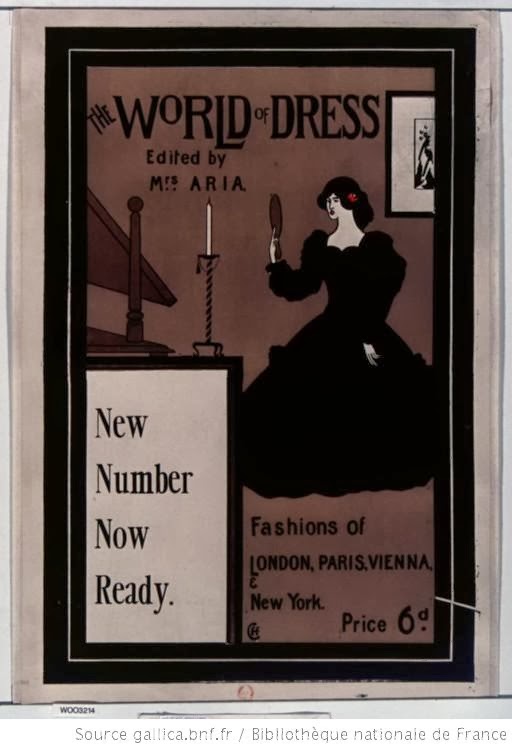
The World of Dress

"It is merely a question of head," said Percy Anderson to me one day, whilst we were discussing some easy method of solving a problem of fancy dress.
And he continued:
"Indeed, I would say that, broadly speaking, of all costume. The fashion of any period is distinguished primarily by the way its wearer dresses her hair.
"And chooses her sleeves," I suggested, and received his approval. 
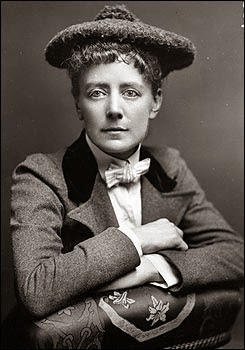
Thus begins Mrs Aria and Percy Anderson’s Costume: Fanciful, Historical, and Theatrical (1906). Who better to speak on the subject of costume than the gossip columnist and editor of the World of Dress, Mrs Aria, a.k.a. Eliza Davis.

Because clothes are so fascinating, I’ve gone off on this wonderful tangent into late-Victorian fashion magazines, but I actually came across Davis through a more solemn matter. Over the weekend, a friend complained that Oscar Wilde was anti-Semitic. I’ve encountered mutterings about his terrible attitudes before and do not intend to diminish any of them, but thought I would look for his anti-Semitism. What I found was an anti-Semitic passage in The Picture of Dorian Gray, which certainly makes Dorian seem like a bit of a jerk (but he’s supposed to be. That’s the point of how he lives his life.) but it doesn’t say much about Wilde’s own views. Secondary sources defend Wilde by becoming as horrid and cliche as possible: “But... but... but, Wilde had Jewish friends!” Then, I found Davis.

Davis writes a little about Wilde and his brother in her autobiography, My Sentimental Self (1922).
Both Oscar Wilde and Willie Wilde became frequent visitors, and in a public garden which spread its ill-kept lumpish lawn behind our dwelling we often played tennis together : Willie in a shirt showing some desire to be divorced from the top of his trousers, and Oscar in a high hat with his frock-coat tails flying and his long hair waving in the breeze.
Because Willie is the real focus of my research (not that you can tell by reading my blog), I forgot all about his younger brother and started looking into the life of his fashionable, ambitious, and gossipy friend.

Davis was Julia Frankau and Owen Hall’s sister, making the Davises a very writerly family. Her niece would later recall that Davis knew loads of literary icons and collected their autographs for her and her own siblings. Really, I think, Davis was poised for success as a gossip columnist.
Whilst I was working for Hearth and Home I conceived the notion that I must possess and edit a journal of my own. Thus came into existence the monthly magazine known as The World of Dress, destined of course to show all other editors how fashion papers should be conducted. 
Other than Davis’s own opinions of it, I’m unable to find much information on the World of Dress. As is the case with most woman writers of the period, more is written about her love affairs than her work. On the other hand, gossip is gossip and gossip was Davis’s business.
The World of Dress possessed many excellent features from many excellent sources. Fashion news from Paris, Vienna and New York, interviews about dress with famous people. Sir James Linton, Sydney Grundy, Max Pemberton, Mortimer Menpes, Downey, the royal photographer, and lastly and most amusingly Dan Leno gave opinions. Casually Dan Leno declared that he of all men best understood women's clothes because he had worn them for years; and he knew all about them from the inside; the property to secure more laughter for him than anything else in his mirthful career being an old wired bonnet, tapped on and tied with strings. Every time it came off he just tapped it on a different part of his head, and the audience roared.
As illustrated throughout her autobiography and her work on dress, Davis had a healthy sense of humour. Biographers have noted that she and her sister didn’t take shots at Wilde after his tragedy in 1895, but even defended him against the homophobia of their brother.

Margaret D. Stetz wrote a lovely short essay on the relationship between Wilde and the Davises. In an effort to return to what led me along this tangent in my research, I conclude with her thoughts:
In The Picture of Dorian Gray and elsewhere, Wilde produced caricatured portraits of Jews. But in later years, his Jewish literary contemporaries also drew portraits of him, sometimes favorable and sometimes not. What all these differing representations signify about the ‘true’ social attitudes and personal views of those who populated the cosmopolitan artistic circles of late-Victorian London remains a mystery even deeper than the question of why Basil Hallward’s painting of Dorian aged and changed. 
Follow me on Twitter @TinyApplePress and like the Facebook page for updates!

Monday, February 10, 2014

Sherlock, the Bully.


It turns out the first actor known to play Sherlock Holmes was also a jealous bully.

Charles Brookfield
Charles Brookfield was an actor, playwright, and journalist with the Saturday Review. Often English satire was all in good fun and could happen between friends, as it did with Arthur Conan Doyle and James Barry. This, however, was not the case when Brookfield wrote a satirical production of Lady Windermere’s Fan.

Brookfield was jealous of Wilde’s success. His parody, Poet and Puppets, was well received at the Comedy Theatre in 1892. Much to his disappointment, Wilde was even amused. Merlin Holland calls Brookfield’s jealousy “envy,” but either way Wilde seemed completely oblivious.

The title, Poet and Puppets, was originally a headline in the Daily Telegraph for a letter Wilde wrote, denying the paper’s earlier assertion that he said actors were puppets to the playwright. Wilde even got to listen to a reading of the parody before it went on stage and only objected to a single line. As H.E. Glover later recalled:
while cigars were burned, the poet puffed, and punctuated each page as it was read with such phrases as ‘Delightful!’ ‘Charming, my old friends!’ (His calling Brookfield ‘old friend’ was touching.) ‘It’s exquisite!’ etc. etc. As he showed us to the door he just gave us this parting shot: ‘I feel, however, that I have been - well - Brookfield, what is the word? - what is the thing you call it in your delightfully epigrammatic Stage English? eh? Oh, yes! - delightfully spoofed.’
I can’t help feeling a huge sense of betrayal on behalf of Wilde, as his brother was a writer for the Daily Telegraph and had written a terrible review of Lady Windermere’s Fan for the paper, and Wilde had no idea about the level of animosity building up in Brookfield. Both Brookfield and Wilde’s own brother would betray him during his infamous trials.

Oscar Wilde is standing. His brother, Willie, sits on right.
By the time Wilde’s trials were getting under way, Wilde had even given Brookfield a small part to play in An Ideal Husband. It was at this time that Brookfield pointed an investigator in the direction of a male prostitute with damning evidence on Wilde.

The list of actors who played Sherlock is long and one from which Brookfield is often omitted, giving the honour of playing the first Sherlock to William Gillette in 1899. Brookfield began playing Sherlock on 25 November 1893 at the Royal Court Theatre in a musical parody called: Under the Clock. Seymour Hicks played Watson. The production lasted for 75 shows, plus one final matinee at a different theatre. According to Amnon Kabatchnik:
Photographs of the era depict Brookfield's Holmes in black tights with a short striped cape over his shoulders, a stubby beard, a thick moustache, and rumpled hair. Seymour's Watson sports a monocle on his right eye, a black high collar around his neck, a pirate's cap on his head, eyebrows that are darkened toward the center and arched to touch the nose, and lips uplifted and highlighted in the middle.
Sadly, I'm unable to locate these photographs and the whole production made Conan Doyle mad.

Brookfield and Hicks used the characters of Holmes and Watson to shoot down other actors, most notably Herbert Beerbohm Tree. The Theatre monthly magazine shot back: “Taunts like these, leveled at Mr. Tree and others, are as cheap as they certainly are nasty. . . .People who want fun instead of a malicious chuckle will find under the clock not exactly to their taste.”

History has found Brookfield not exactly to its taste. Ineffectual bullies don’t keep anyone’s attention for long, though I imagine that Brookfield got along just fine with Wilde’s bullying older brother. Both have left legacies of petty jealousy and pathetic attempts to manipulate and “get back” at the often-oblivious objects of their contempt.

Follow me on Twitter @TinyApplePress and like the Facebook page for updates!

Tuesday, January 7, 2014

Thank You for a Wonderful Year!


A year ago today, I started this blog with my first post: American Cigarettes. I was and still am doing research for my book. A few days earlier, at the library for the University of Akron, I came across what instantly became my favourite Wildism.
I am greatly distressed to hear you and the fascinating Dan are smoking American cigarettes. You really must not do anything so horrid. Charming people should smoke gold-tipped cigarettes or die, so I enclose you a small piece of paper, for which reckless bankers may give you gold, as I don't want you to die.
Posting that was on of those “Dear Internet” moments. I was reaching out through my computer screen, hoping to find someone else as interested in the same things I was.

That first month wasn’t my most prolific writing month, but I wrote more posts in January 2013 than I have since because I started to realize that the opportunities a blog affords a distractible writer, like myself. I wanted to entertain and engage you, so that I could have someone to talk to about my research, but in talking to you I also wanted feedback. Feedback I got!

In a year, I’ve only got 31 comments out of over 14,700 page views, but I couldn’t tell you how many hundreds of emails I received - helpful emails too, emails that led me to make corrections to my posts and emails that led me to follow up certain posts with more detailed explanations of the subject matter. For example, I found an American trade card that depicted Oscar Wilde selling corsets for Warner Brothers, who I associated with movies. Thanks to your feedback I found a pair of much more interesting Warner brothers.


Also on the subject of Wilde and fashion, I got feedback via email about a book I wanted to read from the author! Oscar Wilde on Dress is now also available in a Kindle edition through Amazon and posting a review of this book is a priority for me in the coming year for this blog!

After a year, my all-time most popular post is The Ten Best Restaurants in London, which, of course explores the restaurants of the 1890s. In writing this, I was trying to get a sense of place because restaurant dining was a highly popular form of socializing and Oscar Wilde's family ate out on credit more often then they ate at home, even though they had a cook at home.

This month, my most popular posts are: Being Irish in Victorian London, a post that was promoted by the Irish Literary Society on Twitter; Weirdest Cameras of the 1890s, which looks at spy cameras (I was thinking about using a camera in my book, but decided against it and still couldn't stop looking at cameras from the period); and How to Flirt Like a Victorian. On that last post, I've since decided that Victorians probably didn't use those guides. They are just too silly!

After a year, I want to thank everyone, who has helped me with my research, and while most of you know about my research tangents, few of you know what my project really is - just the areas I’m interested in.

I’m writing a novel, historical fiction. While many of my posts are simply interesting tangents for me, many test out ideas about the history that I actually want to use in my book. In one post, I actually struggle with how I’m going to portray my narrator, but don’t actually give you her name. It’s Lily de Mattos, formerly Lily Wilde, born Sophia Lily Lees. I’m researching all of these writers because I want Lily to tell the story of her time as part of the Wilde family, but it’s more complicated than that.


I got the idea for this novel, when a dear friend of mine died of alcoholism, which is how Lily’s first husband, Willie Wilde, dies, but it’s more complicated than that.

I’m researching all of these writers because they are people that Lily would have met, as Oscar Wilde’s sister-in-law, and I’m using her narrative to explore the question of why, as writers, we write what we write.

So, if you were wondering, that is why I write this blog. That is why I’m obsessed with the 1890s. I’m using Lily’s life in the 1890s and the experiences of all these writers to understand my own life and my own experiences - not just the writers, but the culture around them that informed their lives and, at times, even encouraged them to drink themselves into an early grave.

It sounds miserable and sad, but I think my research demonstrates that it can also at times be very strange, very funny, and a lot like life today. Thank you for all the support you have shown me and please, keep commenting, sending emails, correcting me, and sharing any new information that you think I might find useful.

As always:

Follow me on Twitter @TinyApplePress and like the Facebook page for updates!

Wednesday, December 25, 2013

100 Random Things about Oscar Wilde

In honour of this being my 100th post, I’m sharing 100 things you probably didn’t know about Oscar Wilde. If you knew any of this stuff keep track of how many points you get. Your score should be out of 100. Leave your result as a comment. If you have more Wildean wits about you than I did when I started this list, I’ll have your email address and can contact you in the future, if I have any questions! (Just kidding, sort of.)


1. “The optimist sees the donut, the pessimist sees the hole.” At different points in his life, Wilde comes across as pessimistic and optimistic. His writing style, his critique of his contemporaries, and his ability to laugh at the world around him combine to indicate that he was a realist.

2. One of his greatest gifts was the ability to smile at his own misfortune.

3. Wilde was raised Anglican and Catholic. In college, he became infatuated with the Catholic Church, but did not become a convert until the end of his life. I found an interesting Catholic interpretation of his life on CatholicEducation.org

4. “I never change, except in my affections.” Wilde only dreamt of being able to live this way. His writing sympathized with a common longing for eternal youth and the ability to always remain the same. In practice, once you had Wilde's affection, you always had his sympathy. He had many life-long friendships.

5. Wilde lacked musical talent and never appreciated music, even during his Aesthetic period.

6. Wilde once claimed to never travel anywhere without his copy of Studies in the History of the Renaissance by Walter Pater.

7. Wilde visited Egypt, as a child, and was always fascinated by sphinxes.

8. Although the New York Tribune claimed Wilde’s teeth were “superlatively white,” he was embarrassed by his teeth, often spoke with his hand in front of his mouth to cover them, and eventually got dentures.

9. Wilde disliked idle conversation. “Conversation about the weather is the last refuge of the unimaginative.”

10. Wilde was a tremendously sensitive man, quite capable of indulging in self-pity, but usually only when he had genuine reasons to feel bad for himself. Moreover, he was just as affected by the hardships of others.

11. Wilde was clearly outgoing, but enjoyed privacy and was most productive as a writer when he was alone. Wilde got restless quickly, but always seemed to find himself quite entertaining.

12. Wilde’s ability to speed read and remember long passages has been attributed to an eidetic memory.

13. Wilde’s brother was a newspaper writer, so he often pokes fun at them.

14. Wilde was a very superstitious child, whose mother told him stories about macabre beasts. In the children’s books he wrote, as a father, his antagonists were generally friendly.


15. Wilde met Pope Piux IX, as an undergraduate in 1877.

16. Wilde became famous for his personality. After meeting Wilde at the Royal Court Theatre, Helena Modjeska once said, “What has he done, this young man, that one meets him everywhere? Oh yes he talks well, but what has he done? He has written nothing, he does not sing or paint or act - he does nothing but talk. I do not understand.”

17. In an unguarded moment, Wilde once told the 15 year-old daughter of a friend that if she were a boy, he would adore her. Her name was Aimée Lowther.

18. Wilde travelled extensively throughout Africa, Europe, and the United States.

19. Sex tourism was the most likely reason for Wilde's travel to Africa in adulthood.

20. Wilde's plays got mixed reviews from London theatre critics. One of his worst most vocal critics was his own brother.


21. Wilde feared nothing more than he feared God. The thought of eternal punishment was the one thing that prevented him from committing suicide, during his darkest moments, he told Vincent O’Sullivan.

22. The last gift Wilde gave to his two sons was a copy of Rudyard Kipling’s The Jungle Book.

23. Biographer, Neil McKenna says that Wilde wasn’t good at making a first impression and quotes Bosie, in The Secret Life of Oscar Wilde:
There is no charm in his elephantine body, tightly stuffed into his clothes - no charm in his great face and head of unselect Bohemian cast - save the urbanity he can adopt or the intelligence with which he can vitalise his ponderousness.
24. On holiday, Wilde enjoyed days spent paddling about in a “Canadian canoe.”

25. Wilde wasn’t good at horseback riding.

26. Wilde loved dirty French novels. His love of them almost ruined a British publication.

27. Some say Wilde is the most quotable author of all time, but he once drew a blank when someone asked him what his motto was.

28. Wilde kept a vase of flowers on his writing desk to neutralize the smell of his ashtray.

29. The only time Wilde wasn’t self-conscious about his appearance was when he was playing with his children.


30. Wilde was born at 21 Westland Row, Dublin, which is now the home of the Oscar Wilde Centre, Trinity College.

31. When Wilde published the Happy Prince and Other Tales in May 1888, the Anthaeum compared him to Hans Christian Anderson, which was a far cry from the reputation he had carefully crafted for himself.

32. If you met him and he liked you, Wilde would probably give you a cigarette case.

33. Growing up, Wilde had three pet names: “Ossie” with his family, “Grey Crow” at school, and “Hosky” at Oxford.

34. Wilde had a hard time saying no when asked for money.

35. Wilde’s favourite drinks were brandy and absinthe.

36. The Wildes had servants to cook and clean, but usually ate meals on credit at the hotel.

37. Wilde had five siblings: William 'Willie' Charles Kingsbury Wilde; Isola Francesca Emily Wilde, who died as a child and broke Wilde’s heart; his half-sisters - Emily and Mary Wilde; and his half-brother, Henry Wilson.


38. Early biographers look at the above childhood photo of Wilde dressed in frills and suggest that his mother wanted him to be a girl, thus arousing Wilde’s interest in men, but this was not true in anyway. In mid-nineteenth century Ireland, boys were traditionally dressed as girls to protect them from the dred due, a kind of blood-thirsty fairy, who abducted little boys, but ignored little girls. Wilde’s mother adored old Irish myths and legends, almost as much as she adored her little boys.

39. Wilde had as many female friends as he did male friends and, in fact, was an important contact for female writers in the 1880s.

40. For Christmas 1877, Wilde gave his girlfriend, Florence Balcombe, a small gold cross.

41. The executor for the estate of Oscar Wilde was a Canadian, Robert Ross.

42. Ross is also responsible for bring Wilde back into popularity with his 1908 edition of Wilde’s collected works.

43. Ross worked tirelessly to protect Wilde’s work, after Wilde was gone. This included fighting the rampant black market trade in erotica that was published falsely under Wilde’s name.

44. Wilde often claimed to be two years younger than he was and even lied about his age on his marriage certificate.

45. Wilde never enjoyed competitive sports, but he liked athletes.

46. Wilde tested out his clever maxims in conversations before putting them in his writing.

47. Wilde frequently suffered from writer’s block.

48. Wilde enjoyed sentimental friendships more than romances.

49. After he finished school, Wilde made money lecturing on aesthetics.

50. Wilde’s American tour was funded by Gilbert and Sullivan.


51. One of Wilde’s first impressions of America was that American men “seem to get a hold on life much ealier than we do.”

52. The hardest decision Wilde ever made was probably the decision not to flee to Paris before his trials were over. Even the judge expected him to do it. His family talked him out of it, specifically his mother and brother.

53. Wilde began writing the Sphinx in 1874 and spent many years working on it. He finally published it in 1894.

54. In the beginning, Wilde was uncertain how to go about publishing his poetry, so he wrote to the PM and asked for help, assuming, correctly, that an Oxford boy would not be ignored. “I am little more than a boy,” Wilde wrote and Gladstone wrote back, suggesting his send his poetry to the Spectator. Wilde followed this advice and was met with success!

55. Wilde’s father was a polymath.

56. Wilde spent money as fast as he got it.

57. Before and after they were married, Wilde borrowed money from his wife’s brother.

58. Wilde’s wife, Constance was a writer in her own right and had her own income.

59. In the 1880s, Wilde and Constance held seances at their house on Tite Street.

60. Their home on Tite Street was called “House Beautiful.”

61. After Wilde’s release from prison, when he had moved to Paris, his wife wrote to him that, if she ever saw him again, she would forgive anything.

62. In the Importance of Being Earnest, Wilde based the character, Algernon, on his brother, during a time when they were trying to get along better.

63. Wilde hated his brother, Willie, but often gave him money.


64. While he was in jail, Wilde’s brother pawned or sold most of his favourite things, including his famous fur coat.

65. His parents probably met through a book review. His mother wrote one for his father’s book, The Beauties of Boyne and Blackwater.


66. Wilde wrote reviews for books by lesser known authors. These were published in the Gazette.

67. Wilde’s favourite occupation was reading his own sonnets.

68. They say that people often criticize the character traits that they see as most problematic in themselves. Wilde despised “Vanity, self-esteem, [and] conceit,” but admired the “Power of attracting friends.”

69. Wilde enjoyed writing letters to the editor.

70. Wilde’s favourite actor was Henry Irving.

71. “Ivory” was one of Wilde’s favourite words.

72. “Quite charming” was one of his favourite phrases.

73. Bathing was Wilde’s favourite ritual.

74. If you made it this far, you probably know that Wilde’s favourite colour was green, but might not know that he hated mauve and magenta.

75.. In the Picture of Dorian Gray, Wilde bases the character of Basil on his real-life artist friend and rival, James Whistler.

76. Max Beerbohm characterized Wilde with this list of words:
Luxury - gold-tipped matches - hair curled - Assyrian-wax statue - huge rings - fat white hands - not soignée - feather bed - pointed fingers - ample scarf - Louis Quinze cane - vast Malmaison - cat-like tread - heavy shoulders - enormous dowager - or schoolboy - way of laughing with hand over mouth - stroking chin - looking up sideways - jollity overdone - But real vitality…Effeminate, but vitality of twenty men, magnetism - authority. Deeper than repute or wit, Hypnotic.
77. Wilde probably had sex with Walt Whitman once, but preferred beardless men.

78. Wilde was bisexual.

79. With men, Wilde was a top.

80. Not only did Wilde love women, he liked women too. He enjoyed them socially and found them both attractive and intelligent.

81. Wilde adopted the name Sebastion Melmoth, after prison. Sebation was a martyr. Melmoth is from Melmoth the Wanderer (1820), a novel by his great-uncle that bears some similarities to the Picture of Dorian Gray.

82. Wilde often ate seafood for breakfast, but that was a common upper-class Victorian habit. Victorians were weird.

83. Wilde was 6’3” and got his height from his mother, who was approximately six feet tall.


84. A lot of people considered him fat. Laura Troubridge wrote in her diary in 1883: “Went to a tea party at Cressie's to meet the great Oscar Wilde. He is grown enormously fat with a huge face and tight curls all over his head - not at all the aesthetic he used to look.” And Adrian Hope wrote in 1887: “O.W. was at the Lyric Club, fat and greasy as ever and looking particularly revolting in huge white kid gloves.”

85. Later in life, Wilde considered his aestheticism to have been something of a phase.

86. He spoke the way he wrote. William Butler Yeats couldn’t believe it: “My first meeting with Oscar Wilde was an astonishment. I never before heard a man talking with perfect sentences, as if he had written them all overnight with labor and yet all spontaneous.”

87. When the Savoy Hotel introduced hot and cold running water, Wilde wasn’t pleased. He was happier having someone bring him his water.

88. Wilde called white wine yellow because his friend Robert Sherard once pointed out to him that white wine really isn’t white at all.

89. Wilde was once infatuated with the actress Lillie Langtry, but denied buying a lily daily and walking it over to her home as a gift.


90. Much like the contemporary sociologist, Zygmunt Bauman, Wilde thought that jealousy in a marriage was “closely bound up with our conceptions of property” and “an extraordinary source of crime in modern life.”

91. In 1880, Wilde proposed to Charlotte Montefiore. When she refused, he wrote: “Charlotte, I am so sorry about your decision. With your money and my brain we could have gone far.”

92. Wilde slept with a female prostitute in Paris in 1883. His friend, Robert Sherard wrote about it. Afterwards, Wilde remarked: “What animals we are, Robert!”

93. Wilde almost certainly never had syphilis.

94. Wilde’s first kiss was from a boy he went to school with at Portura. They were saying good-bye at a railway station. He was sixteen years-old.

95. Wilde lied about his early school years in an interview with a journal called Biograph, when he was 26 years old. Nobody is sure why. Portura was a good school.

96. Wilde first described his future wife in a letter to Waldo Story as “quite young, very grave and mystical, with wonderful eyes, and dark brown coils of hair.... We are, of course, desperately in love.” Proof that at least one British postman was able to find Waldo!

97. Though Wilde didn’t see his wife again, after he left prison, they never got divorced.

98. Fatherhood inspired much of Wilde’s work. He took the job as editor of Woman’s World because he had a family to support. He wrote children’s stories because he had children to tell them to. Wilde loved being a father.

99. Wilde wrote in ink and edited in pencil.

100. There’s no evidence that Oscar Wilde ever said: “Be yourself; everyone else is already taken.”

Follow me on Twitter @TinyApplePress and like the Facebook page for updates!