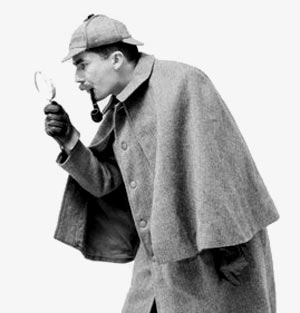
Showing posts with label Sherlock Holmes. Show all posts

Monday, February 23, 2015

Sherlock Holmes and Batman as Aspirational Superheroes


Some people reject the notion of Sherlock Holmes as a superhero because Arthur Conan Doyle's books weren't science fiction, or fantasy. The original character possessed qualities that were within the realm of human possibility, thus making him an aspirational figure. Then again, some people hate superheroes. Those people immediately have something in common with super villains, but that's another story. I love superheroes and argue that Sherlock Holmes most certainly was and always has been a great one.

Wikipedia defines a superhero as:
...a type of heroic character possessing extraordinary talents, supernatural phenomena, or superhuman powers and dedicated to protecting the public.
Sherlock Holmes was/is dedicated to protecting the public. He even has an archenemy. His powers now seem completely within the realm of human possibility, but so do Batman's.

In the 1890s, Sherlock Holmes' powers were most certainly science fiction. His, fortunately, was a case of life imitating art.

When Conan Doyle invented Sherlock Holmes in 1887, police relied on rudimentary evidence and witness testimony to solve criminal cases. There's no way Jack the Ripper would still be a mystery today if police still relied on those techniques and the public was beginning to chalk the lack of science up to police incompetence, but they didn't know it was the science that police were missing.

In many ways, modern science was still being invented and could be viewed as an 1890s gentleman's pursuit, one that Conan Doyle's detective was adept at in ways that no one had ever imagined. In addition to his incredible powers of observation, Sherlock Holmes used chemistry to solve crimes. His methods were aspirational and inspired the first generation of forensic scientists.


Catching a murderer through a blood stain was as unfathomable in 1887 as Batman's collapsable jet-skates were in 1967. Unfortunately, the crime solving applications of Batman's jet-skates are still unfathomable, but when we get there, some people may try to argue that Batman's not a superhero either.

Follow me on Twitter @TinyApplePress and like the Facebook page for updates!

If you have enjoyed the work that I do, please support my Victorian Dictionary Project!

Wednesday, October 29, 2014

Jack the Ripper in Popular Culture

Jack the Ripper is the most legendary terror of late-Victorian London. I've written about him before, and it's the legacy that the ripper case left upon the imagination that fascinates me the most.

If the Ripper Case didn't actually invent crime journalism and detective fiction, it certainly changed the shape of them. Jack the Ripper was the first serial killer to attract worldwide media attention, which was, in part, due total reforms that enabled the wider circulation of inexpensive magazines and newspapers, including the Illustrated Police News.

The Illustrated Police News, 15 September 1888.
"Whatever information may be in the possession of the police they deem it necessary to keep secret ... It is believed their attention is particularly directed to ... a notorious character known as 'Leather Apron'." - Manchester Guardian, 6 September 1888.
'Leather Apron,' 'Jack the Ripper'... adopting a nickname for a murder suspect became standard media practice with these words, and would soon be followed by 'the Axeman' of New Orleans, 'the Boston Strangler,' 'the Düsseldorf Ripper,' and many others.


Public frustration with the inability of the police to solve the case opened the public's hearts to freelance detectives, like Sherlock Holmes and Sexton Blake. The public obsession with this horrifying unsolvable mystery directly captured the imagination of writers as well.

Fiction that was directly inspired by the case began to appear as soon as October 1888. John Francis Brewer wrote a short gothic novel that featured the murder of Catherine Eddowes, The Curse Upon Mitre Square (1888). These stories immediately had an international appeal because the whole world was watching London for clues at the time.

The Spanish-language 'Jack El Destripador' was published soon after the murders, and sent a comedic version of Sherlock Holmes after a similar killer.


Indirectly, Jack the Ripper influenced the popularity of other works, like Dracula, which definitely gained popularity through the public's obsession. But in terms of those that dealt most directly with Jack the Ripper, Marie Belloc Lowndes' 'The Lodger' (1913) was the most influential work. In this novel, Mr. and Mrs. Bunting suspect their lodger is a wanted serial killer, called "the Avenger." Alfred Hitchcock adapted the story to film, and the theme became as popular as Holmes versus the Ripper.

Today there are hundreds of books that try to solve the mystery, and works of fiction that still feed a public interest in the story. Lowndes' novel has been made into five films.

The movie Time After Time (1979) lets Jack the Ripper escape from 1890s London to 1970s San Fransisco, followed in hot pursuit by H.G. Wells.

And Jack the Ripper made it into comic books.


And of course, Ripper Street, the TV series.

In 2011, Madame Vastra from Doctor Who claimed to have eaten Jack the Ripper. As you can see (in the picture below), the construction of Madame Vastra's character is partially built on a framework, pre-established by Sir Arthur Conan Doyle.


Throughout October 2014, I will be sharing the halloween-themed stories of 1890s London. Check back often!

Follow me on Twitter @TinyApplePress and like the Facebook page for updates!

If you have enjoyed the work that I do, please consider supporting my Victorian Dictionary Project!

Tuesday, June 17, 2014

Sherlock Holmes and Retired Copyright

Thanks to a legal battle between author, Leslie Klinger, and the estate of Sir Arthur Conan Doyle, the tales of Sherlock Holmes are now in the public domain. What does that mean?


Works are moved from their protective copyright status to the public domain to balance the public’s interest in open access with the property interest of copyright holders. Overwhelmingly, works in the public domain are so old that their intellectual property rights are no longer applicable. Most of the works discussed in this blog are part of the public domain because enough time has passed since they were first published. Likewise, most of the Sherlock Holmes stories were already in the public domain before Klinger took the estate to court.

Sherlock Holmes became a literary sensation in the 1890s, the thirst for which didn’t dry up when the decade ended. To feed public demand, Conan Doyle continued writing and publishing Sherlock Holmes mysteries until 1927. While most of the Sherlock Holmes canon was moved into the public domain, appearing on public domain web sites, like Project Gutenberg, stories published between 1923 and 1927 were still protected under US copyright law.

The legal status of these last ten Sherlock Holmes stories complicated the legal status of the rest of the Sherlock Holmes stories because characters in fiction are part of a work’s intellectual property. When Klinger published his previous books, inspired by Conan Doyle, she had to pay a fee to his estate. Upon the publication of her second book, she decided to challenge the copyright status and won, thereby moving the complete set of Sherlock Holmes stories into the public domain.


These controls over intellectual property influence the portrayal of characters, who have become classic tropes throughout literature and film. For instance, the Bram Stoker estate tried, but failed to maintain the kind of control over portrayals of Dracula that Conan Doyle’s estate maintained over Sherlock Holmes. As a result, we see rich and varied interpretations of Dracula’s character in literature and film dating back to the 1920s. Conan Doyle’s heirs previously controlled and restricted the ways in which Sherlock Holmes could be interpreted. It will be fascinating to see what happens next!

Follow me on Twitter @TinyApplePress and like the Facebook page for updates!

Monday, March 10, 2014

Spy Cameras & Blackmail

The Victorian sensation novel is evidence that Victorians loved intrigue as much as we do, with all of our murder-mystery television series. The 1890s saw the birth of the forensic sciences at the root of those shows, through the media sensationalism around Jack the Ripper and the popularity of genius detective, Sherlock Holmes.

Jack the Ripper and Sherlock Holmes encouraged widespread mistrust of the police and made many people want to take matters into their own hands by becoming private detectives. As you might have seen in my post on the weirdest cameras of the 1890s, the evolution of photography was ready to appeal to their meddling needs.

Many ads were innocent enough, but others deliberately encouraged customers to spy on people. Marion’s Parcel Camera advertised that:

This Camera is made box-shaped and neatly covered with brown linen-lined paper, and tied with string like an ordinary parcel, of which it has the exact appearance. The object is to disguise its real use, and to permit a Photograph to be taken without raising the slightest suspicion.
Anthony's Patent Satchel Detective Camera illustrates how these devices worked and were evolving.


Conspiratorially, the Labouchere Amendment of 1885 made it easier for the courts to punish male homosexuals, in contexts where anal intercourse could not be proven. Most famously, Oscar Wilde was convicted under this law in 1895. In the years leading up to his trial, he and his friends were tormented by blackmailers. His Tite Street house was even broken into twice, presumably by people looking for further evidence of his affairs.

Photographs weren’t used in Oscar Wilde’s trial, but the years that followed would see a rise in photos taken with the intent of incriminating participants in seemingly private acts.


In 1920, a twenty-year-old actress, called May Levy, was used as bait to ensnare John Blake in a blackmail scheme. Blake recalled hearing a suspicious click in her bedroom, which turned out to be the noise from a camera taking a picture.

In another instance, where no photos were used, a young man name John Richardson propositioned another young man in 1887. Richardson blackmailed his victim by threatening to charge him with assault and followed him to the shop, where he pawned his watch in payment. Both youths were sentenced to ten years.

I can’t be sure how prevalent photographic blackmail was in the 1890s. Court records are difficult for me to access and many cases would have never made it to court for obvious reasons. Between the Labouchere Amendment and spy-camera technology, homosexuals would have been particularly vulnerable. Historian, Angus McLauren, who I once had the honour of taking a course with, summarizes the complex roles of blackmailers and their homosexual victims in fin de siécle London and New York.
Homosexual blackmail trials performed a variety of functions. They were used by the defenders of bourgeois respectability to depict the horrific fate of both the extortionist and the man who had been so incautious as to fall into his snare. In fin de siécle London and New York judges told men as well as women that they had to be wary of strangers, in particular young men. The press reported miscreants who threatened to charge men with “infamous crimes” and the courts dealt openly with accusations of sodomy, yet in generally asserting that the extortioners’ threat was not only illegal but untrue, judges sought to make it known that they had no intention of protecting perverts. The courts and the press careful tried to avoid using blackmail cases to explicitly discuss same-sex passions, while they implicitly warned the adventurous of the dangers of giving way to temptation. Interestingly enough, the court and press reports did not suggest that dangerous youths would necessarily appear effeminate; the stereotyped “homosexual” had not yet fully emerged. Yet because the accused included male prostitutes, the trials no doubt confirmed the popular notion of the homosexual as villainous blackmailer.
If you weren’t inside the circle of targeted victims, as Wilde was, an 1890s onlooker couldn’t have possibly understood the dangers and vulnerability of the love that dare not speak its name, when looking at an ad for a Demon Camera.


Follow me on Twitter @TinyApplePress and like the Facebook page for updates!

Monday, February 17, 2014

Sherlock vs Creationism

While procrastinating on actually writing my book, I've been watching documentaries that trace the origins of forensic science to Sherlock Holmes and Dr. Joseph Bell. I also watched the Bill Nye/Ken Ham debate, which lead me to the conclusion that creationists must be opposed to forensic science.


I have to come at this from two directions, so I will begin with the one most closely related to the subject of my blog.

The documentaries: Sherlock Holmes: the True Story demonstrates the ways in which Dr. Bell (the man who inspired Sherlock's character) was, in real life, the first forensic scientist - and actually used his skills to help police solve crimes! And Sherlock: the First CSI shows us that forensic scientists, since Dr. Bell, have been inspired by the books! If you know who Sherlock Holmes is or what forensic science is, you probably have some idea about how science can help us prove a person is guilty of a crime - even when they swear they are innocent!


During the debate, Ham uses the term 'witness' an awful lot and treats the Bible as a witness's statement. "We weren't there to see what happened, so we could be wrong," says Ham repeatedly. He also repeatedly uses the term 'historical science' to describe Nye's approach. He further differentiates between historical science and observational science.

The term 'historical science' doesn't refer to a documented record of epic moments in science history, though that would be cool. It refers to science that attempts to make claims about the past, like geology and evolutionary biology. These are sciences that try to reconstruct the past. When talking about historical and observational science, Michael Weisberg puts it best:
The main difference is simply that historical sciences like geology and evolutionary biology try to reconstruct the past, while other sciences like chemistry aren't especially concerned with any particular time period.
Modern sciences that concern themselves with a particular time period are integral to our legal system and called forensics. The fictional Sherlock Holmes used chemistry to test blood stains, even when he had witnesses, who claimed to have seen what happened, but were actually guilty of committing the crime. By Ham's logic, the witness provides a more reliable testament to what transpired on a crime scene than the blood on the floor. The creationist case against historical science means they can't accept the results of a DNA test any more than they can the existence of fossils because it is historical science that investigates what happened within a particular time period. Creationists, therefore, must hate Sherlock!


To Tania Lombrozo, who blogged Weisberg's excellent explanation above, the crux of the debate was about the basis of belief, "including the role of evidence versus revelation." Essentially, creationists are suffering from a very Victorian fear, one that Charles Darwin struggled with himself, that God might disappear in a puff of logic.

Here's where I wish that historical science was more about the history of science and less about trying to convince children that science is a bunch of hookum. Last month, I wrote a series of posts on the spirituality of writers in the 1890s. What was so striking about that period in science was how Victorians tried to use science to prove or disprove spiritual claims. Research has been done into the science of having a religious experience and that research has provided an array of explanations for an array of different religious experiences, but, at the time, I found the investigation in to psychics more entertaining (I kinda still do).


The Society for Physical Research was founded in London in 1882, "to approach these varied problems without prejudice or prepossession of any kind, and in the same spirit of exact and unimpassioned enquiry which has enabled science to solve so many problems, once not less obscure nor less hotly debated." W.B. Yeats and Arthur Conan Doyle were both members. The Society disproved one fraud after another.

The Society's track record in the 1890s alone should be enough to strike fear into the heart of anyone promoting spiritual beliefs as science, which might be why creationists recoil from conventional science and are building their own institutions. I'm sorry. I don't mean to suggest that creationist museums will be infiltrated by the Society any time soon. The Society does still exist, but I hadn't heard of them until I started investigating spiritualist frauds and the writers who loved them. Like most Christians of their era, they were searching for ways to reconcile their spiritual beliefs with science.


Really, I'm tired of people talking about science's threat to Christianity. Like Nye, I'm more concerned about the creationist threat to curiousity. Members of the Society believed in all kinds of things (Conan Doyle even believed in fairies), but scientists in the 1890s had curious enough minds to put their beliefs to the test, rather than hiding them so close to their heart that no one could touch them. But, I'm not being fair to creationists, when I glorify the attitudes of my favourite Victorians in the 1890s.

The Fundamentalist Movement was founded in the United States in 1878 and succeeded in getting the teaching of evolution banned from US public schools by the 1920s. Their campaign rode on the shoulders of the anti-German sentiment of the First World War: "The same science that manufactured poisonous gases to suffocate soldiers is preaching that man has a brute ancestry and eliminating the miraculous and the supernatural from the Bible."

Books, like Headquarters Nights (1917) and Science of Power (1918), strove to link Darwinism with Germany. To me these books should be part of the history of conspiracy culture. I like that Conan Doyle wanted Sherlock to take on the Germans too and published His Last Bow in the Strand in September 1917.

Written during the third year of WWI, His Last Bow is set in August 1914 and is crafted as a bit of war propaganda. In it, Sherlock is able to provide German intelligence to the English government before retiring from detective work to keep bees. Ironically, when Dr. Bell retired he also became an etymologist specializing in Bees, but that is another story. His Last Bow finishes with a bit of poetic patriotism.
"There's an east wind coming, Watson." 
"I think not, Holmes. It is very warm." 
"Good old Watson! You are the one fixed point in a changing age. There's an east wind coming all the same, such a wind as never blew on England yet. It will be cold and bitter, Watson, and a good many of us may wither before its blast. But it's God's own wind none the less, and a cleaner, better, stronger land will lie in the sunshine when the storm has cleared."
That sentiment of growing stronger through adversity is what is missing from creationism. To me, a curious and intelligent mind is one that is not afraid to have its opinions and beliefs changed. Sherlock wouldn't have got very far if he began every case with a preconceived notion of who the killer was or just took the witness's word for what had happened. Stories written, like that, wouldn't have captured anyone's interest or inspired chemists to improve blood tests for toxic substances.

The appeal of Sherlock Holmes is that he's kind of like a superhero, but he doesn't have any magical powers, which means that we don't have to be from another planet of bitten by a toxic spider to get as powerful as he is! If we read enough, if we learn enough, if we are observant and conduct a lot of experiments, we might get as smart and powerful as Sherlock!

The danger of not nurturing curious minds is that we won't have as many new advances in forensic science or medicine. Heck, we might even be raising future law enforcement that thinks a witness's statement is more reliable than the smoking gun in her hand.

I'm going to go back to my writing now and will try not to watch so much TV.

Follow me on Twitter @TinyApplePress and like the Facebook page for updates!

Monday, February 10, 2014

Sherlock, the Bully.


It turns out the first actor known to play Sherlock Holmes was also a jealous bully.

Charles Brookfield
Charles Brookfield was an actor, playwright, and journalist with the Saturday Review. Often English satire was all in good fun and could happen between friends, as it did with Arthur Conan Doyle and James Barry. This, however, was not the case when Brookfield wrote a satirical production of Lady Windermere’s Fan.

Brookfield was jealous of Wilde’s success. His parody, Poet and Puppets, was well received at the Comedy Theatre in 1892. Much to his disappointment, Wilde was even amused. Merlin Holland calls Brookfield’s jealousy “envy,” but either way Wilde seemed completely oblivious.

The title, Poet and Puppets, was originally a headline in the Daily Telegraph for a letter Wilde wrote, denying the paper’s earlier assertion that he said actors were puppets to the playwright. Wilde even got to listen to a reading of the parody before it went on stage and only objected to a single line. As H.E. Glover later recalled:
while cigars were burned, the poet puffed, and punctuated each page as it was read with such phrases as ‘Delightful!’ ‘Charming, my old friends!’ (His calling Brookfield ‘old friend’ was touching.) ‘It’s exquisite!’ etc. etc. As he showed us to the door he just gave us this parting shot: ‘I feel, however, that I have been - well - Brookfield, what is the word? - what is the thing you call it in your delightfully epigrammatic Stage English? eh? Oh, yes! - delightfully spoofed.’
I can’t help feeling a huge sense of betrayal on behalf of Wilde, as his brother was a writer for the Daily Telegraph and had written a terrible review of Lady Windermere’s Fan for the paper, and Wilde had no idea about the level of animosity building up in Brookfield. Both Brookfield and Wilde’s own brother would betray him during his infamous trials.

Oscar Wilde is standing. His brother, Willie, sits on right.
By the time Wilde’s trials were getting under way, Wilde had even given Brookfield a small part to play in An Ideal Husband. It was at this time that Brookfield pointed an investigator in the direction of a male prostitute with damning evidence on Wilde.

The list of actors who played Sherlock is long and one from which Brookfield is often omitted, giving the honour of playing the first Sherlock to William Gillette in 1899. Brookfield began playing Sherlock on 25 November 1893 at the Royal Court Theatre in a musical parody called: Under the Clock. Seymour Hicks played Watson. The production lasted for 75 shows, plus one final matinee at a different theatre. According to Amnon Kabatchnik:
Photographs of the era depict Brookfield's Holmes in black tights with a short striped cape over his shoulders, a stubby beard, a thick moustache, and rumpled hair. Seymour's Watson sports a monocle on his right eye, a black high collar around his neck, a pirate's cap on his head, eyebrows that are darkened toward the center and arched to touch the nose, and lips uplifted and highlighted in the middle.
Sadly, I'm unable to locate these photographs and the whole production made Conan Doyle mad.

Brookfield and Hicks used the characters of Holmes and Watson to shoot down other actors, most notably Herbert Beerbohm Tree. The Theatre monthly magazine shot back: “Taunts like these, leveled at Mr. Tree and others, are as cheap as they certainly are nasty. . . .People who want fun instead of a malicious chuckle will find under the clock not exactly to their taste.”

History has found Brookfield not exactly to its taste. Ineffectual bullies don’t keep anyone’s attention for long, though I imagine that Brookfield got along just fine with Wilde’s bullying older brother. Both have left legacies of petty jealousy and pathetic attempts to manipulate and “get back” at the often-oblivious objects of their contempt.

Follow me on Twitter @TinyApplePress and like the Facebook page for updates!

Thursday, October 10, 2013

Sexton Blake and the Penny Dreadful

 
I could here and there see the reflection of light from the window of some student, who was busy at his studies, or throwing away his time over some trashy novel, too many of which find their way into the trunks or carpet-bags of the young men on setting out for college. - William Wells Brown on his visit to Oxford in 1850.
Those were also the days of Edmund Gosse’s terrible childhood.
No fiction of any kind, religious or secular, was admitted into the house. In this it was to my Mother, not to my Father, that the prohibition was due. She had a remarkable, I confess to me still somewhat unaccountable impression that to 'tell a story', that is, to compose fictitious narrative of any kind, was a sin. - Gosse, Father and Son (1907)
In consequence of the stern ordinance which I have described, not a single fiction was read or told to me during my infancy. The rapture of the child who delays the process of going to bed by cajoling 'a story' out of his mother or his nurse, as he sits upon her knee, well tucked up, at the corner of the nursery fire—this was unknown to me. Never in all my early childhood did anyone address to me the affecting preamble, 'Once upon a time!' I was told about missionaries, but never about pirates; I was familiar with hummingbirds, but I had never heard of fairies—Jack the Giant- Killer, Rumpelstiltskin and Robin Hood were not of my acquaintance; and though I understood about wolves, Little Red Ridinghood was a stranger even by name. So far as my 'dedication' was concerned, I can but think that my parents were in error thus to exclude the imaginary from my outlook upon facts. - Gosse, Father and Son (1907)
Though Gosse was a child in the 1850s, his upbringing was a sign of things to come. By the 1860s, certain types of fiction were considered incredibly dangerous, especially the sensation novel. Drawing from gothic and romantic literary fiction, the sensation novel appealed to the uncultured masses through shocking themes, like adultery, theft, kidnapping, insanity, bigamy, forgery, seduction, and murder. Other than relying on shock and awe, sensation novels separated themselves from other more respectable genres by using common settings familiar to their poorer middle- and working- class audiences.


By the 1880s, the sensation novel was replaced by the ‘penny dreadful,’ known as ‘dime novels’ in the United States. Stanford's Dime Novel and Story Paper Collection celebrates the era, which “benefited from three mutually reinforcing trends: the vastly increased mechanization of printing, the growth of efficient rail and canal shipping, and ever-growing rates of literacy.”


I’ve always thought of these as serial novels, published in story-based (I hesitate to use the word literary) publications. Again, their low price made them accessible to the uncultured reading masses, filling their minds with the kind of trash Mother Gosse sought to protect her son from in the 1850s.

In the 1890s, the British newspaper and publishing magnate, Alfred Harmsworth, decided to take on the corrupting influence of the penny dreadfuls, but wound up creating the same thing for less: The Half-penny Marvel, The Union Jack and Pluck, all priced at a half-penny. A.A. Milne once said, "Harmsworth killed the penny dreadful by the simple process of producing the ha'penny dreadfuller." But Harmsworth made some thing wonderful happen.

Meet Sexton Blake, who, in the 1890s, was known as “the poor man’s Sherlock Holmes.” Though written by many hands (Harmsworth owned the rights), the first Sexton Blake story, “The Missing Millionaire,” was published on 20 December 1893 and really sought to capitalize on the popularity of Sherlock Holmes, who Arthur Conan Doyle was already getting tired of writing about.

Like Sherlock Holmes, Sexton Blake was a consulting detective operating out of Baker Street. Blake’s Watson is called Tinker, who didn’t appear until 1904 and is more like Batman’s Robin. Blake’s love interest is Yvone Cartier and his housekeeper is Mrs. Bardell. Blake is a little more clean-cut than Holmes, but is actually an educated medical doctor, like the real Sherlock Holmes.


The Sexton Blake franchise continued on through the 1960s and the official fan website calls for a revival in the 21st century.

So why was Sherlock Holmes considered literature, while Sexton Blake was considered trashy? My focus is on the 1890s, so I’m not going to comment on what might have happened to the franchise in the 20th century, but the fact that it actually was a franchise might have had something to do with it. Maybe having multiple authors had something to do with it? During my undergraduate degree, I took a class, in which we read novels of many shapes, my fellow students found that they had a lower opinion of what a book would be like, based on its shape. If it looked like a Harlequin romance book, they expected it to be trashy. They were often surprised by what they found inside. Maybe readers in the 1890s didn’t take Blake seriously because of the cheap quality of the publications?

Follow me on Twitter @TinyApplePress and like the Facebook page for updates!

Monday, July 29, 2013

The Adventure of the Two Collaborators

Victorians loved a good parody, as is evidenced by the success of Punch, which ridiculed just about everything that became popular or successful. Sherlock Holmes was both popular and successful in the 1890s, but Sir Arthur Conan Doyle was growing weary of his character and even tried to kill him off. Consequently, it comes as no surprise that the best parody of Sherlock Holmes won Doyle's approval.


The story is called "The Adventure of the Two Collaborators" (1893) and what surprised me is that it was written by J.M. Barrie, the author of Peter Pan (1909)! The origin of the story is rooted in a history of collaboration between the two authors. 

In 1892, Barrie suffered from a nervous breakdown, while working on his play, Jane Annie, and turned to his friend, Doyle for support. At this time, Doyle was a new father and he was considering killing off Sherlock Holmes, so that he might pursue a more serious form of writing. Writing for the theatre seemed like just the thing.

If you were wondering why you never heard of Barrie's play, Jane Annie, it wasn't much of a success and got pulled from the theatre in March 1893 after only fifty performances. Doyle tried working from Barrie's notes, but with an obvious lack of success. 

Sometime soon after the play closed, Barrie presented Doyle with a copy of his collection of short stories, A Window in Thrums. Inside the book jacket, Barrie had written "The Adventure of the Two Collaborators" for Doyle. Doyle loved it, though it remained unpublished until 1924, but is presented here for your enjoyment!

The Adventure of the Two Collaborators

Sir James Matthew Barrie 
Written on the flyleaf of a book 
given to Sir Arthur Conan Doyle 
commemorating their failed opera, 
Jane Annie; Or The Good Conduct Prize 
1893 

In bringing to a close the adventures of my frined Sherlock Holmes, I am perforce reminded that he never, save on the occasion which, as you will now hear, brought his singular career to an end, consented to act in any mystery which was concerned with persons who made a livelihood by their pen. "I am not particular about the people I mix among for business purposes," he would say, "but at literary characters I draw the line."
We were in our rooms in Baker Street one evening. I was (I remember) by the centre table writing out "The Adventure of the Man Without a Cork Leg" (which had so puzzled the Royal Society and all the other scientific bodies of Europe), and Holmes was amusing himself with a little revolver practice. It was his custom of a summer evening to fire round my head, just shaving my face, until he had made a photograph of me on the opposite wall, and it is a slight proof of his skill that many of these portraits in pistol shots are considered admirable likenesses.
I happened to look out of the window, and perceiving two gentlemen advancing rapidly along Baker Street asked him who they were. He immediately lit his pipe, and, twisting himself on a chair into the figure 8, replied:
"They are two collaborators in comic opera, and their play has not been a triumph."
I sprang from my chair to the ceiling in amazement, and he then explained:
"My dear Watson, they are obviously men who follow some low calling. That much even you should be able to read in their faces. Those little pieces of blue paper which they fling angrily from them are Durrant's Press Notices. Of these they have obviously hundreds about their person (see how their pockets bulge). They would not dance on them if they were pleasant reading."
I again sprang to the ceiling (which is much dented), and shouted: "Amazing! But they may be mere authors."
"No," said Holmes, "for mere authors only get one press notice a week. Only criminals, dramatists and actors get them by the hundred."
"Then they may be actors."
"No, actors would come in a carriage."
"Can you tell me anything else about them?"
"A great deal. From the mud on the boots of the tall one I perceive that he comes from South Norwood. The other is as obviously a Scotch author."
"How can you tell that?
"He is carrying in his pocket a book called (I clearly see) 'Auld Licht Something.' Would any one but the author be likely to carry about a book with such a title?"
I had to confess that this was improbable.
It was now evident that the two men (if such they can be called) were seeking our lodgings. I have said (often) that my friend Holmes seldom gave way to emotion of any kind, buy he now turned livid with passion. Presently this gave place to a strange look of triumph.
"Watson," he said, "that big fellow has for years taken the credit for my most remarkable doings, but at last I have him - at last!"
Up I went to the ceiling, and when I returned the strangers were in the room.
"I perceive, gentlemen," said Mr. Sherlock Holmes, "that you are at present afflicted by an extraordinary novelty."
The handsomer of our visitors asked in amazement how he knew this, but the big one only scowled.
"You forget that you wear a ring on your fourth finger," replied Mr. Holmes calmly.
I was about to jump to the ceiling when the big brute interposed.
"That Tommy-rot is all very well for the public, Holmes," said he, "but you can drop it before me. And, Watson, if you go up to the ceiling again I shall make you stay there."
Here I observed a curious phenomenon. My friend Sherlock Holmes shrank. He became small before my eyes. I looked longingly at the ceiling, but dared not.
"Let us cut the first four pages," said the big man, "and proceed to business. I want to know why -"
"Allow me," said Mr. Holmes, with some of his old courage. "You want to know why the public does not go to your opera."
"Exactly," said the other ironically, "as you perceive by my shirt stud." He added more gravely, "And as you can only find out in one way I must insist on your witnessing an entire performance of the piece."
It was an anxious moment for me. I shuddered, for I knew that if Holmes went I should have to go with him. But my friend had a heart of gold. "Never," he cried fiercely, "I will do anything for you save that."
"Your contined existence depends on it," said the big man menacingly.
"I would rather melt into air," replied Holmes, proudly taking another chair, "But I can tell you why the public don't go to your piece without sitting the thing out myself."
"Why?"
"Because," replied Holmes calmly, "they prefer to stay away."
A dead silence followed that extraordinary remark. For a moment the two intruders gazed with awe upon the man who had unravelled their mystery so wonderfully. Then drawing their knives --
Holmes grew less and less, until nothing was left save a ring of smoke which slowly circled to the ceiling.
The last words of great men are often noteworthy. These were the last words of Sherlock Holmes: "Fool, fool! I have kept you in luxury for years. By my help you have ridden extensively in cabs, where no author was ever seen before. Henceforth you will ride in buses!"
The brute sunk into a chair aghast.
The other author did not turn a hair.
To A. Conan Doyle, 
From his friend 
J. M. Barrie

The last image was an illustration for the story, created by my daughter.

Follow me on Twitter @TinyApplePress and like the Facebook page for updates!

Thursday, July 11, 2013

The Real Sherlock Holmes

Sir Arthur Conan Doyle was never secretive about his inspiration in writing the character of Sherlock Holmes.  Doyle openly stated that he was inspired by Dr. Joseph Bell, surgeon at Edinburgh Infirmary, and one of the professors at Edinburgh University, for whom Doyle had worked as a clerk when he was a medical student.

According to Julian Symons, Dr. Bell modestly said that Conan Doyle had exaggerated his powers, but he was overall happy with the character and took it as a compliment (even signed his name "sherlock Holmes" a couple times). I would be happy too. Dr. Bell and Sherlock Holmes had some things in common for sure.

  1. As an instructor, Dr. Bell advocated the use of close observation to make a diagnosis. He would often use a stranger to demonstrate and, through the powers of observation, deduce details about the stranger's life. Because of his great powers of deduction Dr. Bell was considered a pioneer of forensic science, particularly forensic pathology, long before science was used regularly in criminal investigations.
  2. Dr. Bell was also involved in many police investigations, involving Scotland Yard, including the Ardlamont Mystery of 1893. On these occasions Dr. Bell was usually accompanied by forensics specialist Professor Henry Littlejohn (Dr. Watson, I presume?). 
  3. Dr. Bell Also wore the classic hat and cloak we've so come to associate with the detective.

I like finding the real inspiration for characters and am not alone in this. Journals that operate under the presumption that Holmes and Watson were real publish speculative articles on the subject. Whole societies of Sherlockiana are still active today, such as the Baker Street Irregulars (named after the gang of street urchins that Holmes employed for reconnaissance).
The Baker Street Journal continues to be the leading Sherlockian publication since its founding in 1946 by Edgar W. Smith. With both serious scholarship and articles that "play the game," the Journal is essential reading for anyone interested in Sherlock Holmes, Sir Arthur Conan Doyle, and a world where it is always 1895.
Follow me on Twitter @TinyApplePress and like the Facebook page  for updates!

Monday, January 21, 2013

Talking to the Dead

Do you believe in ghosts? Sir Arthur Conan Doyle did! The idea of communicating with the dead fascinated him and leaves me puzzling over how to reconcile a personality of a person that loved logic, held scientific degrees, and still believed in ghosts.

Still married to his first wife, the creator of Sherlock Holmes met and fell in love with a spiritual medium in 1897. Her name was Jean Elizabeth Leckie. The couple married in 1907, after the death of Arthur's first wife.

Doyle had complete faith in Jean's skills as a medium. He really believed she was psychic, could predict future events, and speak with the dead. His faith was evidenced by the fact that he would later offer her services to Harry Houdini to help him contact his deceased mother.

How do I reconcile Doyle's mysticism from the logic based aspects of his personality, that I believed helped him to write Sherlock Holmes, when they seem like an utter abandonment of rational thought?

It's difficult to understand anything when you take it out of context. Many of our respected writers of the 1890s belonged to the Hermetic Order of the Golden Dawn. This was a decade when the public wanted the assistance of psychic Robert James in solving the case of Jack the Ripper. What interests me about this aspect of Arthur Conan Doyle is that none of his spiritualism worked into the solutions of Sherlock Holmes' cases; instead, Arthur preferred to write about problems that could be solved in this world.

Upon reflection, and after a visit to Wonders & Marvels, I would add that, maybe, Sherlock Holmes does hold the key to understanding his author's belief in the unbelievable.

The character, Sherlock Holmes, was based on a professor that Arthur knew in school, who had amazing powers of deduction. Arthur was captivated by the way that he could see things no one else could see just by looking at what was right in front of him. Maybe Arthur was fascinated by all unbelievable things, but saw that the most unbelievable things are right in front of us!

Follow me on Twitter @TinyApplePress and like the Facebook page for updates!