Showing posts with label Van Helsing. Show all posts

Tuesday, July 2, 2013

The Arminius Vambery Myth

After considering the German Professor in Dracula and reviewing of Bram Stoker's personal life, I imagine a whole book can be written on the origins of Van Helsing. Until recently, literary historians believed, the Turkolog and traveller, Armin Vambery provided Stoker much of the inspiration for Van Helsing, as well as information about Dracula himself - until we found Stoker's notes on Dracula, which make no reference to Vambery whatsoever.


This myth seems to have begun with scholarship in 1962 by a biographer of Stoker's, Harry Ludlam, who wrote:
Bram sought the help of Arminius Vambery in Budapest ... Vambery was able to report that ‘the Impaler,’ who had won this name for obvious reasons, was spoken of for centuries after as the cleverest and the most cunning, as well as the bravest of the sons of the ‘land beyond the forest.'
In Dracula, Van Helsing even refers to his friend "Arminus of Buda-Pesth University," fueling the belief that Vambery acted as a kind of consultant to Bram on Transylvanian culture by making people think Stoker is paying tribute to Vamberly in the text itself.

It's funny - Dracula scholars and fans love a good myth. Armin has become a popular vampire name, as has Armand. Antonio Banderas totally looks like Vamberly.


However, Stoker’s Notes didn't reference Vambery once. That on its own is not enough for me to dismiss Vambery's influence entirely. I'm writing a story with Oscar Wilde's mother in it and am modelling her character after my cousin, but (until now) I haven't made any mention of my cousin in my notes! 

It's true that Stoker and Vambery were friends; Stoker mentions Vambery twice in his Personal Reminiscences. Other than achieving a similar level of education, Vambery doesn't have anything in common with Van Helsing and didn't seem at all interested in Dracula. Although Vambery wrote extensively on Matthias Corvinus, the Hunyadis, Sultan Mehmed II, and other principal characters of Stoker's plot, Vambery never wrote a word about Dracula. He probably didn't have any information he could tell Stoker - much of his life was top secret!

As is usually the case, truth is stranger than fiction. In 2005, Britain's secret service released documents, which reveal the true Vamberly to be an international spy operating in London in the 1890s. In 2005, the Guardian reported that:
One of the secret service's first foreign agents - before MI6 was established - was Arminius Vambery, professor of oriental languages at the Budapest university at the end of the 19th century.
They add:
His putative usefulness for the British was that he had the ear of the sultan of Turkey, "your friend in Constantinople", as his controller in London described him.
He provided information about the weakening Ottoman empire and its relations with the Austro-Hungarian empire and Russia at the time of what Keith Hamilton, a Foreign Office historian, yesterday called a "new round in the Great Game, the Anglo-Russian struggle for power in Asia".
Even if Stoker and Vambery didn't talk about Vampires, the possible conversations they did have seem endless. From a creative standpoint, the leap from vampire to international spy is just... wow! Maybe I should stop writing about historical figures and just write about vampires who were spies in the era that gave rise to Steampunk?

Follow me on Twitter @TinyApplePress and like the Facebook page for updates!

Wednesday, May 22, 2013

Van Helsing meets Hamlet


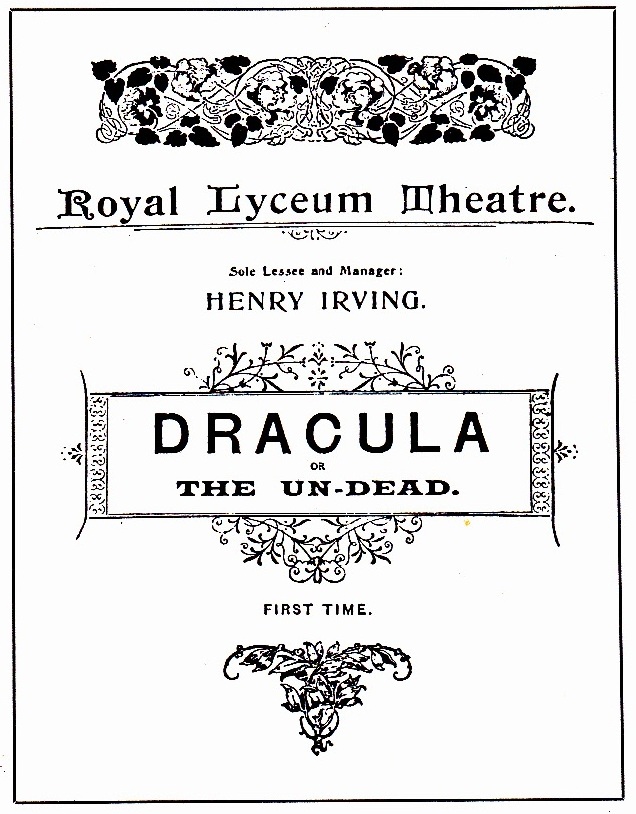
In spite of the fact that Bram Stoker's lasting fame is inextricably linked to Dracula, Stoker was most proud of and most dedicated to his work in the Lyceum Theatre for Sir Henry Irving. While Stoker's notes on Dracula, the original manuscript, and even his own personal diaries have been difficult or impossible to track down, Stoker published his memoirs or Personal Reminiscences on the subject of Henry Irving.

Stoker lived for his work with Irving and he had lots of reasons to. His pretty young wife longed to be an actress, but the career was too controversial for her and she may have lacked the talent. Stoker's father was a giant pushover and loathed the idea that his sons might follow in his footsteps, which usually ensures that they will; hence, sucking up to Irving might have just been in Stoker's nature. Also, the Lyceum in the 1890s was the hottest place for London Society to meet and mingle; Irving was the rockstar actor of his day and was the first English actor to be knighted for achievements in his field.


That being said, the Lyceum presented more Shakespeare than anything else. Irving played the Bard's starring roles, most notably, Hamlet. And all of this got me thinking that some of this Shakespeare must have seeped into Stoker's famous novel. Of course and luckily, I wasn't the first to think of this.

Kelly K.'s EN 122 Blog provides a light and entertaining analysis of the Bard's influence on Dracula.
Without Shakespeare, Van Helsing, a doctor and central character in Dracula, would not be named Van Helsing or hold the characteristics he does. This character’s name originates from the Danish name for Hamlet’s castle, Elsinore—Helsingor, or island of Helsing. Bram Stoker, the author of Dracula, selected to use “Helsing” to represent Van Helsing’s character due to the doctor’s strong and impenetrable personality that is much like the walls of the castle, Elsinore. Also, Van Helsing himself is like Elsinore where he keeps his emotions in, much like Claudius, King of Denmark and father/uncle to Hamlet, keeps him inside Elsinore’s walls. For instance, in chapter ten of Dracula, while he draws blood from Dr. Seward and observes it pour into Lucy Westenra, Van Helsing remains composed and undemonstrative. Without Hamlet, a creation of Shakespeare, Van Helsing would not bear his name or have the characteristics he embraces.
Since reading this, I haven't been able to shake the image of Van Helsing as a sulky prince.

Kelly Kendrick insists:
Shakespeare is the reason Dracula’s plot and characters exist. Without Shakespeare’sHamlet and Macbeth, Van Helsing would not bear his name nor carry the characteristics he does, Harker would never suspect Dracula to be anything other than human, he would never have been prisoner, he would have never contemplated death, and Harker wouldn’t have tried to save his poor Mina. Shakespeare should be mandatory to study simultaneously or prior to Dracula because they are so similar and based off of one another. Without Shakespeare, Dracula would not exist.
I don't know if I would go that far, but it's hard to say that Stoker wasn't influenced by Shakespeare. Everything in our lives can be said to influence us in some way and Shakespearean theatre is one of the things that Stoker was immersed in, while he was writing Dracula. He says so himself in Personal Reminiscences:
Henry VIII. was produced on the night of Tuesday, January 5, 1892, and ran at the Lyceum for two hundred and three perform- ances, ending on November 5. Its receipts were over sixfy-six thousand pounds.
And...
There is another view of Hamlet, too, which Mr. Irving seems to realise by a kind of instinct, but which requires to be more fully and intentionally worked out. . . . The great, deep, underlying idea of Hamlet is that of a mystic. ... In the high-strung nerves of the man; in the natural impulse of spiritual susceptibility ; in his concentrated action, spas- modic though it sometimes be, and in the divine delirium of his perfected passion there is the instinct of the mystic, which he has but to render a little plainer in order that the less susceptible senses of his audience may see and understand.

Sunday, April 28, 2013

The German Professor in Dracula

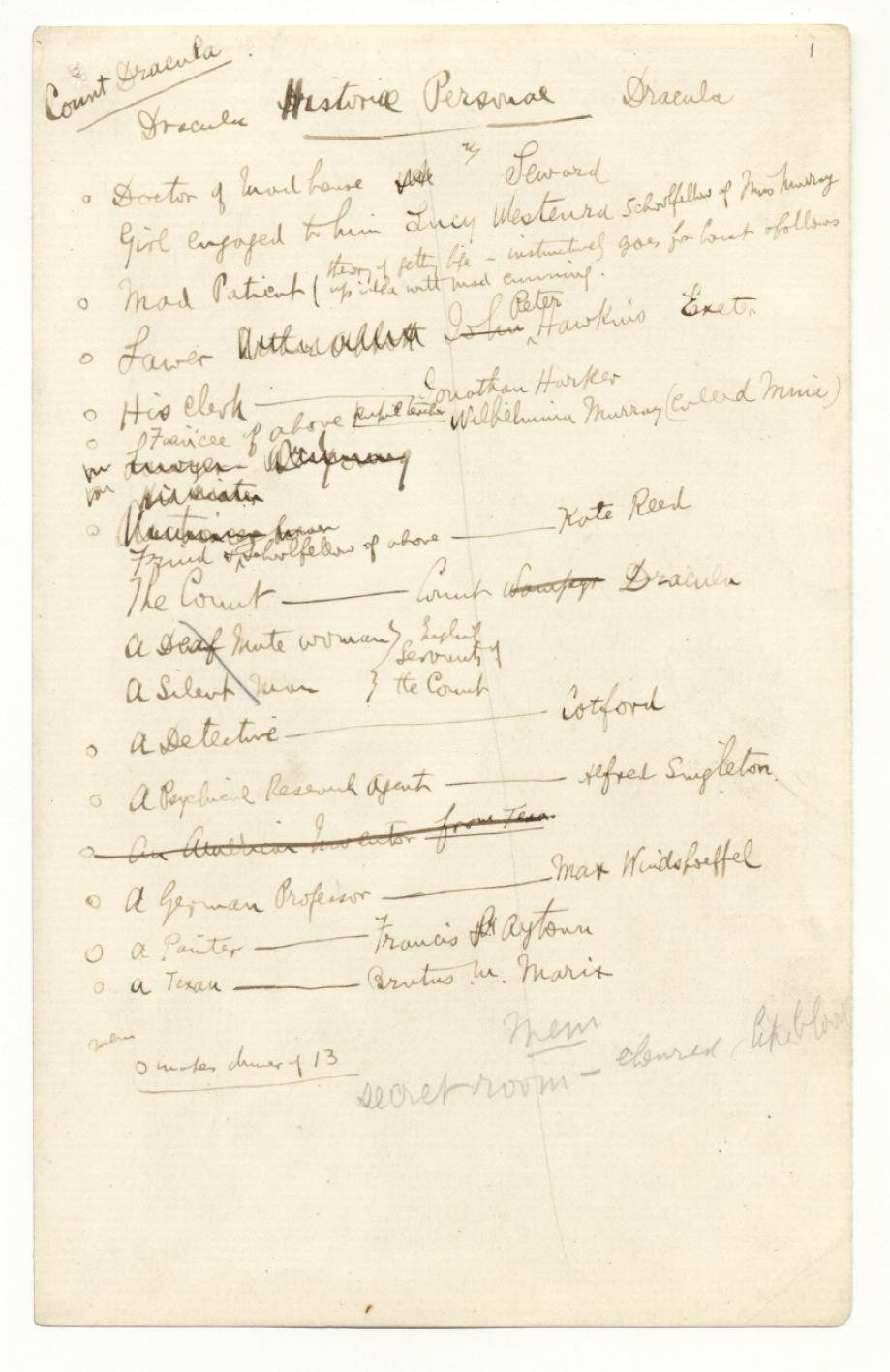
Remember the German professor, Max Windschoeffel, in Dracula? No? That's because there wasn't one. Bram Stoker wrote him out or, rather, let his character be absorbed into the Dutch vampire hunter, Van Helsing, along with other characters, including a detective.


Stoker's "Historiae Personae," pictured above, resides at the Rosenbach Museum & Library in Philedelphia. It likely arrived in the United States through one of Stoker's many visits or when his wife, Florence, moved to the US, after his death.

The "Historiae Personae" shows the way that characters' roles changed and evolved during the writing and research process. Upon close examination, you can see how characters were changed and renamed throughout.

I also love how it problematizes the question of who the real-life inspiration for Dracula was. Scholarship on the question has speculated it could have been Oscar Wilde or Henry Irving.

If Van Helsing was originally supposed to be a German professor, a detective, a physical research agent, and even possibly a painter, it's likely that the vampire's character had many sources of inspiration as well. Henry Irving, Oscar Wilde, Jack the Ripper, and even Stoker himself are tossed around as inspiring Dracula all the time, but it's likely more true that parts of Dracula came from all of them and others as well.

Follow me on Twitter @TinyApplePress and like the Facebook page for updates!