Saturday, August 9, 2014

LGBT Writers in London in the 1890s

This short descriptive list should serve as a catalogue of LGBT writers, who were active in fin-de-siècle London - that is the London of the 1890s. The term "fin de siècle" here refers to the cultural trends of the 1880s and 1890s, including cynicism, and a rebellion against materialism, bourgeois society, liberal politics, and decadence.

This list does not include writers who were too young to be active - even if they were deeply influenced by the era, like Radcliffe Hall. Also, history has made assumptions about the sexuality of some of these writers because homosexuality - especially male homosexuality - was very taboo, especially post-1895. If there's anyone you think I should add to this list, leave a comment, or send me an email.

E.F. Benson
Edward Frederic Benson (1867-1940) was known professionally as E.F. Benson, but his friends called him Fred. He was 23 at the beginning of the decade, and wrote his first book, Dodo: A Detail of the Day (1893), while still a student at King's College. Dodo featured a portrait of the famous suffragette, Ethel Smyth.

Benson was a prolific writer and quickly followed Dodo up with a book per year for the rest of that decade, including: The Rubicon (1894), The Judgement Books (1895), Limitations (1896), The Babe, B.A. (1897), The Money Market (1898), The Vintage (1898), The Capsina (1899), and Mammon and Co. (1899).

Biographers assume that Benson was homosexual because he never married and his work is, at times, homoerotic. In addition to writing, Benson was a star athlete, who represented England at figure skating.

Samuel Butler
Samuel Butler (1835-1902) has made important contributions to the literary canon, most notably (in my opinion), his translations of the Iliad and Odyssey, which remain in use today. He was in his 50s and 60s, during the 1890s. In 1892, his first significant lover, Charles Pauli, died.

After profiting from the sale of a New Zealand farm in the 1860s, Butler began paying Pauli a regular pension, which he continued to do until Butler had spent all of his savings - even though their romance had ended. Shockingly, for Butler, when Pauli died, he learned that Pauli had similar arrangements with other men, and had died wealthy without leaving anything to Butler in his will.

Butler kept another lover on a salary as his literary assistant and travelling companion, but their relationship was not exclusive.

Butler's sentimental poem, "In Memoriam H.R.F," was written in 1895 for Hans Rudolf Faesch, a Swiss exchange student, who had stayed with him in London for two years. Butler had his aforementioned literary assistant, Henry Festing Jones, submit the poem for publication at several important English magazines, but withdrew the poem from publication when the Oscar Wilde trial began in the spring of that year, out of fear of similar persecution.

Butler believed the author of the Odyssey was a woman, and offered his evidence for this theory in The Authoress of the Odyssey (1897). His translation of the Iliad first appeared in 1898, and he published Shakespeare's Sonnets Reconsidered in 1899, in which he proposes that, if Shakespeare's sonnets are rearranged properly, they tell the story of a homosexual affair.

Edward Carpenter (right)
& George Merrill (left).
Edward Carpenter (1844-1929) was actually an early LGBT activist, as might be evidenced simply by reading a list of his 1890s writings.
From Adam's Peak to Elephanta: Sketches in Ceylon and India (1892)
A Visit to Ghani: From Adam's Peak to Elephanta (1892)
Homogenic Love and Its Place in a Free Society (1894)
Sex Love and Its Place in a Free Society (1894)
Marriage in Free Society (1894)
Love's Coming of Age (1896)
Angels' Wings: A Series of Essays on Art and its Relation to Life (1898)
Carpenter was close friends with Walt Whitman and Rabindranath Tagore. He was in his 40s and 50s during the 1890s, and travelled to Ceylon and India in 1890 to spend time with a Hindu teacher, Gnani, described in Adam's Peak to Elephanta (1892). Carpenter felt transformed by the experience, and converted to the belief that Socialism could produce a profoundly good shift in human consciousness, in which mankind would rediscover a primordial state of joy.
The meaning of the old religions will come back to him. On the high tops once more gathering he will celebrate with naked dances the glory of the human form and the great processions of the stars, or greet the bright horn of the young moon. - Edward Carpenter Civilisation: Its Cause and Cure (1889) 
Through his brand of socialism, Carpenter was inspired to campaign against air pollution, while promoting vegetarianism and opposing vivisection.

Carpenter met his life partner when he returned to London from India in 1891. Carpenter's partner, George Merrill was a working class man from Sheffield. In 1898, they moved in together defying contemporary sexual mores, as well as the British class system. Their relationship reflected Carpenter's convictions about same-sex love and his belief that gay culture would radically change their society.

Carpenter's writing is anti-capitalist. He supported Fred Charles of the Walsall Anarchists in 1892, before becoming a founder member of the Independent Labour Party in 1893.

Marie Corelli
Marie Corelli (1855-1924) was famous, like Oprah; I've mentioned her before. She was the "Idol of Suburbia," and, like many writers from the 1890s, her biographers only guess at her sexuality based on the circumstances of her life, such as her companion, Bertha Vyver.

"Vyver and Corekki may be understood as devoted companions, sexual lovers, or romantic friends, sisters, mother and daughter, or even guardian angel and inspired genius. There are so many kinds of relationships, after all," writes biographer, Annette Fredrico, "Certainly Corelli's relationship with Vyver strengthened her faith in women's self-sufficiency and limitless capabilities for achievement."

Corelli favoured spiritual themes in her writing, such as astral projection, and her work is seen as groundbreaking for contemporary New Age religion. She had four novels under her belt by the 1890s, and kept on going with: Wormwood: A Drama of Paris (1890), The Soul of Lilith (1892), Barabbas, A Dream of the World's Tragedy (1893), The Sorrows of Satan (1895), The Mighty Atom (1896), The Murder of Delicia (1896), Ziska (1897), and two short story collections.

Nine film adaptations were made from her books between 1915 and 1926.

The Young Diana (1922)
A Marie Corelli inspired film.
The Sorrows of Satan (1926) Another Marie Corelli inspired film.
Lord Alfred Douglas
Lord Alfred Douglas (1870-1945) a.k.a. "Bosie" or the bloke who ruined Oscar Wilde's life; I don't like him one little bit, but he was an active gay writer in the 1890s, so I feel I ought to mention him.

Douglas and Wilde met in 1891. Robert Hichens' novel, The Green Carnation (1894), was said to be based on Wilde and Douglas's relationship; it was one of the texts used against Wilde in court.

Douglas was editor of the Oxford magazine, The Spirit Lamp, which he used to covertly gain acceptance for homosexuality. Wilde wrote Salomé originally in French, and commissioned Douglas to translate it in 1893. Douglas's French was bad, so his translation was met with scrutiny. Douglas didn't take criticism well, and claimed the errors were in the original play, which lead to one of many temporary breakdowns in their ever turbulent romance.

One story goes, Douglas got sick with the flu and needed Wilde to nurse him. When he got better, Wilde had got the same flu. Instead of taking care of Wilde as Wilde took care of him, Dougas checked into a hotel and sent Wilde the bill.

Douglas also had a careless habit of leaving Wilde's incriminating letters in old clothes that he gave to male prostitutes, leading to blackmail. Of course, Douglas's father, the Marquess of Queensbury, soon discovered the relationship, leading to Wilde's infamous trials and eventual imprisonment.

Signed copy of Douglas's autobiography.
Still, Douglas managed to be the chief mourner at Wilde's funeral at the end of the decade. Soon after, he would meet and marry a rich poet, decide that homosexuality was evil, and persecute more gay men in court. I do not like him, not one little bit.

E.M. Forster
Edward Morgan Forster (1879-1970) is best known for his novel, A Passage to India (1924). I'm still not sure I should include him in this list because he was so young and still at school, but he was attending King's College. While at school, he joined a society called the Apostles (formally the Cambridge Conversazione Society). Its former members went on to establish the Bloomsbury Group, an influential group of associated writers, intellectuals, philosophers and artists, including Forster and Virginia Woolf (who is only three years younger than Forster, but I have to cut off who I'm including in this list somewhere).

Forster was open about his sexuality to his friends, and closed to the public. The love of his life was a married police officer.

A.E. Housman at age 35.
Alfred Edward Housman (1859-1936) was already one of the foremost classicists in the 1890s, and just in his 30s. He has also been ranked one of the greatest scholars who ever lived. He was a classicist and poet, best known for his cycle of poems, A Shropshire Lad (1896).

In the 1890s, Housman was recovering from unrequited love: his college roommate Moses jackson, who married without telling him in 1889, and died in 1892. By that time, Housman's professional reputation had grown such that he was offered professorship of Latin at University College, London, which he accepted.

He liked going to France to read books that were banned in Britain.

Mostly while living in Highgate, London, Housman worked on A Shropshire Lad, a cycle of 63 poems. After being rejected by publishers, he self-published in 1896. After a slow start, it became a lasting success, and has been in print continuously since May 1896.

W. Somerset Maugham as a medical student.
William Somerset Maugham (1874-1965) was young in the 1890s (teens and twenties), playing doctor, until his first novel, Liza of Lambeth (1897) sold out, and he decided to be a writer instead.

As a medical student, Maugham was very self-sufficient and productive, he kept his own place, loved decorating it, though it was cluttered with notebooks full of ideas, and wrote nightly while going to school. What he loved most about being in London was that he got to meet people of a different class that he wouldn't have got to meet otherwise. This was carried forward into his first novel, which is about the consequences of working-class adultery.

When Liza of Lambeth sold out in just a few weeks, he dropped medicine, and devoted his working life to writing.

Walter Pater (1890s)
Walter Horatio Pater (1839-1894) was already a literary celebrity in the 1890s, teaching at Oxford and living with his sisters in Kensington between terms. His 1893 piece on Mona Lisa is considered the most famous piece of writing about any picture in the world: "She is older than the rocks among which she sits; like the vampire, she has been dead many times, and learned the secrets of the grave..."

Pater was one of the founding thinkers of the Aesthetic Movement. Oscar paid tribute to him in The Critic as Artist (1891). Though, Pater wrote a negative review of Oscar Wilde's The Picture of Dorian Gray (1891):
A true Epicureanism aims at a complete though harmonious development of man's entire organism. To lose the moral sense therefore, for instance the sense of sin and righteousness, as Mr. Wilde's heroes are bent on doing so speedily, as completely as they can, is ... to become less complex, to pass from a higher to a lower degree of development.
To be fair, the character, Lord Henry Wonton, willfully and incessantly misquoted Pater throughout the book.

In 1893, he moved his sisters to Oxford, where he was in high demand as a lecturer. He died in that home of heart failure due to rheumatic fever at the age of 54.

Henry James (left), Edith Wharton (middle),
Howard Sturrgis (right).
Howard Overing Sturgis (1855-1920) was the kind of guy who waited until his mom died before moving in with his boyfriend, and it's safe to say that the 1890s were his glory days.

Sturgis was raised in an upper middle class family, attended Eton and Cambridge, and his brother, Julian, also became a novelist. When his mother died in 1888, he moved into a lovely country house with William Haynes-Smith, his lover. I get the sense that Sturgis finally felt free of his family's expectations of him, and he wrote his first novel, Time: A Story of School Life (1891), dedicated to "love that surpasses the love of women." Of course, it's set at a boys boarding school.

Sturgis was friends with Henry James and Edith Wharton. His first two novels sold successfully, but his third petered off. Although Wharton praised it, James called it "unsatisfactory," leading Sturgis's enthusiasm for writing to wane at the beginning of the next century.

Algernon Swinburne
Algernon Charles Swinburne (1837-1909) was a poet, playwright, novelist, and critic; he even contributed to the Eleventh Edition of the Encyclopædia Britannica. He was nominated for the Nobel Prize in Literature in every year from 1903 to 1907 and again in 1909. According to Oscar Wilde, Swinburne was "a braggart in matters of vice, who had done everything he could to convince his fellow citizens of his homosexuality and bestiality without being in the slightest degree a homosexual or a bestializer."

By the 1890s, Swinburne was a mature writer, who spent very little time in London, unlike Wilde. Swinburne had already faced an early death by alcoholism, and overcame it with the help of his mother, sister, and close friend, Theodore Watts-Dunton.

It's said that his poetry suffered after he settled down, but that has also been attributed to his age.

Renée Vivien & Natalie
Clifford Barney
Renée Vivien was born Pauline Mary Tarn (1877-1909), and although she was British, she wrote in French, adopting the mannerisms of Symbolism, as one of the last poets to claim allegiance to the school.

Pauline's father died when she was 9, leaving her everything. Consequently, he mother tried to have her declared insane, so that she could claim the money for herself, but the courts saw through her mother's scheme, and place Vivien in protective care until she reached the age of 21.

In 1898, she inherited her father's fortune, and emigrated to Paris, where it was much easier for women to be involved in the Bohemian arts movement.

It would seem that any time Vivien spent in London before inheriting her independence, was about biding her time until she could become who she truly was. In Paris, Vivien lived lavishly, as an open lesbian, and had a public affair with American heiress and writer Natalie Clifford Barney. She travelled extensively, wintering in Egypt, and exploring China and the Middle East, as well as Europe and America. Contemporaries called her beautiful and elegant, with blonde hair, brown eyes flecked with gold, and a soft-spoken androgynous presence. She wore expensive clothes and particularly loved Lalique jewelry.

Oscar Wilde
Oscar Fingal O'Flahertie Wills Wilde (1854-1900) appears at the end of this list, not because I am saving the best for last, but because I've tried to write this list alphabetically. Wilde is certainly the most famous homosexual in London in the 1890s, a decade which would encompass the best and worst years of his life.

By the time the decade started, Wilde was living in "House Beautiful" on Tite Street with his wife and two young sons. The marriage had problems, most specifically that Wilde wasn't sexually attracted to his wife, after she bore his children, so he started seeing men.

Wilde published his first and only novel in 1890, then began his theatrical career, which produced some of the most witty and quotable plays of all time.

As I mentioned before, Wilde had an affair with the reckless and spoiled Lord Alfred Douglas, whose father found out about the affair, leading to Wilde's imprisonment. The affect of this trial on the gay community and the world cannot be understated. Not only did it drive some homosexuals into hiding,  like Samuel Butler, who withdrew a homoerotic poem that he had submitted for publication, but Wilde's association with homosexuality would code homosexual culture for many years to come.

Wilde had a very identifiable personality, which ever after became associated with homosexual behaviour. Wilde was flamboyant, witty, obsessed with the most minute detail of decorating "House Beautiful," obsessed with his own clothes, as well as the clothes of women. It might be said that the more a homosexual man assimilates his behaviour to Wilde's the more likely it is that he will be identified as "flaming," even today.

Follow me on Twitter @TinyApplePress and like the Facebook page for updates!

Monday, August 4, 2014

Constance Wilde's Celebrity Crush

Much is made of Oscar Wilde's affairs of the heart, but his wife also had a bit of a crush. This was by no means an extramarital affair, and was nothing compared to the way that Oscar carried on, but was more akin to the way a married woman today might feel about Brad Pitt. Constance had a celebrity crush, and his name was Pablo de Sarasate.

Pablo de Sarasate by Whistler
Sarasate's portrait by Whistler was one of the last pieces of Constance's estate to be sold off during Oscar's lifetime. It was painted in 1884, a few years before he would be named "Man of the Day" by Vanity Fair, and Constance would start attending all of the functions at which he might be present - usually with her equally obsessed friend, the writer, Marie Corelli.

The familiar figure of Sarasate
caricatured as a "Man of the Day"
Vanity Fair, 1889
At age five, Sarasate began studying the violin with his father in his birthplace, Pamplona, Navarre. Able to demonstrate a natural talent at a young age, he gave his first public concert at age eight, where he attracted his first patron,  who paid for him to study under Manuel Rodríguez Saez in Madrid, where he gained the favor of Queen Isabella II.

With many prizes already under his belt, Sarasate first performed in London as a teenager in 1861. Constance was still a baby, and Sarasate's best-known compositions wouldn't come until much later: Zigeunerweisen (1878), and the Carmen Fantasy (1883).

Suffering from chronic bronchitis, Sarasate died in France in 1908. Bequeathed to the Musée de la Musique, his violin, made by Antonio Stradivari in 1724,  now bears his name as the Sarasate Stradivarius. The Real Conservatorio Superior de Música, Madrid, own his second Stradivari, the Boissier, made in 1713.

I just wonder if Constance ever wished Oscar had a mustache like Sarasate's.

Follow me on Twitter @TinyApplePress and like the Facebook page for updates!

Wednesday, July 30, 2014

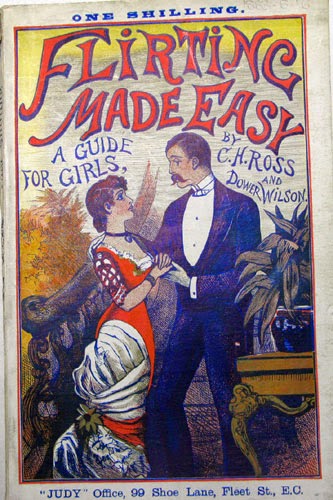
Flirting Made Easy

"All girls flirt with soldiers: they can't help it, no more can the soldiers, or they would.
Cornets or Ensigns, Lieutenants, and Captains are flirted with the most. Only very bold girls indeed would try to flirt with a General!" Flirting Made Easy by C.H. Ross
Although "Flirting Made Easy: A Guide for Girls" (1882) is a little before my time period, I just couldn't resist this tongue-in-cheek etiquette guide by a man who is "not prepared to believe that any male thing could possibly be 'disgusted' with the flirtings of a nice girl, unless the nice girl happened to belong to him, and he had to sit out in the cold whilst the flintiness went on with other fellows."

Although the eBook is available for free on Google Play, I haven't been able to find a single review, and it appears few people read it at all nowadays. For those who do, it is a passing fancy, interesting only in the pursuit of one subject or another that it touches on in its pages. I write this blog post hoping to change that.

Flirting Made Easy tells us a lot about late-Victorian slang, and perceptions of gender. A "deuce" is like cool or swell. "Bosh" and "a jolly crammer" are words for lies. And it's not bosh that Ross thought "Bar Young Ladies" were deuce.
The Bar Young Lady is essentially a modern institution, called into life by a general demand. She in a great measure owes her existence to Charles Dickens, who, in his Christmas Number called "Mugby Junction," was possibly the first to print a diatribe on the iniquities of the railway station sandwich. Long before that everyone had suffered, and, it is only right to ass, suffers still; but great reforms in this particular were at the time talked of, and in some particulars actually effected. One or two enterprising firms took possession of the refreshment-rooms, and handsomely decorated them, and the Bar Young Lady was born and flourished. 
Hitherto there had been barmaids and bar-girls, waitresses and female attendants; but these gave place to the Bar Young Lady, and she was a big success. She came and saw and conquered. She not infrequently married money. 
She was no longer of that sisterhood which were only Pollies, and Mollies, and Mary Annes. She was Miss Pamela Andrews, Miss Clarissa Richardson, Miss Barlow, Miss Sandford, and Miss Merton - (mark well the nomenclature) - not Fitz-Talbot, De Vere, or Montmorency. There was and is an intensity of propriety and respectability about the Bar Young Lady that is absolutely crushing.
What is in a name? These forms of address have so much meaning, even surnames connote class. To many of Ross's peers calling a lady by her first name meant you intended to marry her. Victorian London was also an extremely classist society, and the treatment of lower-class women differed from the treatment of "respectable" women. Ross inadvertently identifies this and the changing expectations of how working women should be treated in his discussion of the "Bar Young Lady."


While Ross's work is intended to be humorous, I can not overlook the fact that the book claims to be "A Guide for Girls," but rarely speaks to women. On many occasions, Ross directly addresses his male friends. For the most part, Flirting Made Easy is a collection of anecdotes, through which Ross pretends to instruct women.

By way of example, I will leave you with a short chapter from Flirting Made Easy that is most appropriate for this blog.

AUTHORESSES CONSIDERED AS WOMEN, 
AND ONE PARTICULAR LITERARY LOVE AFFAIR 
THAT CAME TO NOTHING
Shy authors are probably to be found here and there, but they are not plentiful. There are authors who have not much to say for themselves in the society of other authors, but their silence must not always be attributed to excessive modesty. Occasionally and author sits apart and smolders. Take them altogether, they have a pretty good opinion of themselves, and the shyest one out, most likely, harangues his poor suffering wife upon the subject of himself and works until she gasps again - or gapes. 
I do not, however, speak from experience. The lady members of my household have assured me again and again that they are only too happy to listen to me. Some men have a way of imparting information that carries their readers with them. For my part, I know nothing more delightful than to listen to a witty man with a brilliant flow of language, and this opinion is shared by my sisters, my cousins, and my aunts. 
But I do not want to talk about authors. It is rather authoresses I would converse. I have since childhood's hour had a burning desire to make the acquaintance of literary ladies. I should like to have known Miss Martineau. "Is it a man or a woman, or what sort of animal is it?" the good dame said who met her at Ambleside. "There she came, stride, stride - great heavy shoes, stout leather leggings on - and a knapsack on her back, and they say she mows her own grass and digs her own cabbages and potatoes." And poor L.E.L, "a comely girl with a blooming complexion," who, in spite of her sentimental verse, was fond of "a little quiet dance," and with opinions wild as the wind, flying from subject to subject, lighting up each with wit, "fairly talked herself out of breath." "Hey!" cried Ettrick Shepherd when he met her, "but I didna think ye's bin sae bonnie." 
And Maria Edgeworth, whom Byron described as "a nice little unassuming Jeanie Deans-looking body, who one would never have guessed could write her name." And Charlotte Bronte, who, according to a writer in the "Quarterly," was "a person who, with great mental powers, combined a total ignorance of the habits of society, a great coarseness of taste and a heathenish doctrine of religion." And Mrs. Hemans, whose "silken hair unbraided flowed around her like a veil." and the Countess of Blessington, whose person, when N.P. Willis saw her, "preserved all in the fineness of admirable shape," and she wore a dress of blue satin "cut low and folded across her bosom in a way to show to advantage the sculpture-like curve and whiteness of a pair of exquisite shoulders." 
I should have been a bit afraid of "Holy Hannah," as Walpole calls Mrs. More, and I fancy Anne Radcliffe might have frightened me, though I can find nothing about her personal appearance, and both ladies were rather before my time. But I would willingly have made a little journey to see the authoress of the "Simple Story," whose own account of herself is here before me. Her age, she says, was then a little over thirty. She was above the middle height - rather tall. Her figure was handsome, but a little too stiff. "Shape, rather too fond of sharp angles. Bosom, none." Her skin, by nature fair, but a little freckled. Her hair, a sandy brown. Her face, beautiful. Her countenance, full of spirit and sweetness, "excessively interesting, and, without indelicacy, voluptuous." And her dress, "always becoming; and very seldom worth so much as eightpence." With the figure she describes she might possibly have had threepence to spare if she bought glazed calico. 
It might be urged by an authoress reading these remarks that I make small mention of the mental qualities of most of the ladies I have alluded to. Well, I plead guilty. So many other fellows have already said such a lot upon the subject, and when I think of authoresses, I chose to think of them as women, which to the best of my belief, most of them are. Why, I have heard of one was married twice. 
There is an enthusiasm about the adorable sex when it goes in for anything out of the beaten track. When it writes books, or paints pictures, or makes speeches, or gets itself appointed drum-major to a "Salvation Army," that is delightful to contemplate; but it has then not time for love-making nonsense. 
Where, I have often asked myself, do lady novelists go for their heroines? The heroine of the lady novelist is, as a rule, the very reverse of her own self, if we may believe the nasty cynical male writing things; but, if this be the case, great heaven! where are the illusions of my youth? Is everything different to what it is said to be? Is nothing properly described? As Truthful James asks: "Do I sleep? do I dream? do I wonder and doubt? Are things what they seem, or are visions about? Is our civilization a failure, or is the Caucasion played out?" I don't go so far as to say that I entirely follow T.J. In these observations, but I ask, Are we being deceived by the women who write of women? Are not any of them taken from real life? Do even authoresses, like the rest of their sex, join issue against the unmarried male creature in one great sham? I feel frightened when I think of it. 
Now there is my good friend Boodler, novels, dramatist, poet, critic, and writer of slashing leaders for a great daily. In a print explosive, in private life of the mildest, wearing spectacles. Well, he is an honored guest at the house of a nobleman with whom I have the honor to be acquainted, and of one of that nobleman's daughters was he deeply enamored. Deceived by the graciousness of the dear girl's manner, an impulsiveness amounting almost to gushingness, poor Boodler fancied that he was not wholly indifferent to her. Gently would she lead him forth and trot him out, and he would prattle a long while at a time - with clasped hands and great grey eye, gazed into his spectacle-glasses and seemed to drink in every utterance. 
One day, the wretched man, thus deceived by appearances, and finding himself alone with her, ventured upon tenderness. Happily for him, he was more than usually vague, and preoccupee. She did not understand him, but when he began offering the devotion of a life, she thought - the artful little thing! - she saw a chance she had long been lying in wait for, and proposed that he should exert his influence with the publishers to sell her first novel. Then, right off and without taking a breath, she told him the whole of the plot, the narration of which occupied more than three quarters of an hour. 
Utterly crushed, poor Boddler had not the presence of mind to dictate terms, which in his place some villain might have done. He took the MS away with him. He did his utmost to move heaven and earth and the planets in Paternoster Row, but her could not get that novel bought. He went so far as to say to old What's-his-name, "My dear sir, if you only knew the young lady personally - the loveliest, the most charming in all the world!" "Oh!" said old What's-his-name; he would not buy the novel. Since then she has married - not Boodler. He does not visit at her new home.
Follow me on Twitter @TinyApplePress and like the Facebook page for updates!

Saturday, July 26, 2014

"Aristotle at Afternoon Tea" by Oscar Wilde

Aristotle Pop Art
Oscar Wilde was an excellent conversationalist, but, like anyone who is brilliant at something, he was also ridiculed for it. The memorable quotes, we know to this day, became memorable to all those around him, through his constant repetition, his telling and retelling. Wilde spoke the way he wrote, and did most of his editing orally.

Today, I share, for your reading pleasure, Oscar Wilde’s “Aristotle at Afternoon Tea,” a review of J.P. Mahaffy’s “Principles of the Art of Conversation,” which Wilde calls “the nearest approach, that we know of, in modern literature to meeting Aristotle at an afternoon tea.” It was first published in the Pall Mall Gazette, 16 December 1887.

The Importance of Being Earnest (1952) movie
Because Wilde is a character in my book, I find “Aristotle at Afternoon Tea” to be an interesting character study. Through letters and diaries about Wilde, we know that he was very repetitive, and his most oft repeated word was "charming." In “Aristotle at Afternoon Tea,” he can’t wait longer than the second paragraph before criticizing people who do exactly those things.

Aristotle at Afternoon Tea

by Oscar Wilde
In society, says Mr. Mahaffy, every civilised man and woman ought to feel it their duty to say something, even when there is hardly anything to be said, and, in order to encourage this delightful art of brilliant chatter, he has published a social guide without which no débutante or dandy should ever dream of going out to dine. Not that Mr. Mahaffy's book can be said to be, in any sense of the word, popular. In discussing this important subject of conversation, he has not merely followed the scientific method of Aristotle which is, perhaps, excusable, but he has adopted the literary style of Aristotle for which no excuse is possible. There is, also, hardly a single anecdote, hardly a single illustration, and the reader is left to put the professor's abstract rules into practice, without either the examples or the warnings of history to encourage or to dissuade him in his reckless career. Still, the book can be warmly recommended to all who propose to substitute the vice of verbosity for the stupidity of silence. It fascinates in spite of its form and pleases in spite of its pedantry, and is the nearest approach, that we know of, in modern literature to meeting Aristotle at an afternoon tea. 
As regards physical conditions, the only one that is considered by Mr. Mahaffy as being absolutely essential to a good conversationalist, is the possession of a musical voice. Some learned writers have been of opinion that a slight stammer often gives peculiar zest to conversation, but Mr. Mahaffy rejects this view and is extremely severe on every eccentricity from a native brogue to an artificial catchword. With his remarks on the latter point, the meaningless repetition of phrases, we entirely agree. Nothing can be more irritating than the scientific person who is always saying "Exactly so," or the common-place person who ends every sentence with "Don't you know?" or the pseudo-artistic person who murmurs "Charming, charming," on the smallest provocation. It is, however, with the mental and moral qualifications for conversation that Mr. Mahaffy specially deals. Knowledge he, naturally, regards as an absolute essential, for, as he most justly observes, "an ignorant man is seldom agreeable, except as a butt." Upon the other hand, strict accuracy should be avoided. "Even a consummate liar," says Mr. Mahaffy, is a better ingredient in a company than the scrupulously truthful man, who weighs every statement, questions every fact, and corrects every inaccuracy." The liar at any rate recognises that recreation, not instruction, is the aim of conversation, and is a far more civilised being than the blockhead who loudly expresses his disbelief in a story which is told simply for the amusement of the company. Mr. Mahaffy, however, makes an exception in favour of the eminent specialist and tells us that intelligent questions addressed to an astronomer, or a pure mathematician, will elicit many curious facts which will pleasantly beguile the time. Here, in the interest of Society, we feel bound to enter a formal protest. Nobody, even in the provinces, should ever be allowed to ask an intelligent question about pure mathematics across a dining-table. A question of this kind is quite as bad as enquiring suddenly about the state of a man's soul, a sort of coup which, as Mr. Mahaffy remarks elsewhere, "many pious people have actually thought a decent introduction to a conversation.” 
As for the moral qualifications of a good talker, Mr. Mahaffy, following the example of his great master, warns us against any disproportionate excess of virtue. Modesty, for instance, may easily become a social vice, and to be continually apologising for one's ignorance or stupidity is a grave injury to conversation, for, "what we want to learn from each member is his free opinion on the subject in hand, not his own estimate of the value of that opinion." Simplicity, too, is not without its dangers. The enfant terrible, with his shameless love of truth, the raw country-bred girl who always says what she means, and the plain, blunt man who makes a point of speaking his mind on every possible occasion, without ever considering whether he has a mind at all, are the fatal examples of what simplicity leads to. Shyness may be a form of vanity, and reserve a development of pride, and as for sympathy, what can be more detestable than the man, or woman, who insists on agreeing with everybody, and so makes "a discussion, which implies differences in opinion," absolutely impossible? Even the unselfish listener is apt to become a bore. 
"These silent people," says Mr. Mahaffy, "not only take all they can get in Society for nothing, but they take it without the smallest gratitude, and have the audacity afterwards to censure those who have laboured for their amusement." Tact, which is an exquisite sense of the symmetry of things, is, according to Mr. Mahaffy, the highest and best of all the moral conditions for conversation. The man of tact, he most wisely remarks, "will instinctively avoid jokes about Blue Beard" in the company of a woman who is a man's third wife; he will never be guilty of talking like a book, but will rather avoid too careful an attention to grammar and the rounding of periods; he will cultivate the art of graceful interruption, so as to prevent a subject being worn threadbare by the aged or the inexperienced; and should he be desirous of telling a story, he will look round and consider each member of the party, and if there be a single stranger present will forgo the pleasure of anecdotage rather than make the social mistake of hurting even one of the guests. As for prepared or premeditated art, Mr. Mahaffy has a great contempt for it and tells us of a certain college don (let us hope not at Oxford or Cambridge) who always carried a jest-book in his pocket and had to refer to it when he wished to make a repartee. Great wits, too, are often very cruel, and great humourists often very vulgar, so it will be better to try and "make good conversation without any large help from these brilliant but dangerous gifts.” 
In a tête-à-tête one should talk about persons, and in general Society about things. The state of the weather is always an excusable exordium, but it is convenient to have a paradox or heresy on the subject always ready so as to direct the conversation into other channels. Really domestic people are almost invariably bad talkers as their very virtues in home life have dulled their interest in outer things. The very best mothers will insist on chattering of their babies and prattling about infant education. In fact, most women do not take sufficient interest in politics, just as most men are deficient in general reading. Still, anybody can be made to talk, except the very obstinate, and even a commercial traveller may be drawn out and become quite interesting. As for Society small talk, it is impossible, Mr. Mahaffy tells us, for any sound theory of conversation to depreciate gossip, "which is perhaps the main factor in agreeable talk throughout Society." The retailing of small personal points about great people always gives pleasure, and if one is not fortunate enough to be an Arctic traveller or an escaped Nihilist, the best thing one can do is to relate some anecdote of "Prince Bismarck, or King Victor Emmanuel, or Mr. Gladstone." In the case of meeting a genius and a duke at dinner, the good talker will try to raise himself to the level of the former and to bring the latter down to his own level. To succeed among one's social superiors one must have no hesitation in contradicting them. Indeed, one should make bold criticisms and introduce a bright and free tone into a Society whose grandeur and extreme respectability make it, Mr. Mahaffy remarks, as pathetically as inaccurately, "perhaps somewhat dull." The best conversationalists are those whose ancestors have been bilingual, like the French and Irish, but the art of conversation is really within the reach of almost every one, except those who are morbidly truthful, or whose high moral worth requires to be sustained by a permanent gravity of demeanour and a general dulness of mind. 
These are the broad principles contained in Mr. Mahaffy's clever little book, and many of them will, no doubt, commend themselves to our readers. The maxim, "If you find the company dull, blame yourself," seems to us somewhat optimistic, and we have no sympathy at all with the professional story-teller who is really a great bore at a dinner-table; but Mr. Mahaffy is quite right in insisting that no bright social intercourse is possible without equality, and it is no objection to his book to say that it will not teach people how to talk cleverly. It is not logic that makes men reasonable, nor the science of ethics that makes men good, but it is always useful to analyse, to formularise and to investigate. The only thing to be regretted in the volume is the arid and jejune character of the style. If Mr. Mahaffy would only write as he talks, his book would be much pleasanter reading.
Follow me on Twitter @TinyApplePress and like the Facebook page for updates!

Saturday, July 19, 2014

The Perfect Man


Fin-de-sciele ideals of femininity and masculinity usually bring to mind the tight-laced corset and the dandy, but there was another ideal strutting about 1890s that we tend to forget about. He was a German called Eugen Sandow, and they called him "the Perfect Man."


Today, Sandow is considered the founder of modern bodybuilding. Essentially, he measured the Greek and Roman statues of men in museums, and sculpted his own body to look the part, developing what was called "the Grecian Ideal."

Born in Prussia (1867), as Friedrich Wilhelm Müller, Sandow was the name he adopted when he began travelling through Europe as a circus athlete. Sandow ran away to join the circus in 1885 to avoid mandatory military service. He arrived in London in 1889, performing as a strong man, and became an instant success!

There's so much wonderful Sandow propaganda from the 1890s.

An 1890s cigar label
Cocoa for Health & Strength
Photographic card
"Here! Have a picture of my butt!"
Wearing little more than a fig leaf and a pair of tights, Sandow would imitate the poses of the statues he modelled his body after.


Sandow married Blanche Brooks from Manchester in 1896, with whom he had two daughters. Sadly, he was not a faithful husband, and his life came to an unhappy end in 1925.

Modern biographers speculate that he may have died of syphilis, but newspapers reported that it was a brain hemorrhage, brought on by great strain. According to the papers, Sandow had tried to single-handedly lift his car out of a ditch after an accident, two or three years earlier.

Whatever the cause, Sandow died at home, and his aggrieved wife refused to mark his grave.

Further reading: The Perfect Man by David Waller

After a reader asked me who the perfect woman was, I wrote a post to explain.

Follow me on Twitter @TinyApplePress and like the Facebook page for updates!

Thursday, July 17, 2014

Images of London in 1895

The year got off to a chilly start with the Great Frost of 1895. The lowest temperature (−27.2°C) ever recorded in the U.K. was recorded on February 11th of that year. Sadly, Oscar Wilde went to prison that year. Not all was doom and gloom: the first women's national sporting association was founded, the All England Women's Hockey Association, and an eight-week summer season of daily orchestral classical music concerts and other events, called the Proms, became an annual tradition that year. Circuses and menageries filled the streets, making for some lovely pictures. Enjoy!

Skating on the pond at St. James Park (1895)
The Frozen Thames (1895)
The Smithfield Meat Market (1895)
Waiting for the Prince Regent on St George Street (1895)
Print (circa 1895) of elegant ladies in a restaurant.
Is this the Dorothy Restaurant?
The Lord Mayor at Clapham Junction (1895)
London Docks (1895)
Leadenhall St. (1895)
Irene Vanbrugh as Gwendolen Fairfax
('The Importance of Being Earnest'),
by Alfred Ellis, publicity photograph
from the first production, London, 1895.
Hawaii's Princess Ka'iulani in London (1895)
Harry Houdini and the London Circus (1895)
Women's Football team in bright red uniforms (1895)
A lion in the London Zoological Garden (1895)
Blackheath Hockey Club (1895)
Blackwall Tunnel under construction (1895)
"Lionel Walter Rothschild with his famed zebra carriage,
which he frequently drove through London." (1895)
Albumen print cabinet card (1895) More...
Earl's Court Exhibition Ground,
Kensington, The Great Wheel (1895)
Dancing Bear (1895)
Day's Menagerie, Oxford St Giles Fair (1895)
Don't forget to check out Images of London in 1889, 1890, 1891, 1892, 1893, and 1894.

Follow me on Twitter @TinyApplePress and like the Facebook page for updates!

Monday, July 7, 2014

Pictures of John Gray

Better known as the inspiration for Oscar Wilde's fictional Dorian Gray, John Gray was an English poet and translator whose works include Silverpoints (1893), The Long Road (1926), and Park: A Fantastic Story (1932).

Unlike Dorian, who came from money, John came from a working class background, and worked hard for his education, the way that many students from poor or middle-class families do today. In addition to writing, he also worked as a metal worker, a librarian, and a priest.

These are a few of his pictures:

John Gray by Reginald Savage
John Gray (1893)
Left to right: John Gray, a friend, and Marc-André Raffalovich
Follow me on Twitter @TinyApplePress and like the Facebook page for updates!