Victorian sexuality can be approached from so many directions, including (but not limited to)
body image,
sexual orientation,
masturbation,
prostitution,
sex education,
disease,
religion,
marriage, and pornography. All of these aspects overlap and influence each other, creating tremendous diversity in attitudes toward sex at any given point in history. Each of these factors provide the context in which sexual identities are created. This post is the eighth in a series of posts that seek to explore that context from the 1890s with an emphasis on male sexuality.
Pornography
What is pornography?
The definition of "pornography" is famously subjective. After all, one man's Venus de Milo is another man's masturbation aid. But researchers generally define the genre as material designed solely for sexual arousal, without further artistic merit. - source
When I started this series of posts, I foolishly thought it would be easy to tell you what pornography was, and though this particular post would contain a string of cheeky photos of women in corsets 120 years ago. I was wrong. Determining what counted as porn was as complicated in the 1890s as it is today. The only thing that has become clear is that Victorian society feared sexual arousal, and by extension the distribution and production of pornographic materials.
In 1885, the Society for the Suppression of Vice was absorbed into the National Vigilance Association. The National Vigilance Association (NVA) was inspired by the need to fight child
prostitution. Toward the end of restricting the sale of pornographic material the NVA pursued stricter legislation, and published a pamphlet called Pernicious Literature (1889).
There can be no two opinions that the dissemination of such vile books must do harm to the youth of the country, into whose hands such literature only too readily falls.
The tie between child prostitution and pornography was compelling in 1890s London. Between Jack the Ripper and the Eliza Armstrong Case, in which a thirteen year-old virgin was sold into sexual slavery, poor and working-class girls were in incredible danger. If you were a upper- or middle-class Victorian, these were the same girls who poured your tea and swept your floor at home. Restricting pornography was portrayed as preventing the corruption and victimization of such girls.
In hindsight, we picture the boys in the loading bay at Selfridges with a handful of dirty pictures (Mr Selfridge is a television show; I'm referring here to an episode in which the young men in the loading bay pass around some fairly tame pictures of women), and remember that this was the only form of
sex education available to them. Victorians weren't oblivious to
the instructive side of pornography. Doctors also fell victim to the anti-pornography laws for supplying educational material to their patients, such as the Fruits of Philosophy.
Although I definitely support Annie Bessant and Charles Bradlaugh's cause, I have to concede that the creepy reputation of the Victorian doctor was well-earned. Jack the Ripper suspect, Francis Tumblety claimed to be a doctor and sold pornography to supplement his income during the early years of his notorious career. I can't, however, say with any certainty what kind of pornography he was peddling.
Most sex manuals were considered pornographic. Poems and novels could also be considered pornographic and were identified as such by a yellow jacket. Yellow covers warned readers of pornographic content (most French novels sported yellow covers in London). These yellow novels were associated with the aristocrat and the aesthete. So, what about the boys in the loading bay of Selfridges?
Affordable pornography came in the form of pamphlets containing erotic stories, like "Intrigues and Confessions of a Ballet Girl" (1870), which was one of many. These pamphlets didn't have any explicit sex scenes. According to
Allison Pease, "the cheaper the pornography, the less body and acts were portrayed." Erotic imagery was also an important part of the penny illustrated weeklies, "and a postcard set depicting a nude gymnast on the swing and trapeze could be purchased in the 1890s at a cost of one shilling for thirty-six poses."
Victorians were definitely kinky. There were sub-genres of pornography, just as there is today. Some of these sub-genres included BDSM (especially riding crops and leather), interracial, same-sex, bestiality, and many others.
 |
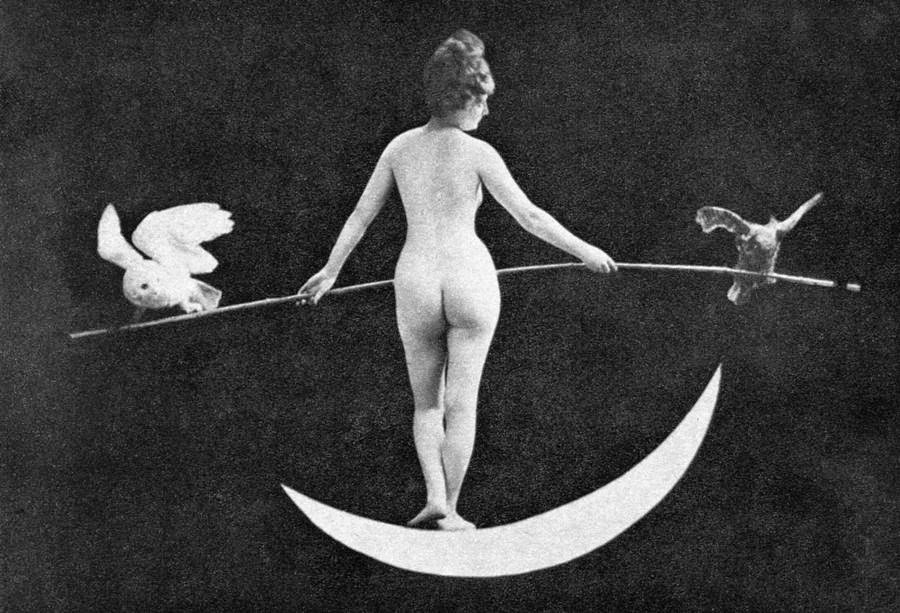
Images like this (some with much more
nudity) were sold as cabinet cards. |
Rule 34 applied in the Victorian era too; if it existed, there was porn of it. They invented the camera and immediately started taking dirty pictures.
 |
| Cabinet card. No date. |
I even found Sasquatch porn. It was terrifying. I'm not sharing those pictures here.
And the idea that pornographic images were either hand-drawn or rather tame, like
the burlesque photos that have been circulating around the internet, is wrong, very wrong. By the 1890s, pornographic images were could be very explicit, as seen in
this auctioneer's photo set.
So, who was buying pornography in the 1890s and how much of it? Although they certainly weren't immune to pornography's allure, the middle-class viewed the poor and the aristocratic as hungry for vice. Unlike
masturbation, I don't think every one does porn. The NVA said there could be no two opinions about the harmful effects of pornography, but there were varying definitions about what pornography was, as seen by the trials of Oscar Wilde. When does a poem become pornographic and what makes it so? Is pornography an art? Can art be pornographic?
 |
| Dracula 1st edition cover. |
Bram Stoker's Dracula originally sported a yellow cover to warn readers of its pornographic contents, which elude the modern reader. Stoker never intended it to be pornographic. Of Dracula, Stoker wrote to William Ewart Gladstone that:
The book is necessarily full of horrors and terrors but I trust that these are calculated to “cleanse the mind by pity & terror.” At any rate there is nothing base in the book and though superstition is brought in with the weapons of superstition I hope it is not irreverent.
Considering him a friend, Stoker had already sent Gladstone, and many other friends, copies of the book. Although the book's cover was yellow, Stoker didn't seem to fear any social repercussions for a book he didn't consider pornographic.
Dracula was nothing compared to
My Secret Life (1888).
The next night undressing, he showed me his prick, stiff, as he sat naked on a chair; it was an exceedingly long, but thin article; he told me about frigging, and said he would frig me, if I would frig him. He commenced moving his hand quickly up and down...
Some books were clearly pornographic, just as they are today. In fact, the only difference between Victorian porn and modern porn is that Victorian porn was lower tech, and more people were 'morally' against it. If you have any further insight, please leave a comment.
I will be writing one more post in this series on 1890s male sexuality, in which I plan to connect the different aspects of what influenced sexuality together, concluding this series.
Follow me on Twitter @TinyApplePress and like the Facebook
page for updates!
If you have enjoyed the work that I do, please consider supporting
my Victorian Dictionary Project!




.jpg)

