Monday, March 7, 2016

Margaret McMillan, Lady Meux's Paid Companion

"Men come here, distinguished men, but not their women. I am outside ... It is only right to tell you, that it isn't a good thing for you to come here. You might not get another post." Source.
According to Devon Cox, these were the words of the socialite, Lady Meux, to the Christian Socialist, Margaret McMillan. In the end, it was Meux who lost her taste for McMillan.

A member of the Fabian Society, McMillan did volunteer work in the poorer neighbourhoods of London. We remember her for the work she did to improve the lives of children to which end she wrote books on early childhood education and pioneered the play-centred approach that we use to teach our children today.

When she went to Meux that day, McMillan was looking for a job; Meux needed to hire a companion. A well-born, or well-raised, woman in England during the 18th to the mid-20th century could find work as a governess or a lady's companion -- literally a companion to a woman who had more money. This position evolved from the position of a lady-in-waiting, which were traditionally high-born women, who took the position for status of associating with higher born women thereby improving their marriage prospects. In the 1890s, women, like McMillan, applied for the job because they needed the money.

As I've mentioned before, Meux came from humble origins, but she married well, even though her in-laws couldn't stand her. Rosaleen Joyce calls Meux "a rags-to-riches barmaid." Many people disliked Meux and spread rumours that she once worked as a prostitute. During McMillan's interview, Meux told her that she was "a woman not received," by which she meant that Society women shunned her. Working for Meux, McMillan's reputation would be tainted by Meux's -- at least that was the warning.

McMillan took the job and lasted three years.
McMillan became her companion. Lady Meux saw in her the potential to become a great actress and paid for her training. She was most displeased, however, at McMillan's public display of socialist views. McMillan stood up for her principles and left Lady Meux's employment, despite her lack of financial means.
Both women went on to live amazing lives, which just goes to show that one thing not working out doesn't mean all things won't work out, even if everything turns out differently than you thought it would.

Follow me on Twitter @TinyApplePress and like the Facebook page for updates!

Wednesday, March 2, 2016

Greenaway Vogue


Kate Greenaway was the author and artist of Victorian childhood by the 1890s. She drew the idyllic images of Victorian children that we think of today and she drew many of the images children were looking at. Biographers compare her work and her life to that of Beatrix Potter. During the 1890s, the aesthetic she created was called Greenaway vogue.

Born in 1846, London has since absorbed Hoxton, the romantic community Greenaway grew up in. Her father was a draughtsman and an engraver and her mother ran a dress shop.
"I had such a very happy time when I was a child, " Greenaway is reported as saying in M. H. Spielmann and G. S. Lanyard's 1905 biography Kate Greenaway, "and, curiously, was so very much happier then than my brother and sister, with exactly the same surroundings. I suppose my imaginary life made me one long continuous joy-filled everything with a strange wonder and beauty. Living in that childish wonder is a most beautiful feeling-I can so well remember it. There was always something more-behind and beyond everything-to me. The golden spectacles were very very big." Source.
Greenaway's parents both encouraged her to draw. As a child, her drawings were often inspired by current events, like the Great Indian War of 1857, which affected her imagination deeply and haunted her dreams. Only eleven years old, her drawings from this time depict women and children fleeing. By age seventeen, she worked skillfully with watercolours and ink, and had won many awards for her artwork.

Greenaway attended the Royal Academy of Art in 1858 and continued to establish herself as an artist, inspired by the Pre-Raphelite Brotherhood. She sold her art on greeting cards and was commissioned by numerous publications continuously, especially to illustrate children's books. Fashion and art circles began recognizing her name and she developed a life-long friendship with John Ruskin, but her big break came when she published her own book.

From Under the Window (1879).
Greenaway's first book, Under the Window: Pictures & Rhymes for Children (1879) was her first in the sense that she both wrote and illustrated it. Selling over 100,000 copies, Under the Window was a big success (sold more than 100,000 copies) and gave Greenaway's the break she had been waiting for as a children's book illustrator and author. Under the Window so popular that the term "Greenaway vogue" was coined in its aftermath.

Greenaway paid careful attention to the clothes that children wore in her books. The fashions harkened back to earlier days, before Industrialization in the 1830s. To get the right looks for the children's clothes, Greenaway designed the dresses herself and used dolls, or had children model them for her drawings. Rather than seeing the styles at old fashioned, Greenaway's readers and their parents idealized them, treasuring their simple innocence. This view was reflected in the fashion industry; Liberties of London developed a clothing line directly inspired by Greenaway's art. Clothing and shoe manufacturers approached Greenaway seeking permission to put her name on their products.

Marigold Garden (1885)
During her career, Greenaway illustrated more than 150 books, but Under the Window and Marigold Garden (1885) are the only two for which she provided both the pictures and the text. Under the Window was groundbreaking as one of the earliest designer picture books, and its popularity caused it to be imitated. Other publishers began copying its style within weeks of its release.

Afternoon Tea (1880), by one of
Greenaway's imitators.
From my own childhood, I remember Kate Greenaway's Doll Book (1987). The book provides tips and patterns for making doll clothes inspired by Greenaway's books. I had little sisters and wanted to make clothes for their dolls, even though I was outgrowing dolls by that time. They say that she was one of the three most popular creators of children's books in the late nineteenth century, but I think she was the most influential of her day.

A copy of the book I had as a child.
Follow me on Twitter @TinyApplePress and like the Facebook page for updates!

Saturday, January 2, 2016

What is so Victorian about an octopus?

Was it the shape of a Victorian dress, a hairdo, or something else entirely? From the octopus tattoo to the etsy iPhone case, consumers of contemporary Victorian culture love octopi. What is so Victorian about an octopus?

One of Punch's occasional sallies into the surreal (1873).
Many contemporary fanciers of Victorian culture say they just like the way that the octopus looks; its tentacles form fancy curls that lend themselves to pretty designs. Yet, whether they know it, or not, there's something very Victorian about the octopus. Tentacle porn and the cartographic land octopus both emerged during the nineteenth century, but the best explanation is in literature (of course).

"Dream of the Fisherman's Wife" (1814)
Woodblock print by Katsushika Hokusai.
"Dream of the Fisherman's Wife" is an often cited example of Japanese erotic art that had been around for hundreds of years and was still in its peak during the early nineteenth century. Japanese erotic art was called "shunga" and this style in particular was called "ukiyo-ye," a term that accurately described the floating world that appeared in these woodblock prints (granted most of these prints didn't feature tentacle porn).

As sensational as nineteenth-century tentacle porn is, the go-to answer for steampunk's fascination with octopi is Jules Verne's classic science fiction novel, "Twenty Thousand Leagues Under the Sea" (1870), in which the octopus-like kraken symbolizes the industrial revolution. I don't deny that Verne's work was influential, but he wasn't the first writer to use the octopus as a symbol of the industrial revolution. Indeed, Verne's monster references the earlier monster in Victor Hugo's "Toilers of the Sea" (1866).

Ink wash painting by Victor Hugo (1866).
"Twenty Thousand Leagues Under the Sea" is a touchstone in the Steampunk literary canon and the image from both stories of seamen/workers fighting a many armed (tentacled) beast/industrial complex made a strong impression in nineteenth century. If you look at Hugo's illustration long enough, you start to see a human head above the eyes. The many curling arms represent the many ways in which a powerful enemy can control the world around it. This image likely inspired further works, like Frank Norris's "The Octopus: A Story of California" (1901).

G. Frederick Keller's "The Curse of California."
The Wasp on August 19, 1882.
A likely origin of the depiction of
the Southern Pacific Railroad monopoly
as an octopus in Frank Norris's novel.
Do I give all the credit for this to Victor Hugo? Not exactly. Remember the cartographic land octopus?
"This Cartographic Land Octopus can be a representation of fear and revolution. Once a reader sees this sea creature image, it gives a feel of horror and fear. Black propaganda maps used this Cartographic Land Octopus to portray how a country takes power over other nation by its tentacles spread over the other areas. Its tentacles can be the reason why this creature is Cartography’s favourite land monster. It represents evil spread over the lands and its head, the center of wicked intelligence" source.
Cartographic propaganda dates back to the Middle Ages and kraken appear on maps for much of that history. The difference between the kraken and the land octopus is location and function. Cartographers used kraken to fill up empty or unknown areas of water. The first land octopus didn't appear until Fred Rose's "Serio-comic war map for the year 1877." Rose's land octopus portrayed the Russian Empire as stretching out its tentacles to take control of Europe. Russia continued to appear as an octopus on propaganda maps through the Second World War.

Fred Rose's "Serio-comic war map for the year 1877."
Rose, however, was a cartoonist - not a proper cartographer by any stretch of the imagination. Appearing eleven years after Hugo's industrial-capitalist octopus and seven years after Verne's, Rose's land octopus was most certainly influenced by the literature, but had its own impact as a late-Victorian propaganda icon. Literature inspired the creation of the land octopi and land octopi prevailed.

Imperial Hendecapus (1888).
Versions of Rose's cartoon map were translated and adapted to different languages. Subsequent cartoonists portrayed Russia as an octopus in the World Wars. Even Vladimir Putin hasn't been able to escape the land octopus characterization of Russia.


Considering its history in representing imperialism and the industrial revolution, the octopus lends itself very well to contemporary Victorian and Steampunk culture. Contemporary Victorian-style interpretations of the octopus visually celebrate the industrial revolution as a weird and fancy part of our past, which is very Victorian.

See more images of land octopi in Popular Science's "A Brief History of Octopi Taking Over the World."

Follow me on Twitter @TinyApplePress and like the Facebook page for updates!

Wednesday, December 30, 2015

Perchta and the History of Oliebollen


It's the night before New Year's Eve and Willie Wilde's best friend, Alexander Teixeira de Mattos (Tex) comes to call on him at Lady Jane's house. A Dutchman, Tex brings with him a basket full of pastries and, knowing how much Lady Jane loves folktales, a story! This might, or might not, have happened, but is the pretext I'm using to write about olibollen.

Oliebollen are a traditional Dutch food eaten at New Year's. The name literally translates to "oil balls" and they were the inspiration for the American invention of the donut. I was always made to understand that these treats are so fattening that it would be bad for you to eat them more than once a year, but the history of Oliebollen and the story Tex would have told Lady Jane are the real New Year's treat.

Imagine, Willie, Lady Jane, and Tex sit around the fire. Lady Jane's servant, Mrs Faithful brings them a warm plate of oliebollen and three cups of whiskey and eggnog. Willie and Lady Jane get powdered sugar on their faces and clothes, as they take their first bites of this doughy pastry with bits of apple, raisins, and dried cranberries, and Tex tells them about Perchta.
Family portrait: Perchta, Krampus Jr., Krampus, and Angel.
James Mundie (2012).
"Perchta – Derived from an early Germanic word meaning “bright or “glorious”. Perchta is famed for her dual nature. Her grim aspect is known as “Perchta the Belly Slitter”. Perchta is alternately described as kind or violent, as a monstrous hag or a willowy maiden" - source.
Perchta is a pagan witch, or Germanic goddess (depending on your point of view), who plays the role of guardian of the beasts, during the twelve days of Christmas. At Yuletide, Perchta flew around the Netherlands with evil spirits looking for food and would cut open the belly of anyone she came across to steal their food. However, if you had been eating oliebollen, the fat in the dough made it so that her sword would slide of your belly.

Young woman with a cooking pot filled with
oliebollen (Aelbert Cuyp, ca. 1652)
While records indicate that the Dutch have been eating oliebollen since medieval times, the first recipe appears in "De verstandige kock" (1667). At that time, they were still oliekoecken (oily cookies); it wasn't until the 1890s that the word oliebollen became the more popular term, appearing in an 1896 Dutch dictionary.

Everywhere in the world that I have travelled, Dutch people serve oliebollen to their friends on New Year's Eve, so I'm pretty sure that Tex would have had some for the Wildes in London in the 1890s.

Have a safe and Happy New Year!

Follow me on Twitter @TinyApplePress and like the Facebook page for updates!

Monday, December 21, 2015

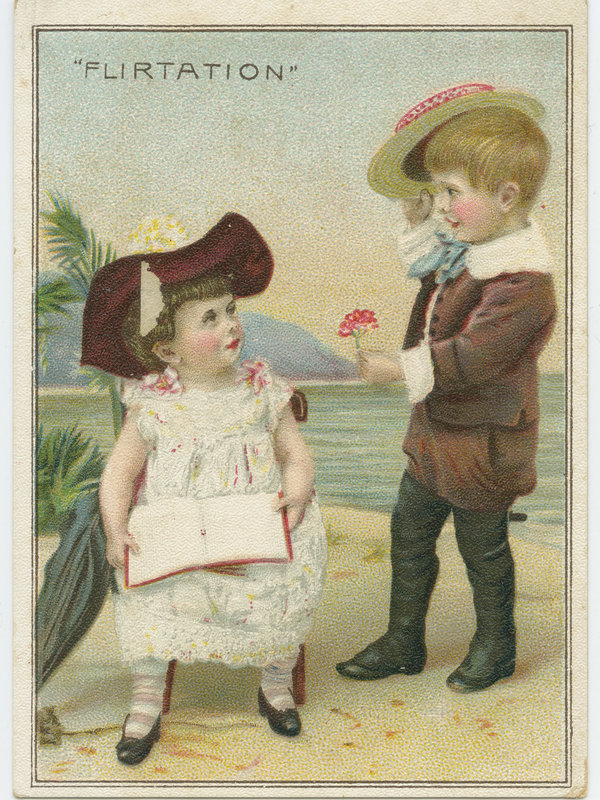
Flirtation, Calling, and Escort Cards: the social media of the 1890s

It's Christmas card time and I stumble upon the headline: "The 19th Century 'Escort Cards' with Pick-up Lines You Definitely Haven't Heard Before." The cards are lovely, but the headline is baiting. The escort card was one of many innocent types of Victorian cards. Escort, or "flirtation," cards were so commonplace that one American grocer adopted their style for an advertisement in 1900.

A commercial ad variation on the flirtation card,
issued by a grocery store. Circa 1900. Source.
1880s and 1890s flirtation cards came in two varieties: the calling card, and the escort card. The calling cards were used to formally introduce oneself to an acquaintance. A gentleman looking for love might have had a set of these printed up with his name on them to be used as an icebreaker at formal gatherings. The escort card was a novelty, reserved for more casual interactions.

Mid-century advancements in print making led to a proliferation of ephemera, like these and a great variety of other cards that helped people navigate the strict rules of middle-class etiquette. Like acronyms on the internet today, the verbal and non-verbal messages on the cards were a short-cut to communication understood by all who used them.
"To the unrefined or under-bred, the visiting card is but a trifling and insignificant bit of social paper; but to the cultured disciple of social law, it conveys a subtle and unmistakable intelligence. Its texture, style of engraving, and even the hour of leaving it, combine to place the stranger, whose name it bears, in a pleasant or a disagreeable attitude, even before his manners, conversation and face have been able to explain his social position." John Young, Our Deportment (1890).
Most commonly the calling card was left at the house of someone you wanted to visit. If the recipient wanted you to visit, they would send you their card. If no card was sent, or your reply card came back in an envelope, you weren't to return. The size of a gentleman's card indicated his marital status. Women's cards were always bigger than men's. During a first visit, a gentleman would leave a card for each lady in the household. Blank spaces on the cards could be used to write notes. Flirtation and escort cards filled those spaces with prepared messages.

If there was a late-Victorian social pastime greater than flirting, it was mourning. The symbols and decorations on mourning communicated the social status of the mourners and social status was, as it is, aspirational.


These cards were presented to everyone who attended the funeral.

When public figures, like Abraham Lincoln, passed, print shops around the world manufactured and sold the cards as collectibles and people most certainly collected them.

Set of three Lincoln mourning cards.
Albums for collection and display of cards were a common fixture in Victorian parlours. Printing a new card was like writing a Facebook status update in that you used it to communicate what you were interested in at the moment to your peers. Because the printing of cards was relevant to a wide range of social activities a collection of cards served as an entertaining record of all that had passed in your social network. When people didn't follow the proper usage of cards (like oversharing on Facebook), they faced social consequences (blocked/unfriended).

Wedding card (1883).
Assorted Victorian dance cards.
Like the Facebook newsfeed, card collections weren't limited to personal cards, but included photographic cabinet cards, advertisements, political propaganda, and cards with uplifting or humorous images and messages.

Someone said recently that in the age of social media, millennials have begun remembering their lives in the present moment, by documenting and sharing everything that happens to them. Cards were the Victorian way of doing the same thing - even allowing young couples to flirt in plain sight.

Follow me on Twitter @TinyApplePress and like the Facebook page for updates!

Monday, November 30, 2015

How to Eat Like a Victorian

At the end of one month, I plan out the details of mine and my husband's menu for the next month. Part way through Thanksgiving weekend, as I look toward Christmas, I feel compelled to keep us from gaining too much weight. As a Victorianist, I remembered reading recently that Victorian diets were some of the healthiest in history - if, of course, you practice better sanitation and avoid gimmicks, like arsenic wafers (those were never good for you)!

It's easy to find meal plans, like what I normally make, online and I often turn to them for inspiration, so I did the same thing in search of a Victorian menu, with no such luck. Of course, this was complicated by the fact that I don't want to eat like a poor Victorian, who ate weird street food and rotting vegetables. I also don't want to eat like a rich Victorian because they spent too much money and wasted too much food. I wanted a practical Victorian diet.

Excerpt from William Banting's Letter on Corpulence (1864)
In my effort to create a meal-plan for the Victorian middling sort, I consulted the Letter on Corpulence (1864) by William Banting, and certainly took his advice on tea and alcohol, but I also consulted numerous other sources to decide what we would eat on a typical week in December in 1889. As the woman of the house, I would be arranging the menu, as I am today, but I would have had a servant to cook it for me. Otherwise, we wouldn't have so many homemade baked goods and puddings.

Monday
Cold puddings!


Breakfast: a large cup of tea, a biscuit, preserves, broiled bone, and devilled kidneys.
Lunch: bread, with cold leftover beef and asparagus/potato, and a cold pudding.
Tea: a cup of tea, a pear, and a biscuit.
Dinner: 2 or three glasses of madeira, shrimp creole, spinach, rice, and a pear.
Supper: 1 or 2 glasses of madeira, and a little more shrimp, or a pear.

Tuesday

Breakfast: a large cup of tea, dry toast, a soft boiled egg, and ham or bacon.
Lunch: a couple pieces of buttered bread, a slice of meat, and a cold pudding.
Tea: a cup of tea, a pear, and a biscuit.
Dinner: 2 or 3 glasses of white wine, chicken baked in rice, asparagus, carrot, and walnuts.
Supper: 1 or 2 glasses of white wine, another piece of chicken, or some nuts.

Wednesday
Eggs for breakfast in the 1890s (source).


Breakfast: a large cup of tea, bread, bacon, and eggs.
Lunch: cold chicken sandwich, a cup of warm broth, and a cold pudding.
Tea: a cup of tea, a pear, and a biscuit.
Dinner: 2 or 3 glasses of white wine, curried fish (preferably cod), carrots, turnips, and nuts.
Supper: 1 or 2 glasses of white wine, and another small piece of fish.

Thursday

Breakfast: a large cup of tea, leftover fish, a fried egg, and a biscuit.
Lunch: a couple pieces of buttered bread, a slice of meat, and a cold pudding.
Tea: a cup of tea, an apple, and a biscuit.
Dinner: 2 or 3 glasses of good claret, Spanish stew, with bread, salad, and sliced apple.
Supper: 1 or 2 glasses of good claret, another meatball,

Friday
Kitchen utensils.


Breakfast: a large cup of tea, savoury eggs, and bread.
Lunch: a couple pieces of buttered bread, a slice of meat, and a cold pudding.
Tea: a cup of tea, grapes, and a pudding.
Dinner: 2 or 3 glasses of sherry, fried fillets of sole, green peas, and grapes.
Supper: 1 or 2 glasses of sherry, and small piece of sole.

Saturday

Breakfast: a large cup of tea, and leftover fish on buttered bread.
Lunch: a couple pieces of buttered bread, a slice of meat, and a cold pudding.
Tea:  a cup of tea, an apple, and a biscuit.
Dinner: 2 or 3 glasses of white wine, beans & bacon, sauté breast of marinated chicken, boiled potato, and sliced apple.
Supper: 1 or 2 glasses of white wine, and another piece of chicken.

Sunday

Breakfast: a large cup of tea, beans & bacon, with savoury eggs, fried potato, and toast.
Lunch:  cold chicken sandwich, a cup of warm broth, and a cold pudding.
Tea:  a cup of tea, an apple, and a biscuit.
Dinner:  2 or 3 glasses of good claret, beef, potatoes, asparagus, and sliced apple.
Supper: 1 or 2 glasses of good claret, and a little chunk of beef.

The breakfast bread, bacon, and eggs of modern brunch was well-established by the Victorian era. Eggs were typically boiled, fried, or poached. Wootton Bridge Historical has several good Victorian recipes for morning eggs, including: egg fritters, curried eggs, and Turkish eggs. Broiled bones and devilled kidneys, however, were just as common. Devilled kidneys were lambs kidneys cooked in a spiced sauce. Also common was the leftover cold meat from the previous evening's meal. Friday's savoury eggs are scrambled and fried with the Spanish meatballs from Thursday's meal.

To be practical and not create a lot of waste, food from the previous evenings meal could be eaten at lunch too. Preserving food was an important part of life in a Victorian kitchen. Potted meats could easily be used at lunch and I found a recipe for potted rabbit here. I think potted meat was the reason anyone ever thought of suggesting SPAM as something to eat. In the absence of leftovers, it could be spread on bread, during lunch. My suggestion of a "cold pudding" is based on James Greenwood's Seven Curses of London (1869), as quoted here.


I will have nothing new add to existing conversations about Victorian tea. I borrowed these recommendations from Banting.

It is easy to find out about what Victorians ate when they were entertaining, but what about when it was just the family at home? Did they always have 14 course dinners? Often not! During my quest for Victorian dinner recipes that my husband would eat, I found some one-pot meals, like the chicken baked in rice, which is like a meat pie with a meat crust and none of the vegetables. I added vegetables to this meal. For dinner, most records suggest a meat dish, two vegetables, and a bit of fruit for dinner.

For dinner, I would use Wootton Bridge Historical's curried fish recipe, and found many other recipes there too, including the fried fillet of sole and on the same site, Spanish stew recipe. Sunday dinner after church was always beef.

Dinner was the main meal of the day. It happened in the afternoon, or early evening. Supper was the Victorian equivalent of a late-night snack. By all reports, most people just picked at what was leftover fro dinner when suppertime came around, as they seemingly did for all their other meals.

When all is said and done, however, I'm having a hard time believing the five glasses of alcohol a day are really good for you, but maybe because so many preservatives and weird sugars have been cut from our diet, maybe...

Follow me on Twitter @TinyApplePress and like the Facebook page for updates!

Monday, November 23, 2015

Victorian Teenagers Gone Wild

The girl in the top left corner
has a mischievous face.
Throughout history, teenagers have rebelled against their parents. Popular psychology maintains that youthful rebellion helps young people build their own identity, separate from their parents. It happens in every class, culture, and race, so of course it happened in the Victorian Era.

You may say: "but Victorians were so proper!"
"Myths about the Victorian family are almost as numerous as those about the American West. Many regard the institution as a model for modern life, full of dutiful children and loving parents. Others see it as an example to avoid -- rigidly patriarchal, unloving, and riddled with class and gender restrictions. Both views, though too generalized, contain some truth, partly because of the tremendous variety of family lives during Queen Victoria's reign. Good or bad, families were the most important factor in a child's success in life" - Ginger S Frost.
 Even today, we tend to attribute the tendency to rebel with trouble in the individual, sometimes linking rebellious behaviour with the early signs of a psychopathic personality. Though teen rebellion often seems selfish, fed by boredom and glib, it generally has nothing to do with those traits in the person, but more to do with what one is rebelling against.


Young middle and upper-class Victorians became social reformers, committed to mending the injustices perpetrated by their society and sometimes within their own families. Young Victorians, like Bram Stoker, became aware of the problems associated with alcoholism and other addictions. The era saw the rise of the suffragette and educational reforms to help the poor. Of course, some young women started smoking and drinking to irritate their parents and some young men dressed below their station, so they could sneak into the poorer neighbourhoods for a bit of slumming - not all rebels are altruistic. We all had that friend who made us aware of broader social problems by personifying them.

1909 woman smoking opium.
Although teen rebellion was wide-spread, two particular people come to mind, when I think of 1890s writers, who were rebellious teenagers: Edmund Gosse and Constance Wilde.

Philip Henry Gosse with his son Edmund (1857).
Frontispiece to the first edition of Father and Son.
Obviously, Gosse comes to mind because of his memoir, Father and Son (1907), which bore the subtitle: "a study of two temperaments." His father, Philip Henry Gosse was a deeply religious scientist, who rejected the theories of his contemporary, Charles Darwin. In Father and Son, Gosse focuses on his father's rejection of the theory of evolution and his own coming of age through the rejection of his father's religion.
My own state, however, was, I should think, almost unique among the children of cultivated parents. In consequence of the stern ordinance which I have described, not a single fiction was read or told to me during my infancy. The rapture of the child who delays the process of going to bed by cajoling 'a story' out of his mother or his nurse, as he sits upon her knee, well tucked up, at the corner of the nursery fire—this was unknown to me. Never in all my early childhood did anyone address to me the affecting preamble, 'Once upon a time!' I was told about missionaries, but never about pirates; I was familiar with hummingbirds, but I had never heard of fairies—Jack the Giant- Killer, Rumpelstiltskin and Robin Hood were not of my acquaintance; and though I understood about wolves, Little Red Ridinghood was a stranger even by name. So far as my 'dedication' was concerned, I can but think that my parents were in error thus to exclude the imaginary from my outlook upon facts. They desired to make me truthful; the tendency was to make me positive and sceptical. Had they wrapped me in the soft folds of supernatural fancy, my mind might have been longer content to follow their traditions in an unquestioning spirit.
As Gosse grew up to be a poet, it's safe to say that his life was formed through his parents' teachings - though not in the ways that they intended.

Constance Lloyd
(before she married Oscar Wilde).
Constance Wilde had a terrible relationship with her mother. Franny Moyle, Constance's biographer, called Constance's mother "a selfish and difficult woman." Her mother's conduct toward Constance may be characterized as abusive. It was a relationship that Constance survived through forming a rich internal life and getting away to school by taking classes at the University of London. The 1871 and 1881 censuses describe Constance as a scholar. As was the case with Gosse, Constance's rebellion was ideological, but also deeply personal.

The outfit that Constance is pictured in above was typical of young aesthetes in her day, which was viewed as both a fashion and an intellectual movement - almost the way that hippies, or people who only wear vegan clothing can be viewed as participating in both a fashion and intellectual (or moral) movement. Constance's brother mocked her dresses and the rest of her family, including an eventual step-sister, encouraged her to dress more like them. But Constance married the Prince of the Aesthetic Movement and realized her independence through marriage - a trope in young Victorian women's lives.

Gosse and Constance's stories critique the Victorian Era as a whole and represent examples of positive social changes (women's education and learning in general), but not all teenage rebellions go so well.

Teen pregnancies are often used as a symbol of teenagers gone wild, so it is worth noting here that during Queen Victoria's reign the rate of premarital pregnancies hovered around 20%, according to Eurostat. It's likely that number was much higher. Yet, there is something twisted about viewing sex as an act of rebellion.

Boys marching out of the London Foundling Hospital for the last time (1926).
For more on the London Foundling Hospital, click here.
The "fallen woman" was a blanket term that Victorians applied to any unmarried woman with sexual knowledge of any sort. This term covered rape victims, prostitutes, and unwed mothers alike; in some families, it might even be applied to a woman who read French novels.

The "new woman" represented another kind of rebellion, closer to what young Constance Wilde was up to.  This term was popularized by Henry James in the 1870s and referred to an emerging feminist ideal.
"In Victorian England, as men clung to the sanctity of the patriarchy, they were increasingly becoming more and more frightened of their own women. Bram Stoker capitalized on this fear in his iconic novel, Dracula. In 1897, a "New Woman" was emerging in Victorian society, coinciding with the women's suffrage movement throughout England. This New Woman, riddled with feminist awareness, would be the cause of fodder for Stoker's heroine, Mina Harker. Because this New Woman was aspiring to be independent of patriarchal male dominance, (or had already obtained said independence) to the old guard of Victorian society, she was viewed as perverse. The New Woman was a mutation of the woman the patriarchal society wanted her to be. The New Woman's strides towards economic and sexual changes in society as a whole should be viewed as terrifying. Stoker takes these beliefs, and applies them to his female characters in Dracula" - source.
Even Bram Stoker's wife might have been viewed in terms of the new woman for her interest in aesthetic, also called "hygienic," dress, she ran in the same circle of women as Constance and even once dated Oscar Wilde.

"New Woman — Wash Day" (1901)
Oscar Wilde's youthful romance with the future Mrs Stoker was also a kind of young rebellion because she was penniless, while he came from an upper-class family, whose fortune was waning.

There were lots of ways for young men to rebel, especially in the 1890s. Any society that oppresses one group, the way that Victorians repressed women, also represses the dominant group by making the perceived characteristics of the oppressed group taboo. Oscar Wilde rebelled by incorporating long hair and feminine characteristics into his interpretation of aestheticism.

Young people help refresh the human population, getting rid of the old ideas that aren't working anymore.

Follow me on Twitter @TinyApplePress and like the Facebook page for updates!