Showing posts with label Ancient Legends Mystic Charms and Superstitions of Ireland. Show all posts

Monday, October 7, 2013

How to Raise a Horror Writer


Bram Stoker was a sickly child and spent a lot of time in bed, while his loving Irish mother, Charlotte Mathilda Blake Thornley (hereafter referred to as "Mother Stoker") entertained him with stories. Many of her stories were oral histories, the kind that the Brothers Grimm sought out in Germany, the kind that appeared in Speranza's Ancient Legends many years later. Sometimes, Mother Stoker would tell little Stoker about the horrors of the potato famine, as he drifted off to sleep other times the stories came from her own family history.

One was about her great-great-great... grandfather. I haven't been able to find much evidence to support her ancestry, but the story of this particular grandfather is scary and fascinating.

First, I didn't know the word "lynch" had different etymology rooted in Ireland than it does in the States. The Irish etymology predates the American through the Stokers' grandfather, James Lynch Fitzstephen, also sometimes called James Fitzstephen Lynch.

Lynch was the infamous cold-hearted mayor/judge of Galway Ireland. The story goes that Lynch's son Walter was jealous of his father's Spanish houseguest, whom he believed was wooing his lady. In a fit of rage, he killed the Spaniard, but sobered up and confessed his crime. The people of Galway, for some reason, were on Walter's side and pleaded mercy on his behalf, but his ruthless father found him guilty and hung him out the window of their home. The house is gone, but the window is still there, marked with a plaque.

This memorial of the stern and unbending justice of the chief magistrate of this city, James Lynch Fitzstephen, elected mayor in A.D. 1493, who condemned and executed his own guilty son, Walter, on this spot.’ He was one son who was not spared.
As gruesome a story as this is, especially for telling a sick little boy, I did find a compelling argument for why the American etymology is more popular. Lynching is something that takes place outside of the law, whereas the mayor of Galway acted within the law. Earliest published use of the term dates back to 1811, well after Charles Lynch added his name to the list of terrible Lynches associated with the word, but, as if to accommodate differences of opinion on its etymology, the OED specifies that in its early use the word implied only "the infliction of punishment, such as whipping" etc.

I have to stop there because the history of the word is so awful that it makes me sick and I lose sleep. Other stories Mother Stoker used to tell were about deaths through the Potato Famine (1845-52). It's possible that she told these stories from her own memory. Punch comics sure had some things to say on the subject.


If Mother Stoker didn't make her son an author of horror stories with those tales, she also had Manus the Magnificent to talk about. Manus O'Donnell (d.1564) was an Irish clan leader and important member of the O'Donnell dynasty based in County Donegal. His father, Hugh, was crowned king of the O'Donnells during their clan's terrible feud with the O'Neills. Just reading his wikipedia entry is like watching the Game of Thrones.

Stoker fans everywhere look for traces of the Tales of Mother Stoker in Bram Stoker's Dracula. I can certainly see that when I think of Dracula talking about history after reading about Manus the Magnificent. The Mayor of Galway also posed a good model for a villain and might have made Stoker more sympathetic, when reading about Vlad the Impaler. But Stoker read about Vlad as an adult, so he must have loved listening to the terrible stories his mother told him as a boy.

***

A few days after I originally posted this, pieces of the stories that I imagine Mother Stoker telling her son start turning up in all of Bram Stoker's writing for me. Most shocking are the final words of Stoker's best known short story, "The Judge's House." My focus is overwhelmingly on the 1890s and Dracula, so as obvious as the connection is between the Mayor of Galway and "The Judge's House," I overlooked it until now. The story ends with the line:
There at the end of the rope of the great alarm bell hung the body of the student, and on the face of the Judge in the picture was a malignant smile.
Please, post a comment, if you find any other connections that I might have overlooked.

Follow me on Twitter @TinyApplePress and like the Facebook page for updates!

Wednesday, July 24, 2013

Irish Legends and a Polish Vampire Graveyard


Today, I'm using a story about a vampire graveyard to talk about a book by Oscar Wilde's mother. The connections between the story and the Ancient Legends, Mystic Charms, and Superstitions of Ireland is tenuous at best, but I believe that Oscar Wilde's mother was a help to Bram Stoker when he was researching Dracula.

Here's the story: road workers in southern Poland recently found a total of seventeen oddly-buried skeletons. The heads were cut off and lay between the hands or knees of the deceased. The bodies date back to the fifteenth or sixteenth centuries, to when fear of vampires was common in the area. Lukasz Obtulowicz, a supervising archaeologist, recognized clear indications that this was a vampire burial site and he noted that stones were placed on the skulls “to prevent the vampires from returning to life.” (Read the full story here.)
"I shall cut off her head and fill her mouth with garlic, and I shall drive a stake through her body."- Van Helsing in Dracula
Clearly, this is the stuff of the legends that Bram Stoker built his vampire story, Dracula, upon, but Bram Stoker never traveled to eastern Europe. His brother, Dr. George Stoker did and may have told him some of these stories about vampires. Bram Stoker first learned about vampires, however, from his mother as a child. Stoker grew up near the Wilde family in Dublin. Oscar Wilde's mother, Lady Francesca Speranza Wilde concedes near the beginning of her book, Ancient Legends, Mystic Charms, and Superstitions of Ireland (1887), that:
Greek, Slav,Teuton, Gypsy— many of their superstitions are dark and gloomy, especially those relating to vampires, wolves, andterrible demons, evil spirits, and fearful witches. The Irish legends rarely deal with anything terrible or revolting.
But Speranza shares a few disturbing Irish legends.
This story of Kern of Querin still lingers in the faithful, vivid Irish memory, and is often told by the peasants of Clare when they gather round the fire on the awful festival of Samhain or November Eve, when the dead walk, and the spirits of earth and air have power over mortals, whether for good or evil.
[...] for the souls of the dead have power over all things on that one night of the year; and they hold a festival with the fairies, and drink red wine from thefairy cups, and dance to fairy music till the moon goes down. 
And a story that goes a small distance toward helping me understand why my daughter is terrified of moths!
At last the agony seemed to cease, and the stillness of death settled on his face. Then the child, who was watching, saw a beautiful living creature, with four snow white wings, mount from the dead man's body into the air and go fluttering round his head. 
So he ran to bring the scholars ; and when they saw it they all knew it was the soul of their master, and they watched with wonder and awe until it passed from sight into the clouds.
And this was the first butterfly that was ever seen in Ireland; and now all men know that the butterflies are the souls of the dead waiting for the moment when they may enter Purgatory, and so pass through torture to purification and peace.
Speranza's Irish fairies steal beautiful healthy children and put dead ones in their place.
Sometimes when the fishermen are out they meet a strange boat filled with people; and when they look onthem they know that they are the dead who have beencarried off by the fairies with their wiles and enchantmentsto dwell in the fairy palaces.
And to be certain, the first vampire that Dracula makes when he gets to Whitby looks more like one of Speranza's Irish fairies than she does a Nosferatu.

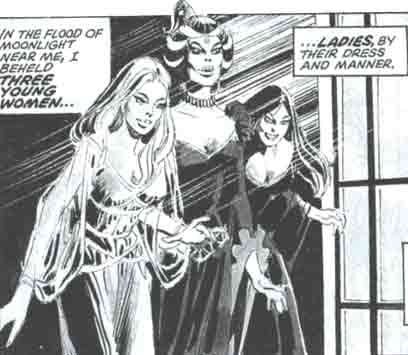
There's even part in Speranza's Ancient Legends that reminds me of the scene in Dracula, where Jonathon Harker faces the three brides of Dracula.
And when Hugh looked he saw a girl that had died the year before, then another and another of his friends that he knew had died long ago; and then he saw that all the dancers, men, women, and girls, were the dead in their long, white shrouds. And he tried to escape from them, but could not, for they coiled round him, and danced and laughed and seized his arms, and tried to draw him into the dance, and their laugh seemed to pierce through his brainand kill him. And he fell down before them there, like one faint from sleep, and knew no more till he found himself next morning lying within the old stone circle by the fairy rath on the hill.
What really made me connect the Polish Vampire Graveyard with Speranza's Ancient Legend was superstition about burying the (un)dead. The full-text of Speranza's book is here and it's full of these kinds of superstitions, like if a suicide is buried in a normal cemetery all the other corpses will turn over on their faces.

Follow me on Twitter @TinyApplePress and like the Facebook page for updates!

Sunday, April 21, 2013

The Importance of Being Oscar Wilde's Mother


Lady Jane Francesca Agnes Wilde (1821-1896), better known as "Speranza," was the youngest child of four in Wexford Ireland. She was an Irish nationalist some Italian roots, though she put stereotypes about that heritage to rest by being over six feet tall and devoting herself to the love of Ireland. She was a poet and her contemporaries considered her a national treasure because wrote about freedom for the people of Ireland, but as time went on tastes and politics would change, so that the younger Irish revolutionaries weren't as able to relate to her work.

She fell in love with and married William Wilde, a scrawny and often disheveled-looking man, who must have looked even smaller standing next to his larger-than-life wife; it was said that she was extremely tall and overweight, “walked like a ship at sea, the sails filled with wind.” For this, she was subject to abuse throughout her life, but developed a strong talent for putting people in their place and would defend the people she loved as well as she defended Ireland.


Sometimes, I think intelligent outcasts are the most important people the development of creativity and culture within any particular group. Henry VIII made big sleeves fashionable for men because preexisting fashions didn't suit his growing figure. Speranza dressed like gypsy, even when she could afford the fashions of her day, and wore cheap costume jewelry, sometimes made of pieces of older broken costume jewelry. The odd biographer suggests that she favoured darkness because it concealed certain physical features that made her insecure; but, according to her, she liked dark rooms lit by candles because it encouraged "bawdy talk."

These dark spaces in her house, which notable always had all of its shutters shut, were decorated with books and artifacts collected during William Wilde's archeological journeys to Egypt and by Speranza herself, who enjoyed busts and paintings from ancient Greece and Rome.

If being "the Irish Poetess" of her day weren't fame enough, she became a famous entertainer, hosting popular salons at her home in Dublin and later in London. She got know many of the most famous creatives and revolutionaries, especially feminists and the political types, that set foot in whatever city she happened to be in, which makes it hard to believe that she was all that shy about being out in the open and walking in the light. When asked how she managed to attract such interesting people, Speranza replied, "By interesting them, of course!"

In addition to the two daughters William Wilde had outside of his marriage, Speranza had two sons and a daughter. Her daughter died in childhood; her firstborn was named for her husband and would always be her favourite, even when he grew up to be a lecherous alcoholic; and her other son was Oscar Wilde. Because of her, the boys were well-educated before they even started school, though some acquaintances, like Lord Alfred Douglas, suggested she might not have provided the most wholesome environment for the boys, due to the types of people she kept around and the types of things they would discuss.

Ostensibly, "respectable people" were forbidden from her home because they were usually so uninteresting. Many of their friends attributed Oscar Wilde's wit to his mother.

Things took a turn for the unfortunate, when William Wilde Sr. was knighted. Speranza believed this misfortune came because fortune and fame attract the maliciousness of jealousy. A Dublin man, whose daughter was a patient of Sir William Wilde, the oculist, claimed Sir Wilde was sexually inappropriate in his conduct toward the young lady and would seek legal action. Speranza must have flown into a rage and wrote a nasty letter to the man, for which they were eventually sued and lost most of their wealth. It was about this time that both of Sir Wilde's daughters burned to death in a fire due to the restrictive nature of their fashionable clothes.


Sir Wilde died not long after and Speranza moved to London with both of her sons. In her reduced circumstances, she relied on the financial assistance of both her boys and earned a modest living as a journalist. She finished the work that she began years ago with her husband and published Ancient Legends, Mystic Charms and Superstitions of Ireland (1888). Oscar began making a name for himself and Speranza continued to hope that both her boys would find their place in parliament. Her favorite son wasn't doing as well as Oscar though.

In London, Speranza became active in the fight for women's legal rights; specifically, the right for a woman to retain her wealth in marriage. She was part of a successful act to support these rights, but, as luck would have it, she needed to find a wealthy wife for her favorite son. The marriage lasted less than a year and Willie came home penniless. Even after he took a second wife, Willie would live with his mother to the end of her days. Many famous people still came to her salons, but she was heard at one such event saying that her life had been reduced to "the importance of being Oscar's mother."


I believe that Speranza died of a broken heart, when Oscar Wilde went to prison. When the trials started, she didn't believe they would imprison her son and wouldn't hear of him fleeing the country. He was, after all, "an Irish-born gentleman." The official cause of death was bronchitis, but her health deteriorated rapidly after Oscar's conviction. Even her requests to visit with him were denied.

Oscar's wife, came back to London from Europe, to break the news of his mother's death to Oscar personally, so that he wouldn't take it too hard.

Follow me on Twitter @TinyApplePress and like the Facebook page for updates!