Showing posts with label famous people. Show all posts

Tuesday, August 11, 2015

Popular Perceptions of Electricity in the 1890s


If you lived in a major city, like London, electricity had become part of your everyday life by the 1890s. You might not have it in your home, but even if you did, you might not understand what it was.

Even electrical engineers, like Nikola Tesla, used words like "energy" to describe that which was generated by electricity and that which he felt after sleeping. It's not clear that many people distinguished between the two. Tesla actually got the idea for tuning radio frequencies through his belief that he and his mother were tuned into the same frequency when she died. Still, Tesla understood more about electricity than most people do today, but the electrical revolution was spreading rapidly.

A town called Godalming, Surrey, built the first central station to provide electricity to the public in the fall of 1881. They did so because the disagreed with the rate the gas company was charging them. I understand the feeling from dealing with my internet provider. Godalming's system was first used for their street lamps, but within the year more than 80% of its homes were connected. Overall, the town wasn't happy with their new electrical system and reverted to gas (also a familiar feeling in dealing with new internet providers). However, by 1882, London had a large-scale power station at Holburn Viaduct.

The power Holburn Viaduct produced was mostly used to power public resources. In spite of widespread apprehension the rails of the London Underground were being electrified. People worried about potentially-fatal electrical short circuits and dangerous accidents. London's Bersey Cabs hit the London streets in 1897. By 1899, ninety percent of New York City's taxi cabs were electric. Electrification of the home was reserved for the most forward-thinking members of the upper class, with the Savoy Hotel being the first such establishment to run its lights and lifts on electric power. While this impressed many of its guests, the popular imagination still viewed this new power source with as much fear as it did curiosity. 


Many people believed electricity could recharge their bodies. The field of medicine was experimenting with electricity. Even rural doctors would charge for coursing low levels of electric current through the body in an effort to cure a variety of real and imaginary ailments. Of course, wherever you could find a quack Victorian doctor, you could find quack Victorian products.


I don't know what electric oil was, but it sounds like wonderful stuff. Moreover, I'm also not sure how you get electricity in a bottle.


In the midst of all this electric healing, electricity was deliberately used to kill for the first time in 1890, when a convicted murderer, William Kemmler sat in the electric chair on 6 August 1890. The first attempt left Kemmler unconsciousness, but did not stop his heart and breathing. After they recharged the generator, the second attempt ruptured blood vessels under Kemmler's skin; the areas around the electrodes singed. Kemmler's execution took about eight minutes. George Westinghouse later commented that "they would have done better using an axe," and a witnessing reporter wrote that it was "an awful spectacle, far worse than hanging." Some say Kemmler burst into flame before finally dying.

Thomas Edison horrifically played on the public's fears about the dangers of electricity when attempting to discredit his competitors by electrocuting and torturing dogs, cats, cows, horses, and most famously, an elephant in public demonstrations.


In conclusion, 1890s people thought electricity had the potential to replace gas as a fuel source; that it was deadly dangerous; but that in small amounts, electricity had magical healing powers. I've read just enough to believe the rumours that some people actually wore electric jewelry for its healing powers and will leave you with the steampunk Jem image that conjured in my mind. The reference here is, of course, to Jem's flashing earrings.

Follow me on Twitter @TinyApplePress and like the Facebook page for updates!

If you have enjoyed the work that I do, please support my Victorian Dictionary Project!

Tuesday, April 28, 2015

The Victorian (and pre-Victorian) Pug Cult

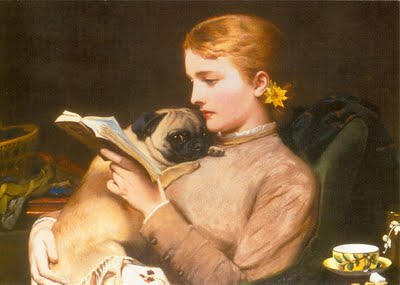
"Blonde and Brunette" by Charles Burton Barber
The rise of the pug cult is popularly traced back to when the British found pugs in the Chinese Imperial Palace during their invasion of China in 1860 and brought them back to England, where black pugs, in particular were made popular by someone called Lady Brassey. "Lady Brassey" probably refers to the travel writer and Baroness, Anna Brassey, who died in 1887. Though it is said she presented a black pug at the Maidstone show in 1886, just a year before her death.

Soon after Brassey made them cool, Queen Victoria became fond of the breed. She had several and it was through her involvement in breeding pugs that the Kennel Club was established in 1873. It was, consequently, a pug who won the first best in show of the Westminster Kennel Club in 1877.

Dog fancying is linked to the Victorian cult of domesticity, supported by the Queen, who commissioned a painter, specifically Charles Burton Barber, to capture her beautiful dogs (and others) on canvas.

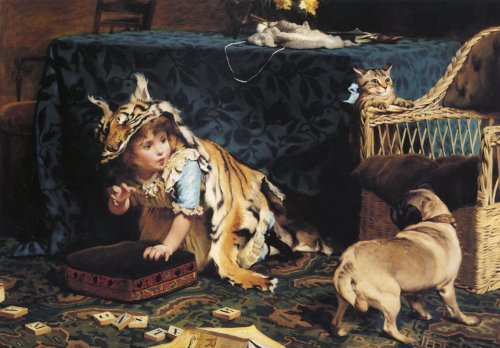
"A Monster" by Charles Burton Barber
According to one blogger, other artists followed suit with amazing results:


I've been wearing mostly jeans, and one blazer has already had a few threads pulled since I got my own little brindle pug a few weeks ago, so I am astonished at that dress. All of the pictures above depict scenes of feminine domestic bliss in the typical Victorian fashion: women and children in household settings with their pets. But, as with everything in the nineteenth century, nothing was as simple as it seemed.


Before Victorian England embraced them, pugs were part of a very masculine culture in continental Europe and this is where it gets really weird.


The Mops-Orden (German for the "Order of the Pug" was a Catholic para-Masonic society that was supposedly founded by Klemens August of Bavaria in 1740 to bypass a papal bull. To the Order of the Pug, the pug represented loyalty, trustworthiness and steadiness, whereas now they are known primarily for their flat faces and love of cheese. Those who belonged to the Order of the Pug were called Mops (Pugs). New members underwent an initiation process that involved wearing a dog collar and behaving, in various ways, like a dog: scratching at the door to get in and kissing a porcelain pug's bum.

The secrets of the Order of the Pug were exposed in Amsterdam in 1745, but it took three years for anyone to ban them (maybe it took that long for them to take it seriously). However, it is rumoured that the Order was active until 1902.

A Pug by Carl Reichert (1836-1918)
Before the British Invasion in 1860, pugs were imported to the European continent by the Dutch East India Company. The dogs have a long history in China and are considered one of the oldest and most loyal breeds, housed only in Tibetan Monasteries and by members of the Chinese Imperial household.

Aside from Queen Victoria's pugs, Minka, Venus, Rooney, Olga, Fatima and Pedro, the most famous pug in European history is probably a little guy, called "Pompey," who, contrary to Monty Python lore, expected the Spanish Inquisition and alerted his master the Prince of Orange William the Silent to their arrival in 1572, thereby saving his life.

So while it is popular to trace the pug cult back to Queen Victoria and Lady Brassey, it has most certainly been around a lot longer than that!

Queen Victoria and one of her pugs.
Follow me on Twitter @TinyApplePress and like the Facebook page for updates!

If you have enjoyed the work that I do, please support my Victorian Dictionary Project!

Saturday, March 14, 2015

Humans of London: Bram Stoker

Again, my twist on Humans of New York, but London in the 1890s...

Yesterday I posted one for Arthur Conan Doyle.

Follow me on Twitter @TinyApplePress and like the Facebook page for updates!

If you have enjoyed the work that I do, please support my Victorian Dictionary Project!

Wednesday, December 25, 2013

100 Random Things about Oscar Wilde

In honour of this being my 100th post, I’m sharing 100 things you probably didn’t know about Oscar Wilde. If you knew any of this stuff keep track of how many points you get. Your score should be out of 100. Leave your result as a comment. If you have more Wildean wits about you than I did when I started this list, I’ll have your email address and can contact you in the future, if I have any questions! (Just kidding, sort of.)


1. “The optimist sees the donut, the pessimist sees the hole.” At different points in his life, Wilde comes across as pessimistic and optimistic. His writing style, his critique of his contemporaries, and his ability to laugh at the world around him combine to indicate that he was a realist.

2. One of his greatest gifts was the ability to smile at his own misfortune.

3. Wilde was raised Anglican and Catholic. In college, he became infatuated with the Catholic Church, but did not become a convert until the end of his life. I found an interesting Catholic interpretation of his life on CatholicEducation.org

4. “I never change, except in my affections.” Wilde only dreamt of being able to live this way. His writing sympathized with a common longing for eternal youth and the ability to always remain the same. In practice, once you had Wilde's affection, you always had his sympathy. He had many life-long friendships.

5. Wilde lacked musical talent and never appreciated music, even during his Aesthetic period.

6. Wilde once claimed to never travel anywhere without his copy of Studies in the History of the Renaissance by Walter Pater.

7. Wilde visited Egypt, as a child, and was always fascinated by sphinxes.

8. Although the New York Tribune claimed Wilde’s teeth were “superlatively white,” he was embarrassed by his teeth, often spoke with his hand in front of his mouth to cover them, and eventually got dentures.

9. Wilde disliked idle conversation. “Conversation about the weather is the last refuge of the unimaginative.”

10. Wilde was a tremendously sensitive man, quite capable of indulging in self-pity, but usually only when he had genuine reasons to feel bad for himself. Moreover, he was just as affected by the hardships of others.

11. Wilde was clearly outgoing, but enjoyed privacy and was most productive as a writer when he was alone. Wilde got restless quickly, but always seemed to find himself quite entertaining.

12. Wilde’s ability to speed read and remember long passages has been attributed to an eidetic memory.

13. Wilde’s brother was a newspaper writer, so he often pokes fun at them.

14. Wilde was a very superstitious child, whose mother told him stories about macabre beasts. In the children’s books he wrote, as a father, his antagonists were generally friendly.


15. Wilde met Pope Piux IX, as an undergraduate in 1877.

16. Wilde became famous for his personality. After meeting Wilde at the Royal Court Theatre, Helena Modjeska once said, “What has he done, this young man, that one meets him everywhere? Oh yes he talks well, but what has he done? He has written nothing, he does not sing or paint or act - he does nothing but talk. I do not understand.”

17. In an unguarded moment, Wilde once told the 15 year-old daughter of a friend that if she were a boy, he would adore her. Her name was Aimée Lowther.

18. Wilde travelled extensively throughout Africa, Europe, and the United States.

19. Sex tourism was the most likely reason for Wilde's travel to Africa in adulthood.

20. Wilde's plays got mixed reviews from London theatre critics. One of his worst most vocal critics was his own brother.


21. Wilde feared nothing more than he feared God. The thought of eternal punishment was the one thing that prevented him from committing suicide, during his darkest moments, he told Vincent O’Sullivan.

22. The last gift Wilde gave to his two sons was a copy of Rudyard Kipling’s The Jungle Book.

23. Biographer, Neil McKenna says that Wilde wasn’t good at making a first impression and quotes Bosie, in The Secret Life of Oscar Wilde:
There is no charm in his elephantine body, tightly stuffed into his clothes - no charm in his great face and head of unselect Bohemian cast - save the urbanity he can adopt or the intelligence with which he can vitalise his ponderousness.
24. On holiday, Wilde enjoyed days spent paddling about in a “Canadian canoe.”

25. Wilde wasn’t good at horseback riding.

26. Wilde loved dirty French novels. His love of them almost ruined a British publication.

27. Some say Wilde is the most quotable author of all time, but he once drew a blank when someone asked him what his motto was.

28. Wilde kept a vase of flowers on his writing desk to neutralize the smell of his ashtray.

29. The only time Wilde wasn’t self-conscious about his appearance was when he was playing with his children.


30. Wilde was born at 21 Westland Row, Dublin, which is now the home of the Oscar Wilde Centre, Trinity College.

31. When Wilde published the Happy Prince and Other Tales in May 1888, the Anthaeum compared him to Hans Christian Anderson, which was a far cry from the reputation he had carefully crafted for himself.

32. If you met him and he liked you, Wilde would probably give you a cigarette case.

33. Growing up, Wilde had three pet names: “Ossie” with his family, “Grey Crow” at school, and “Hosky” at Oxford.

34. Wilde had a hard time saying no when asked for money.

35. Wilde’s favourite drinks were brandy and absinthe.

36. The Wildes had servants to cook and clean, but usually ate meals on credit at the hotel.

37. Wilde had five siblings: William 'Willie' Charles Kingsbury Wilde; Isola Francesca Emily Wilde, who died as a child and broke Wilde’s heart; his half-sisters - Emily and Mary Wilde; and his half-brother, Henry Wilson.


38. Early biographers look at the above childhood photo of Wilde dressed in frills and suggest that his mother wanted him to be a girl, thus arousing Wilde’s interest in men, but this was not true in anyway. In mid-nineteenth century Ireland, boys were traditionally dressed as girls to protect them from the dred due, a kind of blood-thirsty fairy, who abducted little boys, but ignored little girls. Wilde’s mother adored old Irish myths and legends, almost as much as she adored her little boys.

39. Wilde had as many female friends as he did male friends and, in fact, was an important contact for female writers in the 1880s.

40. For Christmas 1877, Wilde gave his girlfriend, Florence Balcombe, a small gold cross.

41. The executor for the estate of Oscar Wilde was a Canadian, Robert Ross.

42. Ross is also responsible for bring Wilde back into popularity with his 1908 edition of Wilde’s collected works.

43. Ross worked tirelessly to protect Wilde’s work, after Wilde was gone. This included fighting the rampant black market trade in erotica that was published falsely under Wilde’s name.

44. Wilde often claimed to be two years younger than he was and even lied about his age on his marriage certificate.

45. Wilde never enjoyed competitive sports, but he liked athletes.

46. Wilde tested out his clever maxims in conversations before putting them in his writing.

47. Wilde frequently suffered from writer’s block.

48. Wilde enjoyed sentimental friendships more than romances.

49. After he finished school, Wilde made money lecturing on aesthetics.

50. Wilde’s American tour was funded by Gilbert and Sullivan.


51. One of Wilde’s first impressions of America was that American men “seem to get a hold on life much ealier than we do.”

52. The hardest decision Wilde ever made was probably the decision not to flee to Paris before his trials were over. Even the judge expected him to do it. His family talked him out of it, specifically his mother and brother.

53. Wilde began writing the Sphinx in 1874 and spent many years working on it. He finally published it in 1894.

54. In the beginning, Wilde was uncertain how to go about publishing his poetry, so he wrote to the PM and asked for help, assuming, correctly, that an Oxford boy would not be ignored. “I am little more than a boy,” Wilde wrote and Gladstone wrote back, suggesting his send his poetry to the Spectator. Wilde followed this advice and was met with success!

55. Wilde’s father was a polymath.

56. Wilde spent money as fast as he got it.

57. Before and after they were married, Wilde borrowed money from his wife’s brother.

58. Wilde’s wife, Constance was a writer in her own right and had her own income.

59. In the 1880s, Wilde and Constance held seances at their house on Tite Street.

60. Their home on Tite Street was called “House Beautiful.”

61. After Wilde’s release from prison, when he had moved to Paris, his wife wrote to him that, if she ever saw him again, she would forgive anything.

62. In the Importance of Being Earnest, Wilde based the character, Algernon, on his brother, during a time when they were trying to get along better.

63. Wilde hated his brother, Willie, but often gave him money.


64. While he was in jail, Wilde’s brother pawned or sold most of his favourite things, including his famous fur coat.

65. His parents probably met through a book review. His mother wrote one for his father’s book, The Beauties of Boyne and Blackwater.


66. Wilde wrote reviews for books by lesser known authors. These were published in the Gazette.

67. Wilde’s favourite occupation was reading his own sonnets.

68. They say that people often criticize the character traits that they see as most problematic in themselves. Wilde despised “Vanity, self-esteem, [and] conceit,” but admired the “Power of attracting friends.”

69. Wilde enjoyed writing letters to the editor.

70. Wilde’s favourite actor was Henry Irving.

71. “Ivory” was one of Wilde’s favourite words.

72. “Quite charming” was one of his favourite phrases.

73. Bathing was Wilde’s favourite ritual.

74. If you made it this far, you probably know that Wilde’s favourite colour was green, but might not know that he hated mauve and magenta.

75.. In the Picture of Dorian Gray, Wilde bases the character of Basil on his real-life artist friend and rival, James Whistler.

76. Max Beerbohm characterized Wilde with this list of words:
Luxury - gold-tipped matches - hair curled - Assyrian-wax statue - huge rings - fat white hands - not soignée - feather bed - pointed fingers - ample scarf - Louis Quinze cane - vast Malmaison - cat-like tread - heavy shoulders - enormous dowager - or schoolboy - way of laughing with hand over mouth - stroking chin - looking up sideways - jollity overdone - But real vitality…Effeminate, but vitality of twenty men, magnetism - authority. Deeper than repute or wit, Hypnotic.
77. Wilde probably had sex with Walt Whitman once, but preferred beardless men.

78. Wilde was bisexual.

79. With men, Wilde was a top.

80. Not only did Wilde love women, he liked women too. He enjoyed them socially and found them both attractive and intelligent.

81. Wilde adopted the name Sebastion Melmoth, after prison. Sebation was a martyr. Melmoth is from Melmoth the Wanderer (1820), a novel by his great-uncle that bears some similarities to the Picture of Dorian Gray.

82. Wilde often ate seafood for breakfast, but that was a common upper-class Victorian habit. Victorians were weird.

83. Wilde was 6’3” and got his height from his mother, who was approximately six feet tall.


84. A lot of people considered him fat. Laura Troubridge wrote in her diary in 1883: “Went to a tea party at Cressie's to meet the great Oscar Wilde. He is grown enormously fat with a huge face and tight curls all over his head - not at all the aesthetic he used to look.” And Adrian Hope wrote in 1887: “O.W. was at the Lyric Club, fat and greasy as ever and looking particularly revolting in huge white kid gloves.”

85. Later in life, Wilde considered his aestheticism to have been something of a phase.

86. He spoke the way he wrote. William Butler Yeats couldn’t believe it: “My first meeting with Oscar Wilde was an astonishment. I never before heard a man talking with perfect sentences, as if he had written them all overnight with labor and yet all spontaneous.”

87. When the Savoy Hotel introduced hot and cold running water, Wilde wasn’t pleased. He was happier having someone bring him his water.

88. Wilde called white wine yellow because his friend Robert Sherard once pointed out to him that white wine really isn’t white at all.

89. Wilde was once infatuated with the actress Lillie Langtry, but denied buying a lily daily and walking it over to her home as a gift.


90. Much like the contemporary sociologist, Zygmunt Bauman, Wilde thought that jealousy in a marriage was “closely bound up with our conceptions of property” and “an extraordinary source of crime in modern life.”

91. In 1880, Wilde proposed to Charlotte Montefiore. When she refused, he wrote: “Charlotte, I am so sorry about your decision. With your money and my brain we could have gone far.”

92. Wilde slept with a female prostitute in Paris in 1883. His friend, Robert Sherard wrote about it. Afterwards, Wilde remarked: “What animals we are, Robert!”

93. Wilde almost certainly never had syphilis.

94. Wilde’s first kiss was from a boy he went to school with at Portura. They were saying good-bye at a railway station. He was sixteen years-old.

95. Wilde lied about his early school years in an interview with a journal called Biograph, when he was 26 years old. Nobody is sure why. Portura was a good school.

96. Wilde first described his future wife in a letter to Waldo Story as “quite young, very grave and mystical, with wonderful eyes, and dark brown coils of hair.... We are, of course, desperately in love.” Proof that at least one British postman was able to find Waldo!

97. Though Wilde didn’t see his wife again, after he left prison, they never got divorced.

98. Fatherhood inspired much of Wilde’s work. He took the job as editor of Woman’s World because he had a family to support. He wrote children’s stories because he had children to tell them to. Wilde loved being a father.

99. Wilde wrote in ink and edited in pencil.

100. There’s no evidence that Oscar Wilde ever said: “Be yourself; everyone else is already taken.”

Follow me on Twitter @TinyApplePress and like the Facebook page for updates!
Monday, October 7, 2013

How to Raise a Horror Writer


Bram Stoker was a sickly child and spent a lot of time in bed, while his loving Irish mother, Charlotte Mathilda Blake Thornley (hereafter referred to as "Mother Stoker") entertained him with stories. Many of her stories were oral histories, the kind that the Brothers Grimm sought out in Germany, the kind that appeared in Speranza's Ancient Legends many years later. Sometimes, Mother Stoker would tell little Stoker about the horrors of the potato famine, as he drifted off to sleep other times the stories came from her own family history.

One was about her great-great-great... grandfather. I haven't been able to find much evidence to support her ancestry, but the story of this particular grandfather is scary and fascinating.

First, I didn't know the word "lynch" had different etymology rooted in Ireland than it does in the States. The Irish etymology predates the American through the Stokers' grandfather, James Lynch Fitzstephen, also sometimes called James Fitzstephen Lynch.

Lynch was the infamous cold-hearted mayor/judge of Galway Ireland. The story goes that Lynch's son Walter was jealous of his father's Spanish houseguest, whom he believed was wooing his lady. In a fit of rage, he killed the Spaniard, but sobered up and confessed his crime. The people of Galway, for some reason, were on Walter's side and pleaded mercy on his behalf, but his ruthless father found him guilty and hung him out the window of their home. The house is gone, but the window is still there, marked with a plaque.

This memorial of the stern and unbending justice of the chief magistrate of this city, James Lynch Fitzstephen, elected mayor in A.D. 1493, who condemned and executed his own guilty son, Walter, on this spot.’ He was one son who was not spared.
As gruesome a story as this is, especially for telling a sick little boy, I did find a compelling argument for why the American etymology is more popular. Lynching is something that takes place outside of the law, whereas the mayor of Galway acted within the law. Earliest published use of the term dates back to 1811, well after Charles Lynch added his name to the list of terrible Lynches associated with the word, but, as if to accommodate differences of opinion on its etymology, the OED specifies that in its early use the word implied only "the infliction of punishment, such as whipping" etc.

I have to stop there because the history of the word is so awful that it makes me sick and I lose sleep. Other stories Mother Stoker used to tell were about deaths through the Potato Famine (1845-52). It's possible that she told these stories from her own memory. Punch comics sure had some things to say on the subject.


If Mother Stoker didn't make her son an author of horror stories with those tales, she also had Manus the Magnificent to talk about. Manus O'Donnell (d.1564) was an Irish clan leader and important member of the O'Donnell dynasty based in County Donegal. His father, Hugh, was crowned king of the O'Donnells during their clan's terrible feud with the O'Neills. Just reading his wikipedia entry is like watching the Game of Thrones.

Stoker fans everywhere look for traces of the Tales of Mother Stoker in Bram Stoker's Dracula. I can certainly see that when I think of Dracula talking about history after reading about Manus the Magnificent. The Mayor of Galway also posed a good model for a villain and might have made Stoker more sympathetic, when reading about Vlad the Impaler. But Stoker read about Vlad as an adult, so he must have loved listening to the terrible stories his mother told him as a boy.

***

A few days after I originally posted this, pieces of the stories that I imagine Mother Stoker telling her son start turning up in all of Bram Stoker's writing for me. Most shocking are the final words of Stoker's best known short story, "The Judge's House." My focus is overwhelmingly on the 1890s and Dracula, so as obvious as the connection is between the Mayor of Galway and "The Judge's House," I overlooked it until now. The story ends with the line:
There at the end of the rope of the great alarm bell hung the body of the student, and on the face of the Judge in the picture was a malignant smile.
Please, post a comment, if you find any other connections that I might have overlooked.

Follow me on Twitter @TinyApplePress and like the Facebook page for updates!

Thursday, July 18, 2013

The Savoy Hotel


Though many writers in the 1890s were starving artists to be sure, some writers grew very wealthy. Oscar Wilde is certainly an example of that kind of success and the lifestyle that went with it, though, to some degree, that was by design when it came to the Savoy Hotel in London.


Not only is the Savoy Hotel a landmark in the history of writers in London in the 1890s, it is also an important place in the history of luxury hotels. In the hotel industry, "everything that’s happened in high-end hotels since the 1890s is arguably just a variation on a theme introduced by César Ritz, the Savoy’s original general manager, who counts electric lights and en-suite bathrooms among his hospitality innovations." I call that putting on the ritz!

Ritz's innovations attracted the rich and famous, which, despite the myth of the starving artist, included many members of the arts communities.

Claud Monet's Waterloo Bridge series was painted in room 618 in 1901.


This lithograph by James Whistler represents the view from his room at the Sovoy Hotel in 1896.


Sarah Bernhardt, H. G. Wells, George Bernard Shaw, and future Kind Edward V11 were also early guests, after the hotel opened in 1889. Though due the scandalous trial, Lord Alfred Douglas and Oscar Wilde are arguably the most well-known occupants of this period.

Ever the critic, Wilde wasn't as awe-struck or impressed with the hotel, in spite of how hard Ritz and his staff worked to accommodate its influential and often choosy guests. The Savoy Hotel kept records of guests’ particular preferences in order to provide them in advance. The staff made hospitality history as the first to photograph a guest's toiletries so they might arrange them accordingly in his washroom. The staff provided a fireproof eiderdown to another guest, who liked to smoke in bed. Wilde, however, scoffed at the very idea cold and hot indoor plumbing at the Savoy:
What is it good for? If I want hot water, I call for it.
The grounds of the Savoy Hotel have a long history of decadence, dating back to 1126 when Peter, Count of Savoy, built his palace there (also called Savoy). The Savoy Palace became the greatest house in England, during medieval times, known as a centre for art and culture. Geoffrey Chaucer began writing his Canterbury Tales, while in residence there. During its lifetime, the Savoy Palace housed the Dukes of Lancaster. The youngest son of King Edward III was living there, when it was destroyed in the peasants revolt of 1381.


Six-hundred years later, Richard D’oyly Carte opened the Savoy theatre on the site, as a showcase for the works of Gilbert and Sullivan. Gilbert and Sullivan's operas proved to be such a success, that D'oyly Carte built the Savoy Hotel next door in 1889 - enter our writers!

Wilde's connections to Gilbert and Sullivan were numerous and D'oyly Carte had organized his 1881 American Tour. They all wanted Wilde, the celebrity aesthete and socialite, as a patron at the Savoy and an all-purpose party guest. Sadly, we know so much about Wilde's days at the Savoy Hotel because they were recounted for his damning trials.

His homosexual affair with Lord Alfred ‘Bosie’ Douglas brought his flamboyant lifestyle at The Savoy to a bitter end. He had taken adjoining rooms on the third floor for himself and Lord Douglas. After a ‘wilde’ time, Douglas left the hotel and Wilde moved into a suite overlooking the river. He then wrote to Douglas: ‘Dearest of Boys, Your letter was delightful, red and yellow wine to me; but I am sad and out of sorts. I must see you soon. You are the divine thing I want, the thing of grace and beauty. My bill here is £49 for a week. I fear I must leave—no money, no credit, and a heart of lead.’
Bosie’s father took his son’s homosexual relations with Wilde as a personal affront and instituted legal proceedings. In one of the most sensational trials of the 19 century, Oscar Wilde was charged in 1895 with committing acts of ‘gross indecency’ with a string of young men. A handful of Savoy employees were among the key witnesses for the prosecution.
Wilde was found guilty and sentenced to two years’ hard labour. Thus, the hotel lost one of its most flamboyant guests. After his release from prison, Wilde left England and wandered around Europe for what were to be the last three years of his life. He died in 1900, at another hotel, the Hotel d’Alsace in Paris.
This - his last - hotel stay brought us his famous comment: “This wallpaper will be the death of me: one of us will have to go.” http://www.famoushotels.org/article/1189

Follow me on Twitter @TinyApplePress and like the Facebook page  for updates!