Showing posts with label aesthetic movement. Show all posts

Wednesday, December 25, 2013

100 Random Things about Oscar Wilde

In honour of this being my 100th post, I’m sharing 100 things you probably didn’t know about Oscar Wilde. If you knew any of this stuff keep track of how many points you get. Your score should be out of 100. Leave your result as a comment. If you have more Wildean wits about you than I did when I started this list, I’ll have your email address and can contact you in the future, if I have any questions! (Just kidding, sort of.)


1. “The optimist sees the donut, the pessimist sees the hole.” At different points in his life, Wilde comes across as pessimistic and optimistic. His writing style, his critique of his contemporaries, and his ability to laugh at the world around him combine to indicate that he was a realist.

2. One of his greatest gifts was the ability to smile at his own misfortune.

3. Wilde was raised Anglican and Catholic. In college, he became infatuated with the Catholic Church, but did not become a convert until the end of his life. I found an interesting Catholic interpretation of his life on CatholicEducation.org

4. “I never change, except in my affections.” Wilde only dreamt of being able to live this way. His writing sympathized with a common longing for eternal youth and the ability to always remain the same. In practice, once you had Wilde's affection, you always had his sympathy. He had many life-long friendships.

5. Wilde lacked musical talent and never appreciated music, even during his Aesthetic period.

6. Wilde once claimed to never travel anywhere without his copy of Studies in the History of the Renaissance by Walter Pater.

7. Wilde visited Egypt, as a child, and was always fascinated by sphinxes.

8. Although the New York Tribune claimed Wilde’s teeth were “superlatively white,” he was embarrassed by his teeth, often spoke with his hand in front of his mouth to cover them, and eventually got dentures.

9. Wilde disliked idle conversation. “Conversation about the weather is the last refuge of the unimaginative.”

10. Wilde was a tremendously sensitive man, quite capable of indulging in self-pity, but usually only when he had genuine reasons to feel bad for himself. Moreover, he was just as affected by the hardships of others.

11. Wilde was clearly outgoing, but enjoyed privacy and was most productive as a writer when he was alone. Wilde got restless quickly, but always seemed to find himself quite entertaining.

12. Wilde’s ability to speed read and remember long passages has been attributed to an eidetic memory.

13. Wilde’s brother was a newspaper writer, so he often pokes fun at them.

14. Wilde was a very superstitious child, whose mother told him stories about macabre beasts. In the children’s books he wrote, as a father, his antagonists were generally friendly.


15. Wilde met Pope Piux IX, as an undergraduate in 1877.

16. Wilde became famous for his personality. After meeting Wilde at the Royal Court Theatre, Helena Modjeska once said, “What has he done, this young man, that one meets him everywhere? Oh yes he talks well, but what has he done? He has written nothing, he does not sing or paint or act - he does nothing but talk. I do not understand.”

17. In an unguarded moment, Wilde once told the 15 year-old daughter of a friend that if she were a boy, he would adore her. Her name was Aimée Lowther.

18. Wilde travelled extensively throughout Africa, Europe, and the United States.

19. Sex tourism was the most likely reason for Wilde's travel to Africa in adulthood.

20. Wilde's plays got mixed reviews from London theatre critics. One of his worst most vocal critics was his own brother.


21. Wilde feared nothing more than he feared God. The thought of eternal punishment was the one thing that prevented him from committing suicide, during his darkest moments, he told Vincent O’Sullivan.

22. The last gift Wilde gave to his two sons was a copy of Rudyard Kipling’s The Jungle Book.

23. Biographer, Neil McKenna says that Wilde wasn’t good at making a first impression and quotes Bosie, in The Secret Life of Oscar Wilde:
There is no charm in his elephantine body, tightly stuffed into his clothes - no charm in his great face and head of unselect Bohemian cast - save the urbanity he can adopt or the intelligence with which he can vitalise his ponderousness.
24. On holiday, Wilde enjoyed days spent paddling about in a “Canadian canoe.”

25. Wilde wasn’t good at horseback riding.

26. Wilde loved dirty French novels. His love of them almost ruined a British publication.

27. Some say Wilde is the most quotable author of all time, but he once drew a blank when someone asked him what his motto was.

28. Wilde kept a vase of flowers on his writing desk to neutralize the smell of his ashtray.

29. The only time Wilde wasn’t self-conscious about his appearance was when he was playing with his children.


30. Wilde was born at 21 Westland Row, Dublin, which is now the home of the Oscar Wilde Centre, Trinity College.

31. When Wilde published the Happy Prince and Other Tales in May 1888, the Anthaeum compared him to Hans Christian Anderson, which was a far cry from the reputation he had carefully crafted for himself.

32. If you met him and he liked you, Wilde would probably give you a cigarette case.

33. Growing up, Wilde had three pet names: “Ossie” with his family, “Grey Crow” at school, and “Hosky” at Oxford.

34. Wilde had a hard time saying no when asked for money.

35. Wilde’s favourite drinks were brandy and absinthe.

36. The Wildes had servants to cook and clean, but usually ate meals on credit at the hotel.

37. Wilde had five siblings: William 'Willie' Charles Kingsbury Wilde; Isola Francesca Emily Wilde, who died as a child and broke Wilde’s heart; his half-sisters - Emily and Mary Wilde; and his half-brother, Henry Wilson.


38. Early biographers look at the above childhood photo of Wilde dressed in frills and suggest that his mother wanted him to be a girl, thus arousing Wilde’s interest in men, but this was not true in anyway. In mid-nineteenth century Ireland, boys were traditionally dressed as girls to protect them from the dred due, a kind of blood-thirsty fairy, who abducted little boys, but ignored little girls. Wilde’s mother adored old Irish myths and legends, almost as much as she adored her little boys.

39. Wilde had as many female friends as he did male friends and, in fact, was an important contact for female writers in the 1880s.

40. For Christmas 1877, Wilde gave his girlfriend, Florence Balcombe, a small gold cross.

41. The executor for the estate of Oscar Wilde was a Canadian, Robert Ross.

42. Ross is also responsible for bring Wilde back into popularity with his 1908 edition of Wilde’s collected works.

43. Ross worked tirelessly to protect Wilde’s work, after Wilde was gone. This included fighting the rampant black market trade in erotica that was published falsely under Wilde’s name.

44. Wilde often claimed to be two years younger than he was and even lied about his age on his marriage certificate.

45. Wilde never enjoyed competitive sports, but he liked athletes.

46. Wilde tested out his clever maxims in conversations before putting them in his writing.

47. Wilde frequently suffered from writer’s block.

48. Wilde enjoyed sentimental friendships more than romances.

49. After he finished school, Wilde made money lecturing on aesthetics.

50. Wilde’s American tour was funded by Gilbert and Sullivan.


51. One of Wilde’s first impressions of America was that American men “seem to get a hold on life much ealier than we do.”

52. The hardest decision Wilde ever made was probably the decision not to flee to Paris before his trials were over. Even the judge expected him to do it. His family talked him out of it, specifically his mother and brother.

53. Wilde began writing the Sphinx in 1874 and spent many years working on it. He finally published it in 1894.

54. In the beginning, Wilde was uncertain how to go about publishing his poetry, so he wrote to the PM and asked for help, assuming, correctly, that an Oxford boy would not be ignored. “I am little more than a boy,” Wilde wrote and Gladstone wrote back, suggesting his send his poetry to the Spectator. Wilde followed this advice and was met with success!

55. Wilde’s father was a polymath.

56. Wilde spent money as fast as he got it.

57. Before and after they were married, Wilde borrowed money from his wife’s brother.

58. Wilde’s wife, Constance was a writer in her own right and had her own income.

59. In the 1880s, Wilde and Constance held seances at their house on Tite Street.

60. Their home on Tite Street was called “House Beautiful.”

61. After Wilde’s release from prison, when he had moved to Paris, his wife wrote to him that, if she ever saw him again, she would forgive anything.

62. In the Importance of Being Earnest, Wilde based the character, Algernon, on his brother, during a time when they were trying to get along better.

63. Wilde hated his brother, Willie, but often gave him money.


64. While he was in jail, Wilde’s brother pawned or sold most of his favourite things, including his famous fur coat.

65. His parents probably met through a book review. His mother wrote one for his father’s book, The Beauties of Boyne and Blackwater.


66. Wilde wrote reviews for books by lesser known authors. These were published in the Gazette.

67. Wilde’s favourite occupation was reading his own sonnets.

68. They say that people often criticize the character traits that they see as most problematic in themselves. Wilde despised “Vanity, self-esteem, [and] conceit,” but admired the “Power of attracting friends.”

69. Wilde enjoyed writing letters to the editor.

70. Wilde’s favourite actor was Henry Irving.

71. “Ivory” was one of Wilde’s favourite words.

72. “Quite charming” was one of his favourite phrases.

73. Bathing was Wilde’s favourite ritual.

74. If you made it this far, you probably know that Wilde’s favourite colour was green, but might not know that he hated mauve and magenta.

75.. In the Picture of Dorian Gray, Wilde bases the character of Basil on his real-life artist friend and rival, James Whistler.

76. Max Beerbohm characterized Wilde with this list of words:
Luxury - gold-tipped matches - hair curled - Assyrian-wax statue - huge rings - fat white hands - not soignée - feather bed - pointed fingers - ample scarf - Louis Quinze cane - vast Malmaison - cat-like tread - heavy shoulders - enormous dowager - or schoolboy - way of laughing with hand over mouth - stroking chin - looking up sideways - jollity overdone - But real vitality…Effeminate, but vitality of twenty men, magnetism - authority. Deeper than repute or wit, Hypnotic.
77. Wilde probably had sex with Walt Whitman once, but preferred beardless men.

78. Wilde was bisexual.

79. With men, Wilde was a top.

80. Not only did Wilde love women, he liked women too. He enjoyed them socially and found them both attractive and intelligent.

81. Wilde adopted the name Sebastion Melmoth, after prison. Sebation was a martyr. Melmoth is from Melmoth the Wanderer (1820), a novel by his great-uncle that bears some similarities to the Picture of Dorian Gray.

82. Wilde often ate seafood for breakfast, but that was a common upper-class Victorian habit. Victorians were weird.

83. Wilde was 6’3” and got his height from his mother, who was approximately six feet tall.


84. A lot of people considered him fat. Laura Troubridge wrote in her diary in 1883: “Went to a tea party at Cressie's to meet the great Oscar Wilde. He is grown enormously fat with a huge face and tight curls all over his head - not at all the aesthetic he used to look.” And Adrian Hope wrote in 1887: “O.W. was at the Lyric Club, fat and greasy as ever and looking particularly revolting in huge white kid gloves.”

85. Later in life, Wilde considered his aestheticism to have been something of a phase.

86. He spoke the way he wrote. William Butler Yeats couldn’t believe it: “My first meeting with Oscar Wilde was an astonishment. I never before heard a man talking with perfect sentences, as if he had written them all overnight with labor and yet all spontaneous.”

87. When the Savoy Hotel introduced hot and cold running water, Wilde wasn’t pleased. He was happier having someone bring him his water.

88. Wilde called white wine yellow because his friend Robert Sherard once pointed out to him that white wine really isn’t white at all.

89. Wilde was once infatuated with the actress Lillie Langtry, but denied buying a lily daily and walking it over to her home as a gift.


90. Much like the contemporary sociologist, Zygmunt Bauman, Wilde thought that jealousy in a marriage was “closely bound up with our conceptions of property” and “an extraordinary source of crime in modern life.”

91. In 1880, Wilde proposed to Charlotte Montefiore. When she refused, he wrote: “Charlotte, I am so sorry about your decision. With your money and my brain we could have gone far.”

92. Wilde slept with a female prostitute in Paris in 1883. His friend, Robert Sherard wrote about it. Afterwards, Wilde remarked: “What animals we are, Robert!”

93. Wilde almost certainly never had syphilis.

94. Wilde’s first kiss was from a boy he went to school with at Portura. They were saying good-bye at a railway station. He was sixteen years-old.

95. Wilde lied about his early school years in an interview with a journal called Biograph, when he was 26 years old. Nobody is sure why. Portura was a good school.

96. Wilde first described his future wife in a letter to Waldo Story as “quite young, very grave and mystical, with wonderful eyes, and dark brown coils of hair.... We are, of course, desperately in love.” Proof that at least one British postman was able to find Waldo!

97. Though Wilde didn’t see his wife again, after he left prison, they never got divorced.

98. Fatherhood inspired much of Wilde’s work. He took the job as editor of Woman’s World because he had a family to support. He wrote children’s stories because he had children to tell them to. Wilde loved being a father.

99. Wilde wrote in ink and edited in pencil.

100. There’s no evidence that Oscar Wilde ever said: “Be yourself; everyone else is already taken.”

Follow me on Twitter @TinyApplePress and like the Facebook page for updates!

Friday, September 20, 2013

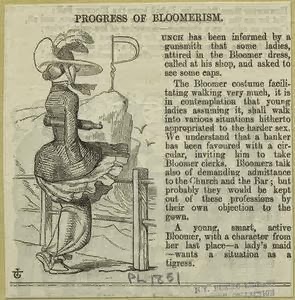
Do Women Wear Pants because of Oscar Wilde?


I posted a quote from a blog that humourously implied that women wear pants because of Oscar Wilde and the aesthetic movement. I still think that's a clever bit of writing and you can see the part I quoted in this post here. Do I think that if it weren't for Oscar Wilde I wouldn't be able to wear pants in public? To say that I did would be a bit of an exaggeration.

Anyone who thinks my collection of trousers would belong to my husband, if it weren't for Oscar Wilde, is overlooking the daring and hard work of so many courageous women. I wrote about Rational Dress, like it were some kind of ambiguous headless entity, when it had many heads and courageous hearts.

Lady Haberton created the divided skirt and didn't go away quietly when she was refused service at an inn for wearing one.

Mary Eliza Haweis was a scholar and an author, who wrote primarily for other educated women. Her research focused on Chaucer and her obituary in the Illustrated News of 3 December 1898 is impressive:
Just who was Mary Eliza Joy Haweis? Wife of philandering preacher and music aficionado Hugh Reginald Haweis; mother of three semi-estranged children; daughter of failed artist Thomas Musgrove Joy; hostess of fancy dress balls; restorer of historic houses; member of the Suffragettes; and author of Flame of Fire, another "foolish effusion with which women writers attack the eternal marriage question." But Haweis was also "an enthusiastic student of Chaucer," whose works were "educationally valuable," "original in plan and conception," and "mine[s] of poetic beauty and most scholarly explanation." She tackled bookish issues—Chaucer's final -e, his accent, and his meter—and she ferreted out academic rumors and pieced together what scholarship she could verify on the poet's life. She wrote in support of the abortive Chaucer concordance that predated John S. P. Tatlock and Arthur G. Kennedy's, and she corresponded with F. J. Furnivall and Sir Israel Gollancz on matters of medieval concern. She researched medieval paintings to make her own illustrations for the Canterbury Tales correct, and she identified the seal of Thomas Chaucer, reproducing it exactly from the miscellanea at the British Museum and from MS Cotton Julius C.vii. Her recorded evidence, gleaned from manuscript rolls and records, is not always chronicled elsewhere. She was the first Chaucerian/art historian to link Chaucer's poetry to existing paintings and drawings, observing that "Chaucer and his contemporaries are as careful as Van Eyck in realizing an exact and brilliant picture, and in trying to put it before our eyes as definitely as they saw it themselves."

The actress, Charlotte Carmichael Stopes wrote one of the most definitve books of the British Women's Suffrage Movement, British Freewomen: Their Historical Privilege (1894). She was a Shakespeare scholar, almost to the same extent that Haweis studied Chaucer. In 1889, Stopes famously staged a coup at a meeting of the British Association for the Advancement of Science in Newcastle upon Tyne, by unexpectedly adding Rational Dress to the programme. Nationwide newspapers reported Stopes's speech, spreading the notion of Rational Dress.

Much the way that our contemporaries refuse to acknowledge the ongoing War on Women worldwide, women, who supported and/or practiced Rational Dress, were subject to ridicule.


While I do feel that Oscar Wilde supported this movement in the Woman's World, I suspect that was partly due to the fact that his mother was a feminist and he married an active member of the Rational Dress Society. In other words, he did nothing to stop women from wearing pants, but I don't think his efforts were terribly significant compared to the work of all these other women.

I also can't finish without saying that I love the term "Bloomerism." Victorians were excellent at making up new words.

Follow me on Twitter @TinyApplePress and like the Facebook page for updates!

Saturday, August 24, 2013

Woman's World Magazine

Fashion is such an essential part of the mundus muliebris of our day, that it seems to me absolutely necessary that its growth, development, and phases should be duly chronicled.
Oscar Wilde was editor of Woman's World Magazine from 1887-1889 and wrote the above in response to criticisms of the magazine's fashion pages. As a writer, trying to recapture some sense of the times, I'm incredibly grateful to those, like Wilde, who documented the frivolity of their times.

Wildeans often think of Oscar Wilde's love of ancient Greece in terms of how he idealized the ancient Greek approaches to men's sexuality, but we can see how he used the classics as models for women's lives as well, when we look at articles he published in Woman's World during those years, articles like “The Women of Greece,” “Woman and Democracy,” “Roman Women at the Beginning of the Empire,” and “A Pompeian Lady.”
The Woman’s World, edited by Mr. Oscar Wilde, gracefully got up as it is in every respect, has taken a high place among the illustrated magazines. Written by women, for women and about women, striking out an original line, it merited the success it has obtained. - The Times (December 1888)
In the 1890s, journalism was increasingly seen as an acceptable career path for a woman. Oscar Wilde's mother supplemented her income this way, she even wrote a piece for Woman's World called "Historic Women." Oscar Wilde's contributors were established female writers, society women, students, professional women and feminist campaigners. Julia Wedgewood, a well-known suffragist, authored "Women and Democracy." 

Readers followed social issues and philanthropy and were overwhelmingly feminist. Of course, with Oscar Wilde at its helm, Woman's World became associated with aestheticism, but it was also linked to women in pursuit of higher education.

Something new that I learned today is the an 1880s and 90s synonym for the "New Woman" was "Girton Girl" because Girton referred to England's first residential college for women, established in 1869. Annie Edwards published a novel called A Girton Girl (1885), which has been digitized by Google, and was published in three volumes, dealing with many of the themes of a late-Victorian New Woman's life.

A laboratory at Girton College Cambridge (1900) 

Poetically, Elaine Showalter writes:
New Women and decadent artists were linked together as twin monsters of a decadent age, sexual anarchists who blurred the boundaries of gender.
I imagine them as very well-dressed and likable monsters, which reminds me that I started this tangent thinking about what my protagonists would wear to a very formal dinner party in 1889/90. 


Toward this end, Oscar Wilde called upon the ancient Greeks and wrote in  Woman's World that women could follow the ancient principles of Greek dress by suspending their dresses from their shoulders, even with sleeves, thereby creating rich and rippling folds.

Most of the information in this post comes from my own research and an essay by Isobel Hurst "Ancient and Modern Women in Woman's World."

Follow me on Twitter @TinyApplePress and like the Facebook page for updates!

Sunday, May 26, 2013

Anarchy, Pottery, and Nice Clothes

When we think of anarchy today, we think of someone who occupies a park, rather than someone who spends ages finely decorating his house before moving into it. Indeed, anarchy, today, is an ambiguous shape-shifting subject that changes from its uber intellectualized to something extremely subversive and counter-culture in the modern youth movement. However, while some Wildean scholars hesitate to draw the link between Oscar Wilde and anarchy, such a link exists - even if it is as tenuous as modern understandings of what anarchy means.

The Soul of a Man Under Socialism (1891) expounds Oscar Wilde's libertarian socialist (anarchist) worldview. There are loads of resources out there that analyze it, so I won't waist your time with it here. What interests me is how Oscar Wilde lived his views. He didn't attend protests and didn't write much on libertarian socialism after 1891. His focus was on the aesthetic movement and his life as an artist. As such, he saw himself as a leader of a sociopolitical movement, the aesthetic movement.

Though it's hard to imagine the links today, the minds of Victorian thinkers, like Wilde, linked anarchy, libertarianism, socialism, and other progress-based social-based political ideologies were linked to decadence. John Barlas (Evelyn Douglas) linked his anarchism to the decadence of Algernon Charles Swinburne in particular.

John Barlas and Swinburne both fit into the category of Writers in London in the 1890s. Algernon Charles Swinburne was a poet, playwright, novelist, and critic. Inventor of the roundel form, he wrote several novels and contributed to the Eleventh Edition of the Encyclopædia Britannica. Swinburne was nominated for the Nobel Prize in Literature in every year from 1903 to 1907 and again in 1909. H.P. Lovecraft felt that Swinburne was the only real poet in England, after the death of Edgar Allan Poe. Wilde once said that Swinburne was "a braggart in matters of vice, who had done everything he could to convince his fellow citizens of his homosexuality and bestiality without being in the slightest degree a homosexual or a bestialiser."

John Barlas was a long time friend of Wilde and his crowd, but, by the 1890s, he was one of those friends kept on the periphery. Interestingly, Oscar Wilde bailed him out of jail after an incident on 31 December 1891.

On that New Year's Eve, Barlas went to the Palace of Westminster and fired a revolver outside the Speaker's House, declaring: "I am an anarchist! What I have done is to show my contempt for the House of Commons." After more than two weeks in jail, it was through Constance that Oscar Wilde was reached to post a bond as surety for Barlas's good behavior.

According to David Lowe's book: John Barlas: Sweet Singer and Socialist (1915), en route, Henry Hyde Champion, secretary of the Social Democratic Federation and the publisher of Bernard Shaw's first novel, Cashel Byron's Profession (1886), informed Wilde that Barlas suffered from the delusion that he was a reincarnated figure from the Bible and believed that others recognized his significance by crossing their hands reverently as he passed. Wilde reportedly said to Champion: "My dear fellow, when I think of the harm the Bible has done, I am quite ashamed of it."

In response to Barlas's letter of gratitude for the bond, Wilde wrote that:
Whatever I did was merely what you would have done for me or for any friend of yours whom you admired and appreciated. We poets and dreamers are all brothers. I am so glad you are feeling better...
And just like brothers or sisters or anarchists today, these anarchists, among the Writers in London in the 1890s, were as diverse as anarchists that you might meet today. Even though Oscar Wilde wrote and lectured (before Barlas was arrested) that:
Individualism, then, is what through Socialism we are to attain to. As a natural result the State must give up all idea of government. It must give it up because, as a wise man once said many centuries before Christ, there is such a thing as leaving mankind alone; there is no such thing as governing mankind. All modes of government are failures. Despotism is unjust to everybody, including the despot, who was probably made for better things. Oligarchies are unjust to the many, and ochlocracies are unjust to the few. High hopes were once formed of democracy; but democracy means simply the bludgeoning of the people by the people for the people. It has been found out. I must say that it was high time, for all authority is quite degrading. It degrades those who exercise it, and degrades those over whom it is exercised.
Wilde had no intention of overthrowing the State and he had a deep and abiding respect for due process through the legal system. During his trials, his radical Irish Nationalist mother assured him repeatedly that their position in society would assure that he would not be found guilty of any crime. While Wilde's friends and even the judge encouraged him to flee, during his own trials, Oscar stayed and was inarguably broken by it.

If his political views weren't reflected in how Wilde died, he certainly felt that they were reflected in how he lived. Compared to his contemporaries, like Bram Stoker, I feel that Wilde was a feminist because he used Women's World magazine to support Constance Wilde's feminist ideas and incorporated healthy or rational dress into the aesthetic movement.

A strong part of the aesthetic movement was about individualism, for Wilde. Self-governance was one extension of that individualism; the freedom of women was another extension. The freedom of workers was part of it as well, for through his mentor, John Ruskin, Wilde incorporated aspects of the Arts and Crafts Movement into the aesthetic movement. The Arts and Crafts Movement is reflected in women's art, in the aesthetic movement, especially pottery. Wilde's marriage to Constance, indeed, was intended to be an example of aesthetic life and the liberties Constance took, with Oscar's blessings and encouragement, were seen by other as scandalous as well as liberating.