Showing posts with label scandal. Show all posts

Sunday, May 26, 2013

Anarchy, Pottery, and Nice Clothes

When we think of anarchy today, we think of someone who occupies a park, rather than someone who spends ages finely decorating his house before moving into it. Indeed, anarchy, today, is an ambiguous shape-shifting subject that changes from its uber intellectualized to something extremely subversive and counter-culture in the modern youth movement. However, while some Wildean scholars hesitate to draw the link between Oscar Wilde and anarchy, such a link exists - even if it is as tenuous as modern understandings of what anarchy means.

The Soul of a Man Under Socialism (1891) expounds Oscar Wilde's libertarian socialist (anarchist) worldview. There are loads of resources out there that analyze it, so I won't waist your time with it here. What interests me is how Oscar Wilde lived his views. He didn't attend protests and didn't write much on libertarian socialism after 1891. His focus was on the aesthetic movement and his life as an artist. As such, he saw himself as a leader of a sociopolitical movement, the aesthetic movement.

Though it's hard to imagine the links today, the minds of Victorian thinkers, like Wilde, linked anarchy, libertarianism, socialism, and other progress-based social-based political ideologies were linked to decadence. John Barlas (Evelyn Douglas) linked his anarchism to the decadence of Algernon Charles Swinburne in particular.
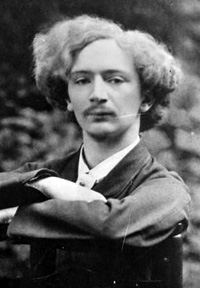
John Barlas and Swinburne both fit into the category of Writers in London in the 1890s. Algernon Charles Swinburne was a poet, playwright, novelist, and critic. Inventor of the roundel form, he wrote several novels and contributed to the Eleventh Edition of the Encyclopædia Britannica. Swinburne was nominated for the Nobel Prize in Literature in every year from 1903 to 1907 and again in 1909. H.P. Lovecraft felt that Swinburne was the only real poet in England, after the death of Edgar Allan Poe. Wilde once said that Swinburne was "a braggart in matters of vice, who had done everything he could to convince his fellow citizens of his homosexuality and bestiality without being in the slightest degree a homosexual or a bestialiser."

John Barlas was a long time friend of Wilde and his crowd, but, by the 1890s, he was one of those friends kept on the periphery. Interestingly, Oscar Wilde bailed him out of jail after an incident on 31 December 1891.

On that New Year's Eve, Barlas went to the Palace of Westminster and fired a revolver outside the Speaker's House, declaring: "I am an anarchist! What I have done is to show my contempt for the House of Commons." After more than two weeks in jail, it was through Constance that Oscar Wilde was reached to post a bond as surety for Barlas's good behavior.

According to David Lowe's book: John Barlas: Sweet Singer and Socialist (1915), en route, Henry Hyde Champion, secretary of the Social Democratic Federation and the publisher of Bernard Shaw's first novel, Cashel Byron's Profession (1886), informed Wilde that Barlas suffered from the delusion that he was a reincarnated figure from the Bible and believed that others recognized his significance by crossing their hands reverently as he passed. Wilde reportedly said to Champion: "My dear fellow, when I think of the harm the Bible has done, I am quite ashamed of it."

In response to Barlas's letter of gratitude for the bond, Wilde wrote that:
Whatever I did was merely what you would have done for me or for any friend of yours whom you admired and appreciated. We poets and dreamers are all brothers. I am so glad you are feeling better...
And just like brothers or sisters or anarchists today, these anarchists, among the Writers in London in the 1890s, were as diverse as anarchists that you might meet today. Even though Oscar Wilde wrote and lectured (before Barlas was arrested) that:
Individualism, then, is what through Socialism we are to attain to. As a natural result the State must give up all idea of government. It must give it up because, as a wise man once said many centuries before Christ, there is such a thing as leaving mankind alone; there is no such thing as governing mankind. All modes of government are failures. Despotism is unjust to everybody, including the despot, who was probably made for better things. Oligarchies are unjust to the many, and ochlocracies are unjust to the few. High hopes were once formed of democracy; but democracy means simply the bludgeoning of the people by the people for the people. It has been found out. I must say that it was high time, for all authority is quite degrading. It degrades those who exercise it, and degrades those over whom it is exercised.
Wilde had no intention of overthrowing the State and he had a deep and abiding respect for due process through the legal system. During his trials, his radical Irish Nationalist mother assured him repeatedly that their position in society would assure that he would not be found guilty of any crime. While Wilde's friends and even the judge encouraged him to flee, during his own trials, Oscar stayed and was inarguably broken by it.

If his political views weren't reflected in how Wilde died, he certainly felt that they were reflected in how he lived. Compared to his contemporaries, like Bram Stoker, I feel that Wilde was a feminist because he used Women's World magazine to support Constance Wilde's feminist ideas and incorporated healthy or rational dress into the aesthetic movement.

A strong part of the aesthetic movement was about individualism, for Wilde. Self-governance was one extension of that individualism; the freedom of women was another extension. The freedom of workers was part of it as well, for through his mentor, John Ruskin, Wilde incorporated aspects of the Arts and Crafts Movement into the aesthetic movement. The Arts and Crafts Movement is reflected in women's art, in the aesthetic movement, especially pottery. Wilde's marriage to Constance, indeed, was intended to be an example of aesthetic life and the liberties Constance took, with Oscar's blessings and encouragement, were seen by other as scandalous as well as liberating.

Sunday, April 21, 2013

The Importance of Being Oscar Wilde's Mother


Lady Jane Francesca Agnes Wilde (1821-1896), better known as "Speranza," was the youngest child of four in Wexford Ireland. She was an Irish nationalist some Italian roots, though she put stereotypes about that heritage to rest by being over six feet tall and devoting herself to the love of Ireland. She was a poet and her contemporaries considered her a national treasure because wrote about freedom for the people of Ireland, but as time went on tastes and politics would change, so that the younger Irish revolutionaries weren't as able to relate to her work.

She fell in love with and married William Wilde, a scrawny and often disheveled-looking man, who must have looked even smaller standing next to his larger-than-life wife; it was said that she was extremely tall and overweight, “walked like a ship at sea, the sails filled with wind.” For this, she was subject to abuse throughout her life, but developed a strong talent for putting people in their place and would defend the people she loved as well as she defended Ireland.


Sometimes, I think intelligent outcasts are the most important people the development of creativity and culture within any particular group. Henry VIII made big sleeves fashionable for men because preexisting fashions didn't suit his growing figure. Speranza dressed like gypsy, even when she could afford the fashions of her day, and wore cheap costume jewelry, sometimes made of pieces of older broken costume jewelry. The odd biographer suggests that she favoured darkness because it concealed certain physical features that made her insecure; but, according to her, she liked dark rooms lit by candles because it encouraged "bawdy talk."

These dark spaces in her house, which notable always had all of its shutters shut, were decorated with books and artifacts collected during William Wilde's archeological journeys to Egypt and by Speranza herself, who enjoyed busts and paintings from ancient Greece and Rome.

If being "the Irish Poetess" of her day weren't fame enough, she became a famous entertainer, hosting popular salons at her home in Dublin and later in London. She got know many of the most famous creatives and revolutionaries, especially feminists and the political types, that set foot in whatever city she happened to be in, which makes it hard to believe that she was all that shy about being out in the open and walking in the light. When asked how she managed to attract such interesting people, Speranza replied, "By interesting them, of course!"

In addition to the two daughters William Wilde had outside of his marriage, Speranza had two sons and a daughter. Her daughter died in childhood; her firstborn was named for her husband and would always be her favourite, even when he grew up to be a lecherous alcoholic; and her other son was Oscar Wilde. Because of her, the boys were well-educated before they even started school, though some acquaintances, like Lord Alfred Douglas, suggested she might not have provided the most wholesome environment for the boys, due to the types of people she kept around and the types of things they would discuss.

Ostensibly, "respectable people" were forbidden from her home because they were usually so uninteresting. Many of their friends attributed Oscar Wilde's wit to his mother.

Things took a turn for the unfortunate, when William Wilde Sr. was knighted. Speranza believed this misfortune came because fortune and fame attract the maliciousness of jealousy. A Dublin man, whose daughter was a patient of Sir William Wilde, the oculist, claimed Sir Wilde was sexually inappropriate in his conduct toward the young lady and would seek legal action. Speranza must have flown into a rage and wrote a nasty letter to the man, for which they were eventually sued and lost most of their wealth. It was about this time that both of Sir Wilde's daughters burned to death in a fire due to the restrictive nature of their fashionable clothes.


Sir Wilde died not long after and Speranza moved to London with both of her sons. In her reduced circumstances, she relied on the financial assistance of both her boys and earned a modest living as a journalist. She finished the work that she began years ago with her husband and published Ancient Legends, Mystic Charms and Superstitions of Ireland (1888). Oscar began making a name for himself and Speranza continued to hope that both her boys would find their place in parliament. Her favorite son wasn't doing as well as Oscar though.

In London, Speranza became active in the fight for women's legal rights; specifically, the right for a woman to retain her wealth in marriage. She was part of a successful act to support these rights, but, as luck would have it, she needed to find a wealthy wife for her favorite son. The marriage lasted less than a year and Willie came home penniless. Even after he took a second wife, Willie would live with his mother to the end of her days. Many famous people still came to her salons, but she was heard at one such event saying that her life had been reduced to "the importance of being Oscar's mother."


I believe that Speranza died of a broken heart, when Oscar Wilde went to prison. When the trials started, she didn't believe they would imprison her son and wouldn't hear of him fleeing the country. He was, after all, "an Irish-born gentleman." The official cause of death was bronchitis, but her health deteriorated rapidly after Oscar's conviction. Even her requests to visit with him were denied.

Oscar's wife, came back to London from Europe, to break the news of his mother's death to Oscar personally, so that he wouldn't take it too hard.

Follow me on Twitter @TinyApplePress and like the Facebook page for updates!