Showing posts with label Charles Dickens. Show all posts

Monday, October 26, 2015

The Ghost Club


Founded in London in 1862, the Ghost Club is the oldest paranormal investigation and research organization in the world. The organization is still active today and its members have included: Charles Dickens, Sir Arthur Conan Doyle, W.B. Yeats, and Siegfried Sassoon.

The Ghost Club was seven years in the making, having started as a conversation about ghosts between Cambridge fellows at Trinity college in 1855. Naturally, it attracted some banter in the Times, but with Charles Dickens and some Cambridge men among their ranks, the Ghost Club soldiered on.

The Davenport Brothers and their spirit cabinet (1870).
Like real-life Victorian Ghostbusters -- though maybe they were more like Myth Busters, the Ghost Club investigated spiritual phenomena, like the Davenport Brother's spirit cabinet. The Davenport Brothers were travelling American magicians and the spirit box was their most famous illusion. In the spirit box illusion, the brothers were tied inside the box with some musical instruments. When the box was closed, the instruments played, but when it was opened, the brothers remained tied in their original positions. The Ghost Club never published the result of their investigation.

Members of the Ghost Club (1882).
Following Dickens' death, the Ghost Club became inactive during the 1870s, but was revived on All Saints Day 1882. It remained a select and private organization of earnest ghost hunters, who really believed that ghosts existed. They met monthly and women were not admitted.

Investigations into the spirit world were referred to as 'physical research,' and the growing popularity of Spiritualism at this time attracted people like Sir Arthur Conan Doyle and Sigmund Freud to its meetings. Many members treated Ghost Club as a kind of refuge, where they were able to conduct the kind of research and have the kind of conversations that they were unable to have elsewhere.

At each meeting of the Ghost Club a list of all the members, dead or alive, was read. Deceased members were said to sometimes make their presence felt during this activity.

Sir Arthur Grey of Jesus College, Cambridge, immortalized the Ghost Club as "The Everlasting Club" in 1919 - a ghost story that, around Cambridge, some still believe to be true.

Wednesday, January 7, 2015

Charles Dickens and PTSD


Generally, I'm not a fan of reading contemporary ailments onto historical figures, but, while searching for more information on Bunbury, which is only remotely connected to my novel at this point, I came across Nicholas Daly's article on railway novels. The introduction to his article left me convinced that Charles Dickens had post traumatic stress disorder (PTSD).
On June 10, 1865 the London Times reported a "Dreadful RailwayAccidentat Staplehurst:10 Persons Killed-Upwards of 20 Wounded."One of the passengers, who had "a narrow escape . . . fortunately for himself and for the interests of literature,"was Charles Dickens. The previous day the 2:38 tidal train from Folkestone had come off the rails at the viaduct just outside Staplehurst. The track was being repaired at the time of the accident and a section of it had been taken up. Having read the wrong time-table, the foreman in charge of the repairs did not expect the train for another two hours, and by the time the train driver saw the flag man who was in the wrong place it was much too late to brake. The front of the train cleared the gap in the tracks, but the rest of the carriages plunged down into the river bed. Only one of the seven first-class carriages escaped the fall by being securely coupled to the second-class carriage in front. In that fortunate carriage were Charles Dickens, his mistress, Ellen Ternan, and her mother. Also present was the manuscript of Our Mutual Friend, which, famously, Dickens rescued from the precariouly balanced carriage, after first extricating the Ternans and offering assistance to the injured and dying. Ellen Ternan appears to have been hurt in the crash, but Dickens felt no ill-effects until he was back in London, when he describes himself as being "quite shattered and brokenup." "Shaken"is the word that he uses to describe his nervous condition in letter after letter. On June 10 he apologizes to Charles Lever that he "can't sign [his] flourish, being nervously shaken." On June 13, in a letter to Thomas Mitton, he describes himself as still reliving the original impact:" In writing these scanty words of recollection I feel the shake and I am obliged to stop." On June 21 he still feels "a little shaken in [his] nervous system by the terrible and affecting incidents of the late railway accident." And the effects lingered long after, as Peter Ackroyd describes:
["]The effect of the Staplehurst accident "tells more and more," [Dickens] noted in 1867, and then a year later he confessed that ". .. I have sudden vague rushes of terror, even when riding in a hansom cab, which are perfectly unreasonable but quite insurmountable." His son, Henry, recalled that "I have seen him sometimes in a railway carriage when there was a slight jolt. When this happened he was almost in a state of panic and gripped the seat with both hands." And Mamie remembered that ". .. my father's nerves never really were the same again ... we have often seen him, when travelling home from London, suddenly fall into a paroxysm of fear,  tremble all over, clutch the arms of the railway carriage, large beads of perspiration standing on his face, and suffer agonies of terror. We ... would touch his hand gently now and then. He had,  however, ... no idea of our presence"["] 
Although Dickens got off lightly in the accident itself, then, the original jolt seems to have left its mark on his body, to have filed itself away in his nervous system; he relived the event over and over, experiencing all the anxiety that he didn't feel at the time. He died on the anniversary of the crash five years later. As Wolfgang Schivelbusch notes, we can identify Dickens as one of the most famous victims of a peculiarly modem form of nervous after-effect: shock.

"Shock," specifically shell-shock after the First World War, was what helped modern doctors identify PTSD. PTSD is most common among veterans, but it can happen to anybody that has experienced a traumatic event. Symptoms usually become evident 1-3 months after the event. About half of all Americans with PTSD never seek treatment. About 21% of those who do get inadequate treatment.

Follow me on Twitter @TinyApplePress and like the Facebook page for updates!

If you have enjoyed the work that I do, please support my Victorian Dictionary Project!

Tuesday, January 15, 2013

A Bunch of Hairy Men

Hall Caine's photo in yesterday's post got me thinking about some of the late-Victorian writers' funny faces. Hall's face especially strikes me because, while I think he looks funny with his buggy eyes and dramatic beard, in the 1890s, ladies actually found him handsome!


Facial hair was popular among men in the 1890s. Although we look back on it with jocularity, it's making a bit of a resurgence in recent years (Movember, hockey beards, etc). Even the Edwardians found outrageous styles of facial hair ridiculous. 

Hall Caine (above) and Joseph Conrad (below) wore beards and mustaches, like Kaiser Wilhelm.


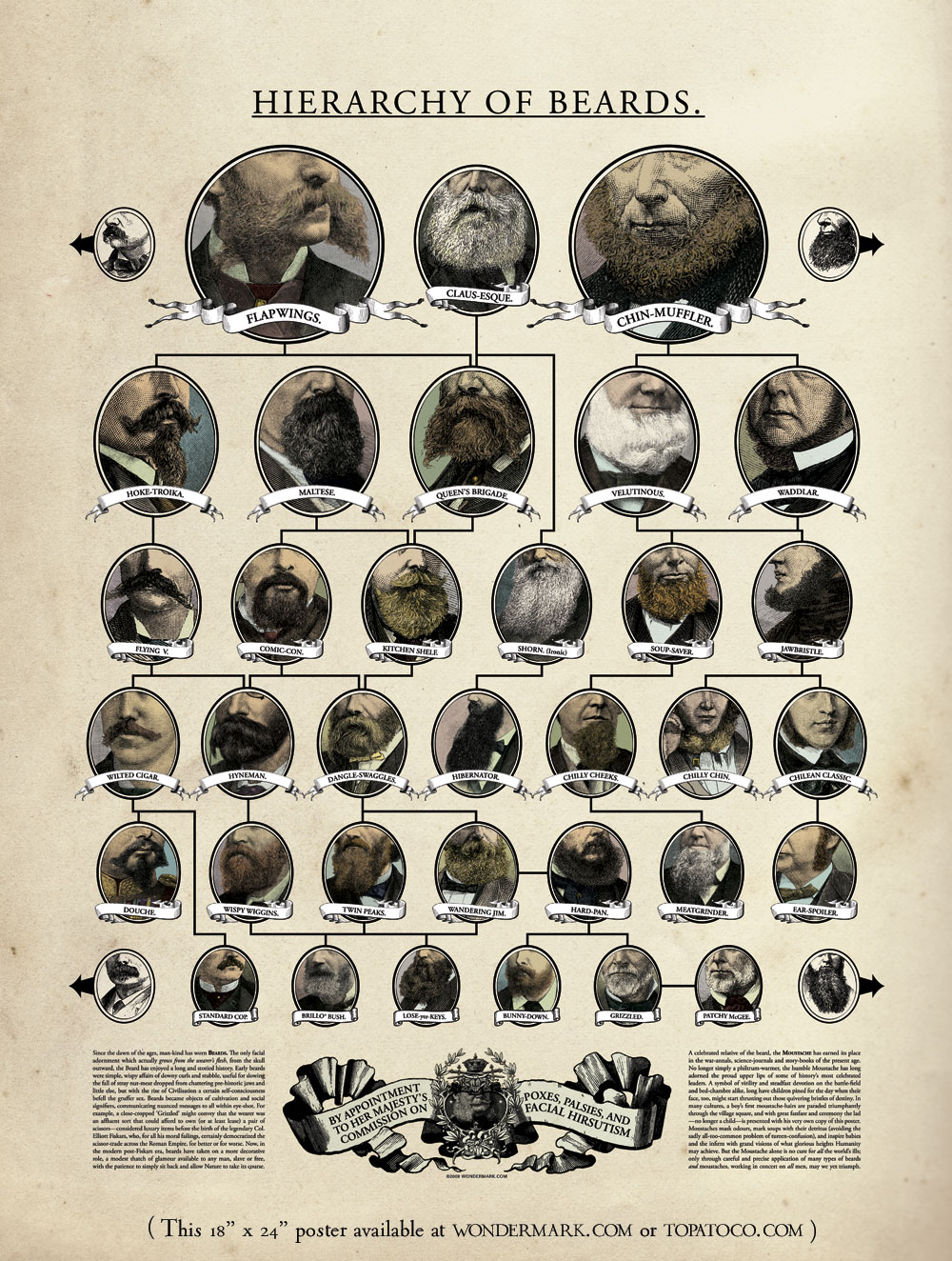
Bram Stoker (above) wore his in a fashion comically referred to as "dangle swaggles" (see picture at bottom).

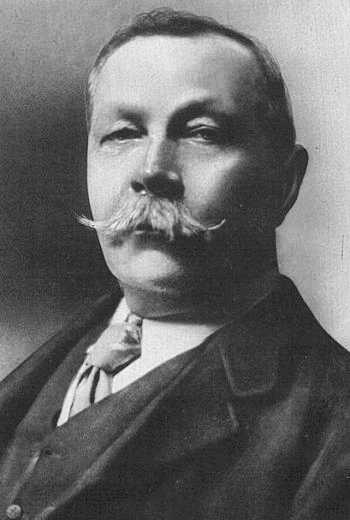
Sir Arthur Conan Doyle, Thomas Hardy, and Ambrose Bierce (all are below) wore matching pointy mustaches that most agreed would make men look more distinguished, a look nowadays people think they can pull off with a pair of non-prescription eyeglasses.


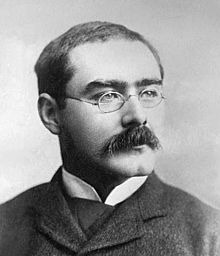
As a young man in the 1890s, H.G. Wells (below) wore something like a walrus, but so did Rudyard Kipling (also below), leading one to speculate that this could have been some hip young thing.


To be fair, there were lots of ridiculous ways for a woman to style her hair that none of these guys would really get away with, but there were many other hairy styles available to men as well.


Though he himself was once a hairy beast, Charles Dickens said it best, when he said:
I am no friend to gentlemen who wilfully affect external oddity, while they are within all dull and commonplace.
Follow me on Twitter @TinyApplePress and like the Facebook page for updates!

Monday, January 14, 2013

Laudanum

From absinthe to laudanum, substance abuse was prevalent during the latter part of the Victorian era. It doesn't seem like you could be a writer in the 1890s, without dying of substance abuse or knowing someone who had. This story bookends the decade, as a reminiscence of an author, who died in 1889, from a book published in 1908.

The book: My Story, Hall Caine's autobiography. Caine (photo on left 1895) was a Manx writer, very popular in the 1890s and 1900s. During the 1890s, he was surely bumping shoulders with my favorite writers. I'm not so fond of his writing as I am of his life and interactions with others of the period.

The passage I've selected is about Wilkie Collins. I just love how in his narrative, Caine portrays himself as using Collins's first and last name every time he addresses him, though they seem to have been great friends. Collins was a prolific writer and published 30 novels, more than 60 short stories, 14 plays, and more than 100 nonfiction essays.


In this passage, Caine is astonished at Collins's use of laudanum. Laudanum was a wildly popular drug during the Victorian era. It was an opium-based painkiller prescribed for everything from headaches to tuberculosis.

Hall writes:
One day, towards the beginning of 1888, I called upon him in great excitement about a difference I had just had with a friend with whom I was trying to collaborate. I wished him to adjudicate in the dispute, and he cordially undertook to do so. 
"State the difficulty," he said ; and I stated it with much fulness. He stopped me again and again — repeated, questioned, and commented. Two hours went by like ten minutes. We were sitting in Wilkie's workshop, With proofs of his current work everywhere about us. The point was a knotty one, and a serious issue seemed involved in it. Wilkie was much worried.  
"My brain is not very clear," he said once or twice, taking a turn across the room. Presently, and as if by a sudden impulse, he opened a cabinet, and took out a wine-glass and what seemed to be a bottle of medicine. " I'm going to show you one of the secrets of my prison- house," he said with a smile, and then he poured from the bottle a full wine-glass of a liquid resembling port wine. "Do you see that?" he asked. " It's laudanum." And straightway he drank it off.  
“Good heavens, Wilkie Collins!" I said, "how long have you taken that drug ? "  
"Twenty years," he answered.  
"More than once a day ? " 
"Oh yes, much more. Don't be alarmed. Remember that De Quincey used to drink laudanum out of a jug." Then he told me a story, too long to repeat, of how a man-servant of his had killed himself by taking less than half of one of his doses.  
"Why do you take it ? " I asked.  
"To stimulate the brain and steady the nerves."  
"And you think it does that?"  
"Undoubtedly," and laughing a little at my consternation, he turned back to the difficult subject I had come to discuss. " I'll see it clearer now. Let us begin again," he said.  
"Wait," I said. "You say, my dear Wilkie, that the habit of taking laudanum stimulates your brain and steadies your nerves. Has it the same effect on other people ?"  
"It had on Bulwer Lytton," answered Collins. "He told me so himself."  
"Well, then, Wilkie Collins," I said, "you know how much I suffer from nervous exhaustion. Do you advise me to use this drug?"  
He paused, changed colour slightly, and then said quietly, "No."  
The last time I saw Collins he was in great spirits and full of the "Reminiscences" that he intended to write. He talked of all his old friends with animation, the friends of his youth, "all gone, the old familiar faces"; and there was less than usual of the dull undertone of sadness that had so often before conveyed the idea of a man who felt that he had strutted too long on his little stage. He enjoyed his wine and some old brandy that came after it and a couple of delicious little cigars of a new brand which he loudly recommended. The more serious questions of literature and morality were all banished, and yarn followed yarn. 
I can only remember a single sad note in his conversation, and it was ominous. He was talking of Dickens, and I think he said he had been engaged to visit at Gad's Hill on the very day that Dickens died.  
A few days later, Wilkie Collins wrote inviting me to lunch, but naming no particular day. I was to go what day I liked, only remembering to send a telegram two or three hours in advance. So one Sunday morning I wrote a letter telling him that I meant to visit him the following day, and asking him for a telegram to say if the time would do. Instead of Wilkie's telegram there came a message from his affectionate adopted daughter, saying that on the previous morning he had been struck down with paralysis.
Follow me on Twitter @TinyApplePress and like the Facebook page for updates!