Showing posts with label Mrs Frank Leslie. Show all posts

Monday, March 23, 2015

Are Men Gay Deceivers?

Headline from the November 18, 1909 issue of The Republican.
Though it sounds funny to our ears now, in the nineteenth century, the term 'gay deceiver' referred to a man who used his charm for personal gain. The term could most certainly be applied to Oscar Wilde's older, and more sinister, brother, Willie.

The following essay, entitled "Are Men Gay Deceivers?" was written and published by Mrs Frank Leslie on the occasion of her divorce from Willie Wilde. She was seeking a divorce because he had clearly married her for her money and refused to work, but spent all of his time drinking instead. In the almost two years it took for their divorce to be finalized, she slandered her soon-to-be ex-husband in the press, while he shacked up with his future wife, the heiress, Sophia Lees. It's hard to not read this essay as Leslie's assessment of Willie's character at this time.
ARE MEN GAY DECEIVERS?
MODERN DECEPTIONS AMONG MEN AND WOMEN.
It is a stock phrase under certain unfortunate circumstances to say that a girl has "been deceived" by some man, or to call an immoral man "a gay deveiver." Now, the question in my mind is whether this is, in the majority of cases, a correct judgement, or whether one might not better say the woman deceived herself and blinded her own eyes.
The fact is that most women are far more clear-sighted than most men, and even those of the sex who might be called deficient in intelligence are endowed with a keen, if vague, instinct which cries "'Ware, danger!" even though it is quite unable to describe the precise nature or position of the menaced trouble.
Willie Wilde by Alfred Bryan.
But a woman, no matter of what degree, so soon as she falls in love blinds herself, or rather, she sets up her own ideal of the beloved object between herself and the reality, and if she said reality only reasonably keep quiet, and not persist in destroying of stepping out from behind his shelter, all will go well.
 The trouble is that few men have enough tact to be really deceitful; few have finesse enough to enter into a woman's mind and perceive the position which she has assigned to her hero of the moment and adapt themselves to it. They try to do it, but they don't often succeed; and by way of a glittering generality on may say that men mean to be deceitful and are really transparent, and that women, while apparently most deliciously transparent, are actually subtly deceitful.
Here, I suspect that Leslie is reflecting on the beginning of her marriage, when she reported in the American press that she had married Oscar Wilde's older brother and that Willie was even more of a genius than Oscar was. It seems that she feels it would have been very easy for Willie to make their marriage work, if he had only seen what a high opinion she had of him and pretended to be clever.
Of course, like other generalities, this rule has particular exceptions; and there are men who really do deceive, and women who cannot do so. I must say that for myself I do not like either of these classes; they are out of nature, and require special study.
Like George Michael, Leslie feels that, as a rule, "There are boys you can trust and girls that you don't."
Born Miriam Florence Folline, she changed her name to retain control of her third husband's publishing empire. Willie Wilde was her fourth and last husband.
The really deceitful has a strong feminine coat of character, and this of the womanish and not womanly nature. He is a self deceiver like her, but not because, like her, he wishes to believe others better than they really are, but because he is determined to believe them as bad as he wishes them to be. He adopts a code of morals, or immorals, and various forms of casuistry persuades himself that this is not only justifiable for himself, but the actual code of others, no matter what they may profess. If he is clever, he can argue from this standpoint that black is white, and left is right, and crooked straight, with so much conviction and candor that he may often end in persuading even a woman to believe him and to adjust her own beliefs to his.
But this sort of man is unfortunately rare; the more usual form is the man who knows very well his right hand from his left, an is perfectly sure that the moon is not made of green cheese, but who wishes to make some woman believe that it is; it is rather interesting to watch the maneuvers of this class of deceivers; the casual mention of the fact to be established, let us say  of the cheesy quality of the moon; the apparent surprise and indulgent amusement when the pupil indignantly contradicts the proposition; the gentle arguments, the mock deference and respect for the feminine view so diffusely and vaguely set forth; the raillery and playful irony, often more effectual than any other weapon; the compliments so skillfully introduced, and the thoughtful pause, as if considering the true value of the pearls of wisdom let fall from the pretty lips, at which he gazes so admiringly.
Later in life, Mrs Frank Leslie fashioned herself the Baroness de Bazus. 
Then comes the personal appeal: "If anybody could convince me, it certainly would be you, and your arguments are so strong and so well put that I am half inclined to accept them in spite of my own reason, and yet I can't but see that there is a very, very cheesy look to the moon, and so many people older and perhaps wiser than either of us have believed it. Don't you think you are perhaps a little prejudiced? I wish we could think alike upon this as upon so many other matters. Now don't you se," this and this?
Victorian advice on handkerchief flirting.
Probably at this point of the game the game the woman who is in love begins to finger the handkerchief with which she will presently blind her own eyes; she listens more to the compliments and personal appeal than to the arguments; she begins to take note of the hyacinthine locks, the careful moustache, the white teeth, the handsome hand of her companion-but shall I tell you where she did not look? It is into his eyes; for although I have seen a great many men trying to deceive, I have never seen one who could bring his eyes into full subjection. He may open them wide and stare you boldly in the face; he may raise them to your own with elaborate candor; he may gaze upward at the ceiling or outward at the sky, or downward in pensive consideration, but I have never yet saw an eye absolutely successful in deceit; and I believe that if Marguerite had looked Mephistopheles full in the eye, and meant to read the truth there, he would not have had power to conceal it; and if he could not, less expert "gay deceivers" need not try to. But if the woman is not in love she is very much tempted to laugh aloud and say: "What a clever special pleader you are! You ought to be a lawyer; but all the same, you don't believe a word you're saying and neither do I. We both know perfectly well that the moon is not made of green cheese, and never was, and never will be. Why pretend it is? 
 I say the woman may be tempted to make this little speech, but if she is a wise woman she will resist the indulgence, for she knows perfectly well that to mortify a man's amour propre is to lose that man's allegiance, whatever that may be. Every man is born with the belief that he is intellectually full-blooded specimen of his sex he carries that belief to his grave; and it is very commendable that he should do so, for one likes to see landmarks respected.
1890s ideal of the perfect man.
 Now, of course, if the woman sees through the man's sophistry, and laughs at his attempts to deceive her, it is flinging confetti or even mud-pellets at the landmarks; it is disturbing tradition and suggesting that she actually knows as much and is quite as clever as her traditional lord and master. Therefore the clear-headed woman never laughs at the man's attempt to deceive, unless  she is ready to be rid of him, and even then it is not a good plan, for no wise woman wishes to sow dragon's teeth in her own path; no, as a general thing she gently deceives him, but not herself; she listens to his arguments, she looks sweetly considerate over his propositions, however absurd; she appears to be on the point of yielding while fixed like a rock in her own position. When tired of the situation, she ends it by murmuring, with pretty deference: "There's a great deal in what you say, and I never looked at the question from your point of view; of course you have studied these matters a great deal more than I, and you have a much wider opportunity of observation-but-well, I must think it over; and certainly I shall look at the moon with different eyes from what I ever did before." But sometimes, alas! one only wishes the man could and would be more deceitful than he tries to be. Most men, when in a candid mood, confess that there are depths in the masculine nature which few, perhaps no women, can fathom; that they are of coarser fiber and more earthly material than women are, and that no woman ever enters into their temptations or realizes their possibilities. All this may be so; if they say so of themselves, one is bound to believe it, for surely no man can be suspected of deceit in this direction. But if these depths do exist, one would wish them to be securely and constantly concealed. the oubliettes in the Imperial Palace were so well disguised that the innocent guests walked over them quite unconsciously, and if some sinister rumor of their existence came to unwilling ears, it could at least be dismissed with the verdict, not proven. But if people insist upon glass windows over their oubliettes, and call upon you, as you gayly tread parlor-floors, to gaze upon the unclean depths below, one wishes that such people were wise enough to at least try to be deceitful. Again, a man is ignoble; he is dishonest in his affairs, he is cowardly, he is disloyal, he is purse-proud, or perhaps he has rheumatism, or colic, or some other distressing complaint not necessarily apparent. Well, let him cover up both his mental and his bodily diseases and deficiencies while in society, and refrain from obtruding sentiments, theories or symptoms with which the companion of the moment can not agree or alleviate. But if he is not wise enough to do this, he may, perhaps never suspect that he ought to have done so, for one of the most charming and most dangerous traits in a woman's nature is her power of sympathy and her dread of giving pain.
She feels for the man who is making himself ridiculous as he would be quite incapable of feeling for himself, and she gently guards him from perceiving his own folly, even while she is dimly conscious that no human power could make him see it. I have seen a very clever woman listening with serene patience and apparent interest to a deluded individual who was explaining the wonderful system he would adopt if he were Secretary of the Treasury, and winding himself up in such a spider's web of words that he finally turned very red and moist, and stammered into silence, with a suspicious glance at the gentle face beside him, upon which, however, not a trace of a smile could be observed as the candid voice replied: "I don't wonder you despair of making me understand. I never could get hold of politics, and am glad all these matters are in your hands rather than mine."
Do you call this woman deceitful? Well, so do I-admirably, generously, charmingly deceitful; and if that man went away comforted in his soul rather than humiliated and stung, was it not well for him and also for her?
When Leslie begins speaking about Titanias, I have to wonder if she is thinking of the woman Willie is living with at the time and will eventually marry. If she is, I suspect she feels more sympathy than jealousy.
Sometimes, of course, the sympathetic in the woman degenerates into weakness; and I have seen nice women behave in anything but a nice manner, simply because they did not wish to mortify their male companions by showing that they felt shocked at their language and manners. In fact, I think women seldom enjoy or wish to indulge for their own pleasure in objectionable pursuits; they simply allow themselves to be led by their companionship, and will, out of real goodness and delicacy, pretend to be bad and coarse. But to return to the first point, of what deceit a good woman will cultivate when she is in love. It is one of the most painful, or rather, pathetic, sights in life to see some lovely, piquant, little Titania trying to impress both the world and herself with the idea that Nick Bottom is a hero, and the ass' head is the true model of an Adonis. How wistfully she watches him in society; how she hovers around his conversations, darting in now and again with some word or hint, or little laugh or gesture, that seems to interpret his platitudes or errors into capital jests and hidden bits of wisdom. How she finishes out his sentences, and suggests to his dull brain something to say next. How lovingly she listens to the dullest and most prolix harangues; how she puts a noble construction upon his most ignoble deeds, and tells everybody how prudent he was in not making that investment, or helping this imposter, or subscribing to their plan, when all the world knows he was saved from loss in these directions by the pigheadedness that never allows him to do what anybody asks him to do.
Shakespeare's Titania depicted by Edwin Landseer in his painting
Scene from A Midsummer Night's Dream.
Dear, deceitful little Titanias! What a multitude of them there are, and how I love them, even while they always remind me of an old Dutch tomb whereon are sculptured two delicate little angels tugging away at the soul of an uncomfortable old alderman who declines to budge an inch.
Follow me on Twitter @TinyApplePress and like the Facebook page for updates!

If you have enjoyed the work that I do, please support my Victorian Dictionary Project!

Sunday, August 17, 2014

What happened to Oscar's stuff?

Scholarly article pay little attention to the role my protagonists played in history, one example being Kevin O'Brien's essay: "Lilly Wilde and Oscar's Fur Coat." If you click on that last link, you should be able to download the article automatically, which I'm basically going to summarize here.

It begins with a letter that Wilde wrote after he had been to prison and had started to track down his things, which had been pawned by Oscar's brother, Willie. The letter mentions "those people," specifically "the man," and "the woman." Those people were Willie and his wife, Lily Wilde. O'Brien says:
The story from their perspective is worth examining, for their relationship with Oscar was a difficult one, and they themselves had a hard, impoverished life together for the five years of their marriage.
Lily was Willie's second wife, who he brought to live at his mother's house, when he more or less gave up on life and let his mother take care of him. Lily had been in love with him, since before he married Mrs. Frank Leslie. As reported in the papers, and as evidenced by the lifestyle provided to her and Willie's daughter Dolly, Lily was an heiress. She was cut off from her fortune for the duration of her marriage to Willie.

Lady Jane Francesca Agnes Wilde
a.k.a. "Speranza"
As O'Brien uncovered, the small traces of history that Lily Wilde left behind depict her as an emotional woman of poor judgement, but still, a devoted friend, or maybe just a fan, of Oscar.

Willie made life difficult for his mother, by being unable to earn an income, and constantly demanding money. He was dying of alcoholism, and most likely suffered from delirium tremens. He had been brought down a peg or two, since his marriage to the richest woman in America failed, so when Oscar showed up at his doorstep in trouble, he likely saw a chance to redeem himself - maybe even look like a bit of hero for helping his brother out.
When Oscar arrived at the doorstep at 146 Oakley Street and pleaded, "Willie, give me shelter or I shall die in the streets," Willie let him in, but without much charity.  Willie later described the scene: "He came tapping with his beak against the windowpane, and fell down on my threshold like a wounded stag."
Though he tried to make it look like he was helping his brother, when he spoke to other people, he was really doing nothing of the sort. Lily and Oscar got along fine. While Willie blackmailed his brother and generally tried to control his life before he went to prison, Lily tried to reassure Oscar that she could manage Willie and take care of his things while he was gone.

Trying to control a raging alcoholic is like trying to teach a cat to clean up after itself.
Another disadvantage of Oscar's stay at 146 Oakley Street is the one quoted at the beginning of this article -- the betrayal by Willie and Lily in the loss of his precious fur coat and, in fact, two trunkloads of clothing.  Lily had quite a different version of the disposal of Oscar's belongings: rather than pawning his clothes without his knowledge, Willie was merely disposing of what had been given him.  According to Lily, before Oscar left for his third and last trial, he said one morning to Willie, "You can have all my things to do what you like with."
Rather than convincing Oscar to leave all his things in her charge, as Oscar claimed, Lily says that when she heard Oscar make the offer to Willie, she took Oscar aside and told him confidentially that "considering Willy's ordinary ways, if the clothes and trunks were left they [will] be sold or pawned."   According to Lily, Oscar answered, "he may have them all, only keep me my shirts." Hard up for money, Willie sold Oscar's fur coat and the two trunks of clothing to a jobber for only £12 or £13.  Lily was vigilant enough to keep her side of the bargain and saved all Oscar's shirts.
When Speranza died, there was no one left to pay rent at 146 Oakley Street. Willie and Lily had to move to a few small rooms at 9 Cheltenham Terrace. During the move, Lily packed up Oscar's shirts, his manuscripts, and a few treasured possessions, which she sent on to More Adey of his for safe keeping, never realizing that all of the possessions he had saved and brought with him to 146 Oakley Street were in fact treasured possessions.

Willie Wilde
It hurt Lily that Oscar was so angry at her for not being able to protect all of his precious things, and her usual protective nature over Willie changed in the face of that anger, she must have realized by this point that Willie sold Oscar's things without his permission because he wished to fuel his own sad addiction.

As Willie continued to drink himself to death, he blamed most of his own problems on his brother, and the two never spoke again. Oscar did not even attend his brother's funeral, or send a kind note.

Constance Wilde used Lily to track Oscar's movements, when he left prison, which Lily did through their mutual friend More Adey. There's evidence to suggest that Willie was jealous of his wife's friendship with his brother.

When Willie died, Oscar did reach out to his brother's widow by offering a small amount of financial support. Oscar and Lily kept in touch, until Oscar died in 1900, at which time he was aware of her second marriage and offered happy approval.

Follow me on Twitter @TinyApplePress and like the Facebook page for updates!

Saturday, May 10, 2014

Someone You Shouldn't Have Fallen in Love With

Willie Wilde
Many a well-known hostess fell before Willie [Wilde]'s charms: one of them Mme Gabrielli sent him, according to Constance Wilde, 'wine, tonics, and bangles'.  - Joan Schenkar
Sometimes, I'll be reading and a word will make me stop. In the sentence above, I stopped several times at the word "fell." Why do we fall in love? Schenkar is talking about Victorian women, falling had other connotations for them... "fallen" women.
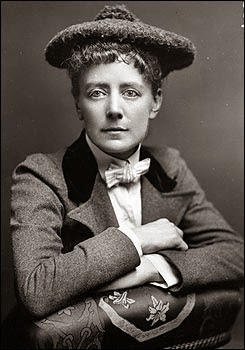
Ethel Smyth

I don't think Schenkar intended for that sentence to give me so much pause. People are "falling" for or "falling in love" with other people all the time! The women who fell for Oscar Wilde's older brother, Willie, didn't go on to lead the life of a fallen woman, as our contemporary understanding of Victorian morality indicates they should have. and Shenkar certainly doesn't imply that they did.
Mrs. Frank Leslie

Shenkar does go on to discuss Willie's relationship with the suffragette, Ethel Smyth. Smyth ended her engagement to Willie, then lead a long and happy life, which included artistic successes and love affairs straight through to her 70s. Willie's first wife travelled and flourished financially after their divorce. Divorcing Willie won her sympathy in the press, rather than condemnation, but she did own more than a few newspapers. Willie's second wife doesn't seem to have had much drama in her life, after Willie's passing, but had a long and happy marriage with Dutch translator, Alexander Teixeira de Mattos.

I find Willie in the biography of his daughter and other histories, like that of his first wife, which all combine to paint a picture of a hideously charming womanizer. A kind of Dr. Jekyll and Mr. Hyde, Willie demonstrated incredible courtesy and outrageous disrespect to the women in his life, including his mother. Like Barney Stintson, I imagine Willie even had a playbook, well-memorized before attending the dances and dinner parties of 1890s London. He slept with as many pretty and rich Victorian women as he could. The latter showered him with gifts and even forgave his attempts to commit bank fraud on their savings accounts.
Dolly Wilde (Willie's daughter)

The image of falling and the long culture of blaming women for indiscreet sexual encounters make me picture the women Willie met as the 1890s equivalent to the women Barney Stintson picked up on the series: How I Met Your Mother, but that simply was not the case. Beautiful, intelligent and wealthy women clearly fell for Willie's charms. He wasn't someone they should have fallen in love with, and may have changed their lives forever; Willie's second wife had a child by him. When the relationship ended, the women in Willie's life were still beautiful, intelligent and wealthy (if they started out that way). The term "fallen" simply does not apply here. Rather than finding the women that Willie preyed on as footnotes in a history of his sexual conquests, I look for him in the footnotes of their biographies because they have biographies and Willie doesn't.

Maybe it's time to question the narrative that a mistake, like Willie, was the end for any good Victorian woman.

Follow me on Twitter @TinyApplePress and like the Facebook page for updates!

Friday, April 11, 2014

Willie Wilde’s Failure as a Husband

Oscar Wilde (2nd from left) & Willie Wilde (sitting on right).
Oscar Wilde's one-time sister-in-law once declared to her then-husband Willie Wilde that she had married the wrong brother. Such bitter irony because Oscar was already married, and we all know how that turned out. Then I found this wonderfully gossipy 1893 article that outlines what made Willie even worse as a husband!
The Morning Call, 8 June 1893, 10.
WILL LOSE WILLIE
Mrs. Leslie in the Divorce Court
RECOLLECTIONS OF A VISIT
The Great Matrimonial Comedy About to Close - Willie Wilde’s Failure as a Husband

Many people out here who had the opportunities a year and a half ago to please themselves by meeting Mrs. Frank Leslie and the brother of Oscar Wilde will gossip with considerable relish about the dissolution of the matrimonial alliance between them.

Mrs. Leslie expects that the bonds will be put assunder by Judge Brown of Newburg, N.Y., in a very few days, and the very minute she finds herself a free woman again she will sail to Europe.

That was a funny sort of match from the start, and the breaking of it now only makes people smile. The characteristic passages in the married life of Mr. and Mrs. William Wilde would make a more delightful society comedy than the stage ever presented if properly selected and strung together.
Mrs. Frank Leslie

People out here who met them when they visited California with the League of Press Clubs were not impressed by the idea that it was one of those tender love affairs. They had been married about four months then, so that the trip came pretty near being a honeymoon tour. Everybody who had ever seen Mrs. Leslie thought they knew what she looked like, for next to President Harrison her picture had been published as often as anybody else’s in America, displaying the bright, handsome face and the trim and stylishly dressed form of a striking and fascinating young woman.

But oh, what a difference time had wrought since the negatives from which all of Mrs. Leslie’s pictures have been made were new! She came as bright, independent, positive and hustling as she ever was, but there were furrows where the bloom had once rested and nature had acquired that careless way of letting lines of grace sag into less pleasing outlines. No good picture of Mrs. Leslie has ever been labeled “From a recent photograph.” But everybody was curious and ambitious to meet the famous woman who had taken a great publishing business where her husband had left it at his death - deeply involved in debt - and by her own shrewdness made an independent fortune out of it.
Oscar & Willie by Unseam

And Willie Wilde - William C. Kingbusy Wilde - was regarded with little less curiosity. He was a great tall, bewhiskered, large-eyed Englishman in rather ill-fitting clothes, with a stoop about his shoulders, a slowness in his talk and movements and a very unaggressive manner.

He was a man who had distinguished himself - by becoming brother of a poet and by marrying Mrs. Frank Leslie. He was the husband of Mrs. Frank Leslie and was always identified that way. That suited the bride to a T - in fact, she insisted on it herself. She never proposed her identity be swallowed up in a mere husband and she never betrayed a disposition to do any great amount of cleaving to him. She was always “Mrs. Frank Leslie,” though at times she would let “Wilde” be tacked on with a hyphen, and she always went right a head having her own way with as little regard for her hubby’s wishes as though he were her coachman. In fact, the ruthless way in which she would “sit down” on him in the presence of strangers was often quite distressing. It was even more distressing to be compelled to witness the apologetic “Will you allow me, madame?” way that William C.K. Wilde had in her presence.

And when Mrs. Leslie and Willie Wilde returned to New York to take up the routine of life they did it in very different ways, and as time went on no affinity was developed. She got out of bed betimes and attended to her business. while he, ready to receive the good sent by the gods, took up the “dolce far niente” style of languid existence, the hustling wife trying in vain to just “sha-ake” him into doing something in the way of “getting there.”

Then there was Willie’s careless way of leaving his teeth lying around her boudoir and little things like that to gradually increase a desire on her part to lose him. So it was no wonder that Willie finally went back to London where she met him and whence he came nerved up to a grim resolve not to weary in persuading, which resolve enabled him to make the one brilliant stroke in his life.

Mrs. Frank Leslie is a brilliant success as a publisher, but like a few other women she was not so smart about getting married. Now people will wonder if she will not go back to Europe to again set the gossips to talking and perhaps see if she can’t do better next time.
Follow me on Twitter @TinyApplePress and like the Facebook page for updates!

Monday, April 7, 2014

Willie Wilde & Mrs. Frank Leslie

Willie Wilde, Los Angeles Herald (1892).
"Vulgarity in journalism, like vituperation in argument, weakens the point." - Willie Wilde, The Los Angeles Herald, 13 February 1892.
I found this marvellous article in the Los Angeles Herald with a sketch of Oscar Wilde's wicked brother in it. Willie Wilde grows more and more wicked with every bit I learn about him. This article ends with Willie's American wife, Mrs. Frank Leslie, complaining about the way the press has treated her for her marriage to Willie. The author, Belle Hunt, also reveals that Willie was caught forging a cheque in Leslie's name a year before they were married. As George Takei would say: "Oh my!"


It certainly seems that Willie's vile reputation preceded him in the United States.


To be fair, Leslie was old enough to be Willie's mother. Within a year's time, she would send him back to his mother.

Follow me on Twitter @TinyApplePress and like the Facebook page for updates!

Tuesday, November 5, 2013

The Baroness de Bazus, Empress of Journalism


One of the craziest Wildes I've found in my research was the one-time wife of Oscar Wilde's brother, who never used the name Wilde. The name that this American publisher enjoyed the longest was Mrs. Frank Leslie, but, rather than dwelling on her names, I'd like to record what I've learned about her Wilde life.


In 1836, Leslie was born Miriam Florence Folline to a noble Huguenot family in New Orleans, Louisiana. Although rumoured to be the product of an affair her father had with a slave, she was raised by her father’s wife, who Leslie knew as her mother. She studied French, German, Latin and Spanish as a child and was provided all of the advantages that her family's dwindling fortune would allow. Yet, Leslie claimed: "I never had any childhood, for the word means sunshine and freedom from care. I had a starved and pinched little childhood, as far as love and merriment go." Her father, personally, supervised her early education, until his financial situation collapsed, in 1846.

Due to her father's financial situation, the family moved to Cincinnati, where her father spent far less time with her, then to New York, around 1950. In New York, her mother ran a boarding house, while striving to keep up appearances, so that her daughter might marry well. I imagine Leslie got her strength and good business sense from her mother, at this time in her life. However, she also got a determination to marry and marry well.

Leslie married, for the first time, at just seventeen. Her first husband, David Charles Peacock was a jeweller. They spent less than a year together as man and wife, in 1854. Ten years Leslie's senior, Leslie's mother forced Peacock to marry Leslie under the threat of arrest for seduction. Peacock landed in an insane asylum, where he eventually died. Their marriage was annulled in 1856 and Leslie's reputation in tact.

Lola Montez

After her marriage to Peacock, in the mid-1850s, Leslie began life as an actress, under the name of Minnie Montez, stage sister to Lola Montez, a charming and legendary adventurer. The story goes like this: while entertaining in the mining settlement of Grass Valley, Califoria, Montez met Leslie’s half-brother Noel Follin, who kept Leslie apprised of his own adventures by post; Follin accompanied Montez on a theatrical tour to Austrailia, but was tragically thrown overboard during the trip; devastated, Montez travelled to New York to offer her services to his family and wound up taking Leslie under her wing.

Ephraim Squier

By 1857, Leslie abandoned her acting career to marry the archeologist and newspaper editor, Ephraim Squier. Leslie married Squier in 1858. Within a couple of years, Squier was promoted to editor-in-chief of Frank Leslie's publishing house, where he supervised the publication of Frank Leslie's Pictorial History of the American Civil War; vol. 1 & 2. I’m sure you can see where this is going.

In 1863, the editor of Frank Leslie’s Lady’s Magazine fell ill and our Leslie volunteered to fill in. The original editor died in 1871 and Leslie got the job permanently. As biographer, Madeleine B. Stern, wrote:
To her various skills Miriam now added the arts of flowery prose writing and editorial acumen. From her editorial corner she watched the House of Leslie expand until it employed from three to four hundred assistants including seventy wood engravers and boasted an aggregate circulation of some half a million copies per week.
To her study of the arts of publishing Miriam joined an equally intense study of the arts of the publisher.

Clearly, lots of wives of editors, who worked for Mr. Frank Leslie, would have loved the job, but Mr. Leslie had been living in the Squier household since 1861. For some time, the relationship between all three became sexual, but eventually Squier appeared to be in the way of a great love that was blossoming between his wife and his boss. Stern writes:
It was inevitable that, after a sensational divorce from the now unbalanced E. G. Squier, she should acquire yet another name—Mrs. Frank Leslie. On July 13, 1874, the thirty-eight-year-old editor of a woman's magazine was married to the suave and elegant fifty-three-year-old magnate of Publishers' Row. One month later, E. G. Squier was committed to an asylum for the insane.
Under the name she liked longest, if not best, Leslie’s life becomes even more interesting.

Joaquin Miller

While the Leslies were on their honeymoon, they met Joaquin Miller, nicknamed the poet of the Sierras. The newlyweds soon began an affair with the poet and Mrs. Leslie became a character in Miller’s novel, The One Fair Woman. I imagine Mr. Leslie is featured in the book as well:
The beautiful lady smiled with an expression of sadness that was even painful, but only smiled. The husband, a handsome, graceful, Italian-looking fellow, with a small hand and a small weak nose, and a small head which was getting bald lifted his hat also, with that ease and composure which shows at least the gentleman bred and born.

Even if Mr. Leslie was bred and born and a gentleman, due to the Panic of 1873, their lavish lifestyle, expensive trips, and probably due to the time those things took away from actual work, the Frank Leslie publishing empire was in financial trouble by 1877/8. By the time of Mr. Leslie’s death, in 1880, they were about $300,000 in debt. She reorganized everything, became president of the company and increased circulation of their most popular publication by over 200,000 copies in just four months.

This is when our Leslie takes over, she put the business on a paying basis, even legally changing her name to Frank Leslie in 1881. In the early 1880s, Leslie made most of her money in the newspaper aspect of her publishing empire, by capitalizing on President Garfield’s assassination in 1881. Garfield’s illness and death provided a national demand for news and Leslie provided it by issuing three illustrated newspapers per week. At the time, her rise from near financial ruin was unparalleled in journalism history, Hailed as the “Empress of Journalism” and a “commercial Joan of Arc,” Leslie became a real-life legendary figure on Publishers’ Row.


Her success afforded her a prominent place in New York society, a place that was so secure that, by the 1890s, she could even afford a run-in with the Wilde family. Followers of the Wilde family history, even followers of my blog, will be familiar with Oscar Wilde’s mother, Speranza, and her love of “interesting” people. Leslie was interesting enough for Speranza. She was also rich and Speranza still had an unmarried son. Speranza is said to have introduced the two with the words: “I’d like you to meet your future husband.”


Leslie brought Willie Wilde back to New York and married him in 1891 at the Church of the Strangers. She had a strange year in store, for Willie was a raging alcoholic, who was jealous of his brother, and apparently couldn’t perform in bed, when Leslie wanted him to. Proclaiming that she had married “the wrong Wilde,” Leslie returned him to his mother in London.

Willie Wilde

Willie Wilde survived the marriage, didn’t go in to an insane asylum, but turned Leslie off of marriage for the remainder of her years, although she did engage in a rather public flirtation with the Marquis Campo Allegre Villaverde, Court Chamberlain to King Alfonso of Spain.

Flirting with aristocrats, Leslie was a self-made multi-millionaire, who craved an aristocratic title, so she simply made one up: Frank Leslie, Baroness de Bazus. Instead of husbands or children, she coddled a Yorkshire Terrier and held salons, similar to those to her former mother-in-law, Spernaza.


A woman, who led such an interesting life, had to have an interesting death and, unlike Willie, Leslie never disappoints. Leslie died in 1914, leaving the majority of her fortune to Mrs. Carrie Chapman Catt, to be used for the promotion of the cause of woman suffrage. Obviously, people claimed she was crazy. After all, she coddled a dog and made her own money... and I guess there was the whole Baroness de Bazus business.

Rose Young tells the story of what happened after 1914. Young’s tale:
records a curious tale of claims and contests with dubious foundation, which made huge inroads into the estate.
It shows how a fortune may be scaled down through depreciation, taxation, and enormous expenses, charged to administration. It shows the lengths to which claimants will go in attacking the reputation of the dead. It records the many suits, judgments and appeals involved in the settlement of the Leslie estate. It sets forth what the next of kin got, what the lawyers got, what the executors got, and, finally, what Mrs. Catt did with the portion that came to her. For suffragists it will serve as a recognition of their interest in the proper disposition of the fund left by Mrs. Leslie to further the suffrage cause, and as an official report of Mrs. Catt's stewardship of that fund.
For my part, I’m blown away by how Leslie lived before woman suffrage, whether she was crazy or not. Also, upon reviewing the images that I've gathered here, I have to say, she liked her men the way she liked her puppy... with lots of facial hair!

Follow me on Twitter @TinyApplePress and like the Facebook page for updates!