Showing posts with label Importance of Being Ernest. Show all posts

Thursday, March 17, 2016

Snuff and Nonsense: Tobacco in the 1890s

Jack.  Well, yes, I must admit I smoke.
Lady Bracknell.  I am glad to hear it.  A man should always have an occupation of some kind.  There are far too many idle men in London as it is.

This blog debuted with a post about cigarettes. Cigarettes themselves were an invention of the nineteenth century. Though the Mayans were using tobacco in the ninth century, tobacco wasn't rolled in fine paper until it went to Spain in the seventeenth century. The Spanish called this a 'papelate.' A papelate went to France in 1830, where they called it a cigarette. French people and cigarettes were two of Oscar Wilde's favourite things. In a letter to his brother, he once said: "Charming people should smoke gold-tipped cigarettes or die."

Gold-tipped cigarettes (circa 1890)
While Oscar's father may have enjoyed the ocassional cigarette, he probably preferred snuff. Long before Oscar Wilde and the cigarette, the ritualistic habits of tobacco users appealed to Europeans all over the world.
Snuff's associations with fashion made it irresistible to British society, whose fondness for rules and tendency to develop tobacco rituals led them to develop a complex etiquette for snuffing, against which they could measure the relative social rank, or intellectual potential, of a stranger. An example is provided by that venerable chronicle of idiocy, the Tatler: 'I cannot see either his person or his habit in his letter, but I shall call at Charles [Charles Lillie, a French perfumer and snuff seller] and know the shape of his snuff box, by which I can settle his character.' -- Iain Gately, "Tobacco: A Cultural History of How an Exotic Plant Seduced Civilization" (2001).
Smoking cigarettes, gold-tipped or otherwise, didn't really catch on until the 1880s, after an American made pre-rolled cigarettes cheaper. James Bonsack lived in Virginia, where his father operated a woolen mill. By tinkering with one of the carding machines from his father's factory, Bonsack created a cigarette rolling machine, capable of producing ten thousand cigarettes per hour.  To put that number in perspective, in an 1897 cigarette rolling contest, the "Queen of the hand-rollers," Lily Lavender rolled 162 cigarettes in thirty minutes. All cigarettes were rolled by hand, until Bonsack got the patent on his machine in 1881.

Diagram from James Albert Bonsack's patent application
(U.S. patent 238,640, granted March 8, 1881). 
"Duke of Durham"
(circa 1890s).
James Duke of W. Duke Sons and Company in Durham had 125 hand rollers producing 250,000 cigarettes a day, when his company tried the Bonsack cigarette machine in 1883. One machine could do the work of 48 people, but other companies were reluctant to try it because they thought people preferred hand-rolled cigarettes; this allowed Duke's company a chance to be the first. By 1888, Duke replaced all of his company's hand-rollers with machines.

By the 1890s, French and British cigarette companies were using various types of cigarette rolling machines, which lowered the cost of cigarettes everywhere. Their popularity increased at this new lower price, so that in the 1890s younger men smoked, whereas older men might have still been attached to the habit of snuff.

Many women, especially feminists who were fighting against social convention, smoked. Though it was typically frowned upon for them to do so in public, its reported that many celebrity women were smoking at the opening of the Dorothy Restaurant on Oxford Street in June 1889.

In Robert Proctor's "Golden Holocaust: Origins of the Cigarette Catastrophe and the Case for Abolition" (2011), Bosnack's smoking machine is partially responsible for setting off the smoking epidemic. Perhaps, as Lady Bracknell says in "The Importance of Being Ernest" (1895) there were far too many idle people in London; idle hands are, as they say, the devil's workshop.

Follow me on Twitter @TinyApplePress and like the Facebook page for updates!

Friday, January 9, 2015

A Hand-Bag?

Jack.  I am afraid I really don’t know.  The fact is, Lady Bracknell, I said I had lost my parents.  It would be nearer the truth to say that my parents seem to have lost me . . . I don’t actually know who I am by birth.  I was . . . well, I was found.
Lady Bracknell.  Found!
Jack.  The late Mr. Thomas Cardew, an old gentleman of a very charitable and kindly disposition, found me, and gave me the name of Worthing, because he happened to have a first-class ticket for Worthing in his pocket at the time.  Worthing is a place in Sussex.  It is a seaside resort.
Lady Bracknell.  Where did the charitable gentleman who had a first-class ticket for this seaside resort find you?
Jack.  [Gravely.]  In a hand-bag.
Lady Bracknell.  A hand-bag?
Jack.  [Very seriously.]  Yes, Lady Bracknell.  I was in a hand-bag—a somewhat large, black leather hand-bag, with handles to it—an ordinary hand-bag in fact.
Lady Bracknell.  In what locality did this Mr. James, or Thomas, Cardew come across this ordinary hand-bag?
Jack.  In the cloak-room at Victoria Station.  It was given to him in mistake for his own.
Lady Bracknell.  The cloak-room at Victoria Station?
Jack.  Yes.  The Brighton line.
Lady Bracknell.  The line is immaterial.  Mr. Worthing, I confess I feel somewhat bewildered by what you have just told me.  To be born, or at any rate bred, in a hand-bag, whether it had handles or not, seems to me to display a contempt for the ordinary decencies of family life that reminds one of the worst excesses of the French Revolution.  And I presume you know what that unfortunate movement led to?  As for the particular locality in which the hand-bag was found, a cloak-room at a railway station might serve to conceal a social indiscretion—has probably, indeed, been used for that purpose before now—but it could hardly be regarded as an assured basis for a recognised position in good society.
Early modern Europeans of both genders wore purses to carry coins. The handbag was an invention of the Victorian era. The word for it was popularized during Oscar Wilde's lifetime; a line of this famous scene from 'The Importance of Being Ernest' is the third recorded use in the Oxford English Dictionary.

In this scene, Wilde pulls apart the handbag, the railway, the premise for every good sensation novel, and the Victorian Era as a whole. Lady Bracknell says the "line is immaterial," but it is the more respectable of the two at Victoria Station at the time. Poor Jack is grasping at straws with this woman, who seems to be a Victorian institution in and of herself.

But I want to talk about the handbag. Lady Bracknell's line, "A hand-bag?" has been interpreted differently by once actress after another, beginning with Edith Evans, who, in the 1952 film, delivered the line with a loud mixture of condescension and astonishment.


At any rate, the establishment didn't crumble because of any Wilde's writings. Oddly, his private relationships bothered the world more. Handbags and trains seem far more commonplace now. What did the invention of the handbag signify for the nineteenth century? Why was it then that something more than a purse was needed?

The handbag was designed by request for use on the railway. In 1841, Doncaster butterscotch manufacturer, Samuel Parkinson ordered a set of luggage, and insisted on something specific to his wife's needs. Her purse was too small; its material too flimsy. Parkinson ordered his wife various hand-bags of different sizes for different occasions, and asked that they be made from the same leather as his cases and trunks, distinguishing them from the all-too-familiar carpetbags. Upon Parkinson's request, H. J. Cave of London then produced the first modern handbags, including a clutch and a tote.

Like many other things women said they wanted, critics complained that they were unnecessary, and damaging to a woman's health. Interestingly, in Wilde's play, Miss Prism's handbag is so similar to Mr Cardew's that the two were mixed up!

Follow me on Twitter @TinyApplePress and like the Facebook page for updates!

If you have enjoyed the work that I do, please support my Victorian Dictionary Project!

Thursday, August 8, 2013

The Rise and Fall of the Cucumber Sandwich


Cucumber sandwiches immediately make me think of the Importance of Being Earnest and the manner in which Algernon gobbled them all. His character is often portrayed as gluttonous for doing so, but cucumber sandwiches really aren't very filling.

In fact, cucumber sandwiches weren't meant to take the place of a meal, but were served as a sign of one's status, like caviar used to be. The idea was that members of the Victorian upper class were men and women of leisure and could afford to eat food of little to no nutritional value - both by being able to waste money on it and by not needing to eat properly for work.


The cucumber sandwich's popularity was rumoured to have begun within the aristocracy, but it definitely ended with the working classes. In the Edwardian era, growers started growing cucumbers cheaply in hot houses throughout the year, making them more affordable and less prestigious. At the same time, tea, as a meal, became less common.

Now, for those of you, who want to try one, I've found tons of recipes online, but have learned that there were certain requirements for a truly refined Victorian cucumber sandwich. The most important thing is that the sandwich should be thin.

For this reason, a denser white bread is preferred. The density of the bread helps to maintain the structural integrity of slice, which should be cut thin enough that, when you hold it to a window, the sun can shine through it.

Keeping the sandwich thin, the cucumbers need to be sliced thin as well, but should be peeled first, if you are not going to make a decorative pattern around each cucumber slice with a fork on the peel. The sliced cucumbers are mixed in vegetable oil and lemon juice with a little white pepper.

Before placing the cucumber on the bread, the bread should be buttered, but just enough to keep the cucumber from making the bread moist.

Once you've constructed the sandwich, cut off the crusts and arrange them on a plate!


Follow me on Twitter @TinyApplePress and like the Facebook page for updates!

Tuesday, February 5, 2013

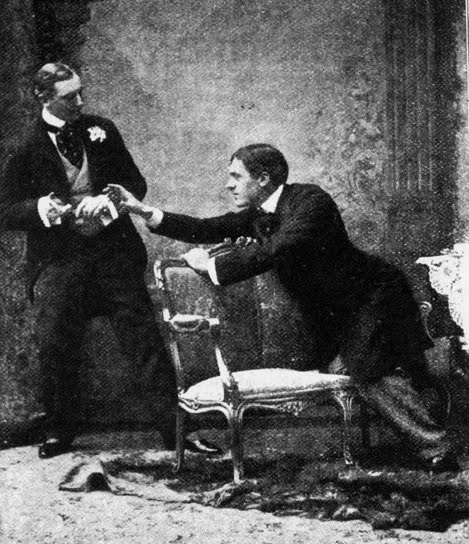
The Cigarette Case


The following is one of my many favorite scenes from the Importance of Being Earnest.
Algernon. Bring me that cigarette case Mr. Worthing left in the smoking-room the last time he dined here.
Lane. Yes, sir. [Lane goes out.]
Jack. Do you mean to say you have had my cigarette case all this time? I wish to goodness you had let me know. I have been writing frantic letters to Scotland Yard about it. I was very nearly offering a large reward.
Algernon. Well, I wish you would offer one. I happen to be more than usually hard up.
Jack. There is no good offering a large reward now that the thing is found.
[Enter Lane with the cigarette case on a salver. Algernon takes it at once. Lane goes out.]
Algernon. I think that is rather mean of you, Ernest, I must say. [Opens case and examines it.] However, it makes no matter, for, now that I look at the inscription inside, I find that the thing isn’t yours after all.
Jack. Of course it’s mine. [Moving to him.] You have seen me with it a hundred times, and you have no right whatsoever to read what is written inside. It is a very ungentlemanly thing to read a private cigarette case.
Algernon. Oh! it is absurd to have a hard and fast rule about what one should read and what one shouldn’t. More than half of modern culture depends on what one shouldn’t read.
Jack. I am quite aware of the fact, and I don’t propose to discuss modern culture. It isn’t the sort of thing one should talk of in private. I simply want my cigarette case back.
Algernon. Yes; but this isn’t your cigarette case. This cigarette case is a present from some one of the name of Cecily, and you said you didn’t know any one of that name.
Jack. Well, if you want to know, Cecily happens to be my aunt.
Algernon. Your aunt!
Jack. Yes. Charming old lady she is, too. Lives at Tunbridge Wells. Just give it back to me, Algy.
Algernon. [Retreating to back of sofa.] But why does she call herself little Cecily if she is your aunt and lives at Tunbridge Wells? [Reading.] ‘From little Cecily with her fondest love.’
Jack. [Moving to sofa and kneeling upon it.] My dear fellow, what on earth is there in that? Some aunts are tall, some aunts are not tall. That is a matter that surely an aunt may be allowed to decide for herself. You seem to think that every aunt should be exactly like your aunt! That is absurd! For Heaven’s sake give me back my cigarette case. [Follows Algernon round the room.]
Algernon. Yes. But why does your aunt call you her uncle? ‘From little Cecily, with her fondest love to her dear Uncle Jack.’ There is no objection, I admit, to an aunt being a small aunt, but why an aunt, no matter what her size may be, should call her own nephew her uncle, I can’t quite make out. Besides, your name isn’t Jack at all; it is Ernest.
Jack. It isn’t Ernest; it’s Jack.
It's even a more interesting read, now that I know that Oscar Wilde really was writing about himself and his brother in this play. In writing it, Oscar saw himself as Jack and his brother, Willie, as Algernon. It's interesting, to me, that Oscar paints himself on the receiving end of a cigarette case as a present, when he was known to give them as gifts, especially to his male lovers. Interesting too that the cigarette case that he was given exposes his secret.

Before Importance of Being Earnest went on stage, Oscar had to testify about cigarette cases before the courts, during his infamous trials. 
Mr. C. F. Gill--You made handsome presents to all these young fellows?
Oscar Wilde--Pardon me, I differ. I gave two or three of them a cigarette case: Boys of that class smoke a good deal of cigarettes. I have a weakness for presenting my acquaintances with cigarette cases.
Mr. C. F. Gill--Rather an expensive habit if indulged in indiscriminately, isn't it?
Oscar Wilde--Less extravagant than giving jewelled garters to ladies. (Laughter.)
Oscar's weakness for presenting people with cigarette cases was performed as a sign of affection. It's a quiet aim of mine to keep all of this month's posts on the romantic side and I do like this idea that Oscar had a sort of trademark gift for his friends.

It's also nice to know that some people gave him cigarette cases in return. Two years ago, the cigarette case Oscar got from Bosie was displayed at the BADA Antiques and Fine Art Fair and is pictured (below).

Follow me on Twitter @TinyApplePress and like the Facebook page for updates!

Wednesday, January 9, 2013

Bunbury

Bunbury is the metaphorical gun on the wall in Oscar Wilde's The Importance of Being Earnest, foreshadowing the deceptions that are to occur throughout the play. It's a silly name and sounds like something one makes up on the spot, hard to think of real-life inspiration for Oscar when he was writing that, especially because his use of the concept is so playful.
Algernon: Bunbury? Oh, he was quite exploded.
Lady Bracknell: Exploded! Was he the victim of a revolutionary outrage? I was not aware that Mr. Bunbury was interested in social legislation. If so, he is well punished for his morbidity.
Algernon: My dear Aunt Augusta, I mean he was found out! The doctors found out that Bunbury could not live, that is what I mean—so Bunbury died.
Lady Bracknell: He seems to have had great confidence in the opinion of his physicians.

Not many people know (I didn't) that Bunbury was the name of a real person, who gained a small amount of fame in an area of interest to Oscar Wilde, while he was writing the play. On 23 January 1894, G.W. Bunbury set the world record for writing shorthand at 250 words per minute for ten minutes; thats 750 words in ten minutes!

Was G.W. Bunbury the inspiration for Algernon's fake identity? Possibly?

I can just picture the conversation,
Bosie: This Bunbury fellow can write 250 words per minute.
Oscar: None of it original.
Bosie: I don't believe he exists.
He did though.

Follow me on Twitter @TinyApplePress and like the Facebook page for updates!