Tuesday, September 29, 2015

The Gentleman's Gentleman

His day commences by seeing that his master’s dressing-room is in order; that the housemaid has swept and dusted it properly; that the fire is lighted and burns cheerfully; and some time before his master is expected, he will do well to throw up the sash [open the window] to admit fresh air, closing it, however, in time to recover the temperature which he knows his master prefers. It is now his duty to place the body-linen on the horse before the fire, to be aired properly; to lay the trousers intended to be worn, carefully brushed and cleaned, on the back of his master’s chair; while the coat and waistcoat, carefully brushed and folded, and the collar cleaned, are laid in their place ready to be put on when required. All the articles of the toilet should be in their places, the razors properly set and stropped, and hot water ready for use.
So says Mrs Beeton's Book of Household Management (1861) on the duties of the Gentleman's Gentleman, or valet, which, although my husband and I have debated the point greatly, rhymes with 'pallet.'
Gentlemen generally prefer performing the operation of shaving themselves, but a valet should be prepared to do it if required; and he should be a good hairdresser. Shaving over, he has to brush the hair, beard and moustache, where that appendage is encouraged, arranging the whole simply and gracefully, according to the age and style of the countenance. Every fortnight, or three weeks at the utmost, the hair should be cut, and the points of the whiskers trimmed as often as required. A good valet will now present the various articles of the toilet as they are wanted; afterwards, the body-linen. Neck-tie, which he will put on, if required, and, afterwards, waist-coat, coat, and boots, in suitable order, and carefully brushed and polished.”
The valet was a gentleman's helicopter parent, overseeing any and every aspect of a gentleman's life - as required. P.G. Wodehouse's Reginald Jeeves, who has come to be thought of as the quintessential valet, takes his duties far beyond the call of any servant, or hired hand. Unlike a butler, Jeeves served the man, not the household, though his duties may at times make him responsible for the gentleman's household. Jeeves' genius and resourcefulness is so well known that it inspired the name of the website, AskJeeves (1996), which was renamed Ask.com in 2006.

Like Jeeves, Corporal Trim, from the Life and Opinions of Tristram Shandy, Gentleman (1759), is a bit more clever, observant, insightful, and gentlemanly than the gentleman who employs him.

Which is just the sort of person you want around if you are on a vengeance mission, like Edmond Dantès in the Count of Monte Cristo (1844). No task is too great, or too small, for a good valet. Consequently, Dantès's valet, Baptistin, is devoted to the task of helping him destroy his enemies.

Loyalty, devotion, and personal service are integral to the role of the valet. The valet of Wayne Manor, Jarvis Pennyworth makes it his dying wish that his son, Alfred, continue serving the Wayne family in Batman.

Moreover, how does one become a gentleman's gentleman without becoming a gentleman himself? And if there was a way to become more gentlemanly than a gentleman, why didn't gentlemen take advantage of the same opportunity?

As Jeeves and Corporal Trim illustrate, one might become a valet in various ways. Someone, like Jeeves, may have started his career as a footman, while gradually picking up the rest of the skills his employer required and occasionally stepping into the role for guests who travelled without their valet, or younger members of the household who didn't yet have their own. Corporal Trim got his training in the military, as a companion-at-arms. Although Alfred is a retired intelligence agent, his family has a history of serving the Wayne family, so Alfred comes into his life's calling through established traditions.

Again, the main difference between butlers and valets is loyalty: butlers serve the household; valets serve the man. The female equivalent to the valet is the lady's maid, whereas, although it less common, women can be butlers too.
A man servant was too expensive, so I caught up a little garden girl, made like a milestone, christened her Bunch, put a napkin in her hand, and made her my butler. The girls taught her to read, Mrs. Sydney to wait, and I undertook her morals. Bunch became the best butler in the country. - Horace Smith, Two Essays, a Story, and Some Verses (1892).
Follow me on Twitter @TinyApplePress and like the Facebook page for updates!

If you have enjoyed the work that I do, please support my Victorian Dictionary Project!

Thursday, September 24, 2015

How Bram Stoker Reanimated Mummies

"...the consciousness of the mummy does not rest but is to be reckoned with." - Bram Stoker

Why are mummies so scary? They don't moan and walk around in real life, the way they do in movies, but they are actual things. Mummies are the realest of all the horror movie monsters. Vampires and werewolves come from literature; trolls and ghosts from myths and folklore; but mummies actually exist. Fear of mummies is a projection of European guilt over the colonial project and embodies aspects of that project by making magical monsters out of the colonial other.

Europeans weren't the first to plunder the Great Pyramids, but late-Victorian London is the focus of this blog, so I'm not going to get side-tracked by other plunderers, especially when the influence of writers from 1890s London has such a profound influence on the development of the monster mummy narrative.

The belief that some of the antiquities were cursed had been circulating around Europe since the end of the 17th century, but that didn't stop "collectors," like Lady Meux and Sir William Wilde. Sir William, Oscar Wilde's father, collects Egyptian antiquities that he took directly from Egypt. Bram Stoker later recalled listening to Sir William's stories about Egypt "before all the archeology started." Lady Meux developed one of the largest collections with over 2,000 pieces, including mummies, which she tried to donate to the British Museum upon her death.


This was the social/political climate in which Bram Stoker wrote the first prominent work of fiction featuring mummies as supernatural antagonists: The Jewel of Seven Stars (1903). Like Stoker's vampires, his mummies became postcolonial pop-culture icons. Before the Jewel was published, mummies' curses were used to explain the deaths of anyone connected to anyone who came into contact with a mummy. After the Jewel was published, the mummies themselves could be reanimated.
"Father, in the Egyptian belief, was the power of resurrection of a mummied body a general one, or was it limited? That is: could it achieve resurrection many times in the course of ages; or only once, and that one final?" 
"There was but one resurrection," he answered. "There were some who believed that this was to be a definite resurrection of the body into the real world. But in the common belief, the Spirit found joy in the Elysian Fields, where there was plenty of food and no fear of famine. Where there was moisture and deep-rooted reeds, and all the joys that are to be expected by the people of an arid land and burning clime." 
Then Margaret spoke with an earnestness which showed the conviction of her inmost soul: 
"To me, then, it is given to understand what was the dream of this great and far-thinking and high-souled lady of old; the dream that held her soul in patient waiting for its realisation through the passing of all those tens of centuries. The dream of a love that might be; a love that she felt she might, even under new conditions, herself evoke. The love that is the dream of every woman's life; of the Old and of the New; Pagan or Christian; under whatever sun; in whatever rank or calling; however may have been the joy or pain of her life in other ways. Oh! I know it! I know it! I am a woman, and I know a woman's heart. [...]" - Bram Stoker, The Jewel of Seven Stars (1903)
The idea of a mummified Egyptian queen, not dead, but asleep and dreaming of love, was transferred directly into an episode of Buffy the Vampire Slayer in 1997, in which the 500 year-old mummy of an Inca princess is brought back to life and falls in love with Zander.

"Inca Mummy Girl," Buffy the Vampire Slayer,
7 October 1997.
Conscious willing desire is what separates pop-culture supernatural antagonistic mummies from their zombie counter parts. Zombies mindlessly wander about seeking brains, but if a mummy feeds on a human it is for strength to carry on a new life, or to maintain guardianship over their afterlife. For Stoker's mummy, it was both. In this scene of the Jewel, Stoker's protagonists are trying to interpret "ka" and "ab" from an Egyptian text:
"It means that for this night the Queen's Double, which is otherwise free, will remain in her heart, which is mortal and cannot leave its prison-place in the mummy-shrouding. It means that when the sun has dropped into the sea, Queen Tera will cease to exist as a conscious power, till sunrise; unless the Great Experiment can recall her to waking life. It means that there will be nothing whatever for you or others to fear from her in such way as we have all cause to remember. Whatever change may come from the working of the Great Experiment, there can come none from the poor, helpless, dead woman who has waited all those centuries for this night; who has given up to the coming hour all the freedom of eternity, won in the old way, in hope of a new life in a new world such as she longed for...!"
George Washington used the term "the Great Experiment" to refer to the United States of America and Stoker was a scholar of American history, so it's not a stretch to say that "the Great Experiment," in this case, refers to modernity. If the experiment is a success the modern world will be everything that the mummy ever dreamed of, and by extension the right place for all other cursed Egyptian antiquities.


The notion that preserving antiquities is the burden of the benefactors of societies great experiments is at the heart of the cursed artefact myth and permeates the views of many modern Egyptologists and museum patrons. In the words of Jasmine Day in "The Mummy's Curse: Mummymania in the English-speaking World" (2006):
Popular archeology's promise of empowerment to its audiences can thus become implicated in a regressive imperialistic fantasy. The 'Humanity Ownership Argument' frequently invoked in debates about control of cultural property, holds that a body of material culture should not be possessed solely by a single ethnic group. This resembles the demand of the Dragon Principle that valuables be ceded to those who can best utilize them. [Some people] believed that indigenous peoples' requests for reparation of their former possessions threatens archeology. They spoke as if their own property were being threatened, because they identified with the archeologists.
In other words, to some, the British Museum is a better caretaker of Egyptian artefacts than Egyptians are. In 1890s terms, British collectors felt they were better caretakers of Egyptian antiquities that Egyptians were.

Bram Stoker might not have invented the mummy, but he animated it and infused its new life with the anxieties of the emerging postcolonial era, the traces of which can still be seen today.

Follow me on Twitter @TinyApplePress and like the Facebook page for updates!

If you have enjoyed the work that I do, please support my Victorian Dictionary Project!

Tuesday, August 11, 2015

Popular Perceptions of Electricity in the 1890s


If you lived in a major city, like London, electricity had become part of your everyday life by the 1890s. You might not have it in your home, but even if you did, you might not understand what it was.

Even electrical engineers, like Nikola Tesla, used words like "energy" to describe that which was generated by electricity and that which he felt after sleeping. It's not clear that many people distinguished between the two. Tesla actually got the idea for tuning radio frequencies through his belief that he and his mother were tuned into the same frequency when she died. Still, Tesla understood more about electricity than most people do today, but the electrical revolution was spreading rapidly.

A town called Godalming, Surrey, built the first central station to provide electricity to the public in the fall of 1881. They did so because the disagreed with the rate the gas company was charging them. I understand the feeling from dealing with my internet provider. Godalming's system was first used for their street lamps, but within the year more than 80% of its homes were connected. Overall, the town wasn't happy with their new electrical system and reverted to gas (also a familiar feeling in dealing with new internet providers). However, by 1882, London had a large-scale power station at Holburn Viaduct.

The power Holburn Viaduct produced was mostly used to power public resources. In spite of widespread apprehension the rails of the London Underground were being electrified. People worried about potentially-fatal electrical short circuits and dangerous accidents. London's Bersey Cabs hit the London streets in 1897. By 1899, ninety percent of New York City's taxi cabs were electric. Electrification of the home was reserved for the most forward-thinking members of the upper class, with the Savoy Hotel being the first such establishment to run its lights and lifts on electric power. While this impressed many of its guests, the popular imagination still viewed this new power source with as much fear as it did curiosity. 


Many people believed electricity could recharge their bodies. The field of medicine was experimenting with electricity. Even rural doctors would charge for coursing low levels of electric current through the body in an effort to cure a variety of real and imaginary ailments. Of course, wherever you could find a quack Victorian doctor, you could find quack Victorian products.


I don't know what electric oil was, but it sounds like wonderful stuff. Moreover, I'm also not sure how you get electricity in a bottle.


In the midst of all this electric healing, electricity was deliberately used to kill for the first time in 1890, when a convicted murderer, William Kemmler sat in the electric chair on 6 August 1890. The first attempt left Kemmler unconsciousness, but did not stop his heart and breathing. After they recharged the generator, the second attempt ruptured blood vessels under Kemmler's skin; the areas around the electrodes singed. Kemmler's execution took about eight minutes. George Westinghouse later commented that "they would have done better using an axe," and a witnessing reporter wrote that it was "an awful spectacle, far worse than hanging." Some say Kemmler burst into flame before finally dying.

Thomas Edison horrifically played on the public's fears about the dangers of electricity when attempting to discredit his competitors by electrocuting and torturing dogs, cats, cows, horses, and most famously, an elephant in public demonstrations.


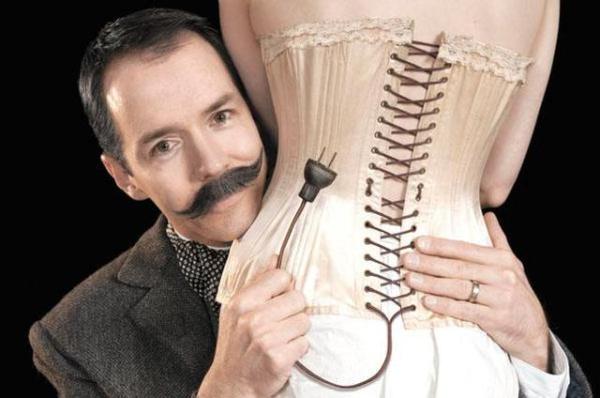
In conclusion, 1890s people thought electricity had the potential to replace gas as a fuel source; that it was deadly dangerous; but that in small amounts, electricity had magical healing powers. I've read just enough to believe the rumours that some people actually wore electric jewelry for its healing powers and will leave you with the steampunk Jem image that conjured in my mind. The reference here is, of course, to Jem's flashing earrings.

Follow me on Twitter @TinyApplePress and like the Facebook page for updates!

If you have enjoyed the work that I do, please support my Victorian Dictionary Project!

Wednesday, August 5, 2015

The Perfect Woman

"The Crush," by Charles Dana Gibson.
Perfection in humans is inarguably subjective, but as I've written a post on the perfect man of the 1890s, it has been pointed out to me that I ought to write one about the perfect woman.

Minerva
I want to write about a female bodybuilder because Eugene Sandow, the bodybuilder, was the perfect man in the 1890s, and I support gender equality, and there were female bodybuilders - even before Sandow began promoting bodybuilding for health and beauty. One of these was America's first famous strong woman, Josie Wohlford, or 'Minerva,' as she was called. Minerva held the Guinness Book World Record for the greatest weight lifted by a woman (18 men on a platform totalling over 3,000 lbs). I want to write about Katie Brumbach the same way, but the female bodybuilders of the 1890s didn't represent an ideal the way that Sandow did.

Katie Sandwina
In the Sandow ideal, form followed function. On the stage, Brumbach performed feats of strength as Katie Sandwina the feminine giantess, but feats of physical strength were not the feminine ideal in the 1890s, an era that would give rise to the Gibson girl in the United States and Lily Langtry in the UK.
[The Gibson girl's] image was unlike those of American woman that had appeared in the nineteenth century. Physically, she looked different. She was tall, with an incredibly tiny waist. She wore her hair swept up into a softly twisted bun called a chignon, revealing her long swanlike neck. What distinguished her more than any physical characteristics, however, was her attitude. [...] The lift of the Gibson girl's chin and her half closed eyes [...] suggested that she was more aloof than nurturing. Some thought her sophisticated. Others thought her haughty or conceited. She didn't stay at home, either. The images placed her on a golf course or on the beach. The media quickly labeled her "the typical American girl."
Gibson girl, 1899.
An invention of the 1890s, the Gibson girl's popularity continued to grow in the early twentieth century. Possessing similar attributes, Langtry was "introduced" in the 1877 and grew in popularity through to the 1890s.

Lily Langtry
An American in London, Langtry was literally introduced at one of Lady Sebright's evenings at home in May 1877. Her social performance there attracted comment, as well as invitations to other events with other important social figures. She had married well enough that she didn't need to work, but her great social success and personal interest in London Society led to an acting career and affairs with noblemen, including the Prince of Wales. Langtry's story encapsulates feminine ideals of the era in that her looks, and her ability to enchant were her keys to success.

Still, it wouldn't do to call Langtry the perfect woman, the way that Sandow was called the perfect man. She did after all, attract gossip by cheating on her husband. The perfect woman of the 1890s was an impossible ideal, one that I think is captured beautifully as George W.E. Russell recalls his friend, Mrs Lowther.
She possessed what men arrogantly call a "masculine understanding," trained into accuracy and thoroughness by the systematic studies of her girlhood. She could direct, organize, and control on the largest scale and in the smallest details. She was competent to deal with the toughest and most intricate problems of business, money, and, if need were, law. She could discuss, on equal terms and at a moment's notice, policies with Premiers, and Fiscal Reform with Chancellors of the Exchequer; Laws of Evidence with Judges, and Education Bills with Bishops. Yet she "bore this load of learning lightly as a flower," and could turn in an instant from the most strenuous themes to the graces and amenities, even the trivialities, of social life. Her enjoyment of that life was keen, and, in whatever phase she found herself, her talents and accomplishments were ready for the occasion.
She was, as most people know, a genuine artist; being very quick to catch an effective point, bold and rapid in execution, accurate in draughtsmanship, and endowed with that rare gift in English art - a true sense for colour. No one but an artist could have arranged the interior decoration of Lowther Lodge, where colour and form are so harmoniously combined. As to music, one who is well qualified to judge says, "She was very musical, and played the piano quite beautifully. She used to have lessons from Chopin, and up to the end remembered by heart pieces she had learnt with him, and played them very often when we were alone." Her waltzing was renowned for lightness and grace; and her familiarity with all minor accomplishments, such as painting on china, wood-carving, and embroidery, was remarkable. Nothing came amiss to her, and no one, I should think, ever spent so few idle moments in a long life.
In literature her taste was for the old than for the new, and she had a hearty contempt for that smattering of ephemeral criticism and culture which is so often used to conceal fundamental ignorance of the books really worth knowing.
Two women reading on a verandah at Ingham, ca. 1894-1903
(Harriett Petifore Brims, JOL, SLQ, Neg 132733)
Her conversational gifts were altogether exceptional. She was always perfectly natural, always in touch with those to whom she was talking, taking their points and interested in their interests. She was keenly alive to anything in her guests' conversation which struck her as important or curious or amusing, and was always ready with the apt reply which showed that she had been attending and not merely hearing. Her own copious and varied knowledge of life and society and art flowed in an easy and continuous stream, which never needed either pumping or damming. She could hit off a ludicrous situation - perhaps sometimes an absurd character - with a touch of genuine humour; and, if her moral sense was shocked or her convictions were outraged, she could express disapprobation with an emphasis all the more impressive because it was not violent.
Perhaps the only subject which did not interest Mrs Lowther, among all those which are discussed in modern society, was Health. Doctors and diseases, diets and systems, bored her to extremity; and this was natural enough, inasmuch as she had never had occasion, in her own case or in that of her family, to make herself acquainted with the dismal lore of the sick-room. She was one of the strongest women in the world; astonishingly active, and ignorant of the meaning of fatigue. In the discharge of her various duties as wife, mother, hostess, member of society, mistress of a large establishment [...] she laboured incessantly, and with no apparent loss of energy, till the last weeks of a protracted life. Energy was indeed her most striking characteristic; and by energy I mean that indefinable gift, rather spiritual than physical, which makes a man or woman live intensely in every nerve and fibre, and throw the whole being into the tasks and interests of the moment. - Sketches and Snapshots by George W.E. Russell
An interesting woman indeed, I don't use Russell's account to suggest that Mrs Lowther was the perfect woman, only that 1890s feminine perfection was the happy stuff of the eulogizing imagination. Whatever resemblance she bore with the real Mrs Lowther, the character Russell sketches for us in that passage shared characteristics with the New Woman, in that she was educated, independent, and capable. Like the Gibson girl, she might be put into practically any situation and would know how to behave. Like Langtry, she seemed capable of enchanting the people around her, so that you want to make her a friend. She would probably be a good friend to have because she listens so well. And like Minerva and Katie Sandwina, she was strong; healthy strong, but (unlike them) not lifting 3,000 pounds on her shoulders strong.

"The New Woman and her bicycle - there will be several varieties of HER!"
Women's weight lifting and bodybuilding still struggle for acceptance, the way that many women's sports are still not taken as seriously as men's. The perfect woman of the 1890s, therefore, poured her inexhaustible energy into more feminine pursuits, while ever-pressing the boundaries of what was traditionally masculine and what was traditionally feminine.

Follow me on Twitter @TinyApplePress and like the Facebook page for updates!

If you have enjoyed the work that I do, please support my Victorian Dictionary Project!

Tuesday, July 28, 2015

Top 10 Wildean Insults


Known for his wit, many of Oscar Wilde's insults are too convoluted to throw out during an argument, but these one-liners have got you covered!

  1. Good novelists are much rarer than good sons (On a New Book on Dickens). This is number one because, whether you are a novelist, a son, or both, this is mean.
  2. Like most artificial people he had a love of nature (Pen, Pencil, and Poison). It is far more genuine to admit that you hate camping, then go to the movies instead. 
  3. Nothing is so dangerous as being too modern. One is apt to grow old-fashioned quite suddenly (An Ideal Husband). I love that one for what it says about those who bought the first iPod, or iPhone, and how proud I was to own the first Sony discman.
  4. There is no reason why a man should show his life to the world. The world does not understand things (De Profundis). I almost left this out because it seems to insult the world. In context it is about the love that dare not speak its name and the reason Oscar Wilde went to prison, but it is true of many people who tweet, or instagram every moment of their day. Someone once beautifully called such  behaviour remembering the present. Yet, Twitter and Instagram are full of haters and looking for validation that way is idiotic.
  5. Whenever people agree with me, I always feel I must be wrong (Lady Windermere's Fan). It's funny if you know that sensation or hearing the words you want to hear and realizing not only how stupid those words sound, but also how stupid you were for wanting to hear them.
  6. I never saw anybody take so long to dress, and with such little result (The importance of Being Earnest). Reminds me of a guy I dated once who spent ages adjusting the way his t-shirt fell around the waistband of his jeans.
  7. Books of poetry by young writers are usually promissory notes that are never met (On Yeats' 'The Wandering of Oisin'). This one just gives me the biggest Lily Allen smile.
  8. Nothing makes one so vain as being told that one is a sinner (The Picture of Dorian Gray). Sometimes people really do seem to seek applause, when they are asking for forgiveness. 
  9. It is only the intellectually lost who ever argue (The Picture of Dorian Gray). I would do well to remember this when perusing reader comments on the internet.
  10. Morality is simply the attitude we adopt towards people whom we personally dislike (An Ideal Husband). I find few things less attractive than people who condemn the lives of other people.
Follow me on Twitter @TinyApplePress and like the Facebook page for updates!

If you have enjoyed the work that I do, please support my Victorian Dictionary Project!
Sunday, May 10, 2015

Poe is nowhere, but Bram Stoker's mother is everything!

Charlotte Matilda Blake Thornley Stoker
I was going to write a blog post today about the mothers of writers in London in the 1890s, but I found this passage in Barbara Belford's biography of Bram Stoker that I think says it all. To me, this passage shows that, when things are looking down, when you are faced with criticisms and your endeavours are not as successful as you hope, mothers often know best.

Stoker borrowed money to publish Dracula, which didn't make him much money (in his lifetime) and got pretty dismal reviews - even from his friends.
Fortunately authors have mothers. "My dear, it is splendid," gushed Charlotte Stoker, "a thousand miles beyond anything you have written before, and I feel certain will place you very high in the writers of the day - the story and style being deeply sensational, exciting and interesting." To his mother, Stoker had surpassed all competitors. "No book since Mrs Shelley's 'Frankenstein' or indeed any other at all has come near yours in originality, or terror - Poe is nowhere," she wrote. "I have read much but I never met a book like it at all. In its terrible excitement it should make a widespread reputation and much money for you." Unfortunately it did neither during Stoker's lifetime. If Dracula had been published in 1818 at the same time as Frankenstein, instead of at the height of literary realism and naturalism, it would have been a Romantic milestone. Source
Thank you for always being so supportive of me, mom. We writers need moms like you.

Follow me on Twitter @TinyApplePress and like the Facebook page for updates!

If you have enjoyed the work that I do, please support my Victorian Dictionary Project!

Tuesday, May 5, 2015

Poop in (Victorian) Beards

Nowadays, when you mention the long beard trend, most people immediately think of hipsters; I still think of the Victorians. With the news this week that these hipster beards harbour the kind of bacteria found in fecal matter, I rolled my eyes and thought about other problems the Victorians had with poop.


Essentially, overpopulation in the City of London caused the Times to speculate in 1894 that by 1950 the horse poop in the streets would be nine feet deep. It was the full-time occupation of the city's block boys to keep the streets free of manure. If you are worried about your beard filling up with poo as you go about your business today, imagine how crappy Bram Stoker's beard was!


In spite of the fact that Stoker took a bath every night before bed, the Victorians aren't remembered for their excellent hygiene, or medical care. Although they weren't known for their especially long life spans, walking around with poop all over their faces isn't what was killing them.

Before you throw hygiene to the wind and embrace the notion of getting poop on your face, remember that a basic understanding of science may be lacking in populations that resist learning about evolution (namely much of the Southern United States and people in the nineteenth century). It wasn't actual poop that they found in the beards of men in Albuquerque, it was the kind of bacteria found in the stomach and in poop. If you don't have enough, or the right kinds of these bacteria, you may develop ulcerative colitis and other gastrointestinal conditions, which are sometimes even treated with a fecal transplant (they take the poop bacteria from the tummy of a healthy person and put it into the tummy of a sick person).

If you are a hipster, be like Stoker. Enjoy your beard, but wash it often. Irregardless of whether you have a beard, no one is going to want to kiss you if you don't take a bath.

Follow me on Twitter @TinyApplePress and like the Facebook page for updates!

If you have enjoyed the work that I do, please support my Victorian Dictionary Project!