Showing posts with label Rational Dress Society. Show all posts

Sunday, January 18, 2015

Oscar Wilde's Underpants

Fashion is a form of ugliness so intolerable that we have to alter it every six months. - Oscar Wilde
In an effort to shame me for my addiction to Cosmo, an old friend of mine used to love to throw this quote at me. He never really understood what it was that the Wildes hated about 'fashion.' It wasn't that they didn't want to look good. Both Oscar and Constance REALLY wanted to look good - they even called their meticulously decorated home 'House Beautiful.' Both Oscar and Constance edited women's magazines. Wilde even promoted a particular brand of underwear, but I'll get to that.

To the Wildes, and most of the cool people in their generation, fashion had victims. The most obvious were the workers that the industry exploited. By the 1880s, opponents of the fashion industry began including animals and birds as victims of the fashion industry because they were (are still) killed for their skin and feathers. The people, especially the women, who gave in to the seductive power of the mainstream fashion industry of the 1880s and 90s were also victims, according to the Rational Dress Society.

Constance was the mouthpiece of the Rational Dress Society, as editor of 'The Rational Dress Society Gazette.' Both she and Oscar were well-known for their support of Rational Dress, also called "Hygienic Dress," which made them persuasive spokespeople for alternative fashion designers. It was in this capacity that Oscar Wilde promoted Dr Jaeger's Hygienic Woolen Underwear, which in turn became the underwear of choice for intellectuals and aesthetes in the 1890s.

A Dr Jaeger imitator in Winnipeg (1907).
Dr Jaeger's became so popular that there were imitators, who claimed to be manufacturing underwear using the Dr Jaeger system, or would simply call their under Jaeger Underwear.

So, it wasn't that Oscar hated fashion. He mostly just hated the unethical practices of the fashion industry.

Follow me on Twitter @TinyApplePress and like the Facebook page for updates!

If you have enjoyed the work that I do, please support my Victorian Dictionary Project!

Sunday, September 29, 2013

A Bit About Ladies' Underwear

...it is really sad to think that in our own day a civilized woman can hang on to a cross-bar while her maid laces her waist into a fifteen-inch circle. To begin with, the waist is not a circle at all, but an oval; nor can there be any greater error than to imagine that an unnaturally small waist gives an air of grace, or even of slightness, to the whole figure. - "Slaves of Fashion," Woman's World, Oscar Wilde
In a previous post, I laughed at a trade card that pictured Oscar Wilde in one of the very things he's complaining about above, corsets! The main reason that I share this blog so widely is to get feedback and I was happy to recently discover that, as is often the case, when I see someone doing something that appears ridiculous in its historical context, there's usually a good explanation.
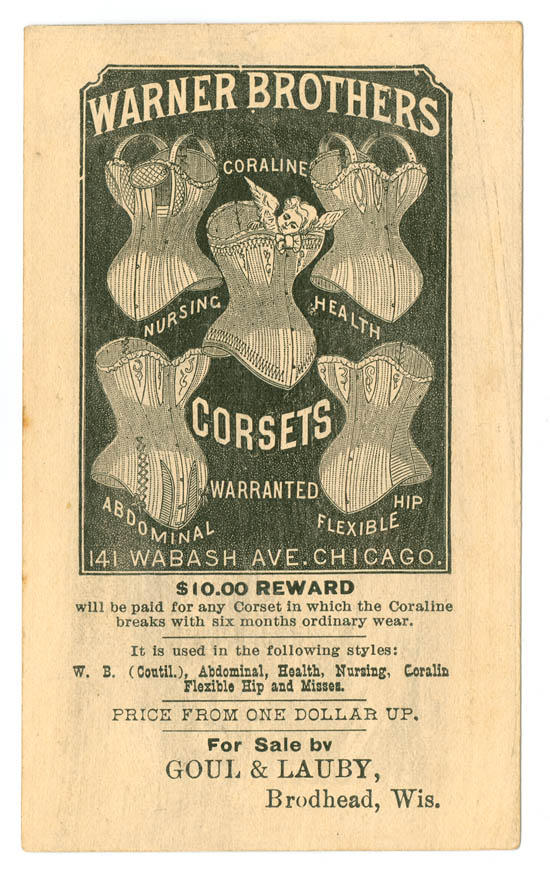
The trade card is an advertisement for Warner Brothers Corsets (I'm guessing it is from the 1890s, but I found it on eBay). The name of the corset company, today, makes the whole thing seem sillier and I couldn't imagine Wilde consenting to the use of his personality. However, I got a tip from one of my twitter followers, which led me to Dr. Lucien Warner.


You can tell by the beard that Dr. Warner is a pretty cool guy. Born in Cuyler NY in 1842, he took some time off from his studies at Oberlin College to serve in 150th Ohio Volunteer Infantry, during the American Civil War. He then earned his medical degree from New York University in 1867 and went on a lecture tour, which earned him an honourary Master's Degree from Oberlin College (big smartypants). He went on to be a major donor to the college, while also playing an active role on the Board of Trustees, and Warner Hall still bears his name.


The coolest thing about Dr. Warner was his commitment to women's health. Oberlin College gave him the honourary degree because he had been lecturing about the dangerous side-effects of the rigid steel-boned corsets women were wearing. Though his lectures obviously won him much acclaim, he didn't feel that enough women were listening. He might have even despaired that they would never listen. So he went home and came up with a compromise. In 1873, he created a new style of corset that gave women the fashionable shape they wanted, while leaving enough flexibility for movement to reduce injury.

If you couldn't tell by the name of the corset company, Dr. Warner had a brother, Dr. Ira De Ver Warner. The two Dr. Warners gave up their medical practices and founded Warner Brothers Corset Manufacturers.


I still don't know if Wilde endorsed the trade card that I wrote about before, but I'm no longer ruling out that possibility. Wilde toured America in the 1880s. They might have met and would have had a lot to talk about, but I doubt Wilde would have disapproved of the product. It was the first corset with shoulder straps. The company didn't stop there! In 1914, they bought the patent for the first bra from the 19 year-old peace activist Mary Phelps Jacob.


Follow me on Twitter @TinyApplePress and like the Facebook page for updates!

Friday, September 20, 2013

Do Women Wear Pants because of Oscar Wilde?


I posted a quote from a blog that humourously implied that women wear pants because of Oscar Wilde and the aesthetic movement. I still think that's a clever bit of writing and you can see the part I quoted in this post here. Do I think that if it weren't for Oscar Wilde I wouldn't be able to wear pants in public? To say that I did would be a bit of an exaggeration.

Anyone who thinks my collection of trousers would belong to my husband, if it weren't for Oscar Wilde, is overlooking the daring and hard work of so many courageous women. I wrote about Rational Dress, like it were some kind of ambiguous headless entity, when it had many heads and courageous hearts.

Lady Haberton created the divided skirt and didn't go away quietly when she was refused service at an inn for wearing one.

Mary Eliza Haweis was a scholar and an author, who wrote primarily for other educated women. Her research focused on Chaucer and her obituary in the Illustrated News of 3 December 1898 is impressive:
Just who was Mary Eliza Joy Haweis? Wife of philandering preacher and music aficionado Hugh Reginald Haweis; mother of three semi-estranged children; daughter of failed artist Thomas Musgrove Joy; hostess of fancy dress balls; restorer of historic houses; member of the Suffragettes; and author of Flame of Fire, another "foolish effusion with which women writers attack the eternal marriage question." But Haweis was also "an enthusiastic student of Chaucer," whose works were "educationally valuable," "original in plan and conception," and "mine[s] of poetic beauty and most scholarly explanation." She tackled bookish issues—Chaucer's final -e, his accent, and his meter—and she ferreted out academic rumors and pieced together what scholarship she could verify on the poet's life. She wrote in support of the abortive Chaucer concordance that predated John S. P. Tatlock and Arthur G. Kennedy's, and she corresponded with F. J. Furnivall and Sir Israel Gollancz on matters of medieval concern. She researched medieval paintings to make her own illustrations for the Canterbury Tales correct, and she identified the seal of Thomas Chaucer, reproducing it exactly from the miscellanea at the British Museum and from MS Cotton Julius C.vii. Her recorded evidence, gleaned from manuscript rolls and records, is not always chronicled elsewhere. She was the first Chaucerian/art historian to link Chaucer's poetry to existing paintings and drawings, observing that "Chaucer and his contemporaries are as careful as Van Eyck in realizing an exact and brilliant picture, and in trying to put it before our eyes as definitely as they saw it themselves."

The actress, Charlotte Carmichael Stopes wrote one of the most definitve books of the British Women's Suffrage Movement, British Freewomen: Their Historical Privilege (1894). She was a Shakespeare scholar, almost to the same extent that Haweis studied Chaucer. In 1889, Stopes famously staged a coup at a meeting of the British Association for the Advancement of Science in Newcastle upon Tyne, by unexpectedly adding Rational Dress to the programme. Nationwide newspapers reported Stopes's speech, spreading the notion of Rational Dress.

Much the way that our contemporaries refuse to acknowledge the ongoing War on Women worldwide, women, who supported and/or practiced Rational Dress, were subject to ridicule.


While I do feel that Oscar Wilde supported this movement in the Woman's World, I suspect that was partly due to the fact that his mother was a feminist and he married an active member of the Rational Dress Society. In other words, he did nothing to stop women from wearing pants, but I don't think his efforts were terribly significant compared to the work of all these other women.

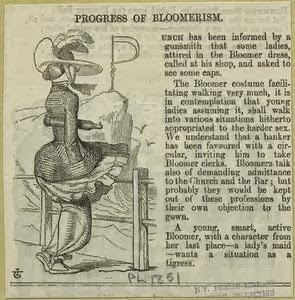
I also can't finish without saying that I love the term "Bloomerism." Victorians were excellent at making up new words.

Follow me on Twitter @TinyApplePress and like the Facebook page for updates!

Wednesday, March 13, 2013

Warner Brothers Corsets


This trade card pictures Oscar Wilde on the right wearing a sunflower and obviously promotes sturdy corsets. It's interesting for a few reasons.

1. It was either printed before he and Constance were married; before he became editor of Woman's world and indicates a shift in his perspective on the rational dress movement OR it was printed without his consent to cash in on some of the pomp and circumstance of one of Oscar Wilde's American tours.

2. Warner Brothers made corsets?

3. The card tries to link wearing a corset to the aesthetic movement, when the opposite was true.

Victorian trade cards were about the size of a 3x5 index card. Like the one pictured here, they typically had a picture with a slogan on one side and advertising text or testimonials on the other side. Most of them date back between 1880-1900. Merchants and their employees would hand the cards out on the street to advertise products and services. A local store would sometimes stamp their name on the back.

Some trade cards were beautiful, some funny, some had puzzles, and some were risque. People would collect the many different cards that appealed to them and paste them into scrap books. I found this one on eBay; where it sold for eight dollars.

Find my follow up to this post here!

Follow me on Twitter @TinyApplePress and like the Facebook page for updates!

Friday, January 18, 2013

Rational Dress

Thanks to Franny Moyle, I've come to see Oscar Wilde's wife as a far more complex character in the lives of writers in the 1890s. A writer in her own right, Constance Wilde wrote extensively on healthy fashions for women and published children's stories. She actively participated in the Rational Dress Society, attending meetings, exhibitions, as well as displaying her own creations (her wedding dress was on display to the public before she was married and what she wore to the theatre and parties was often the described in the press).

Many of the women involved in the artistic and writing communities of the 1890s were involved in the Rational Dress Society or the Artistic Dress Movements, including Bram Stoker's wife, Florence Stoker. Oscar Wilde promoted its ideals, during his tenure at the Woman's World. The Rational Dress Society was an organization founded in 1881 in London. It described its purpose thus:
The Rational Dress Society protests against the introduction of any fashion in dress that either deforms the figure, impedes the movements of the body, or in any way tends to injure the health. It protests against the wearing of tightly-fitting corsets; of high-heeled shoes; of heavily-weighted skirts, as rendering healthy exercise almost impossible; and of all tie down cloaks or other garments impeding on the movements of the arms. It protests against crinolines or crinolettes of any kind as ugly and deforming….[It] requires all to be dressed healthily, comfortably, and beautifully, to seek what conduces to birth, comfort and beauty in our dress as a duty to ourselves and each other.

Like the New Woman, these fashion forward women were often subject to ridicule. Commentary in the press about how Constance Wilde dressed reflected these criticisms.


Nonetheless, criticism made it hard to change the way most women dressed everyday and the Rational Dress Society's greatest triumphs were in the area of undergarments and athletic wear.


Follow me on Twitter @TinyApplePress and like the Facebook page for updates!