Showing posts with label Constance Wilde. Show all posts

Monday, November 23, 2015

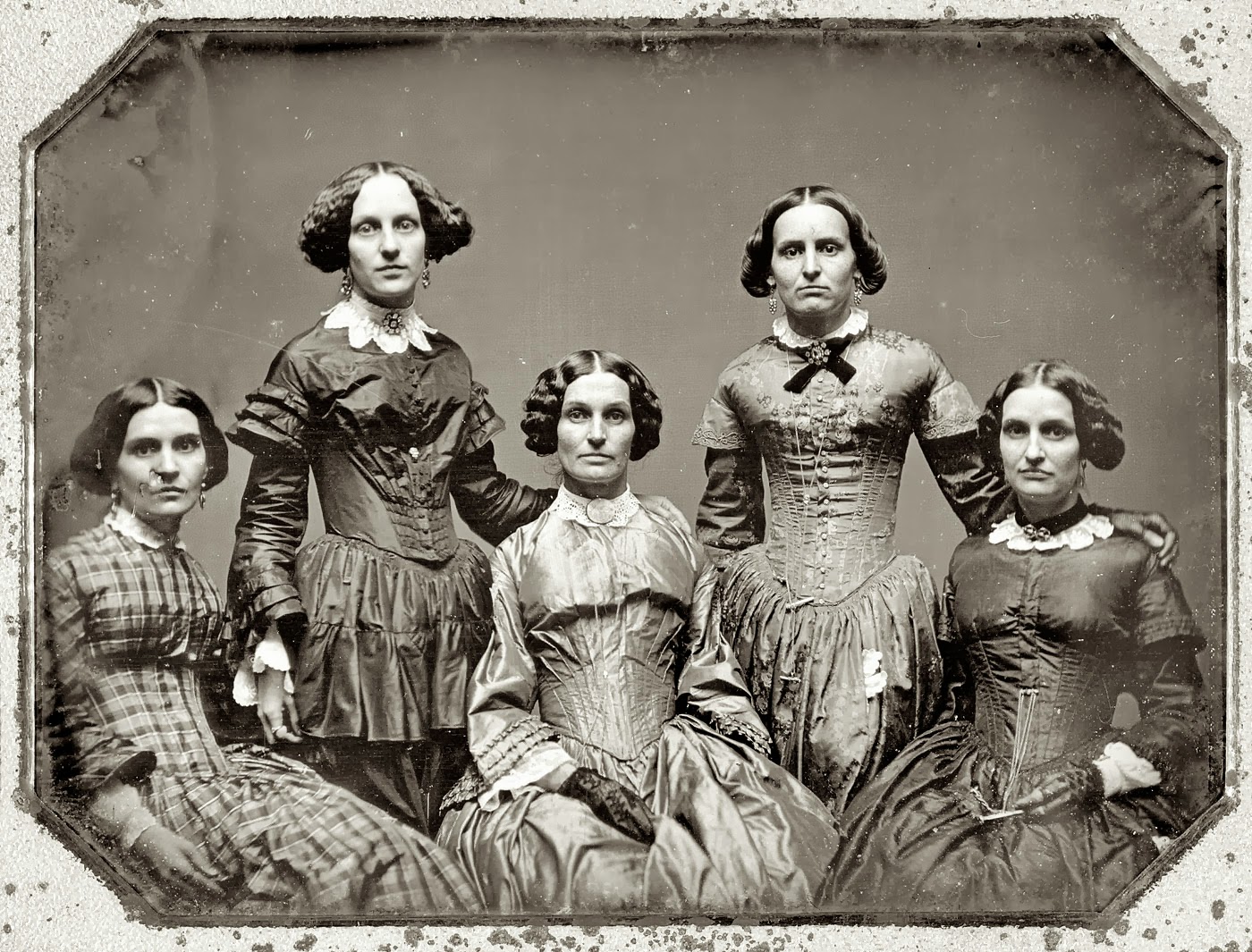
Victorian Teenagers Gone Wild

The girl in the top left corner
has a mischievous face.
Throughout history, teenagers have rebelled against their parents. Popular psychology maintains that youthful rebellion helps young people build their own identity, separate from their parents. It happens in every class, culture, and race, so of course it happened in the Victorian Era.

You may say: "but Victorians were so proper!"
"Myths about the Victorian family are almost as numerous as those about the American West. Many regard the institution as a model for modern life, full of dutiful children and loving parents. Others see it as an example to avoid -- rigidly patriarchal, unloving, and riddled with class and gender restrictions. Both views, though too generalized, contain some truth, partly because of the tremendous variety of family lives during Queen Victoria's reign. Good or bad, families were the most important factor in a child's success in life" - Ginger S Frost.
 Even today, we tend to attribute the tendency to rebel with trouble in the individual, sometimes linking rebellious behaviour with the early signs of a psychopathic personality. Though teen rebellion often seems selfish, fed by boredom and glib, it generally has nothing to do with those traits in the person, but more to do with what one is rebelling against.


Young middle and upper-class Victorians became social reformers, committed to mending the injustices perpetrated by their society and sometimes within their own families. Young Victorians, like Bram Stoker, became aware of the problems associated with alcoholism and other addictions. The era saw the rise of the suffragette and educational reforms to help the poor. Of course, some young women started smoking and drinking to irritate their parents and some young men dressed below their station, so they could sneak into the poorer neighbourhoods for a bit of slumming - not all rebels are altruistic. We all had that friend who made us aware of broader social problems by personifying them.

1909 woman smoking opium.
Although teen rebellion was wide-spread, two particular people come to mind, when I think of 1890s writers, who were rebellious teenagers: Edmund Gosse and Constance Wilde.

Philip Henry Gosse with his son Edmund (1857).
Frontispiece to the first edition of Father and Son.
Obviously, Gosse comes to mind because of his memoir, Father and Son (1907), which bore the subtitle: "a study of two temperaments." His father, Philip Henry Gosse was a deeply religious scientist, who rejected the theories of his contemporary, Charles Darwin. In Father and Son, Gosse focuses on his father's rejection of the theory of evolution and his own coming of age through the rejection of his father's religion.
My own state, however, was, I should think, almost unique among the children of cultivated parents. In consequence of the stern ordinance which I have described, not a single fiction was read or told to me during my infancy. The rapture of the child who delays the process of going to bed by cajoling 'a story' out of his mother or his nurse, as he sits upon her knee, well tucked up, at the corner of the nursery fire—this was unknown to me. Never in all my early childhood did anyone address to me the affecting preamble, 'Once upon a time!' I was told about missionaries, but never about pirates; I was familiar with hummingbirds, but I had never heard of fairies—Jack the Giant- Killer, Rumpelstiltskin and Robin Hood were not of my acquaintance; and though I understood about wolves, Little Red Ridinghood was a stranger even by name. So far as my 'dedication' was concerned, I can but think that my parents were in error thus to exclude the imaginary from my outlook upon facts. They desired to make me truthful; the tendency was to make me positive and sceptical. Had they wrapped me in the soft folds of supernatural fancy, my mind might have been longer content to follow their traditions in an unquestioning spirit.
As Gosse grew up to be a poet, it's safe to say that his life was formed through his parents' teachings - though not in the ways that they intended.

Constance Lloyd
(before she married Oscar Wilde).
Constance Wilde had a terrible relationship with her mother. Franny Moyle, Constance's biographer, called Constance's mother "a selfish and difficult woman." Her mother's conduct toward Constance may be characterized as abusive. It was a relationship that Constance survived through forming a rich internal life and getting away to school by taking classes at the University of London. The 1871 and 1881 censuses describe Constance as a scholar. As was the case with Gosse, Constance's rebellion was ideological, but also deeply personal.

The outfit that Constance is pictured in above was typical of young aesthetes in her day, which was viewed as both a fashion and an intellectual movement - almost the way that hippies, or people who only wear vegan clothing can be viewed as participating in both a fashion and intellectual (or moral) movement. Constance's brother mocked her dresses and the rest of her family, including an eventual step-sister, encouraged her to dress more like them. But Constance married the Prince of the Aesthetic Movement and realized her independence through marriage - a trope in young Victorian women's lives.

Gosse and Constance's stories critique the Victorian Era as a whole and represent examples of positive social changes (women's education and learning in general), but not all teenage rebellions go so well.

Teen pregnancies are often used as a symbol of teenagers gone wild, so it is worth noting here that during Queen Victoria's reign the rate of premarital pregnancies hovered around 20%, according to Eurostat. It's likely that number was much higher. Yet, there is something twisted about viewing sex as an act of rebellion.

Boys marching out of the London Foundling Hospital for the last time (1926).
For more on the London Foundling Hospital, click here.
The "fallen woman" was a blanket term that Victorians applied to any unmarried woman with sexual knowledge of any sort. This term covered rape victims, prostitutes, and unwed mothers alike; in some families, it might even be applied to a woman who read French novels.

The "new woman" represented another kind of rebellion, closer to what young Constance Wilde was up to.  This term was popularized by Henry James in the 1870s and referred to an emerging feminist ideal.
"In Victorian England, as men clung to the sanctity of the patriarchy, they were increasingly becoming more and more frightened of their own women. Bram Stoker capitalized on this fear in his iconic novel, Dracula. In 1897, a "New Woman" was emerging in Victorian society, coinciding with the women's suffrage movement throughout England. This New Woman, riddled with feminist awareness, would be the cause of fodder for Stoker's heroine, Mina Harker. Because this New Woman was aspiring to be independent of patriarchal male dominance, (or had already obtained said independence) to the old guard of Victorian society, she was viewed as perverse. The New Woman was a mutation of the woman the patriarchal society wanted her to be. The New Woman's strides towards economic and sexual changes in society as a whole should be viewed as terrifying. Stoker takes these beliefs, and applies them to his female characters in Dracula" - source.
Even Bram Stoker's wife might have been viewed in terms of the new woman for her interest in aesthetic, also called "hygienic," dress, she ran in the same circle of women as Constance and even once dated Oscar Wilde.

"New Woman — Wash Day" (1901)
Oscar Wilde's youthful romance with the future Mrs Stoker was also a kind of young rebellion because she was penniless, while he came from an upper-class family, whose fortune was waning.

There were lots of ways for young men to rebel, especially in the 1890s. Any society that oppresses one group, the way that Victorians repressed women, also represses the dominant group by making the perceived characteristics of the oppressed group taboo. Oscar Wilde rebelled by incorporating long hair and feminine characteristics into his interpretation of aestheticism.

Young people help refresh the human population, getting rid of the old ideas that aren't working anymore.

Follow me on Twitter @TinyApplePress and like the Facebook page for updates!

Friday, April 24, 2015

Humans of London (in the 1890s)

Who isn't occasionally inspired by Humans of New York? Since I've taken a little break from writing recently and been playing with Photoshop, I thought I would share what I've come up with.


These are writers in London in the 1890s (if they had Facebook and someone got inspired by Humans of New York).


Follow me on Twitter @TinyApplePress and like the Facebook page for updates!

If you have enjoyed the work that I do, please support my Victorian Dictionary Project!

Sunday, January 18, 2015

Oscar Wilde's Underpants

Fashion is a form of ugliness so intolerable that we have to alter it every six months. - Oscar Wilde
In an effort to shame me for my addiction to Cosmo, an old friend of mine used to love to throw this quote at me. He never really understood what it was that the Wildes hated about 'fashion.' It wasn't that they didn't want to look good. Both Oscar and Constance REALLY wanted to look good - they even called their meticulously decorated home 'House Beautiful.' Both Oscar and Constance edited women's magazines. Wilde even promoted a particular brand of underwear, but I'll get to that.

To the Wildes, and most of the cool people in their generation, fashion had victims. The most obvious were the workers that the industry exploited. By the 1880s, opponents of the fashion industry began including animals and birds as victims of the fashion industry because they were (are still) killed for their skin and feathers. The people, especially the women, who gave in to the seductive power of the mainstream fashion industry of the 1880s and 90s were also victims, according to the Rational Dress Society.

Constance was the mouthpiece of the Rational Dress Society, as editor of 'The Rational Dress Society Gazette.' Both she and Oscar were well-known for their support of Rational Dress, also called "Hygienic Dress," which made them persuasive spokespeople for alternative fashion designers. It was in this capacity that Oscar Wilde promoted Dr Jaeger's Hygienic Woolen Underwear, which in turn became the underwear of choice for intellectuals and aesthetes in the 1890s.

A Dr Jaeger imitator in Winnipeg (1907).
Dr Jaeger's became so popular that there were imitators, who claimed to be manufacturing underwear using the Dr Jaeger system, or would simply call their under Jaeger Underwear.

So, it wasn't that Oscar hated fashion. He mostly just hated the unethical practices of the fashion industry.

Follow me on Twitter @TinyApplePress and like the Facebook page for updates!

If you have enjoyed the work that I do, please support my Victorian Dictionary Project!

Thursday, October 9, 2014

1890s Witches


Sir Arthur Conan Doyle protested the harassment of mediums by comparing it to the antiquated persecution of witches. In 1897, Sigmund Freud said he understood "the stern therapy of the witches’ judges," as he learned more about cults, particularly sex cults.


Sex cults were an offshoot of a Victorian obsession with magic. The Victorian obsession with ancient magic and spiritualism was far more mainstream than most people imagine, and included a long list of writers and celebrities, who participated in the Hermetic Order of the Golden Dawn, including Bram Stoker, and Constance Wilde.

Unlike one writer, I think it's safe to say that, although he believed in ghosts and fairies, Conan Doyle didn't believe in, condone, or support witches. However, Joe Revill does identify an interesting current of 1890s writing on the subject of witches.
Karl Pearson

Woman as Witch: Evidences of Mother-Right in the Customs of Mediaeval Witchcraft. A lecture given to the Somerville Club by Karl Pearson, 1891 outlines Pearsons belief that witchcraft was actual magic, and that "the confessions wrung from poor old women in the torture chambers of the Middle Ages have a real scientific value for the historian of a much earlier social life." Pearson was a professor of Applied Mathematics at the University College London, and would carry on theorizing, lecturing, and writing about witches throughout the 1890s.

In Woman as Witch, Pearson makes the connection between the history of witchcraft's relevance to contemporary interests in the status of women. Don't start calling him a suffragette just yet. His view of men and women throughout history was very specific, and served to reinforce Victorian ideas about gender.
The woman as depositary of family custom and tribal lore, the wise-woman, the sibyl, the witch, would hand down to her daughters the knowledge of the religious observances, of the power of herbs, the mother-lore in the mother tongue, possibly also in some form of symbol or rune such as a priestly caste love to enshroud their mysteries in. The symbols of these goddesses would be the symbols of woman’s work and woman’s civilisation, the distaff, the pitchfork, and the broom, not the spear, the axe, and the hammer. Since agriculture in its elements is essentially due to women, hunting and the chase characteristic of men, the emblems of early agriculture would also be closely associated with the primitive goddess. - Karl Pearson
Pearson definitely believed that Joan of Arc was a witch. However, he did not condone the use of witchcraft, or goddess worship, among his contemporaries, considering it primitive and savage. He painted this image of the witch:
We have accordingly to look upon the witch as essentially the degraded form of the old priestess, cunning in the knowledge of herbs and medicine, jealous of the rights of the goddess she serves, and preserving in spells and incantations such wisdom as early civilisation possessed.
Sir Laurence Gomme
Laurence Gomme's Ethnology in Folklore (1892) others witchcraft, the way that Dracula does vampirism, by painting it as a pre-enlightened set of beliefs still held foreign (and 'backwards') cultures. A tantalizing concept for a work of fiction that seeks to frighten its readers, but an isolating approach to cultural studies. Gomme, didn't believe England was safe from witches, any more than Van Helsing thought they were safe from vampires.
The demonism of savagery is parallel to the witchcraft of civilisation in the power which votaries of the two cults profess, and are allowed by their believers to possess, over the elements, over wild beasts, and in changing their own human form into some animal form, and it will be well to give some examples of these powers from the folklore of the British Isles. - Laurence Gomme
Ethnology in Folklore is a terrible read, though it provides an interesting study in the history of race, and frequently sites Jacob Grimm (of the Brothers Grimm) for his work on teutonic mythology. Most notably, Gomme's witches have the power to turn into animals, though their power has been diminishing over the centuries, and by the 1890s they could only turn into small (mostly harmless) animals.

Gomme's writing, however, makes it easier to see why some might think Conan Doyle believed in witches, as it links them directly to fairy magic (with the help of Grimm, of course).

Matilda Joslyn Gage
Although she was writing in the States, Matilda Joslyn Gage must be included among the writers, who wrote about witchcraft in the 1890s. In Women, Church and State (1893), she became one of the first writers to identify Christianity's impediments to women's equality. Gage demonstrated how religious doctrine is (even still) used to justify depriving women of civil, human, economic and political rights, even denying women the right to worship alongside men.

In Women, Church, and State, the historical persecution of witchcraft is identified as one of Christianity's tools for oppressing women for having any kind of knowledge, power, or autonomy. Gage also identifies ways in which her contemporaries recoiled from anything associated with witchcraft.
So firmly did the diabolical nature of the black cat impress itself upon the people, that its effects are felt in business to this day, the skin of black cats being less prized and of less value in the fur market than those of other colors. A curious exemplification of this inherited belief is found in Great Britain. An English taxidermist who exports thousands of mounted kittens each year to the United States and other countries, finds the prejudice against black cats still so great that he will not purchase kittens of this obnoxious color. In the minds of many people, black seems ineradicably connected with sorcery. - Matilda Joslyn Gage
Interestingly, the way that Gage understood witch lore in the 1890s, witches were supposed to be able to fly on animals or bits of wood, whereas in contemporary witch lore, we only image witches flying about on brooms. What is the significance of those brooms in relation to gender? Does it indicate that women are oppressed now in ways we weren't back then?

Aradia, title page.
In 1899, Charles G Leland published a book about witchcraft, as a kind of gospel text, Aradia, or the Gospel of the Witches. In Aradia, Leland claims to convey the traditions of Italian witchcraft as conveyed him by his witch informant, Maddalena. The accuracy of the book is debatable, but it has been influential.

Because Wicca is a real religion today, I would trust the testimony of Wiccans as to whether Aradia is an accurate representation of the craft. The number of self-identified Wiccans in the USA has risen from 8,000 in 1990 to 342,000 in 2008 (interestingly, 75% of these are women). It shouldn't be as hard for us to find someone to ask as it was for Leland.

Leland provided a photograph of his witch informant, as a young fortune teller, making me feel that he wasn't protecting her identity very carefully, or else... he had someone else pose for the photo.

Maddalena, as a young fortune teller.
In the 1890s, as today, witchcraft is generally lumped in with superstition and the occult. While people wrote about witchcraft in the 1890s, witchcraft was still practiced, even in the distorted sense of women providing 'magic' or 'homeopathic' remedies. Oscar Wilde's mother had a woman living with her called 'Mrs Faithful,' who could make a powder that would 'cure' pregnancy.

In Women, Church, and State, Gage sites an American 1867 case of persecuting witchcraft, in which a woman used a few drops of cat's blood to help an ailing child. Compare that unproven remedy to what her contemporaries were buying from Victorian Druggists (cocaine, heroine, antimony, strychnine, etc.), and it becomes harder to argue that "witch" wasn't a word that was just being thrown around to hurt women for having any sort of knowledge, or independence (however weird, I mean... cat's blood? Really...).

Throughout October 2014, I will be sharing the halloween-themed stories of 1890s London. Check back often!

Follow me on Twitter @TinyApplePress and like the Facebook page for updates!

If you have enjoyed the work that I do, please consider supporting my Victorian Dictionary Project!

Sunday, August 17, 2014

What happened to Oscar's stuff?

Scholarly article pay little attention to the role my protagonists played in history, one example being Kevin O'Brien's essay: "Lilly Wilde and Oscar's Fur Coat." If you click on that last link, you should be able to download the article automatically, which I'm basically going to summarize here.

It begins with a letter that Wilde wrote after he had been to prison and had started to track down his things, which had been pawned by Oscar's brother, Willie. The letter mentions "those people," specifically "the man," and "the woman." Those people were Willie and his wife, Lily Wilde. O'Brien says:
The story from their perspective is worth examining, for their relationship with Oscar was a difficult one, and they themselves had a hard, impoverished life together for the five years of their marriage.
Lily was Willie's second wife, who he brought to live at his mother's house, when he more or less gave up on life and let his mother take care of him. Lily had been in love with him, since before he married Mrs. Frank Leslie. As reported in the papers, and as evidenced by the lifestyle provided to her and Willie's daughter Dolly, Lily was an heiress. She was cut off from her fortune for the duration of her marriage to Willie.

Lady Jane Francesca Agnes Wilde
a.k.a. "Speranza"
As O'Brien uncovered, the small traces of history that Lily Wilde left behind depict her as an emotional woman of poor judgement, but still, a devoted friend, or maybe just a fan, of Oscar.

Willie made life difficult for his mother, by being unable to earn an income, and constantly demanding money. He was dying of alcoholism, and most likely suffered from delirium tremens. He had been brought down a peg or two, since his marriage to the richest woman in America failed, so when Oscar showed up at his doorstep in trouble, he likely saw a chance to redeem himself - maybe even look like a bit of hero for helping his brother out.
When Oscar arrived at the doorstep at 146 Oakley Street and pleaded, "Willie, give me shelter or I shall die in the streets," Willie let him in, but without much charity.  Willie later described the scene: "He came tapping with his beak against the windowpane, and fell down on my threshold like a wounded stag."
Though he tried to make it look like he was helping his brother, when he spoke to other people, he was really doing nothing of the sort. Lily and Oscar got along fine. While Willie blackmailed his brother and generally tried to control his life before he went to prison, Lily tried to reassure Oscar that she could manage Willie and take care of his things while he was gone.

Trying to control a raging alcoholic is like trying to teach a cat to clean up after itself.
Another disadvantage of Oscar's stay at 146 Oakley Street is the one quoted at the beginning of this article -- the betrayal by Willie and Lily in the loss of his precious fur coat and, in fact, two trunkloads of clothing.  Lily had quite a different version of the disposal of Oscar's belongings: rather than pawning his clothes without his knowledge, Willie was merely disposing of what had been given him.  According to Lily, before Oscar left for his third and last trial, he said one morning to Willie, "You can have all my things to do what you like with."
Rather than convincing Oscar to leave all his things in her charge, as Oscar claimed, Lily says that when she heard Oscar make the offer to Willie, she took Oscar aside and told him confidentially that "considering Willy's ordinary ways, if the clothes and trunks were left they [will] be sold or pawned."   According to Lily, Oscar answered, "he may have them all, only keep me my shirts." Hard up for money, Willie sold Oscar's fur coat and the two trunks of clothing to a jobber for only £12 or £13.  Lily was vigilant enough to keep her side of the bargain and saved all Oscar's shirts.
When Speranza died, there was no one left to pay rent at 146 Oakley Street. Willie and Lily had to move to a few small rooms at 9 Cheltenham Terrace. During the move, Lily packed up Oscar's shirts, his manuscripts, and a few treasured possessions, which she sent on to More Adey of his for safe keeping, never realizing that all of the possessions he had saved and brought with him to 146 Oakley Street were in fact treasured possessions.

Willie Wilde
It hurt Lily that Oscar was so angry at her for not being able to protect all of his precious things, and her usual protective nature over Willie changed in the face of that anger, she must have realized by this point that Willie sold Oscar's things without his permission because he wished to fuel his own sad addiction.

As Willie continued to drink himself to death, he blamed most of his own problems on his brother, and the two never spoke again. Oscar did not even attend his brother's funeral, or send a kind note.

Constance Wilde used Lily to track Oscar's movements, when he left prison, which Lily did through their mutual friend More Adey. There's evidence to suggest that Willie was jealous of his wife's friendship with his brother.

When Willie died, Oscar did reach out to his brother's widow by offering a small amount of financial support. Oscar and Lily kept in touch, until Oscar died in 1900, at which time he was aware of her second marriage and offered happy approval.

Follow me on Twitter @TinyApplePress and like the Facebook page for updates!

Monday, August 4, 2014

Constance Wilde's Celebrity Crush

Much is made of Oscar Wilde's affairs of the heart, but his wife also had a bit of a crush. This was by no means an extramarital affair, and was nothing compared to the way that Oscar carried on, but was more akin to the way a married woman today might feel about Brad Pitt. Constance had a celebrity crush, and his name was Pablo de Sarasate.

Pablo de Sarasate by Whistler
Sarasate's portrait by Whistler was one of the last pieces of Constance's estate to be sold off during Oscar's lifetime. It was painted in 1884, a few years before he would be named "Man of the Day" by Vanity Fair, and Constance would start attending all of the functions at which he might be present - usually with her equally obsessed friend, the writer, Marie Corelli.

The familiar figure of Sarasate
caricatured as a "Man of the Day"
Vanity Fair, 1889
At age five, Sarasate began studying the violin with his father in his birthplace, Pamplona, Navarre. Able to demonstrate a natural talent at a young age, he gave his first public concert at age eight, where he attracted his first patron,  who paid for him to study under Manuel Rodríguez Saez in Madrid, where he gained the favor of Queen Isabella II.

With many prizes already under his belt, Sarasate first performed in London as a teenager in 1861. Constance was still a baby, and Sarasate's best-known compositions wouldn't come until much later: Zigeunerweisen (1878), and the Carmen Fantasy (1883).

Suffering from chronic bronchitis, Sarasate died in France in 1908. Bequeathed to the Musée de la Musique, his violin, made by Antonio Stradivari in 1724,  now bears his name as the Sarasate Stradivarius. The Real Conservatorio Superior de Música, Madrid, own his second Stradivari, the Boissier, made in 1713.

I just wonder if Constance ever wished Oscar had a mustache like Sarasate's.

Follow me on Twitter @TinyApplePress and like the Facebook page for updates!

Monday, January 20, 2014

The Weird Magic of 1890s Writers: Enochian Magic


Practitioners of Enochian magic attempt to evoke the will of spirits or angels. As i wrote this post, I couldn't get the Black Crowes out of my head and almost called this post "Bram Stoker talks to Angels."

The word “Enochian” refers to the language practitioners use, a language recorded by Dr. John Dee and Edward Kelley in the sixteenth century. The Enochian language was delivered to Dee and Kelley, much the way Joseph Smith wrote wrote the Book of Mormon, through angels. Understanding this language would uncover the secrets of the apocryphal Book of Enoch.

The Book of Enoch is an ancient Jewish religious work, traditionally ascribed to Enoch, the great-grandfather of Noah. It is not part of the Jewish biblical canon, apart from Beta Israel. However, it is regarded as canonical by the Ethiopian Orthodox Tewahedo Church and Eritrean Orthodox Tewahedo Church, but not by any other Christian group.

Still practiced today, Enochian magic is primarily the result of the work of two men: Dee and Kelley.


Dee was a kind of spooky wise man, consulted by Queen Elizabeth I of Welsh. He liked math, astronomy, astrology, the occult, and making ships sail off in the right directions to go subjugate people. He religiously devoted his life to studying alchemy, divination and Hermetic philosophy. Of course, he had a long milky-white beard! He made Christianity magical, dreamed of uniting the world in one religion, and, like Samuel Pepys, kept a fabulous diary. He believed that numbers are the root of all knowledge. He also believed he could talk to spirits.

Kelley and Dee were friends, until sometime after Kelley insisted that God wanted them to share Dee’s wife. Kelley was a long-bearded crystal ball style wizard, I mean... medium. They must have looked like Gandalf and Radagast, which makes the whole thing with Dee’s wife, Jane, just weird.


Kelley did most of the talking to angels through his crystal ball, while Dee wrote it all down. The Writers in London in the 1890s would be glad he did. Enochian occultists assume the exploits of Dee and Kelley are more or less completely true. Though many believe they were also influenced by other magical texts.

Dee and Kelley preferred the term Angelic over Enochian and there’s no evidence they ever used it for magic because the angels didn’t really want them to. Their records are records of the system rather than a log of their workings of the system.

Their work had a big influence on Rosicrucianism, but otherwise went unnoticed until the Hermetic Order of the Golden Dawn formed in the 1890s. The rediscovery of Enochian magic by Samuel Liddell MacGregor Mathers in the 1880s led to Mathers working the material into a system of ceremonial “Magick” for the Order.

Constance Wilde, Bram Stoker, Maud Gonne, W.B. Yeats, and the many others, who joined the Order, used Enochian Magick to talk to Dee and Kelley’s angels, and could purportedly travel as auras into the spirit realm. The calls or keys that evoke the spirits are in the Enochian language that Dee and Kelley recorded, and can be used to enter visionary states, called Aethyrs.


The Aethyrs (numbered from 30-1, by our number-loving wizard friend, Dee) form a map of the universe.

The magic is practiced in a temple, which requires some specific decorating. What’s magic with good paraphernalia? Decorate your Enochian Temple with a table that has a hexagram engraved on top and a surrounding border of Enochian letters. You will also need seven planetary talismans, and five versions of the Seal of God’s Truth, made from beeswax and placed under the table with the hexagram on it. Some kind of crystal ball is also helpful, as is a magician’s ring, with the god-name Pele on it. Finally, there’s a black and red rod that you will want to use.

I’m just going to spend the rest of my afternoon imagining Bram Stoker and Constance Wilde setting up an Enochian Temple to talk to angels.

Follow me on Twitter @TinyApplePress and like the Facebook page for updates!

Wednesday, December 25, 2013

100 Random Things about Oscar Wilde

In honour of this being my 100th post, I’m sharing 100 things you probably didn’t know about Oscar Wilde. If you knew any of this stuff keep track of how many points you get. Your score should be out of 100. Leave your result as a comment. If you have more Wildean wits about you than I did when I started this list, I’ll have your email address and can contact you in the future, if I have any questions! (Just kidding, sort of.)


1. “The optimist sees the donut, the pessimist sees the hole.” At different points in his life, Wilde comes across as pessimistic and optimistic. His writing style, his critique of his contemporaries, and his ability to laugh at the world around him combine to indicate that he was a realist.

2. One of his greatest gifts was the ability to smile at his own misfortune.

3. Wilde was raised Anglican and Catholic. In college, he became infatuated with the Catholic Church, but did not become a convert until the end of his life. I found an interesting Catholic interpretation of his life on CatholicEducation.org

4. “I never change, except in my affections.” Wilde only dreamt of being able to live this way. His writing sympathized with a common longing for eternal youth and the ability to always remain the same. In practice, once you had Wilde's affection, you always had his sympathy. He had many life-long friendships.

5. Wilde lacked musical talent and never appreciated music, even during his Aesthetic period.

6. Wilde once claimed to never travel anywhere without his copy of Studies in the History of the Renaissance by Walter Pater.

7. Wilde visited Egypt, as a child, and was always fascinated by sphinxes.

8. Although the New York Tribune claimed Wilde’s teeth were “superlatively white,” he was embarrassed by his teeth, often spoke with his hand in front of his mouth to cover them, and eventually got dentures.

9. Wilde disliked idle conversation. “Conversation about the weather is the last refuge of the unimaginative.”

10. Wilde was a tremendously sensitive man, quite capable of indulging in self-pity, but usually only when he had genuine reasons to feel bad for himself. Moreover, he was just as affected by the hardships of others.

11. Wilde was clearly outgoing, but enjoyed privacy and was most productive as a writer when he was alone. Wilde got restless quickly, but always seemed to find himself quite entertaining.

12. Wilde’s ability to speed read and remember long passages has been attributed to an eidetic memory.

13. Wilde’s brother was a newspaper writer, so he often pokes fun at them.

14. Wilde was a very superstitious child, whose mother told him stories about macabre beasts. In the children’s books he wrote, as a father, his antagonists were generally friendly.


15. Wilde met Pope Piux IX, as an undergraduate in 1877.

16. Wilde became famous for his personality. After meeting Wilde at the Royal Court Theatre, Helena Modjeska once said, “What has he done, this young man, that one meets him everywhere? Oh yes he talks well, but what has he done? He has written nothing, he does not sing or paint or act - he does nothing but talk. I do not understand.”

17. In an unguarded moment, Wilde once told the 15 year-old daughter of a friend that if she were a boy, he would adore her. Her name was Aimée Lowther.

18. Wilde travelled extensively throughout Africa, Europe, and the United States.

19. Sex tourism was the most likely reason for Wilde's travel to Africa in adulthood.

20. Wilde's plays got mixed reviews from London theatre critics. One of his worst most vocal critics was his own brother.


21. Wilde feared nothing more than he feared God. The thought of eternal punishment was the one thing that prevented him from committing suicide, during his darkest moments, he told Vincent O’Sullivan.

22. The last gift Wilde gave to his two sons was a copy of Rudyard Kipling’s The Jungle Book.

23. Biographer, Neil McKenna says that Wilde wasn’t good at making a first impression and quotes Bosie, in The Secret Life of Oscar Wilde:
There is no charm in his elephantine body, tightly stuffed into his clothes - no charm in his great face and head of unselect Bohemian cast - save the urbanity he can adopt or the intelligence with which he can vitalise his ponderousness.
24. On holiday, Wilde enjoyed days spent paddling about in a “Canadian canoe.”

25. Wilde wasn’t good at horseback riding.

26. Wilde loved dirty French novels. His love of them almost ruined a British publication.

27. Some say Wilde is the most quotable author of all time, but he once drew a blank when someone asked him what his motto was.

28. Wilde kept a vase of flowers on his writing desk to neutralize the smell of his ashtray.

29. The only time Wilde wasn’t self-conscious about his appearance was when he was playing with his children.


30. Wilde was born at 21 Westland Row, Dublin, which is now the home of the Oscar Wilde Centre, Trinity College.

31. When Wilde published the Happy Prince and Other Tales in May 1888, the Anthaeum compared him to Hans Christian Anderson, which was a far cry from the reputation he had carefully crafted for himself.

32. If you met him and he liked you, Wilde would probably give you a cigarette case.

33. Growing up, Wilde had three pet names: “Ossie” with his family, “Grey Crow” at school, and “Hosky” at Oxford.

34. Wilde had a hard time saying no when asked for money.

35. Wilde’s favourite drinks were brandy and absinthe.

36. The Wildes had servants to cook and clean, but usually ate meals on credit at the hotel.

37. Wilde had five siblings: William 'Willie' Charles Kingsbury Wilde; Isola Francesca Emily Wilde, who died as a child and broke Wilde’s heart; his half-sisters - Emily and Mary Wilde; and his half-brother, Henry Wilson.


38. Early biographers look at the above childhood photo of Wilde dressed in frills and suggest that his mother wanted him to be a girl, thus arousing Wilde’s interest in men, but this was not true in anyway. In mid-nineteenth century Ireland, boys were traditionally dressed as girls to protect them from the dred due, a kind of blood-thirsty fairy, who abducted little boys, but ignored little girls. Wilde’s mother adored old Irish myths and legends, almost as much as she adored her little boys.

39. Wilde had as many female friends as he did male friends and, in fact, was an important contact for female writers in the 1880s.

40. For Christmas 1877, Wilde gave his girlfriend, Florence Balcombe, a small gold cross.

41. The executor for the estate of Oscar Wilde was a Canadian, Robert Ross.

42. Ross is also responsible for bring Wilde back into popularity with his 1908 edition of Wilde’s collected works.

43. Ross worked tirelessly to protect Wilde’s work, after Wilde was gone. This included fighting the rampant black market trade in erotica that was published falsely under Wilde’s name.

44. Wilde often claimed to be two years younger than he was and even lied about his age on his marriage certificate.

45. Wilde never enjoyed competitive sports, but he liked athletes.

46. Wilde tested out his clever maxims in conversations before putting them in his writing.

47. Wilde frequently suffered from writer’s block.

48. Wilde enjoyed sentimental friendships more than romances.

49. After he finished school, Wilde made money lecturing on aesthetics.

50. Wilde’s American tour was funded by Gilbert and Sullivan.


51. One of Wilde’s first impressions of America was that American men “seem to get a hold on life much ealier than we do.”

52. The hardest decision Wilde ever made was probably the decision not to flee to Paris before his trials were over. Even the judge expected him to do it. His family talked him out of it, specifically his mother and brother.

53. Wilde began writing the Sphinx in 1874 and spent many years working on it. He finally published it in 1894.

54. In the beginning, Wilde was uncertain how to go about publishing his poetry, so he wrote to the PM and asked for help, assuming, correctly, that an Oxford boy would not be ignored. “I am little more than a boy,” Wilde wrote and Gladstone wrote back, suggesting his send his poetry to the Spectator. Wilde followed this advice and was met with success!

55. Wilde’s father was a polymath.

56. Wilde spent money as fast as he got it.

57. Before and after they were married, Wilde borrowed money from his wife’s brother.

58. Wilde’s wife, Constance was a writer in her own right and had her own income.

59. In the 1880s, Wilde and Constance held seances at their house on Tite Street.

60. Their home on Tite Street was called “House Beautiful.”

61. After Wilde’s release from prison, when he had moved to Paris, his wife wrote to him that, if she ever saw him again, she would forgive anything.

62. In the Importance of Being Earnest, Wilde based the character, Algernon, on his brother, during a time when they were trying to get along better.

63. Wilde hated his brother, Willie, but often gave him money.


64. While he was in jail, Wilde’s brother pawned or sold most of his favourite things, including his famous fur coat.

65. His parents probably met through a book review. His mother wrote one for his father’s book, The Beauties of Boyne and Blackwater.


66. Wilde wrote reviews for books by lesser known authors. These were published in the Gazette.

67. Wilde’s favourite occupation was reading his own sonnets.

68. They say that people often criticize the character traits that they see as most problematic in themselves. Wilde despised “Vanity, self-esteem, [and] conceit,” but admired the “Power of attracting friends.”

69. Wilde enjoyed writing letters to the editor.

70. Wilde’s favourite actor was Henry Irving.

71. “Ivory” was one of Wilde’s favourite words.

72. “Quite charming” was one of his favourite phrases.

73. Bathing was Wilde’s favourite ritual.

74. If you made it this far, you probably know that Wilde’s favourite colour was green, but might not know that he hated mauve and magenta.

75.. In the Picture of Dorian Gray, Wilde bases the character of Basil on his real-life artist friend and rival, James Whistler.

76. Max Beerbohm characterized Wilde with this list of words:
Luxury - gold-tipped matches - hair curled - Assyrian-wax statue - huge rings - fat white hands - not soignée - feather bed - pointed fingers - ample scarf - Louis Quinze cane - vast Malmaison - cat-like tread - heavy shoulders - enormous dowager - or schoolboy - way of laughing with hand over mouth - stroking chin - looking up sideways - jollity overdone - But real vitality…Effeminate, but vitality of twenty men, magnetism - authority. Deeper than repute or wit, Hypnotic.
77. Wilde probably had sex with Walt Whitman once, but preferred beardless men.

78. Wilde was bisexual.

79. With men, Wilde was a top.

80. Not only did Wilde love women, he liked women too. He enjoyed them socially and found them both attractive and intelligent.

81. Wilde adopted the name Sebastion Melmoth, after prison. Sebation was a martyr. Melmoth is from Melmoth the Wanderer (1820), a novel by his great-uncle that bears some similarities to the Picture of Dorian Gray.

82. Wilde often ate seafood for breakfast, but that was a common upper-class Victorian habit. Victorians were weird.

83. Wilde was 6’3” and got his height from his mother, who was approximately six feet tall.


84. A lot of people considered him fat. Laura Troubridge wrote in her diary in 1883: “Went to a tea party at Cressie's to meet the great Oscar Wilde. He is grown enormously fat with a huge face and tight curls all over his head - not at all the aesthetic he used to look.” And Adrian Hope wrote in 1887: “O.W. was at the Lyric Club, fat and greasy as ever and looking particularly revolting in huge white kid gloves.”

85. Later in life, Wilde considered his aestheticism to have been something of a phase.

86. He spoke the way he wrote. William Butler Yeats couldn’t believe it: “My first meeting with Oscar Wilde was an astonishment. I never before heard a man talking with perfect sentences, as if he had written them all overnight with labor and yet all spontaneous.”

87. When the Savoy Hotel introduced hot and cold running water, Wilde wasn’t pleased. He was happier having someone bring him his water.

88. Wilde called white wine yellow because his friend Robert Sherard once pointed out to him that white wine really isn’t white at all.

89. Wilde was once infatuated with the actress Lillie Langtry, but denied buying a lily daily and walking it over to her home as a gift.


90. Much like the contemporary sociologist, Zygmunt Bauman, Wilde thought that jealousy in a marriage was “closely bound up with our conceptions of property” and “an extraordinary source of crime in modern life.”

91. In 1880, Wilde proposed to Charlotte Montefiore. When she refused, he wrote: “Charlotte, I am so sorry about your decision. With your money and my brain we could have gone far.”

92. Wilde slept with a female prostitute in Paris in 1883. His friend, Robert Sherard wrote about it. Afterwards, Wilde remarked: “What animals we are, Robert!”

93. Wilde almost certainly never had syphilis.

94. Wilde’s first kiss was from a boy he went to school with at Portura. They were saying good-bye at a railway station. He was sixteen years-old.

95. Wilde lied about his early school years in an interview with a journal called Biograph, when he was 26 years old. Nobody is sure why. Portura was a good school.

96. Wilde first described his future wife in a letter to Waldo Story as “quite young, very grave and mystical, with wonderful eyes, and dark brown coils of hair.... We are, of course, desperately in love.” Proof that at least one British postman was able to find Waldo!

97. Though Wilde didn’t see his wife again, after he left prison, they never got divorced.

98. Fatherhood inspired much of Wilde’s work. He took the job as editor of Woman’s World because he had a family to support. He wrote children’s stories because he had children to tell them to. Wilde loved being a father.

99. Wilde wrote in ink and edited in pencil.

100. There’s no evidence that Oscar Wilde ever said: “Be yourself; everyone else is already taken.”

Follow me on Twitter @TinyApplePress and like the Facebook page for updates!

Monday, September 23, 2013

Weirdest Cameras of the 1890s

Off on another tangent tonight, this time it's spy cameras. One of my main characters is a journalist, so, obviously, I was captivated by the National Museum's blog post about Victorian concerns over privacy. Their blog post focuses on a wonderful concealed vest camera, a camera to be worn around the neck, while discretely taking photos.


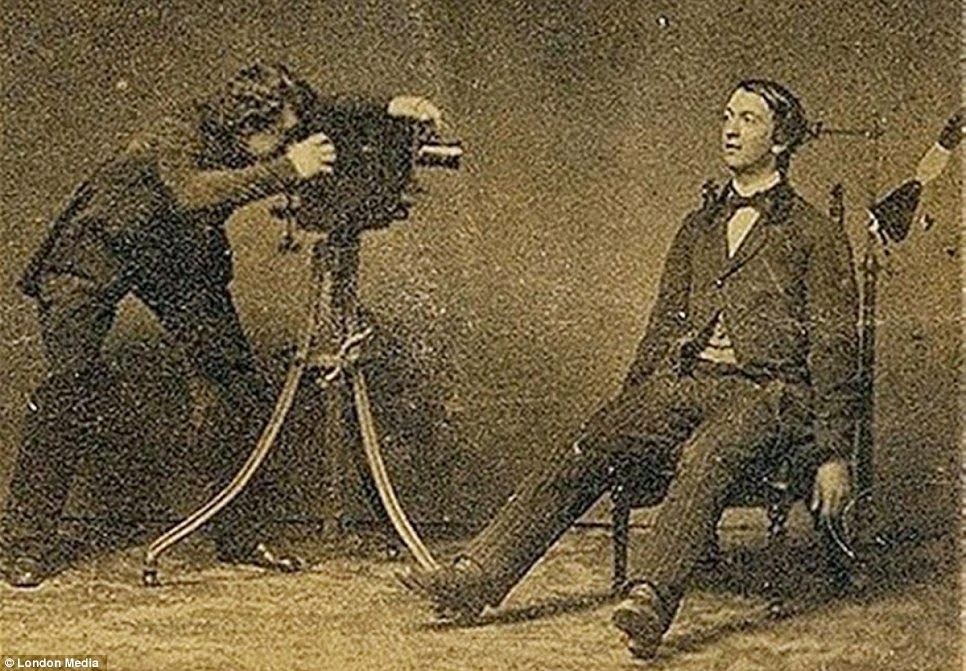
In the early 1800s, cameras were introduced that allowed for light to be captured on photographic plates, producing an image. These early cameras took a long time to capture a photo, which meant that the subject had to stay still and the photographer needed to use a tripod (or something like a tripod) to keep the camera from moving. That's why you don't usually see people smiling in early-Victorian photographs. It doesn't matter how happy you are; if you hold a smile long enough, you start to look a little deranged. Sadly, sitting perfectly still and staring at a camera for five minutes had the same effect.


It also meant that dead people were excellent and popular models.


By the 1870s, new technology became available that allowed people to capture photos more quickly. Photos from this time on begin to appear more candid and, like our concealed vest camera above, cameras could be made smaller.

In the 1880s and 1890s, people started to take up photography as a hobby. In the 1890s, the word "Kodak" became synonymous with camera and "Kodaking" was a verb for practicing photography because Kodak introduced a camera that used a portable roll of film in 1890. Constance Wilde took one of these with her travelling in the early 1890s, but mostly used it to take picture of sights, rather than people (bummer). I find pictures of people so much more interesting than pictures of places because people change faster and are more interactive (most of the time).


Smaller and more fascinating cameras were being invented in the 1880s, like the concealable vest camera, but these were never as popular as the Kodak. Thinking of spy cameras, I've endeavoured to share a few of them with you here.

J. Lancaster & Son began producing this marvelous watch camera in 1886. More detailed images of it can be found here.


The year after that ad was printed, J. Lancaster & Son also featured a camera that was just small enough to fit in your pocket.


I have no documented evidence that this next one was ever a real product. I'd be a little horrified, but still amused if it was because I've read various claims that not only was it a camera and a cigarette lighter, disguised as a book, but it was also a gun! I suppose that was for all those times Victorians craved a cigarette, while taking a photo of someone they were about to kill?


If it was a gun, don't you think it would be difficult to aim and shoot with a book that could also set you on fire?

And yet, this isn't the only device that links guns with photography in the 1890s. E.J. Marey, a French scientist and photographer, made a chronophotographic gun in 1882, not for shooting bullets at things, but for rapid-fire picture taking to aid in the study of movement. Marey was most interested in seeing how birds fly, but also studied humans, horses, dogs, sheep, donkeys, elephants, fish, insects, reptiles, and microscopic creatures. His longest-lasting impact on culture, was a study about how cats always land on their feet. He made the world's first cat video and we know what that did to the internet. 


I love that as soon as people could start taking candid pictures, they started taking pictures of cats. We all know that a cat can sit perfectly still all day, until you try to take its picture!

Books were definitely a popular way to disguise a spy camera. In 1892, Scovill & Adams disguised a camera as a stack of three books, titled "French," "Latin," and "Shadows." This also included a classic leather strap (I don't understand how people ever used those to carry books).


The name, "Demon Detective Camera," says so much about some of these small portable cameras. The British-made Demon was a cheap simple camera. The rear bears the manufacturer's name: "W. Phillips stamper Birmingham." The patent covering the camera belonged to W. O'Reilly. Some ads reported that 100,000 cameras had been made. They must have been kidding! I hope they were kidding?


In 1885, the Marion & Company of London began producing the Marion's Parcel Detective Camera. As its name suggests, the camera was disguised as a parcel to conceal its actual purpose from the subjects of its photos. The most popular version was covered in brown paper and tied with string, like the typical parcels of the day. A more expensive version was also available covered in leather. As you can see in the ad, the gentleman holding it doesn't look suspicious at all!


More detective cameras were manufactured in the 1900s, but are beyond the scope of this blog. As fun as these cameras are, I find them a little insidious. Readers of this blog will empathize with my affection for Oscar Wilde and Victorian scholars of homosexuality in the Victorian era will know that blackmail was a problem for anyone who didn't strictly adhere to cultural norms.
The Demon Camera Depicts the hypocrisy of life and the frivolities of fashion unknown to its victims. Can be used on the promenade, in law courts, churches, and railway carriages; also in breach of promise divorce casesl in fact at all awkward moments when least expected. The artful maiden, the wily detective, the wronged wife will now collect damning evidence. The bad boy will levy black mail upon his sisters by illustrating family squabbles instead of angelic sweetness, and human happiness will now be within reach of all.
And that's from the camera's own ad!


Follow me on Twitter @TinyApplePress and like the Facebook page for updates!