Showing posts with label trials of Oscar Wilde. Show all posts

Saturday, February 7, 2015

The Importance of Being Irish Gentlemen

Source of quote.
I've been thinking about the way that Oscar Wilde's family treated him when he was going to trial. The following is an excerpt from H. Montgomery Hyde's book: Oscar Wilde.
The Marquess had hired a gang of roughs and instructed them to follow Wilde and see that he did not secure admittance to any hotel in town. [...] Towards midnight, however, they lost sight of him. At this time Wilde's mother was living with Willie in Oakley Street, Chelsea, and it was to the door of their house that Wilde at length staggered in a state of complete physical exhaustion. 'Give me shelter, Willie,' he gasped as his astonished brother opened the door. 'Let me lie on the floor, or I shall die in the streets.' With these words he collapsed across the threshold, as Willie Wilde put it, 'like a wounded stag.'
[...] The family atmosphere had the worst possible psychological effect upon him. Both his eccentric mother and his drunken brother kept telling him that he must behave like an Irish gentleman and face the music. 'This house is depressing,' he complained. 'Willie makes such a merit of giving me shelter. He means well, I suppose, but it is all dreadful.'
I feel I should make it clear that Oscar's brother, Willie, wasn't housing their mother, but their mother was housing him and his wife. It was her house.
Newman Noggs and Kate Nickleby
Charles Dickens

Franny Moyle calls Oscar's trials eerily similar to his father's own scandal years before. The scandal of Wilde's father came about as part of the fallout of a relationship with a young woman, called Mary Travers. After their relationship ended, Travers accused Sir Wilde of seducing her, then published a pamphlet that parodied Sir and Lady Wilde as Dr and Mrs Quilp. In her pamphlet, Dr Quilp raped a female patient anaesthetised under chloroform. Lady Wilde was vocal and outraged; Travers sued her for libel. The legal costs financially ruined the Wildes. The case was publicized all over Dublin and Sir Wilde was criticized for refusing to enter the witness box - an act which was criticized as ungentlemanly.

Oscar's mother obviously remembered the Travers case. Her insistence that it would be ungentlemanly for him not to turn up in court clearly echoes what happened with her husband. But Willie actively prevented Oscar from fleeing.

I'm beginning to believe that Oscar's older brother, Willie, was scarred deeply by these events. As in Edgar Allan Poe's The Telltale Heart, the things that people frequently repeat about themselves are the things that they are trying to convince themselves of; that's why one doesn't go around telling people they're not crazy! Willie oft repeated that he was an 'Irish gentleman'. Never was he more adamant that his brother was also an Irish gentleman than when Oscar was thinking of fleeing to Paris.

It was never inevitable that Oscar would be convicted in court. Everybody, including Queensberry and the judge, thought that Oscar would flee to Paris. His friends even arranged transportation for him. I believe Oscar wanted to flee to Paris and that was why his brother blackmailed him into staying. His brother could not stand the idea of history repeating itself in their family.

In Willie's mind, after all, they were Irish gentlemen.

Follow me on Twitter @TinyApplePress and like the Facebook page for updates!

If you have enjoyed the work that I do, please support my Victorian Dictionary Project!

Friday, January 2, 2015

Pornography


Victorian sexuality can be approached from so many directions, including (but not limited to) body image, sexual orientation, masturbation, prostitution, sex education, disease, religion, marriage, and pornography. All of these aspects overlap and influence each other, creating tremendous diversity in attitudes toward sex at any given point in history. Each of these factors provide the context in which sexual identities are created. This post is the eighth in a series of posts that seek to explore that context from the 1890s with an emphasis on male sexuality.

Pornography

What is pornography?
The definition of "pornography" is famously subjective. After all, one man's Venus de Milo is another man's masturbation aid. But researchers generally define the genre as material designed solely for sexual arousal, without further artistic merit. - source
When I started this series of posts, I foolishly thought it would be easy to tell you what pornography was, and though this particular post would contain a string of cheeky photos of women in corsets 120 years ago. I was wrong. Determining what counted as porn was as complicated in the 1890s as it is today. The only thing that has become clear is that Victorian society feared sexual arousal, and by extension the distribution and production of pornographic materials.


In 1885, the Society for the Suppression of Vice was absorbed into the National Vigilance Association. The National Vigilance Association (NVA) was inspired by the need to fight child prostitution. Toward the end of restricting the sale of pornographic material the NVA pursued stricter legislation, and published a pamphlet called Pernicious Literature (1889). 
There can be no two opinions that the dissemination of such vile books must do harm to the youth of the country, into whose hands such literature only too readily falls.
The tie between child prostitution and pornography was compelling in 1890s London. Between Jack the Ripper and the Eliza Armstrong Case, in which a thirteen year-old virgin was sold into sexual slavery, poor and working-class girls were in incredible danger. If you were a upper- or middle-class Victorian, these were the same girls who poured your tea and swept your floor at home. Restricting pornography was portrayed as preventing the corruption and victimization of such girls.


In hindsight, we picture the boys in the loading bay at Selfridges with a handful of dirty pictures (Mr Selfridge is a television show; I'm referring here to an episode in which the young men in the loading bay pass around some fairly tame pictures of women), and remember that this was the only form of sex education available to them. Victorians weren't oblivious to the instructive side of pornography. Doctors also fell victim to the anti-pornography laws for supplying educational material to their patients, such as the Fruits of Philosophy.

Although I definitely support Annie Bessant and Charles Bradlaugh's cause, I have to concede that the creepy reputation of the Victorian doctor was well-earned. Jack the Ripper suspect, Francis Tumblety claimed to be a doctor and sold pornography to supplement his income during the early years of his notorious career. I can't, however, say with any certainty what kind of pornography he was peddling.

Most sex manuals were considered pornographic. Poems and novels could also be considered pornographic and were identified as such by a yellow jacket. Yellow covers warned readers of pornographic content (most French novels sported yellow covers in London). These yellow novels were associated with the aristocrat and the aesthete. So, what about the boys in the loading bay of Selfridges?

Affordable pornography came in the form of pamphlets containing erotic stories, like "Intrigues and Confessions of a Ballet Girl" (1870), which was one of many. These pamphlets didn't have any explicit sex scenes. According to Allison Pease, "the cheaper the pornography, the less body and acts were portrayed." Erotic imagery was also an important part of the penny illustrated weeklies, "and a postcard set depicting a nude gymnast on the swing and trapeze could be purchased in the 1890s at a cost of one shilling for thirty-six poses."

Victorians were definitely kinky. There were sub-genres of pornography, just as there is today. Some of these sub-genres included BDSM (especially riding crops and leather), interracial, same-sex, bestiality, and many others.

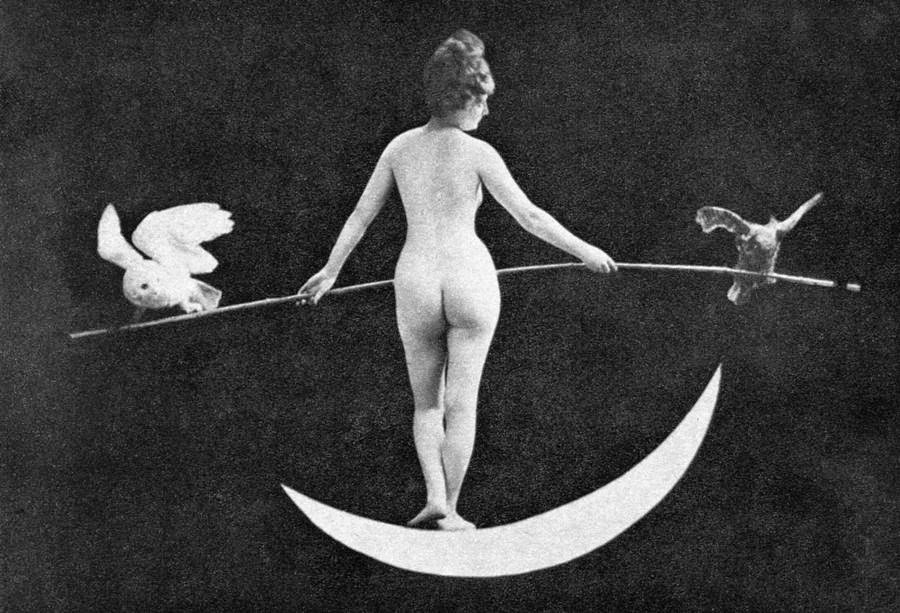
Images like this (some with much more
nudity) were sold as cabinet cards.
Rule 34 applied in the Victorian era too; if it existed, there was porn of it. They invented the camera and immediately started taking dirty pictures.

Cabinet card. No date.
I even found Sasquatch porn. It was terrifying. I'm not sharing those pictures here.

And the idea that pornographic images were either hand-drawn or rather tame, like the burlesque photos that have been circulating around the internet, is wrong, very wrong. By the 1890s, pornographic images were could be very explicit, as seen in this auctioneer's photo set.

So, who was buying pornography in the 1890s and how much of it? Although they certainly weren't immune to pornography's allure, the middle-class viewed the poor and the aristocratic as hungry for vice. Unlike masturbation, I don't think every one does porn. The NVA said there could be no two opinions about the harmful effects of pornography, but there were varying definitions about what pornography was, as seen by the trials of Oscar Wilde. When does a poem become pornographic and what makes it so? Is pornography an art? Can art be pornographic?

Dracula 1st edition cover.
Bram Stoker's Dracula originally sported a yellow cover to warn readers of its pornographic contents, which elude the modern reader. Stoker never intended it to be pornographic. Of Dracula, Stoker wrote to William Ewart Gladstone that:
The book is necessarily full of horrors and terrors but I trust that these are calculated to “cleanse the mind by pity & terror.” At any rate there is nothing base in the book and though superstition is brought in with the weapons of superstition I hope it is not irreverent.
Considering him a friend, Stoker had already sent Gladstone, and many other friends, copies of the book. Although the book's cover was yellow, Stoker didn't seem to fear any social repercussions for a book he didn't consider pornographic.

Dracula was nothing compared to My Secret Life (1888).
The next night undressing, he showed me his prick, stiff, as he sat naked on a chair; it was an exceedingly long, but thin article; he told me about frigging, and said he would frig me, if I would frig him. He commenced moving his hand quickly up and down...
Some books were clearly pornographic, just as they are today. In fact, the only difference between Victorian porn and modern porn is that Victorian porn was lower tech, and more people were 'morally' against it. If you have any further insight, please leave a comment.

I will be writing one more post in this series on 1890s male sexuality, in which I plan to connect the different aspects of what influenced sexuality together, concluding this series.

Follow me on Twitter @TinyApplePress and like the Facebook page for updates!

If you have enjoyed the work that I do, please consider supporting my Victorian Dictionary Project!

Tuesday, December 2, 2014

The Sexual Orientation of Men in the 1890s


Victorian sexuality can be approached from so many directions, including (but not limited to) body image, sexual orientation, masturbation, prostitution, sex education, disease, religion, marriage, and pornography. All of these aspects overlap and influence each other, creating tremendous diversity in attitudes toward sex at any given point in history. Each of these factors provide the context in which sexual identities are created. This post is the second in a series of posts that seek to explore that context from the 1890s with an emphasis on male sexuality.

Sexual Orientation
"Sexual orientation" is the preferred term used when referring to an individual's physical and/or emotional attraction to the same and/or opposite gender. "Gay," "lesbian," "bisexual" and "straight" are all examples of sexual orientations. A person's sexual orientation is distinct from a person's gender identity and expression. - The Human Rights Campaign
For the purposes of this post, I will be looking at the sexual orientations of self-identified men in the 1890s, especially writers. There will be little discussion of trans-men because I have little information on the lives of trans people in London in the 1890s, though they certainly existed, and likely wrote many wonderful things. I encourage all of my readers to discuss 1890s trans authors' sexual orientations in the comments of this post.

Oscar Wilde and Lord Alfred Douglas
1890s London was an extremely heterosexist place to live and be. It was also the most interesting and scary time of the century, in terms of discussing sexual orientation. Male homosexuality, as it exists today, was, in many ways, invented at this time. Of course, the history of male homosexuality dates way back before the 1890s, but at least two major events happened in 1890s London that would shape male homosexual culture for the next hundred years. Oscar Wilde's infamous trials occurred in 1895, and Havelock Ellis's translated Sexual Inversion (1897) became the first English medical textbook on homosexuality. 

Robert Ross at age 24
When I say that male homosexuality was invented, I mean that without differentiating labels of sexual orientation, we are all just sexual human beings. Men certainly didn't need the label of 'homosexuality' to be openly attracted to other men. Robbie Ross was relatively open about his sexuality before the 1890s, he was discriminated against and bullied at school, and embraced by his family. It was the ways that heterosexist society understood male homosexual attraction that were changing.

Heterosexist society is only capable of understanding homosexuality from within the context of heterosexuality. It normalizes heterosexuality, but at the beginning of the decade even heterosexuality was a problem. 

The Elder's Happy Home (1881).
'The sexual problem' and 'varietism' were a couple of the terms used in alternative journals to discuss what was most commonly being referred to as 'the marriage question.' Of course, marriage to a woman was the ideal goal of male sexuality in the 1800s. The marriage question's main focus was divorce, though it was expanded to include polyamory, and the complications involved in legalizing extramarital relationships to legitimize the children born of these relationships. Essentially, it struggled with the problem of men who were sexually attracted to people other than the woman they married.

W. Somerset Maugham's first novel, Liza of Lambeth (1897) tackles the marriage question by outlining many of the ways in which working-class Londoners struggled with the institution of marriage, and the ways in which marriage regulated heterosexual sex. At one point, Liza's lover even considers bigamy.

Hall Caine and Family (1890s).
Living as man and wife outside of marriage was more common than most people think in the Victorian Era. (George Elliott) Mary Ann Evans' partner, philosopher and critic George Henry Lewes was already married when he met Evans, but had an open marriage, and was unable to get a divorce, so he lived with Evans, as if they were man and wife. Hall Caine's wife, Mary Chandler was only 13 when they met, and too young to get married. They lived together, had children, and people assumed they were married, although they couldn't and didn't get married until she was almost of age.

Evolutionary theory provided fascinating new ways to think about those problems. The Darwinian Revolution was changing the way that people thought about life, the universe, and everything. As soon as it was published, it began to permeate fiction. By the 1890s, young writers had inherited a body of work to build off of that had created scenes and plots that adopted natural selection as part of human mating rituals. 


Darwinian courtship narratives featured, as Bert Bender put it, 'aggressive, eager, and possessive males and coy females; males participating in the "law of battle"; or scenes of music and dance that dramatized Darwin's theories on sexual attraction and biological beauty." Darwinian courtship narrative were also applied to real life.

Scientists used theories of evolution to naturalize perceived differences between men and women, especially in terms of courtship and sexual attraction. The dance floor became a metaphorical jungle for men and women's animalistic instincts. In my post on dancing, I discuss the scenes of music and dance that provided middle- and upper-class men one of the rarer opportunities to meet single women their mothers would approve of because those women occupied entirely different spheres of London life than their male counterparts. Most discussions on the separate spheres of Victorian life emphasize the restrictions that this highly gendered society imposed on women, but many Victorian men hardly ever got the chance to meet a woman they weren't related to. When they did, their were guides to help them through it, like Flirting Made Easy (1882).

From Flirting Made Easy (1882).
Although Flirting Made Easy is called a guide for girls, the text is clearly directed toward men, and echoed Darwinian courtship narratives found in fiction. Mrs. Humphry, Manners for Men (1897) describes the ideal man as the product of evolution, defined through his abilities to deal with all of the elements presented to him in the masculine spheres of society.
It was once said by a clever man that no one could be a gentleman all round who had not knocked about the world and associated with all sorts and conditions of men, high and low, rich and poor, good and bad. Experiences like these are like the processes for refining gold. The man who emerges unharmed from the fire of poverty and its associations, and who retains his independent manliness in relations with those high-place, must have within him a fibre of strength that is the true essence of manliness.
In this, we also have the idea of men knocking about with men becoming more manly men, which seems to reinforce the righteousness of a separate spheres ideology, in the midst of which a man could go to certain theatres, streets, hotel lobbies, and hire a 'rent boy.' Rent boys were young male prostitutes.

In the 1880s, 'the social purity movement' sought to contain the many manifestations of male lust, including prostitution.  In 1885, they pushed through legislation that would ruin Wilde's life ten years later.  The main intention of the legislation wasn't on regulating homosexuality (most of the movements supporters likely had little idea that such relationships existed). The legislation's main intent was to protect young girls from indecent assaults. Section 11 of the Criminal Law Amendment Act of 1885 revised the age of consent for girls from thirteen to sixteen (so until 1885, there was nothing legally wrong with Caine's relationship with Chandler).  The law was also amended to make any indecent assault punishable by making 'gross indecencies,' regardless of age, punishable as a misdemeanor.  Consequently, the vague wording was interpreted more broadly to apply to consensual same-sex acts between adults, which is what Wilde was sent to prison for in 1895.

I keep saying that most people in this heterosexist society didn't know anything about homosexuality, so that it was as if homosexuality didn't exist. Clearly, men who were interested in such encounters found them, and a dialogue was beginning to emerge. Richard von Krafft-Ebing first introduced the word 'homosexual' to the language through his English translation of Psychopathia Sexualis in 1892. A more popular word among homosexual men, at the time, was 'Uranian,' which emerged in poetry that referred to a third sex, which placed a female psyche in a male body.

The widespread belief that homosexual men are more feminine emerged during this time, and was reinforced through Ellis and Wilde.

Before Wilde was identified as a homosexual, the traits that we've grown to associate with homosexual culture were regarded as part of the culture of refined gentlemen, living an artistic life. Wilde was flamboyant, he cared about his hair, his clothes, his wife's clothes, he edited a woman's magazine, he wrote for the theatre... Ladies loved Oscar Wilde so much that he hired a guy with hair like his to travel with him on his American tour, so that he might be able to fulfill his many female fans' requests for locks of hair without having to cut any of his own. He was a masculine sex symbol at the beginning of the 1890s - not in spite of his aestheticism, but because of it.


At the end of the decade, the characteristics that made Wilde so masculine and sexy to women were associated with what Ellis called 'sexual inversion.' In his book, Ellis provided what is considered my many to be the first objective assessment of the sexual relations of homosexual men, including men with boys. Ellis didn't characterize homosexuality in terms of morality, or as a disease. It did, however, create a link between homosexuality and child abuse that has been difficult to reverse. There was no evidence then, or now, to suggest that homosexual men were, or are, more likely to abuse children than heterosexual men.

Child abuse was approached much differently in the 1880s and 90s than it is today, as illustrated through the beginning of Caine's relationship with Chandler (who eventually became his wife). Chandler's father ran a restaurant, and was called on to deliver a sandwich to Caine. After delivering the sandwich, Chandler's father (rightly or wrongly) believed that something sexually inappropriate had occurred between Caine and 13 year-old Chandler. Because he now viewed his daughter as sexually impure, he insisted that she was to be Caine's responsibility from that day forward.

Other cases in the UK and throughout the colonies, provide examples where parents sought monetary compensation in addition to an arrangement where the pedophile had access to their child victim. It was cases like this that the 1885 law sought to prevent. Pedophilia is not considered a sexual orientation today, but rather a paraphilia, or 'a condition characterized by abnormal sexual desires, typically involving extreme or dangerous activities.' It wasn't considered a sexual orientation in the 1890s either, if only, because people were still trying to figure out what sexual orientation was.

Three Yale men in drag; New Haven, CT (1880).
This photo likely had nothing to do with
sexual orientation, just some young men
dressing up as women for a photo.
Because 1890s London was such an extremely gendered and heterosexist society, anything outside of reproductive sex within a marriage was considered a vice, and needed to be repressed. Of course, the people within that society were still people with all kinds of sexual urges, as is clear through the lives of the writers presented here, like Oscar Wilde, Robbie Ross, Hall Caine, and Bram Stoker.

By today's standards, Oscar Wilde would most likely identify as bisexual because he did love women, including his wife, Violet Hunt, and Florence Balacombe (the future Mrs Stoker). He also loved Lord Afred Douglas, and Robbie Ross.

Robbie Ross was a homosexual before there was a word for it, and is perhaps one of the first gay activists. During the First World War, he even mentored a group of primarily homosexual poets and artists, which included Siegfired Sassoon and Wilfred Owen.

Hall Caine was also probably bisexual. He had many children with his young wife, but he also had many extramarital love affairs with men.

Although it's popular to insist that Bram Stoker was also into men, I would argue that he was probably a very typical heterosexual gentleman. There's no evidence that he ever cheated on his wife. He had romantic friendships with men, like Walt Whitman, which could rightly be considered an infatuation. However, he spent the majority of his married life away from his wife, which gave him ample opportunity to act on any extramarital urges he might have had, and didn't. I think that those romantic friendships were simply characteristic of a time when men weren't afraid of being considered homosexual because no one really knew what homosexuality was.


Of course, I am transposing contemporary ideas of homosexuality, bisexuality, and heterosexuality onto historical figures, which is a pretty anachronistic thing to do. In 1890s heterosexist society, if sexual orientation had anything to do with a man's identity, he most likely viewed it in a Jekyll and Hyde way, meaning he would Hyde any parts of himself that didn't fit with the heterosexist expectations of respectable life. He may still engage in those activities, but he would be very careful about letting anyone know about it.

Follow me on Twitter @TinyApplePress and like the Facebook page for updates!

If you have enjoyed the work that I do, please consider supporting my Victorian Dictionary Project!

Friday, November 7, 2014

Who was Dracula?


Who was Dracula? Ever since the novel was published in 1897, scholars and fans have been trying to answer this question. In honour of Bram Stoker's birthday, I'm sharing a few of the ideas I've heard over the years.

1. Vlad the Impaler.

Vlad the Impaler was the Prince of Wallachia a member of the House of Drăculești, and descended from a member of the Order of the Dragon. The Order of the Dragon was founded to protect Christianity in Eastern Europe. After his death, Vlad became a folk hero in Romania and parts of Eastern Europe for protecting the Romanian population. The nickname "Impaler" is part of the folk legend, that he impaled his enemies on the battle field. During his lifetime, he gained an excessive reputation for cruelty.

Vlad III Prince of Wallachia

In Dracula: Sense and Nonsense (2005), Elizabeth Miller argues that Vlad the Impaler was not the inspiration for the famous vampire. Because we didn't have access to Stoker's notes until fairly recently, many myths about the novel were created through speculation, and this was one of them.

Bram Stoker's Dracula (1992)
It's still very appealing to the imagination, and permeates films about vampires, including Bram Stoker's Dracula (1992).
Sir Henry Irving

2. Sir Henry Irving.

Irving was one of the most famous actors in the world in Stoker's day, and he was Stoker's boss, the owner of the Lyceum Theatre, where Stoker worked between 1878 and 1898. Stoker adored Irving, modeled many of his own opinions after Irvings, claiming in Irving's biography to have been able to speak with the same mind as Irving.

Strong arguments have been advanced that Irving was Stoker's real-life inspiration for Dracula's character, the way that he moved, and commanded all of those around him. Stoker even wanted Irving to play Dracula on the stage. Irving refused.

Irving and Stoker getting into a cab.
3. Oscar Wilde.
Oscar Wilde

If you read my blog, you know who Oscar Wilde was. He and Stoker were long time friends, going back to Dublin, where Stoker stole Wilde's childhood sweetheart, Florence Balcombe.

Theories that advance Wilde as an inspiration for the vampire, usually draw on Wilde's lifestyle, especially his homosexuality, turning vampirism into a metaphor for homosexuality. Stoker was extremely sympathetic toward his friend during his infamous trials of 1895, and may have been homosexual himself, as has been evidenced in his letters to Walt Whitman.

Who do you think inspired the world's most famous vampire?

Follow me on Twitter @TinyApplePress and like the Facebook page for updates!

If you have enjoyed the work that I do, please consider supporting my Victorian Dictionary Project!

Tuesday, September 16, 2014

Riches to Rags: the Wilde Stories

Oscar Wilde, Constance Wilde, and one of their sons.
If you've ever been broke, you are probably familiar with the way that it makes you feel, like there's something wrong with you, and the world despises you. Academically, we know this isn't true. Not having money isn't a character fault in and of itself. As the saying goes: "You can't control what happens to, but you can control how you deal with what happens to you."

The Wilde Family make an interesting case study in this phenomena when we look at the lives and misfortunes of Speranza and her two sons, Willie and Oscar Wilde. Each lost a fortune, and each dealt with it differently, with different consequences.

Speranza
Speranza was Dublin's most popular socialite. Her husband was knighted. She lived in the best house. She had the most interesting guests, and the best parties. She loved culture, history, art, and Ireland. Her fortune dried up when she and her husband got caught up in a scandal, the details of which are still controversial. Her husband soon died, leaving her with little money.

In response, she packed up her house, and moved to smaller quarters in London, where she could continue to pursue her art. She did what she could to continue to support her family. She got a little support from her sons for a while, but their lives weren't going well either. She kept trying, until she was too old to try anymore. She continued to host her famous salons, and the most interesting people continued to attend.

Her son, Willie, was an alcoholic though, and alcoholics tend to drag their loved ones down with them, which Willie did. Speranza died in a room full of empty gin bottles, and Willie blamed his brother.

Willie Wilde
Willie also made a noble effort to prevent himself from descending into rags. A few years after he went bankrupt, he married the richest woman in America. That didn't go so well because of his drinking, and he wound up living with his mother, and claiming to take care of her. As you know, from Speranza's story, he didn't do a very good job of that.

After his mother died, he had to find a new place to live. He sold off most of his brother's belongings. He sold his wife's wedding ring. Eventually he died from alcoholism, and few of the wonderfully successful people he once called friends ever mentioned him in their memoirs. The newspaper he was a lead reporter for, at one time, barely mentioned his passing.


Oscar, on the other hand, continually tried to make everyone happy. In a way, that's how he got his money. He became a celebrity before he did anything, just because people liked him so much. His wife had money, which was helpful, and he was good at earning his own money, which he promptly spent on his friends and lovers.

Oscar Wilde's downfall was very public. He went from being a darling to being a demon, and he definitely felt terrible about the impact that this had on all the people he cared about. Oscar realized that we never suffer in isolation, but our suffering impacts everybody around us. His imprisonment, and the backlash against him, hurt his family, his friends, and his business associates. For this, he expressed his remorse.

When Oscar was released from prison, he was broke, worse off than his brother or mother had ever been, but the love that he gave to other people came back to him. His good friends did what they could to help support him, and, though he never really recovered from the losses he sustained at that time in his life, he is remembered with fondness because of the love he spread.

Follow me on Twitter @TinyApplePress and like the Facebook page for updates!

Sunday, August 17, 2014

What happened to Oscar's stuff?

Scholarly article pay little attention to the role my protagonists played in history, one example being Kevin O'Brien's essay: "Lilly Wilde and Oscar's Fur Coat." If you click on that last link, you should be able to download the article automatically, which I'm basically going to summarize here.

It begins with a letter that Wilde wrote after he had been to prison and had started to track down his things, which had been pawned by Oscar's brother, Willie. The letter mentions "those people," specifically "the man," and "the woman." Those people were Willie and his wife, Lily Wilde. O'Brien says:
The story from their perspective is worth examining, for their relationship with Oscar was a difficult one, and they themselves had a hard, impoverished life together for the five years of their marriage.
Lily was Willie's second wife, who he brought to live at his mother's house, when he more or less gave up on life and let his mother take care of him. Lily had been in love with him, since before he married Mrs. Frank Leslie. As reported in the papers, and as evidenced by the lifestyle provided to her and Willie's daughter Dolly, Lily was an heiress. She was cut off from her fortune for the duration of her marriage to Willie.

Lady Jane Francesca Agnes Wilde
a.k.a. "Speranza"
As O'Brien uncovered, the small traces of history that Lily Wilde left behind depict her as an emotional woman of poor judgement, but still, a devoted friend, or maybe just a fan, of Oscar.

Willie made life difficult for his mother, by being unable to earn an income, and constantly demanding money. He was dying of alcoholism, and most likely suffered from delirium tremens. He had been brought down a peg or two, since his marriage to the richest woman in America failed, so when Oscar showed up at his doorstep in trouble, he likely saw a chance to redeem himself - maybe even look like a bit of hero for helping his brother out.
When Oscar arrived at the doorstep at 146 Oakley Street and pleaded, "Willie, give me shelter or I shall die in the streets," Willie let him in, but without much charity.  Willie later described the scene: "He came tapping with his beak against the windowpane, and fell down on my threshold like a wounded stag."
Though he tried to make it look like he was helping his brother, when he spoke to other people, he was really doing nothing of the sort. Lily and Oscar got along fine. While Willie blackmailed his brother and generally tried to control his life before he went to prison, Lily tried to reassure Oscar that she could manage Willie and take care of his things while he was gone.

Trying to control a raging alcoholic is like trying to teach a cat to clean up after itself.
Another disadvantage of Oscar's stay at 146 Oakley Street is the one quoted at the beginning of this article -- the betrayal by Willie and Lily in the loss of his precious fur coat and, in fact, two trunkloads of clothing.  Lily had quite a different version of the disposal of Oscar's belongings: rather than pawning his clothes without his knowledge, Willie was merely disposing of what had been given him.  According to Lily, before Oscar left for his third and last trial, he said one morning to Willie, "You can have all my things to do what you like with."
Rather than convincing Oscar to leave all his things in her charge, as Oscar claimed, Lily says that when she heard Oscar make the offer to Willie, she took Oscar aside and told him confidentially that "considering Willy's ordinary ways, if the clothes and trunks were left they [will] be sold or pawned."   According to Lily, Oscar answered, "he may have them all, only keep me my shirts." Hard up for money, Willie sold Oscar's fur coat and the two trunks of clothing to a jobber for only £12 or £13.  Lily was vigilant enough to keep her side of the bargain and saved all Oscar's shirts.
When Speranza died, there was no one left to pay rent at 146 Oakley Street. Willie and Lily had to move to a few small rooms at 9 Cheltenham Terrace. During the move, Lily packed up Oscar's shirts, his manuscripts, and a few treasured possessions, which she sent on to More Adey of his for safe keeping, never realizing that all of the possessions he had saved and brought with him to 146 Oakley Street were in fact treasured possessions.

Willie Wilde
It hurt Lily that Oscar was so angry at her for not being able to protect all of his precious things, and her usual protective nature over Willie changed in the face of that anger, she must have realized by this point that Willie sold Oscar's things without his permission because he wished to fuel his own sad addiction.

As Willie continued to drink himself to death, he blamed most of his own problems on his brother, and the two never spoke again. Oscar did not even attend his brother's funeral, or send a kind note.

Constance Wilde used Lily to track Oscar's movements, when he left prison, which Lily did through their mutual friend More Adey. There's evidence to suggest that Willie was jealous of his wife's friendship with his brother.

When Willie died, Oscar did reach out to his brother's widow by offering a small amount of financial support. Oscar and Lily kept in touch, until Oscar died in 1900, at which time he was aware of her second marriage and offered happy approval.

Follow me on Twitter @TinyApplePress and like the Facebook page for updates!

Thursday, May 29, 2014

Children in Prison and Other Cruelties of Prison Life by Oscar Wilde


On 25 May 1895, at the height of his career, Oscar Wilde was convicted of gross indecency and sentenced to two years' hard labour. Wilde and his fellow inmates faced a regimen of "hard labour, hard fare and a hard bed." Accustomed to all of the finest things in life and utterly shunned by the public, who once adored him, Wilde simply could not bare prison life. His health declined sharply, and that November he collapsed from illness and hunger, rupturing his right ear drum in the fall. Within a few short years this injury would lead to his death.

After serving his sentence, Wilde remained concerned for some of the younger inmates at Reading Gaol. In February 1898, he published "Children in Prison and Other Cruelties of Prison Life." The publisher's note appears as follows:


The pamphlet begins by addressing the editor of the Daily Chronicle:
Sir, - I learn with great regret, through an extract from the columns of your paper, that the warder Martin, of Reading Prison, has been dismissed by the Prison Commissioners for having given some sweet biscuits to a little hungry child. I saw the three children myself on the Monday preceding my release. They had just been convicted, and were standing in a row in the central hall in their prison dress, carrying their sheets under the arms previous to their being sent to the cells allotted to them. I happened to passing along one of the galleries on my way to the reception room, where I was to have an interview with a friend. They were quite small children, the youngest - the one to whom the warder gave the biscuits - being a tiny little chap, for whom they had evidently been unable to find clothes small enough to fit. I had, of course, seen many children in prison during the two years during which I myself was confined. Wandsworth Prison, especially, contained always a large number of children. But the little child I saw on the afternoon of Monday, the 17th at Reading, was tinier than any one of them. I need not say how utterly distressed I was to see these children at Reading, for I knew the treatment inshore for them...
Wilde published Children in Prison as an attempt to publicize and promote action to end the scandal of child prisoners incarcerated in British jails. The pamphlet was first published in letter form to the editor of the Daily Chronicle newspaper in 1897. In prison Wilde saw the many young boys locked up with adults, who posed various dangers to the young boys, causing them ‘sheer terror.’ Many children were locked away in near darkness for 23 hours each day, and fed only on water and ‘badly baked’ bread.

To draw attention to the scandal, Wilde describes the case of warden Thomas Martin, who was dismissed from his post for offering a biscuit to a child found to be ‘crying with hunger’. Wilde advocated that no child be imprisoned for any reason if they were less than 14 years old.

You can see the entire pamphlet online through the British Library. The library has introduced a wonderful new resource, "Discovering Literature: Romantics and Victorians," which makes available over 1,200 Romantic and Victorian Literary treasures.

Follow me on Twitter @TinyApplePress and like the Facebook page for updates!

Monday, March 24, 2014

Wilde's Last Real Friend

The Picture of Dorian Gray recently ranked 27th in the Guardian's list of the 100 best novels. Robert McCrum goes on to explain that Dorian Gray wasn't met with the warmest reception in 1891.
Of all the books in this series, Oscar Wilde's only novel enjoyed by far the worst reception on its publication. The reviews were dreadful, the sales poor, and it was not until many years after Wilde's death that this remarkable work of imagination was recognised as a classic.
While this is all true, I'm writing today to give credit where credit is due. Readers around the world didn't suddenly start rereading Dorian Gray on their own. Wilde's name was tainted by his infamous trials; his descendants still go by the name their mother assumed when she fled the country. His work became tainted by Victorian ideas of homoerotic pornography. Black market pornographers unlawfully used Wilde's name on their books in an effort to sell more copies - even after Wilde's death. Lucky for all of us, Wilde had one good friend who worked tirelessly to preserve Wilde's name as an artist, while maintaining the integrity of his Work.

That friend was Robbie Ross (May 25, 1869 – October 5, 1918), a French-born Canadian.


Ross worked as a journalist and art critic and dealer in London, but is remembered for his relationship with Oscar Wilde, to whom he was a literary executor. Ross was important in his own right as part of the London literary and arts scene in the 1890's and for the remainder of his years. He even mentored Siegfried Sassoon.

Ross grew up in Toronto and Ottawa, but moved to England to study at Cambridge. Ross began his studies in 1888 and even at that young age - in the Victorian Era too - Ross was open about his sexuality. Other students abused him for it, even with the support of one of their professors, Arthur Augustus Tiley.

After catching pneumonia from being dunked in a fountain, Ross demanded an apology. His fellow students complied, but Tiley refused. Rightfully enraged, Ross fought to have Tiley dismissed from the university to no avail. Defeated, Ross left school and came out to his family.

Robert Ross (Age 24)
Ross is widely believed to have been Wilde's first male lover. What is certain is that he became Wilde's last real friend. Ross was no stranger to homophobia, which didn't disappear when he left school. Years before Wilde went to court, the parents of a young man, who had intimate encounters with Ross and Lord Alfred Douglas, hired solicitors to take legal action, but were persuaded not to go to court.

When Wilde was released from prison, Ross was there with emotional and financial support.

Upon Wilde's death, Ross became Wilde's literary executor. Before Wilde went to prison, most of his possessions were sold off in bankruptcy, including the rights to all of Wilde's texts. Ross tracked these down and purchased them. He enlisted others, like Christopher Sclater Millard, to assist in the fight against the black-market trade in pornographic texts fraudulently published under Wilde's name.

With the definitive bibliography intact, Ross gave Wilde's sons the rights to all their father's works along with the money earned from their printing/performance while he was executor.

In 1908, he produced the definitive edition of Wilde's work. Ross hired Jacob Epstein to design Wilde's final resting place, requesting that Epstein add a small compartment to the tomb for Ross’s own ashes.


If it sounds like Ross was a little obsessed with Wilde, then I have misled you. While Ross was doing all of this he led a full and vibrant career in the arts, including management of the Carfax Gallery, a small commercial gallery in London, from 1901-1908. There, he showed artists, like Aubrey Beardsley, William Blake and John Singer Sargent. Ross went on to become the art critic for the Morning Post. During the First World War, Ross mentored a group of primarily homosexual poets and artists, which included Sassoon and Wilfred Owen.

Ross suffered for helping Wilde even in death, and was wickedly harassed by Lord Alfred Douglas (Wilde's Bosie and Ross's former friend), who tried to have him arrested for homosexual conduct.

During the German Spring Offensive (1918), Noel Pemberton Billing, a right-wing Member of Parliament, published an article called: "The Cult of the Clitoris," in which he painted Ross and his circle as the centre of a conspiracy by 47,000 homosexual traitors, who were betraying the nation to the Germans. Maud Allan, an actress who had played Wilde's Salome in a performance authorised by Ross, was identified as a member of the "cult". She unsuccessfully sued Billing for libel, causing a national sensation in Britain.

The incident brought a lot of negative publicity to Ross and his associates.

Later that year, Ross died suddenly, while preparing to travel to Australia, to open an exhibition at the National Gallery of Victoria.

In 1950, on the 50th anniversary of Wilde's death, Ross's ashes were added to Wilde's tomb in Père Lachaise Cemetery in Paris. Now, if you want to get all teared-up like I just did, go watch this video on YouTube that pays tribute to their friendship.

Follow me on Twitter @TinyApplePress and like the Facebook page for updates!

Monday, March 10, 2014

Spy Cameras & Blackmail

The Victorian sensation novel is evidence that Victorians loved intrigue as much as we do, with all of our murder-mystery television series. The 1890s saw the birth of the forensic sciences at the root of those shows, through the media sensationalism around Jack the Ripper and the popularity of genius detective, Sherlock Holmes.

Jack the Ripper and Sherlock Holmes encouraged widespread mistrust of the police and made many people want to take matters into their own hands by becoming private detectives. As you might have seen in my post on the weirdest cameras of the 1890s, the evolution of photography was ready to appeal to their meddling needs.

Many ads were innocent enough, but others deliberately encouraged customers to spy on people. Marion’s Parcel Camera advertised that:

This Camera is made box-shaped and neatly covered with brown linen-lined paper, and tied with string like an ordinary parcel, of which it has the exact appearance. The object is to disguise its real use, and to permit a Photograph to be taken without raising the slightest suspicion.
Anthony's Patent Satchel Detective Camera illustrates how these devices worked and were evolving.


Conspiratorially, the Labouchere Amendment of 1885 made it easier for the courts to punish male homosexuals, in contexts where anal intercourse could not be proven. Most famously, Oscar Wilde was convicted under this law in 1895. In the years leading up to his trial, he and his friends were tormented by blackmailers. His Tite Street house was even broken into twice, presumably by people looking for further evidence of his affairs.

Photographs weren’t used in Oscar Wilde’s trial, but the years that followed would see a rise in photos taken with the intent of incriminating participants in seemingly private acts.


In 1920, a twenty-year-old actress, called May Levy, was used as bait to ensnare John Blake in a blackmail scheme. Blake recalled hearing a suspicious click in her bedroom, which turned out to be the noise from a camera taking a picture.

In another instance, where no photos were used, a young man name John Richardson propositioned another young man in 1887. Richardson blackmailed his victim by threatening to charge him with assault and followed him to the shop, where he pawned his watch in payment. Both youths were sentenced to ten years.

I can’t be sure how prevalent photographic blackmail was in the 1890s. Court records are difficult for me to access and many cases would have never made it to court for obvious reasons. Between the Labouchere Amendment and spy-camera technology, homosexuals would have been particularly vulnerable. Historian, Angus McLauren, who I once had the honour of taking a course with, summarizes the complex roles of blackmailers and their homosexual victims in fin de siécle London and New York.
Homosexual blackmail trials performed a variety of functions. They were used by the defenders of bourgeois respectability to depict the horrific fate of both the extortionist and the man who had been so incautious as to fall into his snare. In fin de siécle London and New York judges told men as well as women that they had to be wary of strangers, in particular young men. The press reported miscreants who threatened to charge men with “infamous crimes” and the courts dealt openly with accusations of sodomy, yet in generally asserting that the extortioners’ threat was not only illegal but untrue, judges sought to make it known that they had no intention of protecting perverts. The courts and the press careful tried to avoid using blackmail cases to explicitly discuss same-sex passions, while they implicitly warned the adventurous of the dangers of giving way to temptation. Interestingly enough, the court and press reports did not suggest that dangerous youths would necessarily appear effeminate; the stereotyped “homosexual” had not yet fully emerged. Yet because the accused included male prostitutes, the trials no doubt confirmed the popular notion of the homosexual as villainous blackmailer.
If you weren’t inside the circle of targeted victims, as Wilde was, an 1890s onlooker couldn’t have possibly understood the dangers and vulnerability of the love that dare not speak its name, when looking at an ad for a Demon Camera.


Follow me on Twitter @TinyApplePress and like the Facebook page for updates!

Monday, February 10, 2014

Sherlock, the Bully.


It turns out the first actor known to play Sherlock Holmes was also a jealous bully.

Charles Brookfield
Charles Brookfield was an actor, playwright, and journalist with the Saturday Review. Often English satire was all in good fun and could happen between friends, as it did with Arthur Conan Doyle and James Barry. This, however, was not the case when Brookfield wrote a satirical production of Lady Windermere’s Fan.

Brookfield was jealous of Wilde’s success. His parody, Poet and Puppets, was well received at the Comedy Theatre in 1892. Much to his disappointment, Wilde was even amused. Merlin Holland calls Brookfield’s jealousy “envy,” but either way Wilde seemed completely oblivious.

The title, Poet and Puppets, was originally a headline in the Daily Telegraph for a letter Wilde wrote, denying the paper’s earlier assertion that he said actors were puppets to the playwright. Wilde even got to listen to a reading of the parody before it went on stage and only objected to a single line. As H.E. Glover later recalled:
while cigars were burned, the poet puffed, and punctuated each page as it was read with such phrases as ‘Delightful!’ ‘Charming, my old friends!’ (His calling Brookfield ‘old friend’ was touching.) ‘It’s exquisite!’ etc. etc. As he showed us to the door he just gave us this parting shot: ‘I feel, however, that I have been - well - Brookfield, what is the word? - what is the thing you call it in your delightfully epigrammatic Stage English? eh? Oh, yes! - delightfully spoofed.’
I can’t help feeling a huge sense of betrayal on behalf of Wilde, as his brother was a writer for the Daily Telegraph and had written a terrible review of Lady Windermere’s Fan for the paper, and Wilde had no idea about the level of animosity building up in Brookfield. Both Brookfield and Wilde’s own brother would betray him during his infamous trials.

Oscar Wilde is standing. His brother, Willie, sits on right.
By the time Wilde’s trials were getting under way, Wilde had even given Brookfield a small part to play in An Ideal Husband. It was at this time that Brookfield pointed an investigator in the direction of a male prostitute with damning evidence on Wilde.

The list of actors who played Sherlock is long and one from which Brookfield is often omitted, giving the honour of playing the first Sherlock to William Gillette in 1899. Brookfield began playing Sherlock on 25 November 1893 at the Royal Court Theatre in a musical parody called: Under the Clock. Seymour Hicks played Watson. The production lasted for 75 shows, plus one final matinee at a different theatre. According to Amnon Kabatchnik:
Photographs of the era depict Brookfield's Holmes in black tights with a short striped cape over his shoulders, a stubby beard, a thick moustache, and rumpled hair. Seymour's Watson sports a monocle on his right eye, a black high collar around his neck, a pirate's cap on his head, eyebrows that are darkened toward the center and arched to touch the nose, and lips uplifted and highlighted in the middle.
Sadly, I'm unable to locate these photographs and the whole production made Conan Doyle mad.

Brookfield and Hicks used the characters of Holmes and Watson to shoot down other actors, most notably Herbert Beerbohm Tree. The Theatre monthly magazine shot back: “Taunts like these, leveled at Mr. Tree and others, are as cheap as they certainly are nasty. . . .People who want fun instead of a malicious chuckle will find under the clock not exactly to their taste.”

History has found Brookfield not exactly to its taste. Ineffectual bullies don’t keep anyone’s attention for long, though I imagine that Brookfield got along just fine with Wilde’s bullying older brother. Both have left legacies of petty jealousy and pathetic attempts to manipulate and “get back” at the often-oblivious objects of their contempt.

Follow me on Twitter @TinyApplePress and like the Facebook page for updates!

Thursday, November 21, 2013

The Battle for Reading Gaol


The historic prison that once housed Oscar Wilde is scheduled to close today. Students of Victorian literature will forever remember the name of the place. Wilde made it the subject of his Ballad of Reading Gaol. The Oscar Wilde Society wants to save Reading Gaol. While I’m a lover of history and an admirer of the Oscar Wilde Society, I’m not sure I would like Reading Gaol to remain standing.

Wilde served two years hard labour there in the 1890s, after being found guilty of gross indecency for his relationship with Alfred Douglas. To me, this marks Reading Gaol as a historic sight of injustice and I believe there are too many of these sites in the history of homophobia already.

I do not mean to say that we should forget history that unsettles us, but I would like landmarks to lead us toward a brighter future, while celebrating the triumphs of the oppressed against certain hardship. Moreover, I can’t imagine Oscar Wilde would want that prison left standing.

I never saw a man who looked 
With such a wistful eye 
Upon that little tent of blue 
Which prisoners call the sky, 
And at every drifting cloud that went 
With sails of silver by. 

I walked, with other souls in pain, 
Within another ring, 
And was wondering if the man had done 
A great or little thing, 
When a voice behind me whispered low, 
"That fellows got to swing." 

Dear Christ! the very prison walls 
Suddenly seemed to reel, 
And the sky above my head became 
Like a casque of scorching steel; 
And, though I was a soul in pain, 
My pain I could not feel. 
- Oscar Wilde from the Ballad of Reading Gaol

Follow me on Twitter @TinyApplePress and like the Facebook page for updates!