Showing posts with label Victorian sex. Show all posts

Saturday, January 3, 2015

Marriage Really Was The Answer To Everything


Eight posts ago, I started a series on 1890s male sexuality, and expected to wind up characterizing the 1890s gentleman and his sexy self as Dr Jekyll and Mr Hyde, but the novel itself can be read as a critique of societal expectations of male sexuality.
The strange sense of man's double being which must at times come in upon and overwhelm the mind of every thinking creature gives us the Strange Case of Dr Jekyll and Mr Hyde and its posing and eliding of the issue of man, sliding as it does between male and human, between a sexual-instinctual problematic of masculinity and an undifferentiating psychological recognition of the beyond of consciousness, of ego and id. The story starts from the exclusion of the woman which is the condition of a questioning of the man and also its limitation, the specifics of difference are pulled back into general themes. The title, in fact, is misleading or, to put it another way, is itself one of the precautions and a symptom of the problem of representation: nothing about the story is really strange other than that it should be thought strange, the strange case of male sexuality is precisely unstrange by being made into this strange case which comes out of, works with the assumptions of, the given system of representation. Male sexuality is neither the foregone conclusion of animal passion nor the horror of an unspeakable darkness but once it is envisaged within this system that is all that can be said, all that is allowed.
I love-love-love this passage in Stephen Heath's "Psychopathia sexualis: Stevenson's Strange Case." I love the essay for what it is, and love this passage for how it speaks to this series of posts. For over a month now, I've been talking about male sexuality as if there is some difference between male sexuality and human sexuality, and I've been trying to limit the discussion of female sexuality. Picturing sexuality as animal passion, is it wrong to assume that there was any difference in sexuality 120 years ago? Surely, as animals we can't have changed that much.
Eugen Sandow

I began this series by discussing 1890s male body image. The ideal male form was characterized as much by ability as it was by form. Form, they had discovered, could be sculpted, and doctors were already refusing to treat obese patients.

In my discussion on sexual orientation, I showed you how they were inventing the modern concept of homosexuality. Men having sex with other men wasn't new, but the act of letting the action define who one was was new. Identities carry power. As a heterosexist society, 1890s London mobilized to limit the power of homosexual identities by outlawing it, and redefining it as a form of mental illness.  In spite of the homophobia that this gave rise to, I think that homosexual men in the 1890s were better off than the men who had no labels because they must have felt less alone.

Which brings me to my post on masturbation: everybody did it, but Victorians worked very hard to make each other feel bad about it. The rumors about what masturbation could do to your health were almost as bad as the remedies for masturbators. It was during this post that I felt the most like I would end up with a Jekyll and Hyde conclusion because it seemed that people feared sex so much that the most reasonable personal solution was to keep it a secret.


Thankfully, that's not generally what they were doing. Homosexuality wasn't the only new identity an 1890s guy could wear. People were trying out aestheticism, being a Bohemian, they were even switching religions, and inventing new religions. In many ways, the 1890s were like the 1960s, but people dressed better. It seems that they were even beginning to understand that the identity of 'man' or 'woman' is one that we create for ourselves, but the full realization of that notion still seems a long way off.

There were both male and female prostitutes, just like there have always been, but the motivation of male prostitutes was perceived differently from the motivation of female prostitutes, much the same way the idea of being a male porn star today is quite different from the idea of being a female porn star. My discussion on prostitution made it clearer to me that the main difference between 1890s male sexuality and 1890s female sexuality was the concept of agency.


Men were perceived as having these out-of-control sex drives, whereas women weren't supposed to have a sex drive at all. What little sex education existed in the 1890s existed exclusively for young men. On the other hand, all responsibility for the transmission of STDs fell on the heads of female prostitutes.

In many ways the increase in religious and spiritual feeling at the end of the 19th century can be linked to the Darwinian Revolution and the need some people felt to differentiate themselves from animals. Sex was viewed as a baser instinct, an act they had in common with every other mammal on the planet. Morality was used to condemn anything they didn't like, and science was frequently used to back those notions up. Disease could then be read as a moral failing, linked to the degeneration (rather than upward evolution) of mankind.

I couldn't talk about 1890s male sexuality without talking about women. Women were cast into a separate sphere, dressed up as a morally-outstanding potential wife/mother, taught to refuse all sexual advances, and portrayed as the antidote to all male sexual problems.

If Eugen Sandow was the perfect man, the perfect woman knew nothing about sex and was a virgin until the horrible night that she got married. Her life's ambition was to become a mother. The perfect woman had no aspirations outside of keeping a perfect house to raise her perfect children in. She would refuse sex to her husband whenever he asked for it, and would refuse to take her clothes off when they did it.

If you were a man and were less than perfect in any way, common sense of the day suggested you find that woman and marry her straight away because she would cure your masturbating, she would reduce your sex drive, and she would shape you into the kind of man who could carry a family of six on his shoulders.

Basically, women were needed to balance out the baser instincts of male sexuality and to harness his ambitious nature, while directing him along the right path in life. That path steered clear away from pornography, masturbation, and dirty pictures, and on toward a bland diet, lots of exercise, and kids to ignore. The kids were her responsibility.

We know, of course, from the biographies of nearly every writer ever mentioned in this blog that, even if this was the ideal, it was almost never the reality, and more married couples lived apart in England and Wales than in any other part of Europe. Like Jekyll and Hyde, there were probably some men who lived double lives, just as there are today, but for the most part, people couldn't help being whoever they were, even if society was working really hard to make them feel bad about it.

Follow me on Twitter @TinyApplePress and like the Facebook page for updates!

If you have enjoyed the work that I do, please consider supporting my Victorian Dictionary Project!

Friday, January 2, 2015

Pornography


Victorian sexuality can be approached from so many directions, including (but not limited to) body image, sexual orientation, masturbation, prostitution, sex education, disease, religion, marriage, and pornography. All of these aspects overlap and influence each other, creating tremendous diversity in attitudes toward sex at any given point in history. Each of these factors provide the context in which sexual identities are created. This post is the eighth in a series of posts that seek to explore that context from the 1890s with an emphasis on male sexuality.

Pornography

What is pornography?
The definition of "pornography" is famously subjective. After all, one man's Venus de Milo is another man's masturbation aid. But researchers generally define the genre as material designed solely for sexual arousal, without further artistic merit. - source
When I started this series of posts, I foolishly thought it would be easy to tell you what pornography was, and though this particular post would contain a string of cheeky photos of women in corsets 120 years ago. I was wrong. Determining what counted as porn was as complicated in the 1890s as it is today. The only thing that has become clear is that Victorian society feared sexual arousal, and by extension the distribution and production of pornographic materials.


In 1885, the Society for the Suppression of Vice was absorbed into the National Vigilance Association. The National Vigilance Association (NVA) was inspired by the need to fight child prostitution. Toward the end of restricting the sale of pornographic material the NVA pursued stricter legislation, and published a pamphlet called Pernicious Literature (1889). 
There can be no two opinions that the dissemination of such vile books must do harm to the youth of the country, into whose hands such literature only too readily falls.
The tie between child prostitution and pornography was compelling in 1890s London. Between Jack the Ripper and the Eliza Armstrong Case, in which a thirteen year-old virgin was sold into sexual slavery, poor and working-class girls were in incredible danger. If you were a upper- or middle-class Victorian, these were the same girls who poured your tea and swept your floor at home. Restricting pornography was portrayed as preventing the corruption and victimization of such girls.


In hindsight, we picture the boys in the loading bay at Selfridges with a handful of dirty pictures (Mr Selfridge is a television show; I'm referring here to an episode in which the young men in the loading bay pass around some fairly tame pictures of women), and remember that this was the only form of sex education available to them. Victorians weren't oblivious to the instructive side of pornography. Doctors also fell victim to the anti-pornography laws for supplying educational material to their patients, such as the Fruits of Philosophy.

Although I definitely support Annie Bessant and Charles Bradlaugh's cause, I have to concede that the creepy reputation of the Victorian doctor was well-earned. Jack the Ripper suspect, Francis Tumblety claimed to be a doctor and sold pornography to supplement his income during the early years of his notorious career. I can't, however, say with any certainty what kind of pornography he was peddling.

Most sex manuals were considered pornographic. Poems and novels could also be considered pornographic and were identified as such by a yellow jacket. Yellow covers warned readers of pornographic content (most French novels sported yellow covers in London). These yellow novels were associated with the aristocrat and the aesthete. So, what about the boys in the loading bay of Selfridges?

Affordable pornography came in the form of pamphlets containing erotic stories, like "Intrigues and Confessions of a Ballet Girl" (1870), which was one of many. These pamphlets didn't have any explicit sex scenes. According to Allison Pease, "the cheaper the pornography, the less body and acts were portrayed." Erotic imagery was also an important part of the penny illustrated weeklies, "and a postcard set depicting a nude gymnast on the swing and trapeze could be purchased in the 1890s at a cost of one shilling for thirty-six poses."

Victorians were definitely kinky. There were sub-genres of pornography, just as there is today. Some of these sub-genres included BDSM (especially riding crops and leather), interracial, same-sex, bestiality, and many others.

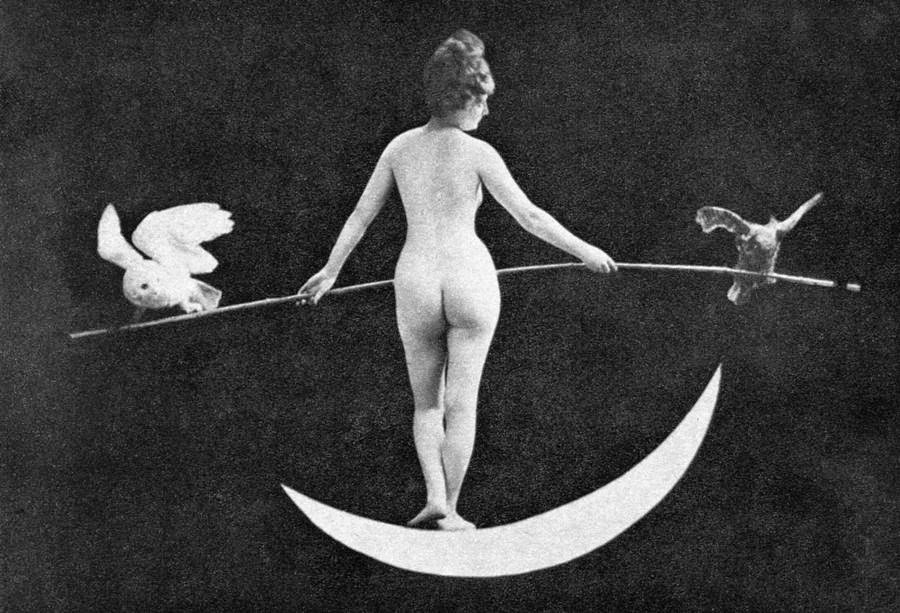
Images like this (some with much more
nudity) were sold as cabinet cards.
Rule 34 applied in the Victorian era too; if it existed, there was porn of it. They invented the camera and immediately started taking dirty pictures.

Cabinet card. No date.
I even found Sasquatch porn. It was terrifying. I'm not sharing those pictures here.

And the idea that pornographic images were either hand-drawn or rather tame, like the burlesque photos that have been circulating around the internet, is wrong, very wrong. By the 1890s, pornographic images were could be very explicit, as seen in this auctioneer's photo set.

So, who was buying pornography in the 1890s and how much of it? Although they certainly weren't immune to pornography's allure, the middle-class viewed the poor and the aristocratic as hungry for vice. Unlike masturbation, I don't think every one does porn. The NVA said there could be no two opinions about the harmful effects of pornography, but there were varying definitions about what pornography was, as seen by the trials of Oscar Wilde. When does a poem become pornographic and what makes it so? Is pornography an art? Can art be pornographic?

Dracula 1st edition cover.
Bram Stoker's Dracula originally sported a yellow cover to warn readers of its pornographic contents, which elude the modern reader. Stoker never intended it to be pornographic. Of Dracula, Stoker wrote to William Ewart Gladstone that:
The book is necessarily full of horrors and terrors but I trust that these are calculated to “cleanse the mind by pity & terror.” At any rate there is nothing base in the book and though superstition is brought in with the weapons of superstition I hope it is not irreverent.
Considering him a friend, Stoker had already sent Gladstone, and many other friends, copies of the book. Although the book's cover was yellow, Stoker didn't seem to fear any social repercussions for a book he didn't consider pornographic.

Dracula was nothing compared to My Secret Life (1888).
The next night undressing, he showed me his prick, stiff, as he sat naked on a chair; it was an exceedingly long, but thin article; he told me about frigging, and said he would frig me, if I would frig him. He commenced moving his hand quickly up and down...
Some books were clearly pornographic, just as they are today. In fact, the only difference between Victorian porn and modern porn is that Victorian porn was lower tech, and more people were 'morally' against it. If you have any further insight, please leave a comment.

I will be writing one more post in this series on 1890s male sexuality, in which I plan to connect the different aspects of what influenced sexuality together, concluding this series.

Follow me on Twitter @TinyApplePress and like the Facebook page for updates!

If you have enjoyed the work that I do, please consider supporting my Victorian Dictionary Project!

Monday, December 29, 2014

The Marriage Question


Victorian sexuality can be approached from so many directions, including (but not limited to) body image, sexual orientation, masturbation, prostitution, sex education, disease, religion, marriage, and pornography. All of these aspects overlap and influence each other, creating tremendous diversity in attitudes toward sex at any given point in history. Each of these factors provide the context in which sexual identities are created. This post is the seventh in a series of posts that seek to explore that context from the 1890s with an emphasis on male sexuality.

Marriage

“A man who moralizes is a hypocrite, and a woman who does so is invariably plain.” - Oscar Wilde, Lady Windermere's Fan.
Victorians generally viewed heterosexual marriage as beneficial to both men and women. Marriage and motherhood were the ultimate goal for a young woman. In the separate spheres ideology, women were portrayed as the angel of the household and a wife would act as her husband's moral compass. In this view, corrupt men could be reformed by such a woman.


Heterosexist views of sexuality painted women into asexual angels. In terms of sexual relations with their husbands, new brides were advised to "GIVE LITTLE, GIVE SELDOM, AND ABOVE ALL, GIVE GRUDGINGLY. Otherwise what could have been a proper marriage could become an orgy of sexual lust." - Ruth Smythers (1894).

Even today, the heterosexist binary view of gender paints men with sex drives that they will not be able to control if women aren't chaste enough. Ideally, the Victorian wife's refusal of sex tempered her husband's raging libido. Of course, we know none of this is true. Men do not necessarily have higher sex drives than women, and many people would give anything to turn their marriages into "an orgy of sexual lust." But, in the Victorian era, if you were a man, who masturbated or thought about having sex with men, marriage to a woman, who would ideally refuse to have sex with you, would somehow save your life.


History is full of examples of this not working out very well. Oscar Wilde is one example, though friends speculated, at the time, that, perhaps, he had married the wrong woman, and that if he had married his first love (Bram Stoker's wife), none of his same-sex relationships would have ever taken place.

Florence Stoker is an example of the ideal Victorian wife. The Stokers had one child. After he was born, his parents stopped having sex. Although there's evidence that Bram Stoker may have had many homosexual fantasies, there's no evidence that he ever cheated on his wife, even though they spent most of their time apart (he was busy working and travelling).

Although I don't think that Oscar marrying Florence would have prevented his affairs, I don't think that either of them were happy in their marriages, even though Florence was such a 'good' wife. They pined for each other, and neither were completely happy with their spouse. So, what happened when someone was unhappy with their spouse in the 1890s?


I've already mentioned 'the marriage question' in my post on sexual orientation. The marriage question focused on divorce. Ironically, the divorce rate in England and Wales in the 1890s was the lowest in Europe. However, its estimated legal separation rate was the highest.

Bram Stoker's employer, Henry Irving got married in July 1869. One night in November 1871, when she was pregnant with their second child, his wife criticized his work: "Are you going on making a fool of yourself like this all your life?" They were riding in a carriage, and Irving stepped out of it at Hyde Park Corner. Their paths would never cross again. They never divorced, and when Irving was knighted for his work, his wife styled herself "Lady Irving."

Irving's case was not exceptional. Contrary to popular belief, marriage was very unstable in Victorian times. Private separation deeds were common place and not confined to the upper-classes, as poor and working class people also sought to avoid the embarrassing scandal of divorce.

Martha Tabram, possibly the first victim of Jack the Ripper, had parents who separated, then had a troubled marriage herself, due to her alcoholism. Her husband left her in 1875, and paid her 12 shillings a week for three years. He reduced this amount to two shillings and sixpence when she moved in with another man.

Further contradicting popular beliefs about Victorian marriages, many couples of all classes lived together without ever getting married. Oscar Wilde's brother lived with his second wife for about a year before they were married. In the Murder of Mrs and Baby Hogg, we learned that the killer lived with a man before moving in with Mr Hogg, and had assumed that first man's name without marrying him.

With real life providing so many examples that contradicted the mainstream ideal of what marriage should be, writers and readers in the 1890s questioned the institution of marriage on legal grounds, and based on human desire. With the support of women writers mentioned elsewhere in this blog, legal reforms began to support women's property rights in marriage, and after it. As the Darwinian Revolution began to scientize the way people thought about themselves and their basic instincts, people questioned the monogamy that traditional marriage demanded. If men supposedly had such strong libidos, maybe they weren't meant to be with just one woman their entire lives.

The marriage question, also sometimes referred to as 'the sexual problem,' brought with it the concept of 'varietism.' According to Anne Humphreys, 'varietism' meant anything from promiscuity to serial monogamy, and the language used to discuss it was cloaked in evolutionary theory. This need to describe sexuality in terms of evolutionary theory ties back into people's needs to justify desires that were not condoned by their religious beliefs.

Although they thought and wrote about it an awful lot, the marriage question was never really answered in the 1890s. Though they thought about 'varietism' and engaged in alternatives to conventional married life, none of it was ever fully embraced by the more dominant aspects of their heterosexist culture. In 1912, Dr Muller-Lyer wrote:
The body of available and necessary knowledge to be taught the young became larger, the task of imparting it more difficult, and it was essential that family life should become consolidated, for much of this instruction could only be imparted by and in the family. And therefore monogamy became more frequent and met with definite approval, and unrestrained varietism in sex relations began to appear harmful, exceptional, and disreputable.
Consequently, the marriage question was thought about and written about throughout the twentieth century, and the way that we discuss it reflects the challenges of our times. Like most nineteenth and early-twentieth century German texts on evolutionary theory, eugenics, and race, Muller-Lyer's book is loaded with racism and classism, but he does suggest that we stop morally judging our ancestors for their sexuality, which is an attitude that should be applied to the way that we think of our contemporaries as well.

Follow me on Twitter @TinyApplePress and like the Facebook page for updates!

If you have enjoyed the work that I do, please consider supporting my Victorian Dictionary Project!

Friday, December 26, 2014

God, Goddesses, Guilt, and Desire


Victorian sexuality can be approached from so many directions, including (but not limited to) body image, sexual orientation, masturbation, prostitution, sex education, disease, religion, marriage, and pornography. All of these aspects overlap and influence each other, creating tremendous diversity in attitudes toward sex at any given point in history. Each of these factors provide the context in which sexual identities are created. This post is the sixth in a series of posts that seek to explore that context from the 1890s with an emphasis on male sexuality.

Religion
There are no perfect rules for sexual behavior, but the conservative elements of society often try to enforce traditional rules and understandings. Sometimes when these rules are based upon mistaken ideas, they generate more problems than they solve. - "Shattering Sacred Myths," The Academy of Evolutionary Metaphysics, 2005.
Religion can be defined in many ways. For the purposes of this discussion, I'm defining it as a set of beliefs about what life means, and how it ought to be lived. I'm going to focus on how religion in 1890s London influenced the way that men thought they ought to be living their sexual lives.

Religion was different in the early-Victorian era from what it became after Darwin published the Origin of Species in 1859. In the late-Victorian era, people were not so much moving away from religion as they were moving away from literal interpretations of the Bible. This is the time when people started to feel "more spiritual than religious," which I still hear people saying today.

Contrary to what American Creationists claim, Darwin didn't turn very many people away from religion. The Presbyterian Church of England was founded in 1876. Jehovah's Witnesses evolved out of the Bible Student Movement of the 1870s, which also gave rise to the Watch Tower Society. New Churches began forming around the world at a rate not seen since the Protestant Reformation, and this continued into the early-twentieth century.


While many clung harder than ever to their religious beliefs, others began understanding religion in new ways. For some, this meant exploring the history of religion around the world, and lead to the creation of hybrid religious organizations in London, like the Hermetic Order of the Golden Dawn, and numerous other spiritualist cults, including sex cults that claimed the expression of female sexuality was divine and/or men should have as many wives as possible.
"Priestess of Delphi," by John Collier  (1891).
"It was an era of religion and faith, and intellectual change." - Nina Auerbach 
The Salvation Army was founded in 1865, in the throws of the Darwinian Revolution, and represents the kind of change that was happening. Still riddled with ethical problems, the Salvation Army has always been something of an activist church that has maintained a vision of Christianity in action. It has, since its founding, promoted the idea that the ideal expression of one's faith is through good works, especially helping those less fortunate.


The flip side was what bad works could get you. Sex and sexual desire, outside of the desire to procreate within marriage, could create tremendous feelings of guilt, and was likely one of the reasons that 'discipline and punishment' was a popular fetish in Victorian pornography.

If one doesn't feel guilty about wanting something that is generally frowned upon by others, one might be inclined to find ways of justify wanting it. In this was a time of intellectual and spiritual change, new religions offered many ways to justify some sexual desires. For example, the religious utopian community of Oneida NY reorganized the Victorian concept of marriage and supported a system of 'free love,' which elevated the status of women, while making them vulnerable to the sexual desires of higher ranking Oneida men.

Although the Oneida Community was founded before the publication of
the Origin of Species, they began selective breeding programs in the 1870s.
Meanwhile, intellectuals, and many of the Bohemian artists in this blog, began looking to history, as well as religion, for guidance on how and why they should live their lives. Removing sex from the equation, Edmund Gosse's Father and Son explores the tension between the religious beliefs of early- to mid-Victorian parents and their children, who used their creativity and improved understandings of science to reevaluate traditional religious beliefs. Oscar Wilde wavered between Anglicanism and Catholicism, while embracing historical examples of same-sex love between older and younger men.

It was important and still is to people, like Wilde, to find historical precedents for how they needed to live their lives and express themselves sexually because religion was being used as an extension of (some may say the root of) Victorian morality, a concept they used to condemn the things they didn't like, including sex, women, foreigners, poverty, and disease. The intellectual and artistic quest to better understand humanity and our internal struggles gets painted as the antidote to foolish religious beliefs. This is in no small way because of the comfort knowledge can bring to one, who has long suffered from unnecessary religious guilt.

Follow me on Twitter @TinyApplePress and like the Facebook page for updates!

If you enjoy the work that I do, support my Victorian Dictionary Project!

Saturday, December 13, 2014

The No-Nose Club and Victorian STDs


Victorian sexuality can be approached from so many directions, including (but not limited to) body image, sexual orientation, masturbation, prostitution, sex education, disease, religion, marriage, and pornography. All of these aspects overlap and influence each other, creating tremendous diversity in attitudes toward sex at any given point in history. Each of these factors provide the context in which sexual identities are created. This post is the sixth in a series of posts that seek to explore that context from the 1890s with an emphasis on male sexuality.

Disease

Speaking about disease within the context of sexual identity, the first that come to mind are sexually transmitted diseases (STD). Other diseases also play a big role in how we identify as sexual human beings across gender lines. Illness even makes us feel irresponsible today: not just blaming ourselves for getting sick, but also feeling that we should have been better prepared for such an event. Consequently, health plays a huge role in any person's sexual identity, as does the fear of getting sick.

Victorian, and other historical, illnesses are approached with hindsight, and we can't talk about sexual identity and disease without talking about STDs. From where I sit, literary historians like to read the most common Victorian STDs onto historical figures. Oscar Wilde did not die of syphilis; there's also no solid emphasis that Bram Stoker had it. Yet, we seem obsessed with reading these diseases onto our beloved authors.

Things were quite different at the time. 

'Morality' was central to the very heterosexist racist society that was London, and the rest of the English-speaking world, in the 1890s. Morality was a concept they used to condemn the things they didn't like, including sex, women, foreigners, poverty, and disease. 

Cartoon from The Wasp (San Fransisco) of May 26, 1882,
promoting the then-common racist myth that diseases
were rampant in Chinatown. (Source)
One of the most outstanding examples of how Victorians used illness to shame the sick is Max Nordau's Degeneration (1895).
A race which is regularly addicted, even! without excess, to narcotics and stimulants in any form (such, as fermented alcoholic drinks, tobacco, opium, hashish, arsenic, which partakes of tainted foods (bread made with bad corn, which absorbs organic poisons (marsh fever, syphilis, tuberculosis, goitre), begets degenerate descendants who, if they remain exposed to the same influences, rapidly descend to the lowest degrees of degeneracy, to idiocy, to dwarfishness, etc. That the poisoning of civilized peoples continues and increases at a very rapid rate is widely attested by statistics.
Degeneration was translated to English three years after its initial publication, and introduced to London at a time when they were starting to talk more seriously about STDs.  Coincidently, 1895 is the same year Wilde went to prison. The book maintained ideas that were popular outside the bohemian set; chiefly, that lust was incompatible with intellect and artistic genius.

Women were still blamed for the spread
of STDs in WW2 propaganda posters
If the statistics Nardau refers to existed, they were, at best, misleading. Victorian doctors did not yet possess the means of accurately diagnosing STDs, and were as likely to overlook STDs, as they were to over-diagnose them. Wealthier people would have been seen outside of hospitals, and could expect their doctors to be discreet. Autopsies usually only superficially identified cause of death, such as which organs failed, though they might not know why.

They knew that STDs existed, and primarily blamed prostitutes, as is evidenced by the Contagious Diseases Acts, originally passed in parliament in 1864. 'Blame' is even too light a word, in this context. If a female sex worker was believed to have a STD, she would be locked away in a special hospital, until 'cured' - only there wasn't enough room in these Lock Hospitals (that's actually what they were called), so she was more likely to end up in a workhouse infirmary. Those laws were repealed in 1885, but the prevailing attitude toward sex workers and disease hadn't really changed by the 1890s.

Still, I am trying to talk about how STDs impacted a man's sexual identity in the 1890s. The state didn't do anything to the men, who had slept with the infected sex workers. In one sense, these men were left to fend for themselves, to find their own treatment. I don't know how many saw doctors. Their doctors were very discreet, after all. More realistically, they continued sleeping with sex workers, and spreading their infections.

Origin of the No Nose Club. Star, Issue 1861,
18 February 1874, p. 3. (Source)
The idea of catching an STD would have been terrifying, and a little unbelievable. As I've mentioned before, sex education wasn't very popular yet, and rumours were abundant. Indicative, of what men imagined from an STD was the No-Nose Club, which Linda Dowling calls, "an imaginary assembly of beakless sufferers of syphilis." They imagined that the signs of such terrible diseases would be quite obvious.

"The Martyrdom of Mercury," (1709).
If one didn't have symptoms, one couldn't be sick! Antibiotics weren't used to treat the disease until 1905-1910. For a man in the 1890s, having an STD was probably a secret shame, akin to masturbating. Admitting you had it or did it was akin to admitting you were a crazed pervert. Treatment with mercury was most common in the 1890s, and that was worse than the symptoms of infection, which brings us back to the spreading of diseases. It was as John H. Stokes wrote in 1920:
The third great plague is syphilis, a disease which, in these times of public enlightenment, is still shrouded in obscurity, entrenched behind a barrier of silence, and armed, by our own ignorance and false shame, with a thousand times its actual power to destroy. . . . It is one of the ironies, the paradoxes, of fate that the disease against which the most tremendous advances have been made, the most brilliant victories won, is the third great plague, syphilis the disease that still destroys us through our ignorance or our refusal to know the truth. (Source)
Shame kept people from getting treatment, so people died from their illnesses. Our beloved Mrs Beeton, of the  popular household management book, a pillar of society, died of syphilis, contracted from her husband. It may have also killed her first two children. I mention Mrs Beeton because her case demonstrates that there is no shame in getting sick. She bought into Victorian morality wholeheartedly, and it did nothing to save her.

Lee Jackson tells the story of another innocent woman, who died of syphilis, and concludes: "Who could have seen that hapless, unoffending victim to her woman's trust and man's barbarity, hurried to an early grave, without asking himself could such a one have been marked out for example and for punishment by a discerning Providence, as some would tell us?"

Follow me on Twitter @TinyApplePress and like the Facebook page for updates!

If you enjoy the work that I do, support my Victorian Dictionary Project!

Tuesday, December 9, 2014

Why Victorians Thought Sex Manuals Were Like Porn


Victorian sexuality can be approached from so many directions, including (but not limited to) body image, sexual orientation, masturbation, prostitution, sex education, disease, religion, marriage, and pornography. All of these aspects overlap and influence each other, creating tremendous diversity in attitudes toward sex at any given point in history. Each of these factors provide the context in which sexual identities are created. This post is the fifth in a series of posts that seek to explore that context from the 1890s with an emphasis on male sexuality.

Sex Education

We know now, beyond any reasonable doubt, that sex education reduces the risk of unwanted pregnancy, and prevents the spread of sexually transmitted diseases. Of course, there are still a few crazy people, who argue against sex education, people, I assume, who don't know the difference between sex education and pornography. Those people were the majority in the nineteenth century, believing that sex education led to promiscuity. 

The Victorians had more of an excuse for feeling that way, as there was often little difference between sex education manuals and pornography. Often pornography was a young man's first introduction to sex. BuzzFeed Contributor, Fern Riddel inadvertently made this case last year with a list of "9 Books That Will Change Your 19th Century Sex Life." The books are described as sex manuals, and include the English translation of the Kama Sutra (1883), and My Secret Life (1888).


I imagine that most of my readers know about the Kama Sutra and Orientalism in the nineteenth century, and beyond. The chapter of My Secret Life, published by anonymous, but attributed to Henry Spencer Ashbee, begins like this:
Providence has made the continuation of the species depend on a process of a coupling the sexes, called fucking. It is performed by two organs. That of the male is familiarly and vulgarly called a prick, that of the female a cunt. Politely one is called a penis the other a pudenda. The prick, broadly speaking, is a long, fleshy, gristly pipe. The cunt a fleshy, warm, wet hole, or tube. The prick is at times and in a peculiar manner, thrust up the cunt, and discharges a thick fluid into it, and that is the operation called fucking. It is not a graceful operation, in fact it is not more elegant than pissing, or shitting, and is more ridiculous; but it is one giving the intensest pleasure to the parties operating together, and most people try to do as much of it as they can.
If you read the rest of this chapter, you will quickly see that the author needs a lesson in "no means no." The Victorian sex manual's association with books like this made more earnest attempts at promoting sex education much more difficult. I'd like to give two examples of this: The Fruits of Philosophy, and Abbotsholme, before I discuss the difference in sex education for Victorian men and women.


An American doctor, atheist, and writer, Charles Knowlton wrote 'The Fruits of Philosophy, or the Private Companion of Young Married People' and was sharing it with his patients. In addition to offering treatments for impotence and advice on conceiving children, the book promoted then-popular methods of contraception, like chemical douching. For his efforts, Knowlton was prosecuted and fined for distributing pornography, so he published a second edition in 1832, so that it might be more widely distributed.

Of course, this led to Knowlton's three-months in prison, and another blasphemy trial in 1838. He died in 1850.

Annie Besant (1847–1933)
was a prominent British socialist, theosophist,
women's rights activist, writer and orator
and supporter of Irish and Indian self-rule.
In 1877, Charles Bradlaugh and Annie Besant were tried in London, for publishing the book there. Telling of the demand for sex education, the trial turned the book into a bestseller, increasing sales from around 700 copies to 125,000 copies in a single year. 

I've seen it proudly stated that England was the first country to offer formalized sex education classes. However, I don't think the creator of those classes felt that his country was so proud of him at the time.

Cecil Reddie
Cecil Reddie was the founder of Abbotsholme School, a school for boys between the ages of ten and nineteen, in Rocester in Staffordshire. Reddit was an education reformer, influenced by John Ruskin; fellow teacher, Clement Charles Cotterill; polymath, Patrick Geddes; and the romantic socialist poet, Edward Carpenter. Reddie lived with Carpenter, and Carpenter helped Reddie found the school in 1889. He ran the first formalized sex education class at that school. 

In 1900, Reddie wrote a book about his experiences running the school from 1889-1899. Though many of his students were British, his teaching methods were more popular in Europe, especially Germany. Teachers came from around the world to learn his methods, and set up their own schools. In England, his methods were met with great opposition, though the greatest opposition he faced came after the turn of the century when England developed a distaste for his pro-German leanings.

1890s Abbotsholme School.
Which leads me nicely into the difference between sex education between genders. If any female students attended such classes in the 1890s, Reddie would have likely been shut down. The rest of England wasn't as opposed to men learning about sex, as it was to women learning about... well... anything. 

The sexual education of boys was broadly discouraged. As I said in my post on prostitution, it was broadly believed that men needed some form of sexual relief, but they weren't allowed to masturbate. If there was any chance that sex education, being so much like porn, might encourage a man to masturbate, it was to be discouraged. Hence, most wouldn't risk it.

On top of this, a young man's parents likely didn't have any sex education either, and probably didn't know that they were making their sons and daughters more vulnerable to diseases and unwanted pregnancies. The idea that their children might have been masturbating would have terrified most parents in the 1890s. Because most sex manuals were so strongly linked in their minds to pornography, knowledge of sex insinuated an interest in pornography.

Consequently, any sex education for women was reserved for marriage. "Instruction and advice for the young bride," an article published in The Madison Institute Newsletter, Fall Issue, 1894, promotes the notion that women have no interest in sex - even after they are married! Author, Ruth Smythers writes, encouragingly, "By their tenth anniversary many wives have managed to complete their child bearing and have achieved the ultimate goal of terminating all sexual contacts with the husband."

Follow me on Twitter @TinyApplePress and like the Facebook page for updates!

If you enjoy the work that I do, support my Victorian Dictionary Project!

Sunday, December 7, 2014

Rent Boys & Degenerate Men

From Tom Kalin's "Swoon" (1992).
Victorian sexuality can be approached from so many directions, including (but not limited to) body image, sexual orientation, masturbation, prostitution, sex education, disease, religion, marriage, and pornography. All of these aspects overlap and influence each other, creating tremendous diversity in attitudes toward sex at any given point in history. Each of these factors provide the context in which sexual identities are created. This post is the fourth in a series of posts that seek to explore that context from the 1890s with an emphasis on male sexuality.

Prostitution


Our attitudes toward women and prostitution haven't changed much since 1899, but attitudes toward men and prostitution changed dramatically between 1890 and 1899. As I explained in my post on sexual orientation, the decade began without the labels of hetero, or homosexual, society was very heterosexist.

Male prostitution existed in 1890. Homosexual prostitution, both male and female, was a common part of city life. The city had molly houses (places for men to dress in drag and meet other men), and there was an all-male brothel on Cleveland Street in 1889. Male prostitutes serviced male clients.

Without sexual orientation labels, people normalized male homosexual acts by over-sexualizing men. The idea was, and sadly sometimes still is, that men needed to have sex, masturbation was forbidden, and if he couldn't find a woman, sex with another man would do, especially a young man because they could sometimes look a little like women.

Richard Freiherr von Krafft-Ebing
with his wife, Marie Luise.
In Psychopathia Sexualis (1886; 1894 translated), Richard von Kraft-Ebing only reinforced the idea that, while abstinence in women was to be expected, abstinence in men was "sufficient to overcome re-pugnance for the unnatural act," by 'unnatural' he meant 'homosexual.'

So, it was believed that:
  • Men needed to have sex.
  • If they masturbated, they might go insane, or develop epilepsy.
  • If they couldn't find a woman to have sex with, a man would do.
  • Two men having sex was still unnatural, whatever that means.
The heterosexist society of London in the 1890s heteronormalized the male on male sex acts taking place in the streets until they were blue in the balls, but the fact was that there were more female prostitutes per capita in London in 1890, than there are today. 
Indeed, many of those who campaigned against female prostitution, both in the eighteenth century and the early twentieth, sought only to regulate the trade rather than to eliminate it, fearing that if men did not have easy access to women, they would turn to each other. - Kerwin Kaye
It might have actually been easier for these men to hire a female prostitute. None of these men were paying men to have sex with them because they couldn't find a woman who would do it; these men were paying men to have sex with them because homosexual sex was exactly the kind of sex they wanted to have.

Cleveland Street Scandal in the London Illustrated News (1889).
The Criminal Law Amendment Act of 1885, which sent Oscar Wilde to prison for two years, was a source of ongoing torment for many men, who slept with "rent boys," or male prostitutes. When the Cleveland Street brothel was discovered by police, it was rumoured that one of its clients was second in line to the throne, reinforcing a popular idea that the men who hired male prostitutes were generally rather affluent. This led to some especially seedy characters, taking up the profession of male prostitution, in order to be able to blackmail their clients after the fact. 

The practice was so common that most of the writers in my blog, who used male prostitutes at one time, or another, were at some point also victims of blackmail. Consequently, the clients were labelled as degenerate hedonists, who deserved to be blackmailed; while the male prostitutes themselves were to be viewed with suspicion.


Until the invention of homosexuality, neither of the actors in male on male prostitution were viewed as homosexuals, only as degenerate men with excessive sexual tastes that corrupted younger men into an 'easy' way of making money.

Gender played a strong role in the perception of prostitutes. More agency was read into the characters of male prostitutes. They were seen as more responsible for their own fates, and their own destinies. A male prostitute could leave it behind him, when he got too old to continue working, or simply didn't wish to carry on with it anymore. The main difference between the perception of male prostitutes versus the perception of female prostitutes was how much agency men and women had.

No one seemed to be organizing to reform male prostitutes the way that they were organizing to reform female prostitutes, often called "fallen women," out of the separate spheres ideology. Separate spheres ideology maintained that while men needed sex, women shouldn't even want it a little bit. The idea that a Victorian woman might have had sex with many men was devastating to the angel of the household mythology. Even if a female prostitute was reformed, or somehow 'saved' from her 'vile' circumstances, she would never be admitted into polite society, as was the case with Lady Meux.

Lady Meux.
Still, Victorians were mighty reformers, and a man with a questionable past could always be redeemed by marriage to a morally outstanding woman. I will write more on marriage later.

Follow me on Twitter @TinyApplePress and like the Facebook page for updates!

If you have enjoyed the work that I do, please consider supporting my Victorian Dictionary Project!

Wednesday, December 3, 2014

The Charlatans of the 1890s Anti-Masturbation Movement


Victorian sexuality can be approached from so many directions, including (but not limited to) body image, sexual orientation, masturbation, prostitution, sex education, disease, religion, marriage, and pornography. All of these aspects overlap and influence each other, creating tremendous diversity in attitudes toward sex at any given point in history. Each of these factors provide the context in which sexual identities are created. This post is the third in a series of posts that seek to explore that context from the 1890s with an emphasis on male sexuality.

Masturbation


Onanism is another word for masturbation that was popular in the 1890s.
Masturbation is a natural part of human life. Many adults and children even do it in their sleep. In the 1800s, it was generally believed that masturbation was bad for you - real bad. Although women masturbate too and precautions were taken to prevent them from doing so, the anti-masturbation movement primarily focused on men. 
Throughout the 1800s and into the mid-1900s, charismatic charlatans and money-hungry doctors throughout the Western World and its colonies continued to cash in on the anti-masturbation craze by selling snake oil and sadistic appliances to the masses. Most of these devices operated on the principle that aversion therapy - teaching men to associate fear and pain with genital stimulation - would put an end to masturbation. Among the numerous devices manufactured to cure self-stimulation: a "Penis Cooling Device," invented by Frank Orth (1893); the Stephenson Spermatic Truss (1876); a saw toothed steel penis ring to prevent erection (1908); a leather and steel penis "corset," invented by a Dr. Fleck (1931). These and dozens of other types of cages and chastity contraptions were routinely used on boys and men, not only in the spas and clinics run by the charlatans, but in hospitals and mental wards throughout Europe and North America, where psychiatrists eagerly applied themselves to the task of " curing" male masturbation by causing intense pain to their genitals. - Gloria G. Brame, The Truth about Sex, a Sex Primer for the 21st Century: Sex and the Self (2011).
 One of the most famous anti-masturbation advocates of the 1890s was John Harvey Kellogg of Kellogg's cereal. He may rightly be considered one of the charlatans that Brame refers to above, because he made a lot of money through his sanatarium and anti-masturbatory Corn Flakes cereal.

John Harvey Kellogg
Typical of the medical professionals of the era, Kellogg advocated sexual abstinence. He discouraged sexual activity for both medical and moral reasons, which he learned through the  Seventh-day Adventist Church, but were broadly supported at the time. He wrote books about abstinence, and believed the diet he was prescribing would reduce the sexual urges of its adherents. Kellogg loved enemas for this reason, and, like Frank Orth, the inventor of the 'Penis Cooling Device,' Kellogg supported the 'benefits' of hydrotherapy.

Frank Orth's Penis Cooling Device.
Kellogg was even against excessive sex within a marriage, and any sexual acts that were "against nature." Legend has it that Kellogg even spent his honeymoon writing one of his books on abstinence.

In his campaign against masturbation, Kellogg drew upon contemporary scientific rumors of masturbation-related deaths, in "such a victim literally dies by his own hand." Many of his contemporaries joined him in the claim that masturbation caused cancer of the womb, urinary diseases, nocturnal emissions, impotence, epilepsy, insanity, as well as numerous other disabilities.

Kellogg set out to rehabilitate masturbators through extreme measures, including genital mutilation of both sexes. He advocated the circumcision of young boys without painkillers to curb masturbation, and the application of phenol to a young woman's clitoris. He produced cages for boys' genitals and electric shock therapy.

People, like me, pick on Kellogg because he is a recognizable figure, who promoted harmful ideas. In context, Kellogg's ideas were as commonplace as viagra is today. Out of context, circumcising a guy of any age to keep him from masturbating sounds barbaric, but today's widespread circumcision of boys began in the late-Victorian era for this reason.

Medical Reference
(28 September 1895).
As late as the 1860s, circumcision was viewed primarily as a Jewish practice, until doctors began to view it as a way of preventing men and boys from masturbating. One 1895 medical journal calls circumcision "the physician's best friend and ally" because it "provides immunity from after-reproach." The same medical journal claims:
...should there be any play the patient will be found to readily resume his practice, not begrudging the time and extra energy required to produce the orgasm. It is true, however, that the longer it takes to have an orgasm, the less frequently it will be attempted, consequently the greater the benefit gained.
This journal advocates early circumcision, but says that if performed before puberty, it might have to happen again! Yikes! It also greatly advocates circumcision on men over fifty because they are less likely to suffer "the mental depression" that was sometimes observed after the fact in younger patients. However, they felt that passed that age masturbation has little effect on a man's health.

So, if doctors in the 1890s really believed all this nonsense, does Brame go too far in calling them charlatans? In some cases, these doctors were absolutely charlatans! Harry Finely makes the point that with all of the anti-masturbation propaganda circulating about, these 'doctors' had a very guilty and captive audience because almost everybody has masturbated at some point in their life. Combine that guilty conscience with a $10 instant cure, and these doctors definitely turned into charlatans.

I would compare it to the distribution of viagra today. Many men worry about their ability to get and maintain an erection, which has resulted in the over-prescription and abuse of medical aids, like viagra. Doctors, today, don't make extra money for writing a prescription, they worry for their patients, and I think many misguided doctors felt the same way regarding their patients concerns over masturbation in the 1890s.

Follow me on Twitter @TinyApplePress and like the Facebook page for updates!

If you have enjoyed the work that I do, please consider supporting my Victorian Dictionary Project!