Showing posts with label Henry Irving. Show all posts

Monday, December 29, 2014

The Marriage Question


Victorian sexuality can be approached from so many directions, including (but not limited to) body image, sexual orientation, masturbation, prostitution, sex education, disease, religion, marriage, and pornography. All of these aspects overlap and influence each other, creating tremendous diversity in attitudes toward sex at any given point in history. Each of these factors provide the context in which sexual identities are created. This post is the seventh in a series of posts that seek to explore that context from the 1890s with an emphasis on male sexuality.

Marriage

“A man who moralizes is a hypocrite, and a woman who does so is invariably plain.” - Oscar Wilde, Lady Windermere's Fan.
Victorians generally viewed heterosexual marriage as beneficial to both men and women. Marriage and motherhood were the ultimate goal for a young woman. In the separate spheres ideology, women were portrayed as the angel of the household and a wife would act as her husband's moral compass. In this view, corrupt men could be reformed by such a woman.


Heterosexist views of sexuality painted women into asexual angels. In terms of sexual relations with their husbands, new brides were advised to "GIVE LITTLE, GIVE SELDOM, AND ABOVE ALL, GIVE GRUDGINGLY. Otherwise what could have been a proper marriage could become an orgy of sexual lust." - Ruth Smythers (1894).

Even today, the heterosexist binary view of gender paints men with sex drives that they will not be able to control if women aren't chaste enough. Ideally, the Victorian wife's refusal of sex tempered her husband's raging libido. Of course, we know none of this is true. Men do not necessarily have higher sex drives than women, and many people would give anything to turn their marriages into "an orgy of sexual lust." But, in the Victorian era, if you were a man, who masturbated or thought about having sex with men, marriage to a woman, who would ideally refuse to have sex with you, would somehow save your life.


History is full of examples of this not working out very well. Oscar Wilde is one example, though friends speculated, at the time, that, perhaps, he had married the wrong woman, and that if he had married his first love (Bram Stoker's wife), none of his same-sex relationships would have ever taken place.

Florence Stoker is an example of the ideal Victorian wife. The Stokers had one child. After he was born, his parents stopped having sex. Although there's evidence that Bram Stoker may have had many homosexual fantasies, there's no evidence that he ever cheated on his wife, even though they spent most of their time apart (he was busy working and travelling).

Although I don't think that Oscar marrying Florence would have prevented his affairs, I don't think that either of them were happy in their marriages, even though Florence was such a 'good' wife. They pined for each other, and neither were completely happy with their spouse. So, what happened when someone was unhappy with their spouse in the 1890s?
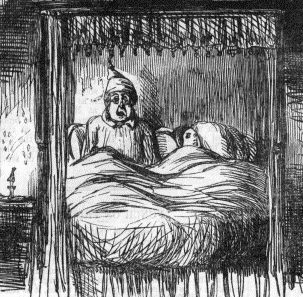

I've already mentioned 'the marriage question' in my post on sexual orientation. The marriage question focused on divorce. Ironically, the divorce rate in England and Wales in the 1890s was the lowest in Europe. However, its estimated legal separation rate was the highest.

Bram Stoker's employer, Henry Irving got married in July 1869. One night in November 1871, when she was pregnant with their second child, his wife criticized his work: "Are you going on making a fool of yourself like this all your life?" They were riding in a carriage, and Irving stepped out of it at Hyde Park Corner. Their paths would never cross again. They never divorced, and when Irving was knighted for his work, his wife styled herself "Lady Irving."

Irving's case was not exceptional. Contrary to popular belief, marriage was very unstable in Victorian times. Private separation deeds were common place and not confined to the upper-classes, as poor and working class people also sought to avoid the embarrassing scandal of divorce.

Martha Tabram, possibly the first victim of Jack the Ripper, had parents who separated, then had a troubled marriage herself, due to her alcoholism. Her husband left her in 1875, and paid her 12 shillings a week for three years. He reduced this amount to two shillings and sixpence when she moved in with another man.

Further contradicting popular beliefs about Victorian marriages, many couples of all classes lived together without ever getting married. Oscar Wilde's brother lived with his second wife for about a year before they were married. In the Murder of Mrs and Baby Hogg, we learned that the killer lived with a man before moving in with Mr Hogg, and had assumed that first man's name without marrying him.

With real life providing so many examples that contradicted the mainstream ideal of what marriage should be, writers and readers in the 1890s questioned the institution of marriage on legal grounds, and based on human desire. With the support of women writers mentioned elsewhere in this blog, legal reforms began to support women's property rights in marriage, and after it. As the Darwinian Revolution began to scientize the way people thought about themselves and their basic instincts, people questioned the monogamy that traditional marriage demanded. If men supposedly had such strong libidos, maybe they weren't meant to be with just one woman their entire lives.

The marriage question, also sometimes referred to as 'the sexual problem,' brought with it the concept of 'varietism.' According to Anne Humphreys, 'varietism' meant anything from promiscuity to serial monogamy, and the language used to discuss it was cloaked in evolutionary theory. This need to describe sexuality in terms of evolutionary theory ties back into people's needs to justify desires that were not condoned by their religious beliefs.

Although they thought and wrote about it an awful lot, the marriage question was never really answered in the 1890s. Though they thought about 'varietism' and engaged in alternatives to conventional married life, none of it was ever fully embraced by the more dominant aspects of their heterosexist culture. In 1912, Dr Muller-Lyer wrote:
The body of available and necessary knowledge to be taught the young became larger, the task of imparting it more difficult, and it was essential that family life should become consolidated, for much of this instruction could only be imparted by and in the family. And therefore monogamy became more frequent and met with definite approval, and unrestrained varietism in sex relations began to appear harmful, exceptional, and disreputable.
Consequently, the marriage question was thought about and written about throughout the twentieth century, and the way that we discuss it reflects the challenges of our times. Like most nineteenth and early-twentieth century German texts on evolutionary theory, eugenics, and race, Muller-Lyer's book is loaded with racism and classism, but he does suggest that we stop morally judging our ancestors for their sexuality, which is an attitude that should be applied to the way that we think of our contemporaries as well.

Follow me on Twitter @TinyApplePress and like the Facebook page for updates!

If you have enjoyed the work that I do, please consider supporting my Victorian Dictionary Project!

Friday, November 7, 2014

Who was Dracula?


Who was Dracula? Ever since the novel was published in 1897, scholars and fans have been trying to answer this question. In honour of Bram Stoker's birthday, I'm sharing a few of the ideas I've heard over the years.

1. Vlad the Impaler.

Vlad the Impaler was the Prince of Wallachia a member of the House of Drăculești, and descended from a member of the Order of the Dragon. The Order of the Dragon was founded to protect Christianity in Eastern Europe. After his death, Vlad became a folk hero in Romania and parts of Eastern Europe for protecting the Romanian population. The nickname "Impaler" is part of the folk legend, that he impaled his enemies on the battle field. During his lifetime, he gained an excessive reputation for cruelty.

Vlad III Prince of Wallachia

In Dracula: Sense and Nonsense (2005), Elizabeth Miller argues that Vlad the Impaler was not the inspiration for the famous vampire. Because we didn't have access to Stoker's notes until fairly recently, many myths about the novel were created through speculation, and this was one of them.

Bram Stoker's Dracula (1992)
It's still very appealing to the imagination, and permeates films about vampires, including Bram Stoker's Dracula (1992).
Sir Henry Irving

2. Sir Henry Irving.

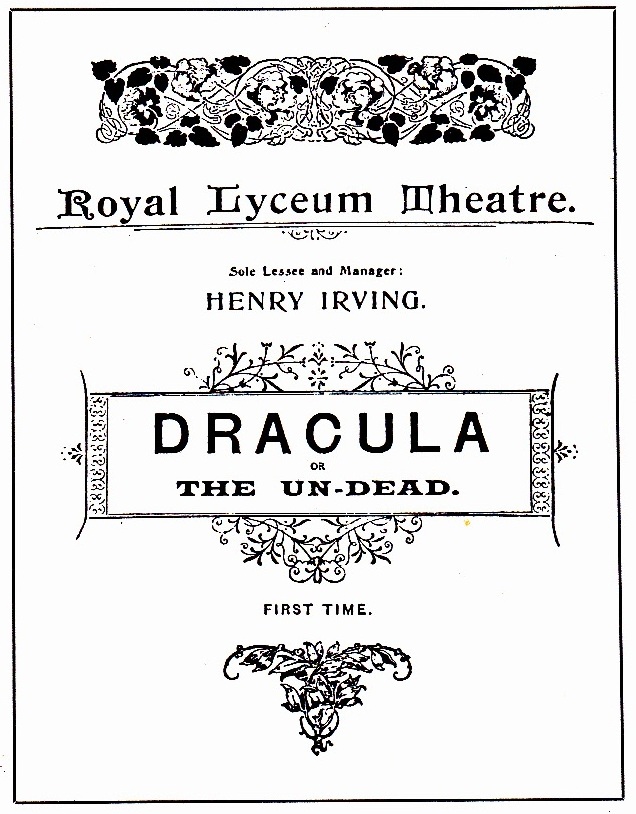
Irving was one of the most famous actors in the world in Stoker's day, and he was Stoker's boss, the owner of the Lyceum Theatre, where Stoker worked between 1878 and 1898. Stoker adored Irving, modeled many of his own opinions after Irvings, claiming in Irving's biography to have been able to speak with the same mind as Irving.

Strong arguments have been advanced that Irving was Stoker's real-life inspiration for Dracula's character, the way that he moved, and commanded all of those around him. Stoker even wanted Irving to play Dracula on the stage. Irving refused.

Irving and Stoker getting into a cab.
3. Oscar Wilde.
Oscar Wilde

If you read my blog, you know who Oscar Wilde was. He and Stoker were long time friends, going back to Dublin, where Stoker stole Wilde's childhood sweetheart, Florence Balcombe.

Theories that advance Wilde as an inspiration for the vampire, usually draw on Wilde's lifestyle, especially his homosexuality, turning vampirism into a metaphor for homosexuality. Stoker was extremely sympathetic toward his friend during his infamous trials of 1895, and may have been homosexual himself, as has been evidenced in his letters to Walt Whitman.

Who do you think inspired the world's most famous vampire?

Follow me on Twitter @TinyApplePress and like the Facebook page for updates!

If you have enjoyed the work that I do, please consider supporting my Victorian Dictionary Project!

Tuesday, February 4, 2014

50 Random Things about Bram Stoker

Bram Stoker
1. Bram Stoker was a good dancer and especially liked to waltz.

2. Stoker was named after his father, a clerk at Dublin castle, who walked miles every day to work for fifty years.
George Stoker

3. Stoker loved libraries. Who doesn’t?

4. Two of Stoker’s brother’s became doctors.

5. His brother, Dr. George Stoker, came to live with him, after travelling through Eastern Europe. Stoker was writing and researching Dracula at the time. George’s stories about his travels and the people he met might have informed the novel.

6. Stoker stole Oscar Wilde’s first girlfriend.

7.Stoker liked to use the word “weird.”

8. At age twenty-two, Stoker fell in love with the poetry of Walt Whitman and wrote Whitman a fan letter that sparked a great literary friendship.

9. Whitman thought of Stoker as a son: “he has always treated me like a best son.”

10. Whitman’s then-controversial and homoerotic Leaves of Grass was Stoker’s first encounter with the poet. He said: “Needless to say that amongst young men the objectionable passages were searched for and more noxious ones expected.”


11. The young Stoker described himself as follows:
“I am six feet two inches high and twelve stone weight naked and used to be forty-one or forty-two inches round the chest. I am ugly but strong and determined and have a large bump over my eyebrows. I have a heavy jaw and a big mouth and thick lips—sensitive nostrils—a snubnose and straight hair. I am equal in temper and cool in disposition and have a large amount of self control and am naturally secretive to the world. I take a delight in letting people I don’t like— people of mean or cruel or sneaking or cowardly disposition—see the worst side of me.”
12. Stoker was often nervous having conversations in groups, but could speak easily one on one.

13. Stoker attributed his love of writing to a long illness he had in early childhood, which prevented him from even being able to walk. He said his earliest memories were of being carried from place to place and “I was naturally thoughtful and the leisure of long illness gave opportunity for many thoughts which were fruitful according to their kind in later years.”
Charlotte Matilda Blake Thornley Stoker

14. Stoker’s mother was a politically active feminist, who told her sickly son gruesome tales.

15. Although Stoker’s writing often comes across as misogynistic, he writes more complex believable female characters than male characters.

16. His female characters usually have names that begin with the letter M, Maggie, Mina, Mimi, Marjory, Margaret...

17. Stoker usually didn’t write more than a page at a time.

18. In spite of this, Stoker wrote most of his stories very quickly, with the exception of Dracula, which was at least seven years in the making.

19. Although there are many theories on who inspired Dracula, Henry Irving is one of my favourite because Stoker asked him to play Dracula in the theatrical version of his novel. Irving, however, refused.

20. Irving liked to make fun of him for his Irish national pride and support for Home Rule.

21. Stoker always took it personally when Irving made fun of him.

22. When Stoker first met Irving, he helped save him from bankruptcy and said: “no artist can properly attend to his own business.”

23. This led to many years of employment and an elevated position in London Society as Irving’s business manager, but Stoker didn’t always feel so secure in this role and faced the competition and ridicule of a young journalist, later employed by Irving as personal secretary, Louis Frederick Austin.

Henry Irving
24. Austin and Stoker didn’t get along and Austin claimed that Stoker was lying when he said he did most of Irving’s speech writing and press statements for him.

25. Stoker spent most of his career working on the business end of theatre and believed strongly in government subsidies for the arts.
“The strain of ceaseless debt must always be the portion of any one who endeavours to uphold serious drama in a country where subsidy is not a custom. In the future, the State or the Municipality may find it a duty to support such effort, on the ground of public good. Otherwise the artist must pay with shortened life the price of his high endeavour.”
26. Although Stoker wound up devoting most of his time to the theatre, he wanted to move to London to be a writer before he ever met Irving.

27. While living in London, Stoker also managed to earn a law degree.

28. Stoker was a night owl. He enjoyed staying up all night and seeing the dawn break.

29. Stoker always took a bath before going to bed.

30. Stoker liked thinking of himself as large.

31. Stoker preferred home-cooking to eating at restaurants.

Irving and Stoker getting into a cab.
32. Stoker felt it showed poor manners to have a second drink when someone else was buying.

33. Stoker thought brandy was good for your health.

34. Stoker’s son claims his dad got the idea for Dracula from a nightmare he had after eating too much dressed crab.

35. Stoker was interested in mesmerism and the occult sciences. He had strong links to the Hermetic Order of the Golden Dawn.

36. Stoker was fascinated by dreams. He studied dream theory, while writing Dracula.

37. Stoker described watching someone high on opium as moving and speaking, “like a man in a dream.”

38. Stoker’s French wasn’t very good.

39. As much as Stoker liked German folklore, he didn’t speak German.

40. Van Helsing was an amalgamation of at least three different characters Stoker wanted to include in the book, including a German professor.

41.Although Stoker supported Home Rule, as an Irish Nationalist, he was also a monarchist, in support of England as a force for good in the world.

42. Stoker was against any form of violent Irish nationalism.

43. Contrary to popular belief, there is no evidence that Stoker died of syphilis - only that he suffered from a number of Strokes before he died. It’s possible that he was also suffering from depression toward the end of his life.

44. Stoker didn’t like giving up his career with Irving at the Lyceum. He was upset that Irving sold the theatre without consulting him. This might have caused the onset of depression.


45. Even though Stoker’s wife always wanted to and even tried starting a career as an actress, Stoker considered Ellen Terry the best actress of their time. Terry was the female star of the Lyceum. Stoker said:
“Ellen Terry is a great actress, the greatest of her time; and she will have her niche in history. She is loved by every one who ever knew her. Her presence is a charm, her friendship a delight ; her memory will be a national as well as a personal possession.”
46. Stoker’s wife was considered one of the three most beautiful women in England, but their marriage was platonic after the birth of their only child.

Florence Stoker (presumably photoshopped, but still cool)
47. Although the documentary Dracula’s Bram Stoker makes a strong argument that Stoker was gay, there’s no evidence that he ever cheated on his wife with a man or a woman.

48. When Stoker died in 1912, Sotheby’s auctioned off his library. Whitman’s lecture on Lincoln, which he bequeathed to Stoker, sold for $25.

49. His wife tried to put a stop to the film: Nosferatu (1922) because, as Stoker’s widow, she owned the rights to Dracula, hadn’t been consulted and hadn’t been paid any royalties. This resulted in a lengthy court case, which she eventually won, while trying to destroy any and all copies of the film. As much as I like her as a historical figure, I’m glad she didn’t succeed.

50. On his 165th birthday, Stoker was honoured with a Google Doodle.

Follow me on Twitter @TinyApplePress and like the Facebook page for updates!

Wednesday, November 6, 2013

Why Writers Moved to London


Bram Stoker’s Personal Reminiscences of Henry Irving (1906) is the closest thing we have to an autobiography of Stoker’s life. Moments, inside the text, reveal much about Stoker and, sometimes, appear to have nothing to do with Irving at all.

The tidbit, which I share with you today, is set in 1877, a year before Stoker married Florence Balcombe and almost two years before they moved to London, where Stoker would devote his life to the service of the actor and theatre owner, Irving.

In this tidbit, we find Stoker engaged in a conversation with Sir James Knowles, the architect and editor. Knowles is remembered as the architect, who designed amongst other buildings, three churches in Clapham, Lord Tennyson's house at Aldworth, the Thatched House Club, the Leicester Square garden (as restored at the expense of Baron Albert Grant), and Albert Mansions, Victoria Street, Westminster. Clearly, in this passage, however, Stoker is a humble writer, talking to an editor. Luckily, for me, they talk about why writers should move to London.
I may here give an instance of his thoughtful kindness. Since our first meeting the year before, he had known of my wish to get to London, where as a writer I should have a larger scope and better chance of success than at home. One morning, July 12, I got a letter from him asking me to call at 17 Albert Mansions, Victoria Street, at half-past one and see Mr. Knowles. I did so, and on arriving found it was the office of the Nineteenth Century. There I saw the editor and owner, Sir (then Mr.) James Knowles, who received me most kindly and asked me all sorts of questions as to work and prospects. Presently while he was speaking he interrupted himself to say :
"What are you smiling at?”
I answered: "Are you not dissuading me from venturing to come to London as a writer?"
After a moment's hesitation he said with a smile: "Yes ! I believe I am."
"I was smiling to think," I said, "that if I had not known the accuracy and wisdom of all you have said I should have been here long ago!''
That seemed to interest him; he was far too clever a man to waste time on a fool.
Presently he said: “Now, why do you think it better to be in London? Could you not write to me, for instance, from Dublin?"
"Oh! yes, I could write well enough, but I have known that game for some time. I know the joy of the waste-paper basket and the manuscript returned unread. Now Mr. Knowles," I went on, "may I ask you something?"
"Certainly!"
"You are, if I mistake not, a Scotchman?" He nodded acquiescence, keeping his eye on me and smiling as I went on: "And yet you came to London. You have not done badly either, I understand? Why did you come?"
"Oh!" he answered quickly, "far be it from me to make little of life in London or the advantages of it. Now look here, I know exactly what you feel. Will you send me anything which you may have written, or which you may write for the purpose, which you think suitable for the Nineteenth Century ? I promise you that I shall read it myself; and if I can I will find a place for it in the magazine ! ''
I thanked him warmly for his quick understanding and sympathy, and for his kindly promise. I said at the conclusion: "And I give you my word that I shall never send you anything which I do not think worthy of the Nineteenth Century!"
From that hour Sir James and I became close friends. I and mine have received from him and his innumerable kindnesses; and there is for him a very warm corner in my heart.
Strange to say. the next time we spoke of my writing in the Nineteenth Century was when in 1881 he asked me to write an article for him on a matter then of much importance in the world of the theatre. I asked him if it was to be over my signature.
When he said that was the intention, I said: "I am sorry I cannot do it. Irving and I have been for now some years so closely associated that anything I should write on a theatrical subject might be taken for a reflex of his opinion or desire. Since we have been associated in business I have never signed any article regarding the stage unless we shared the same view. And whilst we are so associated I want to keep to that rule. Otherwise it would not be fair to him, for he might get odium in some form for an opinion which he did not hold ! As a matter of fact we join issue on this particular subject!"
The first time I had the pleasure of writing for him was when in 1890 I wrote an article on "Actor-Managers" which appeared in the June number. Regarding this, Irving's opinion and my own were at one, and I could attack the matter with a good heart. I certainly took pains enough, for I spent many, many hours in the Library of my Inn, the Inner Temple, reading all the "Sumptuary" laws in the entire collection of British Statutes. Irving himself followed my own article with a short one on the subject of the controversy on which we were then engaged.
As Stoker goes on to talk about his relationship with Knowles in the years to come, we see more of Stoker’s deep dedication to his work with Irving, how it became part of his identity - that he wouldn’t even put his name on something that Irving might disagree with.


The Nineteenth Century, you may have guessed, was a literary magazine, founded by Knowles in London in 1877. Adorably, the title of the magazine was changed to the Nineteenth Century and After in 1901.

Follow me on Twitter @TinyApplePress and like the Facebook page for updates!

Monday, September 9, 2013

Wired Love and Thereby Hangs a Tale

By the 1890s, Sir Arthur Conan Doyle achieved considerable success, as the author of Sherlock Holmes, but was anxious to start writing something different. In 1892, he wrote a play, which was immediately snatched up by London's most famous actor, Henry Irving, and presented to his theatre manager, Bram Stoker.


In his Personal Reminiscences of Henry Irving, Stoker recorded the event, as follows:

WATERLOO 
"KING ARTHUR" 
"DON QUIXOTE" 
ONE day early in March 1892, whilst we were rehearsing Tennyson's play, The Foresters, which in accordance with the author's request was produced for copyright purposes at the Lyceum, Irving came into the office in a hurry. He was a little late. He, Loveday and myself always used the same office, as we found it in all ways convenient for our perpetual consultations. As he came hurrying out to the stage, after putting on the brown soft broad-brimmed felt hat for which he usually exchanged his "topper" during rehearsals, he stopped beside my table where I was writing, and laying a parcel on it said: 
"I wish you would throw an eye over that during rehearsal. It came this morning. You can tell me what you think of it when I come off!" 
I took up the packet and unrolled a number of type-written sheets a little longer than foolscap. I read it with profound interest and was touched to my very heart's core by its humour and pathos. It was very short, and before Irving came in again from the stage I had read it a second time. When he came in he said presently in an unconcerned way: 
"By the way, did you read that play?"
"Yes!" 
"What do you think of it?" 
"I think this," I said, "that that play is never going to leave the Lyceum. You must own it at any price. It is made for you." 
"So I think, too!" he said heartily. 
"You had better write to the author to-day and ask him what cheque we are to send. We had better buy the whole rights!' 
"Who is the author?" 
"Conan Doyle!" 
The author answered at once and the cheque was sent in due course. The play was then named A Straggler of '15. This Irving changed to A Story of Waterloo, when the play was down for production. Later this was simplified to Waterloo. 
Irving fell in love with the character, and began to study it right away. The only change in the play he made was to get Sir Arthur then "Dr." or "Mr." Conan Doyle to consolidate the matter of the first few pages into a shorter space. The rest of the MS. remained exactly as written. 
It was not, however, for nearly two years that he got an opportunity of playing it. It is a difficult matter to find a place for an hour-long play in a working bill. Henry VII., King Lear, and Becket held the Lyceum stage till the middle of 1893. Then came a tour in America lasting up to end of March 1 894. The short London season was taken up with a prearranged reproduction of Faust. 
Then followed a provincial tour from September to Christmas. Here was found the opportunity. The Bells is a short play, and for mere length allows of an addition. 
In the first week of the tour at the Princes Theatre, Bristol, on September 21, 1894, A Story of Waterloo was given. The matter was one of considerable importance in the dramatic world ; not only was Irving to play a new piece, but that piece was Conan Doyle's first attempt at the drama. The chief newspapers of London and some of the greater provincial cities wished to be represented on the occasion ; the American press also wished to send its critical contingent. Accordingly we arranged for a special train to bring the critical force. Hearing that so many of his London journalistic friends were coming an old friend of Irving' s then resident in Bristol, Mr. John Saunders, arranged to give a supper in the Liberal Club, to which they were all invited, together with many persons of local importance. 
The play met with a success extraordinary even for Irving. The audience followed with rapt attention and manifest emotion, swaying with the varying sentiments of the scene. The brief aid to memory in my diary of that day runs: 
"New play enormous success. H. I. fine and great. All laughed and wept. Marvellous study of senility. Eight calls at end." Unfortunately the author was not present to share the triumph, for it would have been a delightful memory for him. He was on a tour in America; "and thereby hangs a tale."
 Amongst the audience who had come specially from London was  Mr. H. H. Kohlsaat, owner and editor of the Chicago Times Herald,  a close and valued friend of Irving and myself. He was booked  to leave for America the next day. When the play was over  and the curtain finally down, he hurried away just in time to  catch the train for Southampton, whence the American Line boat  started in the morning. He got on board all right. The follow-  ing Saturday he arrived in New York, just in time to catch the "flyer," as they call the fast train to Chicago on the New York  Central line. On Sunday night a public dinner was given to Conan  Doyle to which of course Kohlsaat had been bidden. He arrived  too late for the dining part ; but having dressed in the train he  came on to the hotel just as dinner was finished and before  the speeches began. He took a chair next to Doyle and said  to him:
"I am delighted to tell you that your play at Bristol was an  enormous success!"   
"So I am told," said Doyle modestly. "The cables are excellent."   
"They are not half enough!" answered Kohlsaat, who had been  reading in the train the papers for the last week.   
"Indeed! I am rejoiced to hear it! " said Conan Doyle  somewhat dubiously. 
"May I ask if you have had any special  report?"   
"I didn't need any report, I saw it! "   
"Oh, come!" said Conan Doyle, who thought that he was in  some way chaffing him." 
That is impossible!"   
"Not to me! But I am in all human probability the only man on the American continent who was there?" 
Then whilst the  gratified author listened he gave him a full description of the play  and the scene which followed it. To my own mind Waterloo as an acting play is perfect ; and  Irving's playing in it was the high-water mark of histrionic art.  Nothing was wanting in the whole gamut of human feeling. It was a cameo, with all the delicacy of touch of a master-hand  working in the fine material of the layered shell. It seemed to  touch all hearts always. When the dying veteran sprang from his  chair to salute the colonel of his old regiment the whole house  simultaneously burst into a wild roar of applause. This was  often the effect at subsequent performances both at home and in America.
There's so much in this tale that I love, but mostly it's the global nature of the story. Even years later, as Stoker sits writing it, he can hardly believe the speed with which his friend got from the Lyceum Theatre in London to Doyle in Chicago - faster than the cables even! No wonder Victorians were interested in evolution and felt they were sitting on the edge of the future. No wonder we relate to them so well today.

Wired Love: A Romance of Dots and Dashes tells a very contemporary story, which, after being forgetten for many years, is resurfacing as something very much like internet dating, and is near the top of my reading list. Stoker's Dracula was also considered a bit of technofiction, in which the protagonists used half a dozen new modes of recording their thoughts to tell the story of a vampire in London. I wonder what Stoker and Doyle would have thought of FaceTime and Skype.

I'm not, however, convinced that Stoker ever used most of the technology he was fascinated with. For many Victorians, new technology was frightening. Sigmund Freud and Queen Victoria were afraid of trains. The first time they showed a movie of a train in London, people fled the theatre afraid that the train was headed right for them!

Back to Stoker's story above, I love almost any story that can incorporate the word foolscap. It's a word I'm afraid will drop out of usage, during my lifetime. And I love that Stoker explains why he shared an office at the Lyceum, though my heart breaks for him a little bit.

He was the theatre manager and he was sitting there writing (maybe working on Dracula, when Irving barged in. Mrs. Stoker didn't like it when he wrote at home because he liked to act out his characters, so maybe the theatre was the right place for him to be writing, but he probably justified his sharing an office to his father too.

Abraham Stoker, Bram Stoker's father, was a petty Dublin cleric, who felt he had let his employers walk all over him throughout his career and wanted his sons to have more than him. Stoker doted on Irving and still had to share an office - poor guy.

Follow me on Twitter @TinyApplePress and like the Facebook page for updates!

Sunday, September 1, 2013

The Sublime Society of Beefsteaks


The Lyceum Theatre, in the 1890s, was best known for its stars: Ellen Terry and Henry Irving. Irving cultivated a reputation for himself as a serious professional. He purchased the theatre in 1878 and was the first actor ever knighted for his professional achievements in the performing arts. Irving's earnest reputation, however, was largely due to the earnest devotion of his manager, Bram Stoker, who, through Irving's success, also managed to maintain a place at the top of London Society. Although, Irving was wholeheartedly devoted to raising the status of the performing arts among his contemporaries, Stoker really did all of the earnest business work, leaving Terry free to slide down the bannister from her dressing room, when making an entrance, and Irving free to contemplate other things, like beefsteak!


The Lyceum was the centre of Irving's highly successful career, but was also a place where he gathered people to eat a lot of beef (and drink a lot of wine). The present-day Beefsteak Club is (intentionally?) located on Irving Street in London. In the 1890s, Irving had his Beefsteak Room behind the stage of the Lyceum theatre. He decorated it in the most elaborate gothic fashion and used it to hold star-studded events. Stoker organized most of these events, but Irving and Terry presided over them, "as if they were hosting a royal court."


With help from his friends, 18th-century actor, Richard Estcourt, established the first Beefsteak Club in 1705, but this club lasted less than ten years. Twenty years later, another actor, John Rich, established the Sublime Society of Beefsteaks. The Society was a big success within the performing arts community and was joined by Samuel Johnson in 1780. The Prince of Wales even joined in 1785. Members wore a blue coat and buff waistcoat with brass buttons, with a gridiron motif that read "Beef and liberty." And yes, together they sat around eating steak and potatoes. The Sublime Society of Beefsteaks met regularly until 1867.

Sublime Society of Beefsteaks, courtesy of "Supersizers Go: Regency"

The Sublime Society of Beefsteaks was revived as the Beefsteak Club in 1876. Initially, organizers wanted to rent the room at the Lyceum, but didn't get the chance, until Irving bought the Lyceum two years later. Beefsteakers were and are an odd bunch. Two features of the club were, and are, that all members and guests sit together at a single long table, and that by tradition the club steward and the waiters are all addressed as "Charles."

Curiously, the beefsteak was (and maybe still is) seen as a symbol of patriotic Whig concepts of liberty and prosperity. The beefsteak fit with Irving's vision for the Lyceum, where he hoped to establish a place of cultural importance that would firmly legitimize theatre as an art form. I suspect he was more fond of the famous historic figures, who once belonged to the Sublime Society of Beefsteaks, than he was of Whig concepts of anything, especially because he and Stoker established a strong relationship between the theatre and Tory Prime Minister William Ewart Gladstone.


Though I'm not sure if Gladstone ever dined there, Irving liked to host intellectual celebrities, like Franz Lizst, as well as travelling celebrities and other actors, which is where and how the Actor's Benevolent Fund was formed.

In most accounts, Irving's Beefsteak Room is described in the most respectable of Victorian terms, but Irving had the occasional wild rumpus in this well-appointed room behind the stage in his theatre. Oscar Wilde's brother partook of some shenanigans there. And, sometimes, the police even had to break up a few ruckuses at the door. If not through having a good time with Beefeaters, I think Irving achieved his goals (with Stoker's help) through the Lyceum theatre.

As I already mentioned, Irving was knighted in 1895, the first ever accorded an actor. He was also the recipient of honorary degrees from the universities of Dublin (LL.D 1892), Cambridge (Litt.D 1898), and Glasgow (LL.D 1899). He also received the Komthur Cross, 2nd class, of the Saxe-Ernestine House Order of Saxe-Coburg-Gotha and Saxe-Meiningen.

Follow me on Twitter @TinyApplePress and like the Facebook page for updates!

Tuesday, June 18, 2013

Faust in America


For most of his life, Bram Stoker worked for the famous actor, Henry Irving. On many occasions, this work brought Stoker to America. As I'm about to set off on my own summer adventures, I found this passage about a trip in 1888 from Stoker's Personal Reminiscences of Henry Irving especially appealing.

When we played Faust in America, it was curious to note the different reception accorded to it undoubtedly arising from traditional belief.
In Boston, where the old puritanical belief of a real devil still holds, we took in one evening four thousand eight hundred and fifty-two dollars more than a thousand pounds the largest dramatic house up to then known in America. Strangely the night was that of Irving's fiftieth birthday. For the rest the lowest receipts out of thirteen performances was two thousand and ten dollars. Seven were over three thousand, and three over four thousand.
In Philadelphia, where are the descendants of the pious Quakers who followed Penu into the wilderness, the average receipts were even greater. Indeed at the matinee on Saturday, the crowd was so vast that the doors were carried by storm. All the seats had been sold, but in America it was usual to sell admissions to stand at one dollar each. The crowd of "standees," almost entirely women, began to assemble whilst the treasurer, who in an American theatre sells the tickets, was at his dinner. His assistant, being without definite instructions, went on selling till the whole seven hundred left with him were exhausted. It was vain to try to stem the rush of these enthusiastic ladies. They carried the outer door and the checktaker with it ; and broke down by sheer weight of numbers the great inner doors of heavy mahogany and glass standing some eight feet high. It was impossible for the seat-holders to get in till a whole posse of police appeared on the scene and cleared them all out, only readmitting them when the seats had been filled. 
But in Chicago, which as a city neither fears the devil nor troubles its head about him or all his works, the receipts were not much more than half the other places Not nearly so good as for the other plays of the repertoire presented. 
In New York the business with the play was steady and enormous. New York was founded by the Bible-loving righteous-living Dutch. 
This passage appeals to me because of the sense that Stoker is making grand and sweeping judgements as a foreign observer. It's something that can be humourous, but is also important not to do when you are travelling. 

I also find this passage interesting because of the old stereotypes about Americans as superstitious religious fanatics. Stoker extols these stereotypes here. Stoker sees Americans' religious biases as more pervasive than their ability to appreciate art, literature, and theatre. 

It's funny that Stoker is unable to see New York, Boston, and Philadelphia as cultural centres themselves. Even by the late 1880s, New York was blossoming as a cultural centre.


Follow me on Twitter @TinyApplePress and like the Facebook page for updates!

Wednesday, May 22, 2013

Van Helsing meets Hamlet


In spite of the fact that Bram Stoker's lasting fame is inextricably linked to Dracula, Stoker was most proud of and most dedicated to his work in the Lyceum Theatre for Sir Henry Irving. While Stoker's notes on Dracula, the original manuscript, and even his own personal diaries have been difficult or impossible to track down, Stoker published his memoirs or Personal Reminiscences on the subject of Henry Irving.

Stoker lived for his work with Irving and he had lots of reasons to. His pretty young wife longed to be an actress, but the career was too controversial for her and she may have lacked the talent. Stoker's father was a giant pushover and loathed the idea that his sons might follow in his footsteps, which usually ensures that they will; hence, sucking up to Irving might have just been in Stoker's nature. Also, the Lyceum in the 1890s was the hottest place for London Society to meet and mingle; Irving was the rockstar actor of his day and was the first English actor to be knighted for achievements in his field.


That being said, the Lyceum presented more Shakespeare than anything else. Irving played the Bard's starring roles, most notably, Hamlet. And all of this got me thinking that some of this Shakespeare must have seeped into Stoker's famous novel. Of course and luckily, I wasn't the first to think of this.

Kelly K.'s EN 122 Blog provides a light and entertaining analysis of the Bard's influence on Dracula.
Without Shakespeare, Van Helsing, a doctor and central character in Dracula, would not be named Van Helsing or hold the characteristics he does. This character’s name originates from the Danish name for Hamlet’s castle, Elsinore—Helsingor, or island of Helsing. Bram Stoker, the author of Dracula, selected to use “Helsing” to represent Van Helsing’s character due to the doctor’s strong and impenetrable personality that is much like the walls of the castle, Elsinore. Also, Van Helsing himself is like Elsinore where he keeps his emotions in, much like Claudius, King of Denmark and father/uncle to Hamlet, keeps him inside Elsinore’s walls. For instance, in chapter ten of Dracula, while he draws blood from Dr. Seward and observes it pour into Lucy Westenra, Van Helsing remains composed and undemonstrative. Without Hamlet, a creation of Shakespeare, Van Helsing would not bear his name or have the characteristics he embraces.
Since reading this, I haven't been able to shake the image of Van Helsing as a sulky prince.

Kelly Kendrick insists:
Shakespeare is the reason Dracula’s plot and characters exist. Without Shakespeare’sHamlet and Macbeth, Van Helsing would not bear his name nor carry the characteristics he does, Harker would never suspect Dracula to be anything other than human, he would never have been prisoner, he would have never contemplated death, and Harker wouldn’t have tried to save his poor Mina. Shakespeare should be mandatory to study simultaneously or prior to Dracula because they are so similar and based off of one another. Without Shakespeare, Dracula would not exist.
I don't know if I would go that far, but it's hard to say that Stoker wasn't influenced by Shakespeare. Everything in our lives can be said to influence us in some way and Shakespearean theatre is one of the things that Stoker was immersed in, while he was writing Dracula. He says so himself in Personal Reminiscences:
Henry VIII. was produced on the night of Tuesday, January 5, 1892, and ran at the Lyceum for two hundred and three perform- ances, ending on November 5. Its receipts were over sixfy-six thousand pounds.
And...
There is another view of Hamlet, too, which Mr. Irving seems to realise by a kind of instinct, but which requires to be more fully and intentionally worked out. . . . The great, deep, underlying idea of Hamlet is that of a mystic. ... In the high-strung nerves of the man; in the natural impulse of spiritual susceptibility ; in his concentrated action, spas- modic though it sometimes be, and in the divine delirium of his perfected passion there is the instinct of the mystic, which he has but to render a little plainer in order that the less susceptible senses of his audience may see and understand.

Sunday, April 28, 2013

The German Professor in Dracula

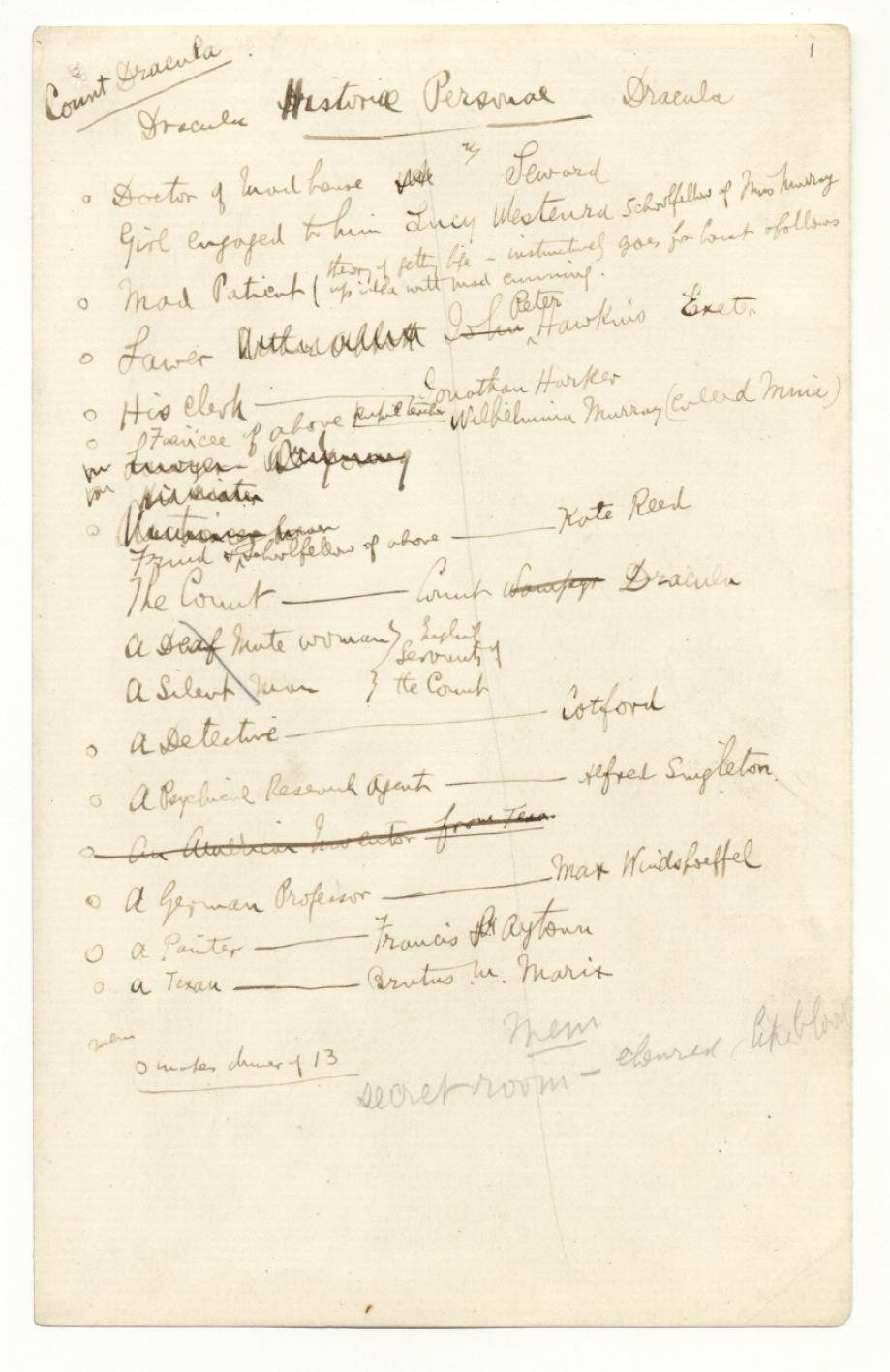
Remember the German professor, Max Windschoeffel, in Dracula? No? That's because there wasn't one. Bram Stoker wrote him out or, rather, let his character be absorbed into the Dutch vampire hunter, Van Helsing, along with other characters, including a detective.


Stoker's "Historiae Personae," pictured above, resides at the Rosenbach Museum & Library in Philedelphia. It likely arrived in the United States through one of Stoker's many visits or when his wife, Florence, moved to the US, after his death.

The "Historiae Personae" shows the way that characters' roles changed and evolved during the writing and research process. Upon close examination, you can see how characters were changed and renamed throughout.

I also love how it problematizes the question of who the real-life inspiration for Dracula was. Scholarship on the question has speculated it could have been Oscar Wilde or Henry Irving.

If Van Helsing was originally supposed to be a German professor, a detective, a physical research agent, and even possibly a painter, it's likely that the vampire's character had many sources of inspiration as well. Henry Irving, Oscar Wilde, Jack the Ripper, and even Stoker himself are tossed around as inspiring Dracula all the time, but it's likely more true that parts of Dracula came from all of them and others as well.

Follow me on Twitter @TinyApplePress and like the Facebook page for updates!

Thursday, April 11, 2013

Dracula's Fingerprint

Sir Henry Irving, Bram Stoker's employer, the occupation of most of his life, is popularly believed to be the inspiration for the character of Dracula.

One of many outrageous ideas, forwarded by the Victorians, was that a person's character could be summed up by the tip of their finger. In this 11 June 1898 article, Irving's fingerprint is used as an example of such analysis.

The article surmises many flattering things about Irving, who was a major celebrity at the time. Those, trying to advance the case for Irving as Dracula often echo the line about his "unlimited power of command," whatever that means.

Of Irving, the article claims to have read by his fingertip:
The finger print of Sir Henry Irving is strongly characteristic of the man. Extreme generosity is a marked feature; impulsiveness, determination, eloquence and desire for information, all these are marked items in the character of the print.
Sir Henry would approve of no wrong-doing, while his gentle nature proves his fairness in all things. He possesses unlimited power of command, and though he is always open to conviction, the operation of his mind works against the principle of accepting too much correction. His is the print of a successful man; fortune crowns the ridges, and upon close inspection it will appear patent to you that he is generally an even man in all his doings.
The article also provides analysis of the Lord Chief Justice of England, Sir Spencer Walpole, John Dunn, the city's mayor, and Edward Terry. It is pictured in full below.


Follow me on Twitter @TinyApplePress and like the Facebook page for updates!

Sunday, January 13, 2013

"Dr. Livingstone, I presume?"

The man believed to have uttered the phrase: "Dr. Livingstone, I presume?" Henry Morton Stanley (1841-1904) was considered, by many of his British contemporaries, to be the greatest explorer of Africa. On 26 June 1890, Bram Stoker was invited to a dinner by Edward Marston (his publisher) in honour of Stanley. For Bram, this was a night to remember. His recollections of the evening and of Stanley provide valuable insight into Bram and his perception of the world.
Bram's father believed his sons fortunes could lie in the exploration of Africa. Abraham Stoker Sr. was something of a pencil pusher and pushover. He didn't want his sons to grow up like him and the exploration of Africa was one of the many thing he dreamed of them doing. Bram never went to Africa, but his father's dreams probably put the continent somewhere on the list of places he would like to go.

The possibility of going to Africa crops up in Bram's reminiscence of the June 26th dinner, as does the way that he saw life and death in people that he met. Of that night, Bram wrote:

The dinner given to Stanley by Edward Marston, the publisher, on the eve of bringing out Stanley's great book, In Darkest Africa June 26, 1890 was a memorable affair. Marston had then published two books of mine, Under the Sunset, and the little book on America, and as "one of his authors " I was a guest at the dinner. Irving was asked, but he could not go as he was then out of town on a short holiday, previous to commencing an engagement of two weeks at the Grand Theatre, Islington, whilst the Lyceum was occupied by Mr. Augustin Daly's company from New York. 
At the dinner I sat at an inside corner close to Sir Harry (then Mr.) Johnston, the explorer and administrator, and to Paul B. du Chaillu, the African explorer who had discovered gorillas. I had met both these gentlemen before ; the first in London several times ; the latter in New York, in December 1884, in the house of Mr. and Mrs. Tailer, who that night were entertaining Irving and Ellen Terry. There we had sat together at supper and he had told me much of his African experience and of his adventures with gorillas. I had of course read his books, but it was interesting to hear the stories under the magic of the adventurer's own voice and in his characteristic semi- French intonation. 
In the course of conversation he had said to me something which I never have forgotten it spoke volumes : "When I was young nothing would keep me of out Africa. Now nothing would make me go there !" 
In reply to the toast of his health, Stanley spoke well and said some very interesting things : "In my book that is coming out I have said as little as possible about Emin Pasha. He was to me a study of character. I never met the same kind of character." Again : "I have not gone into details of the forest march and return to the sea. It was too dreary and too horrible. It will require years of time to be able to think of its picturesque side." 
At that time Stanley looked dreadfully worn, and much older than when I had seen him last. The six years had more than their tally of wear for him, and had multiplied themselves. He was darker of skin than ever ; and this was emphasised by the whitening of his hair. He was then under fifty years of age, but he looked nearer to eighty than fifty. His face had become more set and drawn had more of that look of slight distortion which comes with suffering and over-long anxiety. There were times when he looked more like a dead man than a living one. Truly the wilderness had revenged upon him the exposal of its mysteries.
Edward Marston, Harry Johnston, Paul B. du Chaillu, Ellen Terry... As you can see by this excerpt, Bram liked name-dropping. Bram uses Stanley's view to justify not going to Africa. The darkening of Stanley's skin could be a nod to a commonly held belief in environmental determinism. Moreover, this passage also recalls Bram's depictions of Dracula and how his age changed the more he fed.

In Stanley's defense, I've placed a photograph of him from 1890, the year of that dinner. His hair certainly is much whiter than pictured above, but he doesn't look that much older!