Showing posts with label vampires. Show all posts

Monday, November 10, 2014

Bram Stoker & Oscar Wilde Kiss & Tell

After many years of lipstick kisses, Oscar Wilde moved to a new tomb in 2011
How did Bram Stoker and Oscar Wilde feel about kissing in their writing? I've talked about dancing, and women, and other things. So what about kisses?

Let's start with the Picture of Dorian Gray (1891).
[Sybil Vane] was free in her prison of passion. Her prince, Prince Charming, was with her. She had called on memory to remake him. She had sent her soul to search for him, and it had brought him back. His kiss burned again upon her mouth. Her eyelids were warm with his breath.
From the TV series Penny Dreadful
I was once told that people kiss because it engages so many of the senses: touch, taste, smell... In that passage, this certainly seems true. Sybil is just remembering Dorian's kiss, and the memory of it activates all of these senses. It's quite different from how she kisses her mother.
Sybil rushed to her, flung her arms round her neck, and kissed her. 
When it comes to kissing family members, Sybil likes to take a running leap.
"You might keep some of your kisses for me, Sybil, I think," said the lad [her brother] with a good-natured grumble."
Ah! but you don't like being kissed, Jim," she cried. "You are a dreadful old bear." And she ran across the room and hugged him.
But it seems Sybil is wrong about how much her brother likes being kissed.
There was jealousy in the lad's heart, and a fierce murderous hatred of the stranger who, as it seemed to him, had come between them. Yet, when her arms were flung round his neck, and her fingers strayed through his hair, he softened and kissed her with real affection. 
He even kisses their mother before he leaves. I have to say that there's not this much kissing in my family. We kiss children, and spouses, that's about it. If we ever kiss each other, it's on the cheek. Absolutely none of this "real affection" and hair-touching that Oscar Wilde is talking about.

Dorian Gray (2009)
But back to Sybil and Dorian. There's a big difference in how the two of them remember kissing that reflects on how they each feel about their relationship. As I said before, Sybil's memory is very visceral, whereas Dorian's memory of it literally focuses on the art.
"After the performance was over, I went behind and spoke to her. As we were sitting together, suddenly there came into her eyes a look that I had never seen there before. My lips moved towards hers. We kissed each other. I can't describe to you what I felt at that moment. It seemed to me that all my life had been narrowed to one perfect point of rose-coloured joy. She trembled all over and shook like a white narcissus. Then she flung herself on her knees and kissed my hands. I feel that I should not tell you all this, but I can't help it. Of course, our engagement is a dead secret. She has not even told her own mother. I don't know what my guardians will say. Lord Radley is sure to be furious. I don't care. I shall be of age in less than a year, and then I can do what I like. I have been right, Basil, haven't I, to take my love out of poetry and to find my wife in Shakespeare's plays? Lips that Shakespeare taught to speak have whispered their secret in my ear. I have had the arms of Rosalind around me, and kissed Juliet on the mouth."
Spoiler: Dorian loves Sybil for her art, but doesn't like the person she really is. He leaves her. She's not very happy about that.
"I think I should never have known it if you had not kissed me—if we had not kissed each other. Kiss me again, my love. Don't go away from me. I couldn't bear it. Oh! don't go away from me."
That is part of a desperate plea on her part.

Sybil Vane commits suicide, and Dorian imagines kissing himself, while looking at his hideous portrait.
Once, in boyish mockery of Narcissus, he had kissed, or feigned to kiss, those painted lips that now smiled so cruelly at him.
But, when she's dead, he does try to get some memorial of her.
"You must do me a drawing of Sibyl, Basil. I should like to have something more of her than the memory of a few kisses and some broken pathetic words."
Moving on to Bram Stoker's Dracula (1897).

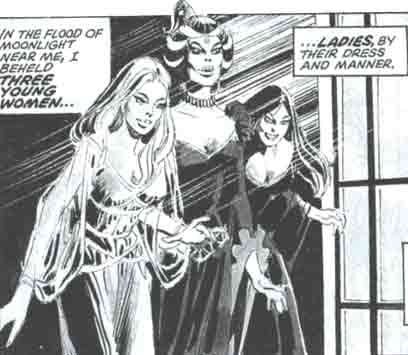
Immediately, the kisses become more sexual, as Jonathan Harker is in Dracula's castle with the three brides of Dracula.
I felt in my heart a wicked, burning desire that they would kiss me with those red lips. It is not good to note this down, lest some day it should meet Mina’s eyes and cause her pain; but it is the truth.
Bram Stoker's Dracula (1992)
“Go on! You are first, and we shall follow; yours is the right to begin.” The other added:
“He is young and strong; there are kisses for us all.”
"Yours is the right to begin" is an interesting choice of words, most likely borrowed from the grimoires to give this scene an occult feel.

Of course, the Count saves Jonathan from this 'terrifying' scene, but promises the ladies they can kiss him at will, when he has fulfilled his use.

Big surprise in Dracula is that vampires love to kiss.

But there's also some regular courting going on in this story. There's some kissing when Lucy tells Mr Morris that her heart belongs to another, then as he leaves, he says:
‘Little girl, I hold your hand, and you’ve kissed me, and if these things don’t make us friends nothing ever will. Thank you for your sweet honesty to me, and good-bye.’
 Of course, the man Lucy loves loves her back.
Besides, it was all so confused; it seemed only a moment from his coming into the room till both his arms were round me, and he was kissing me. I am very, very happy, and I don’t know what I have done to deserve it.
Mina and Lucy in NBC's TV series Dracula.
Much has been written to compare Mina and Lucy. Lucy kisses people when she is breaking up with them, she kisses passionately, with both arms around her. Mina is married and her kisses to Jonathan are promises. Lucy dies because of vampires, whereas good men are able to save Mina's soul. Is this a commentary on women's sexuality? Yes, it probably is. But I like it when Mina and Lucy kiss each other. In fact, this is probably my favourite line in the whole book. From Lucy to Mina:
Oceans of love and millions of kisses, and may you soon be in your own home with your husband.
When Lucy is dying, and under Van Helsing's care, he gives her fiancé permission to kiss her. Implicit in this is that when a woman is sick, she no longer has the authority to offer, or deny, kisses to her intended.
“The brave lover, I think, deserve another kiss, which he shall have presently.” [Van Helsing]
Lucy actually thanks Van Helsing for this aspect of his 'service' with a kiss.
Very shortly after she opened her eyes in all their softness, and putting out her poor, pale, thin hand, took Van Helsing’s great brown one; drawing it to her, she kissed it. “My true friend,” she said, in a faint voice, but with untellable pathos, “My true friend, and his! Oh, guard him, and give me peace!”
“I swear it!” he said solemnly, kneeling beside her and holding up his hand, as one who registers an oath. Then he turned to Arthur, and said to him: “Come, my child, take her hand in yours, and kiss her on the forehead, and only once.”
Of course, when Lucy is dead, Arthur kisses her corpse.
he went back and took her dead hand in his and kissed it, and bent over and kissed her forehead.
But we can't overlook the fact that, in Dracula, kisses are contagious. As Van Helsing explains:
Friend Arthur, if you had met that kiss which you know of before poor Lucy die; or again, last night when you open your arms to her, you would in time, when you had died, have become nosferatu, as they call it in Eastern Europe, and would all time make more of those Un-Deads that so have fill us with horror.
 So, after Lucy dies, they have to really kill her. Then, Van helping says:
“And now, my child, you may kiss her. Kiss her dead lips if you will, as she would have you to, if for her to choose. For she is not a grinning devil now—not any more a foul Thing for all eternity. No longer she is the devil’s Un-Dead. She is God’s true dead, whose soul is with Him!”
Arthur bent and kissed her...
Next, people start kissing Mina. Van Helsing kisses and is kissed by her, as acknowledgement of their friendship. After Mina's own husband kisses her, he asks God to bless her.

After Mina becomes sick, she polices her own kissing.

Winona Ryder as Mina (1992).
“Unclean, unclean! I must touch him or kiss him no more. Oh, that it should be that it is I who am now his worst enemy, and whom he may have most cause to fear.”
The message here seems to be that virtuous married women, although not immune to corruption, have more control over their own kisses, and, by extension, their own bodies. As is clear in this scene, where Mina is laying ill.
Then she raised her head proudly, and held out one hand to Van Helsing who took it in his, and, after stooping and kissing it reverently, held it fast. The other hand was locked in that of her husband, who held his other arm thrown round her protectingly.
In that kissing scene, Mina chooses who gets to kiss her and where, with her husband protectively watching over her.

Mina and Jonathan's kisses continue to be followed by promises, even when given to cement friendships.
Mina and I both felt so, and simultaneously we each took one of the old man’s hands and bent over and kissed it. Then without a word we all knelt down together, and, all holding hands, swore to be true to each other.
As they ride through the snow in pursuit of the Count, Mina is seeking the three women her husband wrote about.
It was as though my memories of all Jonathan’s horrid experience were befooling me; for the snow flakes and the mist began to wheel and circle round, till I could get as though a shadowy glimpse of those women that would have kissed him.
Kisses that are uncontrolled make men weak, in Dracula.
Then the beautiful eyes of the fair woman open and look love, and the voluptuous mouth present to a kiss—and man is weak. 
By comparing kisses in The Picture of Dorian Gray and Dracula, the message we get from both of them is that kisses need to mean the same thing to both (or all) the parties involved. Also, it's possible that there was more kissing in the Wilde family than there should have been!

Follow me on Twitter @TinyApplePress and like the Facebook page for updates!

If you have enjoyed the work that I do, please consider supporting my Victorian Dictionary Project!

Wednesday, January 29, 2014

The Dialogue with Devils of 1890s Writers: Theurgy


My quest to understand the spiritual nature of writers in London in the 1890s, who participated in the Hermetic Order of the Golden Dawn, has taken me to strange places indeed. I began, today, by looking into theurgy and wound up at the Book of Ceremonial Magic (1911) by Arthur Edward Waite.

Theurgy describes the operation or effect of supernatural or divine agency in human affairs. In Esoteric Christianity, this benefits a person by bringing one closer to God. As I discovered through my exploration of Christian Mysticism, the Order supported the notion that such a union may be attained through performing acts, in the form of rituals or spells, to gain knowledge. Through this knowledge, I presume, members of the Order felt that they were getting closer to God. The Hermetic Order of the Golden Dawn claimed to teach a type of theurgy that would help one ascend spiritually, while learning about the true nature of the self and its relationship to the Universe.


Best known for his role in creating the Rider-Waite Tarot Deck in 1910, Waite joined the Order in 1891. Waite moved to London from the United States as a child and was scarred by the death of his sister in 1874. Biographers use his sisters death to explain Waite’s attraction to physical research, a term used to describe the attempt at scientizing mysticism in the nineteenth century. Waite had a successful career, as a mystic, before entering the Order, and wrote the Book of Ceremonial Magic before leaving the Order in 1914. He also participated in the Societas Rosicruciana in Anglia and the Fellowship of the Rosy Cross, on top of becoming a Freemason at the turn of the century.

In his book, Waite makes a distinction between White and Black Magic.
The history of this distinction is exceedingly obscure, but there can be no question that in its main aspect it is modern--that is to say, in so far as it depends upon a sharp contrast between Good and Evil Spirits. In Egypt, in India and in Greece, there was no dealing with devils in the Christian sense of the expression; Typhon, Juggernaut and Hecate were not less divine than the gods of the over-world, and the offices of Canidia were probably in their way as sacred as the peaceful mysteries of Ceres.
To Waite, the real difference lies in the user’s intent.
White Ceremonial Magic is, by the terms of its definition, an attempt to communicate with Good Spirits for a good, or at least an innocent, purpose. Black Magic is the attempt to communicate with Evil Spirits for an evil, or for any, purpose.

Or at least an innocent purpose? That's the slippery part and it's only not dangerous, if you don't believe in theurgy, which I sometimes wonder whether Waite did. I have never believed in any of this stuff really. Communicating with spirits for an innocent purpose reminds me of being in the eighth grade, using a Ouija Board with my BFF, Kari Lozinski. I'm sorry, Kari, wherever you are. I moved the pointer. Ok... so are Ouija Boards a form of theurgy? The first advertisements for the talking board appeared in 1891. The ad claims:

The Ouija is. without doubt, the most interesting, remarkable and mysterious production of the nineteenth century. Its operations are always interesting and frequently invaluable, answering as it does questions concerning the past, present and future with marvelous accuracy. It furnishes never-failing amusement and recreation for all classes, while scientific or thoughtful its mysterious movements invite the most careful research and investigation - apparently forming the link which unites the known with the unknown, the material with the immaterial. It forces upon us the conviction that a great truth was contained in the statement of the Danish Prince: “There are more things in Heaven and Earth, Horatio, than were ever dreamed of in thy philosophy.” Price $1.49
In that the Ouija board aims to contact spirits, I would say it is a form of theurgy. The famous occultist and member of the Order, Aleister Crowley, advocated use of the Ouija Boards. Like other forms of theurgy, users ran the titillating risk of unleashing the diabolical.

Diabolism, I have to wonder, might have been part of Bram Stoker’s interest in the Order, since he was writing and researching Dracula, when he participated with its members. Dracula’s plot is all about people with innocent intentions, who inadvertently unleash a monster, a monster, who can damn them to hell. Van Helsing says to poor Mina:
”...All this without that diabolic aid which is surely to him [Dracula]; for it have to yield to the powers that come from, and are, symbolic of good. And now this is what he is to us. He have infect you—oh, forgive me, my dear, that I must say such; but it is for good of you that I speak. He infect you in such wise, that even if he do no more, you have only to live—to live in your own old, sweet way; and so in time, death, which is of man’s common lot and with God’s sanction, shall make you like to him.”
Guilt by association. Mina was bit by a kind of devil and will be damned to hell, unless through certain rituals they can bring her closer to God again by ridding the Earth of this vampire.


It’s relevant that Dracula was a high-born male and that his victims were either feeble-minded or women, especially when reading the Book of Ceremonial Magic. Waite believed that magic was most dangerous in the hands of “The class of people to whom such [selfish] considerations would appeal were those obviously--and as I have otherwise indicated--who could not obtain their satisfaction through the normal channels--the outcasts, the incompetent, the ignorant, the lonely, the deformed, the hideous, the impotent and those whom Nature and Grace alike denied.” Of course, the Victorian social-stratification of society played a role in one’s ability to access other worlds.

In spite of the fact that he slept in the vampire's house, Mina's husband was able to avoid being bitten, even though he had a luscious night with three diabolical women. Poor Mina only wanted to save her friend.

The Ouija Board might have been for everyone, but the Book of Ceremonial Magic and the secrets of the Hermetic Order of the Golden Dawn most certainly were not.

Follow me on Twitter @TinyApplePress and like the Facebook page for updates!

Tuesday, August 13, 2013

Bram and Emily: Vampires to Werewolves


Emily Gerard, sometimes known as Mrs de Laszowska, Emily Laszowska, Emily Gerard, or Emily de Laszowska Gerard, was a Scottish-born Victorian writer, who is remembered for her perceived influence on the novel Dracula. While that's important and is (admittedly) what got me interested in her, she did publish six novels in the 1890s, one in collaboration with her sister.

Gerard's works were popular enough that two are available online, including her 1890s novels: A Secret Mission (1891) and The Voice of a Flower (1893).

The more I read about Gerard the more I relate. I almost feel like I should just start calling her Emily, but that might be some form of disrespect. Like my husband, Gerard's husband worked in a different country. She moved from Scotland to Transylvania to be with him. Reckless scholars might call me studious, but Gerard definitely was and, like me, she researched her new land to make herself feel at home.

Her essay, Transylvanian Superstitions, is widely believed to have provided inspiration to Dracula's author, Bram Stoker. The essay is available here and Dracula is available here. Stoker originally wanted to locate his vampire in Tyrol, but, it is believed that reading Gerard's work changed his mind, so Dracula wound up in Transylvania instead.

In her Essay, Gerard writes:
Among the various omens of approaching death are the ungrounded barking of a dog or the crowing of a black hen.

Bram Stoker definitely adopts this omen. Jonathan Harker hears "a dog howling all night" under his window on his way to Transylvania and there are dogs barking all along the road. All of Dracula is peppered with the howling of dogs, but no hens of any colour.

When Gerard begins speaking about vampires specifically in her essay I'm reminded of the Polish vampire graveyard that was recently uncovered, where the bodies were buried in a way that is similar to what she describes here.
There are two sorts of vampires — living and dead. The living vampire is in general the illegitimate offspring of two illegitimate persons, but even a flawless pedigree will not ensure anyone against the intrusion of a vampire into his family vault, since every person killed by a nosferatu becomes likewise a vampire after death, and will continue to suck the blood of other innocent people till the spirit has been exorcised, either by opening the grave of the person suspected and driving a stake through the corpse, or firing a pistol shot into the coffin. In very obstinate cases it is further recommended to cut off the head and replace it in the coffin with the mouth filled with garlic, or to extract the heart and burn it, strewing the ashes over the grave. That such remedies are often resorted to, even in our enlightened days, is a well-attested fact, and there are probably few Roumenian villages where such has not taken place within the memory of the inhabitants.
Stoker's Van Helsing certainly knows what to do with the undead:
"I shall cut off her head and fill her mouth with garlic, and I shall drive a stake through her body."
Dracula is also a shape-shifter, like the were-wolves that Gerard writes most of her essay about. Gerard tells us that:
First cousin to the vampire, the long exploded were-wolf of the Germans is here to be found, lingering yet under the name of the Prikolitsch. Sometimes it is a dog instead of a wolf, whose form a man has taken either voluntarily or as penance for his sins.
Movies that have burst out of Dracula make much to do of the vampire as a tragic hero being punished for his or sins through a dreadful transformation, though not usually into a werewolf as well. Read both works and tell me if you think that Stoker learned this from Gerard?

Follow me on Twitter @TinyApplePress and like the Facebook page for updates!

Wednesday, July 24, 2013

Irish Legends and a Polish Vampire Graveyard


Today, I'm using a story about a vampire graveyard to talk about a book by Oscar Wilde's mother. The connections between the story and the Ancient Legends, Mystic Charms, and Superstitions of Ireland is tenuous at best, but I believe that Oscar Wilde's mother was a help to Bram Stoker when he was researching Dracula.

Here's the story: road workers in southern Poland recently found a total of seventeen oddly-buried skeletons. The heads were cut off and lay between the hands or knees of the deceased. The bodies date back to the fifteenth or sixteenth centuries, to when fear of vampires was common in the area. Lukasz Obtulowicz, a supervising archaeologist, recognized clear indications that this was a vampire burial site and he noted that stones were placed on the skulls “to prevent the vampires from returning to life.” (Read the full story here.)
"I shall cut off her head and fill her mouth with garlic, and I shall drive a stake through her body."- Van Helsing in Dracula
Clearly, this is the stuff of the legends that Bram Stoker built his vampire story, Dracula, upon, but Bram Stoker never traveled to eastern Europe. His brother, Dr. George Stoker did and may have told him some of these stories about vampires. Bram Stoker first learned about vampires, however, from his mother as a child. Stoker grew up near the Wilde family in Dublin. Oscar Wilde's mother, Lady Francesca Speranza Wilde concedes near the beginning of her book, Ancient Legends, Mystic Charms, and Superstitions of Ireland (1887), that:
Greek, Slav,Teuton, Gypsy— many of their superstitions are dark and gloomy, especially those relating to vampires, wolves, andterrible demons, evil spirits, and fearful witches. The Irish legends rarely deal with anything terrible or revolting.
But Speranza shares a few disturbing Irish legends.
This story of Kern of Querin still lingers in the faithful, vivid Irish memory, and is often told by the peasants of Clare when they gather round the fire on the awful festival of Samhain or November Eve, when the dead walk, and the spirits of earth and air have power over mortals, whether for good or evil.
[...] for the souls of the dead have power over all things on that one night of the year; and they hold a festival with the fairies, and drink red wine from thefairy cups, and dance to fairy music till the moon goes down. 
And a story that goes a small distance toward helping me understand why my daughter is terrified of moths!
At last the agony seemed to cease, and the stillness of death settled on his face. Then the child, who was watching, saw a beautiful living creature, with four snow white wings, mount from the dead man's body into the air and go fluttering round his head. 
So he ran to bring the scholars ; and when they saw it they all knew it was the soul of their master, and they watched with wonder and awe until it passed from sight into the clouds.
And this was the first butterfly that was ever seen in Ireland; and now all men know that the butterflies are the souls of the dead waiting for the moment when they may enter Purgatory, and so pass through torture to purification and peace.
Speranza's Irish fairies steal beautiful healthy children and put dead ones in their place.
Sometimes when the fishermen are out they meet a strange boat filled with people; and when they look onthem they know that they are the dead who have beencarried off by the fairies with their wiles and enchantmentsto dwell in the fairy palaces.
And to be certain, the first vampire that Dracula makes when he gets to Whitby looks more like one of Speranza's Irish fairies than she does a Nosferatu.

There's even part in Speranza's Ancient Legends that reminds me of the scene in Dracula, where Jonathon Harker faces the three brides of Dracula.
And when Hugh looked he saw a girl that had died the year before, then another and another of his friends that he knew had died long ago; and then he saw that all the dancers, men, women, and girls, were the dead in their long, white shrouds. And he tried to escape from them, but could not, for they coiled round him, and danced and laughed and seized his arms, and tried to draw him into the dance, and their laugh seemed to pierce through his brainand kill him. And he fell down before them there, like one faint from sleep, and knew no more till he found himself next morning lying within the old stone circle by the fairy rath on the hill.
What really made me connect the Polish Vampire Graveyard with Speranza's Ancient Legend was superstition about burying the (un)dead. The full-text of Speranza's book is here and it's full of these kinds of superstitions, like if a suicide is buried in a normal cemetery all the other corpses will turn over on their faces.

Follow me on Twitter @TinyApplePress and like the Facebook page for updates!

Tuesday, July 2, 2013

The Arminius Vambery Myth

After considering the German Professor in Dracula and reviewing of Bram Stoker's personal life, I imagine a whole book can be written on the origins of Van Helsing. Until recently, literary historians believed, the Turkolog and traveller, Armin Vambery provided Stoker much of the inspiration for Van Helsing, as well as information about Dracula himself - until we found Stoker's notes on Dracula, which make no reference to Vambery whatsoever.


This myth seems to have begun with scholarship in 1962 by a biographer of Stoker's, Harry Ludlam, who wrote:
Bram sought the help of Arminius Vambery in Budapest ... Vambery was able to report that ‘the Impaler,’ who had won this name for obvious reasons, was spoken of for centuries after as the cleverest and the most cunning, as well as the bravest of the sons of the ‘land beyond the forest.'
In Dracula, Van Helsing even refers to his friend "Arminus of Buda-Pesth University," fueling the belief that Vambery acted as a kind of consultant to Bram on Transylvanian culture by making people think Stoker is paying tribute to Vamberly in the text itself.

It's funny - Dracula scholars and fans love a good myth. Armin has become a popular vampire name, as has Armand. Antonio Banderas totally looks like Vamberly.


However, Stoker’s Notes didn't reference Vambery once. That on its own is not enough for me to dismiss Vambery's influence entirely. I'm writing a story with Oscar Wilde's mother in it and am modelling her character after my cousin, but (until now) I haven't made any mention of my cousin in my notes! 

It's true that Stoker and Vambery were friends; Stoker mentions Vambery twice in his Personal Reminiscences. Other than achieving a similar level of education, Vambery doesn't have anything in common with Van Helsing and didn't seem at all interested in Dracula. Although Vambery wrote extensively on Matthias Corvinus, the Hunyadis, Sultan Mehmed II, and other principal characters of Stoker's plot, Vambery never wrote a word about Dracula. He probably didn't have any information he could tell Stoker - much of his life was top secret!

As is usually the case, truth is stranger than fiction. In 2005, Britain's secret service released documents, which reveal the true Vamberly to be an international spy operating in London in the 1890s. In 2005, the Guardian reported that:
One of the secret service's first foreign agents - before MI6 was established - was Arminius Vambery, professor of oriental languages at the Budapest university at the end of the 19th century.
They add:
His putative usefulness for the British was that he had the ear of the sultan of Turkey, "your friend in Constantinople", as his controller in London described him.
He provided information about the weakening Ottoman empire and its relations with the Austro-Hungarian empire and Russia at the time of what Keith Hamilton, a Foreign Office historian, yesterday called a "new round in the Great Game, the Anglo-Russian struggle for power in Asia".
Even if Stoker and Vambery didn't talk about Vampires, the possible conversations they did have seem endless. From a creative standpoint, the leap from vampire to international spy is just... wow! Maybe I should stop writing about historical figures and just write about vampires who were spies in the era that gave rise to Steampunk?

Follow me on Twitter @TinyApplePress and like the Facebook page for updates!

Sunday, April 28, 2013

The German Professor in Dracula

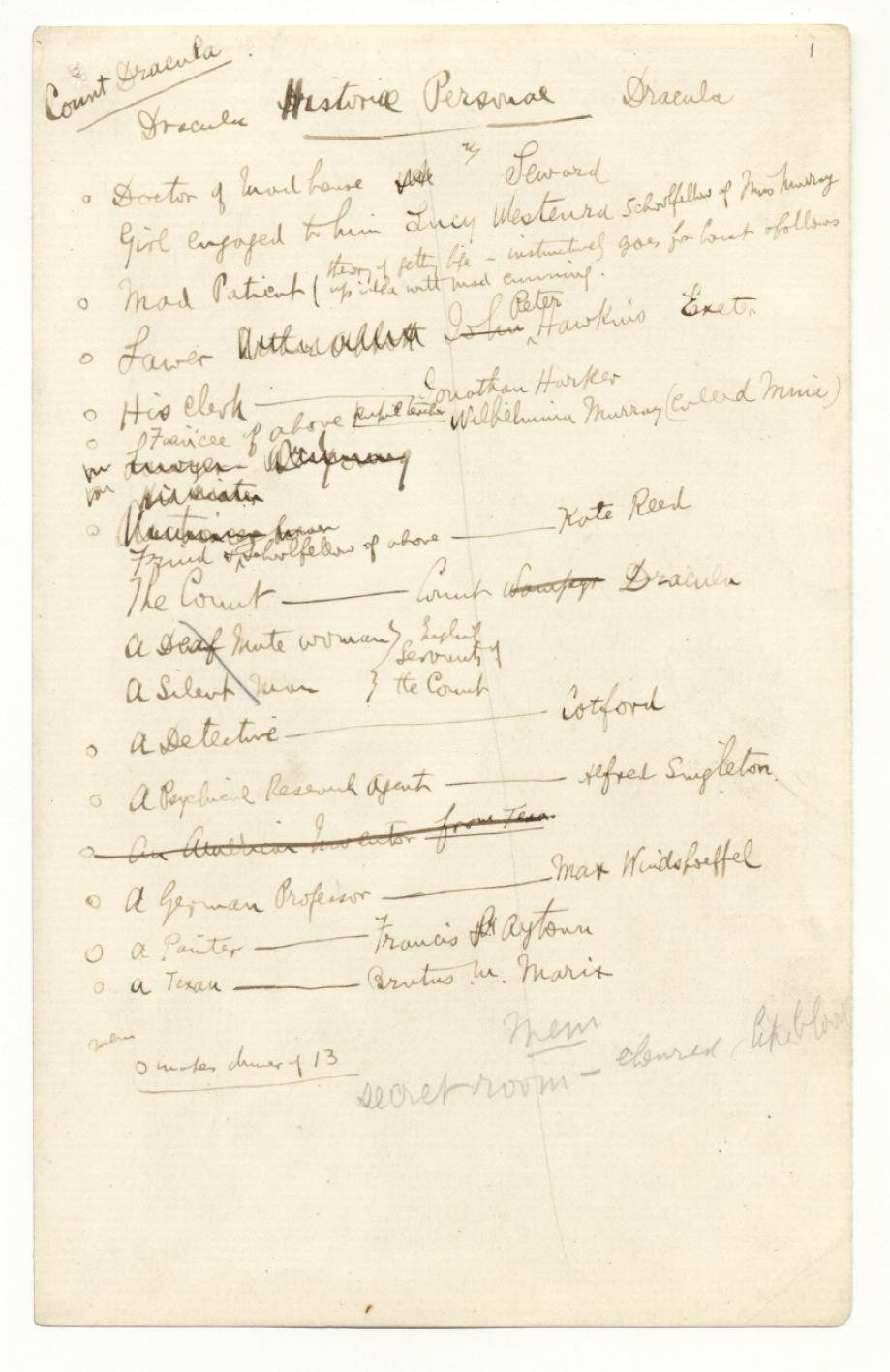
Remember the German professor, Max Windschoeffel, in Dracula? No? That's because there wasn't one. Bram Stoker wrote him out or, rather, let his character be absorbed into the Dutch vampire hunter, Van Helsing, along with other characters, including a detective.


Stoker's "Historiae Personae," pictured above, resides at the Rosenbach Museum & Library in Philedelphia. It likely arrived in the United States through one of Stoker's many visits or when his wife, Florence, moved to the US, after his death.

The "Historiae Personae" shows the way that characters' roles changed and evolved during the writing and research process. Upon close examination, you can see how characters were changed and renamed throughout.

I also love how it problematizes the question of who the real-life inspiration for Dracula was. Scholarship on the question has speculated it could have been Oscar Wilde or Henry Irving.

If Van Helsing was originally supposed to be a German professor, a detective, a physical research agent, and even possibly a painter, it's likely that the vampire's character had many sources of inspiration as well. Henry Irving, Oscar Wilde, Jack the Ripper, and even Stoker himself are tossed around as inspiring Dracula all the time, but it's likely more true that parts of Dracula came from all of them and others as well.

Follow me on Twitter @TinyApplePress and like the Facebook page for updates!

Tuesday, January 22, 2013

Bram Stoker on Abraham Lincoln

I never would have guessed that Bram Stoker was an Amerophile, but he was. He aspired to learn the histories of all the American presidents and research Abraham Lincoln extensively. I think he was attracted to Lincoln by the name. I know I'm always pretty stoked to meet someone with the same first name as myself - and I think I'd still be stoked if my first name were more common.

I was surprised to find this out about Stoker because we remember writers for their successes. I find Stoker's relationship to Lincoln interesting because it’s a writer's failures that make him/her human. Also, doing my own writing and research, it's sometimes comforting to know that even "great" writers weren't always a success.

Did I mention that Stoker wasn't a successful Loncoln scholar? No one ever thinks of him as an Amerophile because he didn't have much success as one. Moreover, I think thins might have caused him a bit anxiety and trepidation as he prepared to meet one of his favorite writers, Walt Whitman - an American. 


In 1887, Bram researched and prepared a lecture on Lincoln, which he practiced, with some success, in England, before delivering it in the United States, where he was to later meet his idol, Walt Whitman. When he met Whitman, also a fan of Lincoln, he said nothing about his lecture. Historians speculate this is because he was embarrassed, after receiving a terrible review in the New York Times.
Less than 100 people listened to a lecture by Bram Stoker yesterday afternoon in Chickering Hall, the subject being 'Abraham Lincoln.' 
Mr. Stoker has delivered this lecture with great acceptance before unenlightened English audiences, and his utterances have been highly commended by the semi-educated English press. 
On this side of the water, however, where Abraham Lincoln lived and died, and where American history is taught in public schools, a historical review of the life and times of the martyr-President, even when presented by Mr. Henry Irving's manager, is apt to fall flat. : General Horace Porter, who was an apparently interested auditor, congratulated Mr. Stoker at the conclusion of the lecture, and Major Pond, as he gazed sadly around the vast array of empty seats, said: "Well, I didn't expect any thing else. This lecture was advertised just as extensively as the readings of Charles Dickens or the talk of Max O'Reil. I spent just as much money on it. Mr. Stoker showed me some very flattering notices of his lecture clipped from the English press. So I said to him one day, 'Why don’t you deliver that lecture in New York, Stoker!' 
The fact is," said the Major, reflectively, "nobody cares to listen to a lecture on Abraham Lincoln in this country." 
We can understand, if Bram was embarrassed after reading that, knowing his hero likely read it too before their meeting. Swallowing his pride, Bram and Whitman became friends.

Bram made frequent trips to the United States, but arrived a little too late in 1894 to see Whitman for the last time. On this visit, however, he learned that Whitman had left something behind for him: an envelope with the original notes from his own American lecture on Abraham Lincoln, dated April 15, 1886. With this, was a letter that said: “Enclosed I send a full report of my Lincoln Lecture for our friend Bram Stoker.”

23 April 2014

To this, I would like to add that my opinions here were based on limited research, using source materials created in the United States. I think that I, like the others I was reading before, had trouble finding a primary source on Stoker's Lincoln Lectures. Such a source may be found in: Robert J. Havlik's “Bram Stoker’s Lecture on Abraham Lincoln,” Irish Studies Review 10:1 (April 2002).

I'm yet to find any reviews of Stoker's Lincoln Lectures in London, but suspect that research based on the American reviews is inclined to mimic the mocking tone of those reviews. Stoker's interest in Lincoln was actually fuelled by Whitman and borrowed from Whitman's research into Lincoln's assassination. Reading the Stoker essay, presented by Havlik, I found Stoker's thoughts to be balanced and elegantly presented.

Follow me on Twitter @TinyApplePress and like the Facebook page for updates!

Wednesday, January 9, 2013

Hermetic Order of the Golden Dawn

Interest in alternative spirituality and the occult peaked before the Second World War, but mysticism was already becoming popular in the late-Victorian period, after the Darwinian Revolution.

In the 1890s, Bram Stoker was involved in an occult-like spiritualist organization, called the Hermetic Order of the Golden Dawn. This mystic order was shrouded in secrecy. Indeed, the order threatened to ruin people's lives, if they revealed its secrets to outsiders. However, its hermetics were based on things people  thought of before, like Freemasonry, the religion of ancient Egypt, alchemy, and tarot cards.


Other members of the Order included W.B. Yeats, Algernon Blackwood, and Oscar Wilde's wife: Constance. A new biography, Constance: the Tragic and Scandalous Life of Mrs. Oscar Wilde, goes into great detail of Constance's experiences with the Order and how being among the first to join elevated members' positions. Digging Hermetics in the 1890s got you in on the ground floor, so-to-speak, because the movement was young and still under the direction of it's founder William Wynn Westcott.

In October 1887, Westcott wrote to Anna Sprengel, whose name and address he received through the decoding of the Cipher Manuscripts. Westcott claimed to receive a wise reply which conferred honorary grades of Adeptus Exemptus on Westcott, and his fellow Freemasons Samuel Liddell MacGregor Mathers, and William Robert Woodman and chartered a Golden Dawn temple consisting of the five grades outlined in the manuscripts. Anna Sprengel died four years after helping to found the order.

Anna Sprengel, countess of Landsfeldt, love-child of Ludwig I of Bavaria and Lola Montez, may never have existed at all, as there is no proof of her existence and it now seems she was invented by Westcott to confer legitimacy on the Golden Dawn (although I'm not sure how the support of imaginary people confers legitimacy on anything). In 1901 Mathers, leader of the Golden Dawn, briefly supported the claim of Swami Laura Horos, who had long campaigned for recognition as that countess, to have written Westcott as Anna Sprengel.

Regardless, I think it could have been the order and organization within the Hermetic Order of the Golden Dawn that provided orderliness to previously unruly creatures, specifically Bram Stoker's vampires. Anna Sprengel was supposedly a countess and Bram's vampires were led by a count. I don't know of any other interpretations of vampires that require devotion and worship, like Renfield has for Dracula:
"I am here to do your bidding, Master. I am your slave, and you will reward me, for I shall be faithful. I have worshipped you long and afar off. Now that you are near, I await your commands, and you will not pass me by, will you, dear Master, in your distribution of good things?"
Follow me on Twitter @TinyApplePress and like the Facebook page for updates!