Showing posts with label Jack the Ripper. Show all posts

Tuesday, November 15, 2016

Dorian Gray Goes Slumming (a close reading)

"The Hooligans," by Leonard Raven-Hill (1899)
In Chapter 16 of Oscar Wilde's novel The Picture of Dorian Gray (1891), Dorian Gray goes slumming. The upper classes began visiting the slums for recreational, or charitable, purposes in the 1880s. In Wilde's novel, Dorian travels there for pleasure and has acquired a drug addiction. Wilde's portrayal of London's East End explores the nature of class divisions in the 1890s. Although it's only a few lines long, the first paragraph sets the scene and it's a horrible one, in which light makes the dark more frightening.
A cold rain began to fall, and the blurred street-lamps looked ghastly in the dripping mist. The public-houses were just closing, and dim men and women were clustering in broken groups round their doors. From some of the bars came the sound of horrible laughter. In others, drunkards brawled and screamed.
The first five words tell us this isn't going to be a pleasant night. The rain is cold and it is just beginning. This rain isn't cleansing, but a "dripping mist," like the fog of London -- only wetter.

We know it is dark because the street lamps are on, but rather than lighting the way the street lamps are "blurred" and "ghastly." Ghastly things cause terror. How can a street lamp be ghastly? A ghastly street lamp causes terror by exposing it. Light makes the dark more frightening by providing glimpses of what is hiding in the dark.

Source.
By continuing a close reading of this chapter, we will find several references to Jack the Ripper. When Wilde was writing this, interest in Jack the Ripper was high, creating a morbid recreational fascination with the East End among Dorian's peers, who connected the area to the Ripper's brutal crimes.

The public houses, referred to in the second sentence, were East End pubs and taverns. It's closing time. The drinks of last call are done. The "dim men and women" are drunk. Of all the Victorian words for drunkenness, Wilde chose "dim" for the continued allusion to light. The men and women are dim in the ghastly light of the street lamps.

We may also assume that these were ghastly men and women. Respectable Victorian women didn't drink in public houses, or in public at all. The fact that they do here is part of the depravity Wilde wants to portray. Drunken women mingling, or "clustering in broken groups," with drunken men implies loose morals and possible prostitution. Poverty and drunkenness were Victorian character flaws caused by loose morals. Women could not easily be forgiven for ever having demonstrated such character flaws; Lady Meux was shunned by respectable society her entire life because she once worked in a public house.

"From some of the bars came the sound of horrible laughter." The perceived depravity of the poor and drinking classes makes their laughter horrible. In the public houses where they aren't laughing, they are brawling and screaming. Before Dorian even steps out of his carriage, this is the scene that readers see him in.

Source.
This paragraph prepares the reader for a chapter that follows Dorian into the slums, where he will find characters from his deplorable past. This paragraph also serves as a window that provides the reader with a view of London's East End from a very specific angle. From this angle, residents of the East End are morally depraved, ghastly individuals, who participate in creating the dangerous situations we find them in.

I will read the next paragraph in my next blog post. In the mean time, you can read The Picture of Dorian Gray at Project Gutenberg. For more information on 1890s slums and slumming visit the Victorian Web.

Follow me on Twitter @TinyApplePress and like the Facebook page for updates!

Wednesday, October 29, 2014

Jack the Ripper in Popular Culture

Jack the Ripper is the most legendary terror of late-Victorian London. I've written about him before, and it's the legacy that the ripper case left upon the imagination that fascinates me the most.

If the Ripper Case didn't actually invent crime journalism and detective fiction, it certainly changed the shape of them. Jack the Ripper was the first serial killer to attract worldwide media attention, which was, in part, due total reforms that enabled the wider circulation of inexpensive magazines and newspapers, including the Illustrated Police News.

The Illustrated Police News, 15 September 1888.
"Whatever information may be in the possession of the police they deem it necessary to keep secret ... It is believed their attention is particularly directed to ... a notorious character known as 'Leather Apron'." - Manchester Guardian, 6 September 1888.
'Leather Apron,' 'Jack the Ripper'... adopting a nickname for a murder suspect became standard media practice with these words, and would soon be followed by 'the Axeman' of New Orleans, 'the Boston Strangler,' 'the Düsseldorf Ripper,' and many others.


Public frustration with the inability of the police to solve the case opened the public's hearts to freelance detectives, like Sherlock Holmes and Sexton Blake. The public obsession with this horrifying unsolvable mystery directly captured the imagination of writers as well.

Fiction that was directly inspired by the case began to appear as soon as October 1888. John Francis Brewer wrote a short gothic novel that featured the murder of Catherine Eddowes, The Curse Upon Mitre Square (1888). These stories immediately had an international appeal because the whole world was watching London for clues at the time.

The Spanish-language 'Jack El Destripador' was published soon after the murders, and sent a comedic version of Sherlock Holmes after a similar killer.


Indirectly, Jack the Ripper influenced the popularity of other works, like Dracula, which definitely gained popularity through the public's obsession. But in terms of those that dealt most directly with Jack the Ripper, Marie Belloc Lowndes' 'The Lodger' (1913) was the most influential work. In this novel, Mr. and Mrs. Bunting suspect their lodger is a wanted serial killer, called "the Avenger." Alfred Hitchcock adapted the story to film, and the theme became as popular as Holmes versus the Ripper.

Today there are hundreds of books that try to solve the mystery, and works of fiction that still feed a public interest in the story. Lowndes' novel has been made into five films.

The movie Time After Time (1979) lets Jack the Ripper escape from 1890s London to 1970s San Fransisco, followed in hot pursuit by H.G. Wells.

And Jack the Ripper made it into comic books.


And of course, Ripper Street, the TV series.

In 2011, Madame Vastra from Doctor Who claimed to have eaten Jack the Ripper. As you can see (in the picture below), the construction of Madame Vastra's character is partially built on a framework, pre-established by Sir Arthur Conan Doyle.


Throughout October 2014, I will be sharing the halloween-themed stories of 1890s London. Check back often!

Follow me on Twitter @TinyApplePress and like the Facebook page for updates!

If you have enjoyed the work that I do, please consider supporting my Victorian Dictionary Project!

Sunday, September 7, 2014

Jack the Ripper Found At Last!

The signature on a letter dated 29 October 1888
written by a person claiming to be Jack the Ripper
that was sent to Doctor Thomas Openshaw of
the London Hospital Whitechapel.
Don't clap all at once...

As I write this, there's still some speculation, but it seems pretty clear that, using DNA evidence, Russel Edwards and Dr. Jari Louhelainen have identified the Polish hairdresser Aaron Kosminski as Jack the Ripper. The Jack the Ripper killings had a strong influence on 1890s London. Learning who the killer is brought up two main issues for me.

My first thought, reading the head line that a friend forwarded to me, was that I hoped it was the suspect that I'd recently written about for a print publication. It wasn't. Maybe it was selfish for me to think that way. But with all of the fun and mystery of speculation around the Jack the Ripper case, did we really want to know who the actual killer was? If not, why not?

Clearly some people wanted to know. Edwards and Louhelainen wanted to know badly enough that they actually found out. But I will venture to guess that there are a lot of Ripperologists out there who groaned when they found out that it was the hairdresser.

Maybe, like me, they weren't thinking about or writing about the hairdresser, and most of us don't like to be proven wrong. But the second issue this brought up for me is: what does all of this say about our mistakes!

Francis Tumblety
For over a hundred years, history has identified these people as possible serial killers. Francis Tumblety actually fled to England, while under suspicion. Sure, the list of suspects is a list of some really messed up Victorians, but it sucks to find out that you've been pointing your finger at the wrong man. It sucks even more to see how finger pointing adversely affected their lives.

As we wait for confirmation that Edwards and Louhelainen's tests were correct, what are we really hoping the answer will be?

Follow me on Twitter @TinyApplePress and like the Facebook page for updates!

Monday, March 10, 2014

Spy Cameras & Blackmail

The Victorian sensation novel is evidence that Victorians loved intrigue as much as we do, with all of our murder-mystery television series. The 1890s saw the birth of the forensic sciences at the root of those shows, through the media sensationalism around Jack the Ripper and the popularity of genius detective, Sherlock Holmes.

Jack the Ripper and Sherlock Holmes encouraged widespread mistrust of the police and made many people want to take matters into their own hands by becoming private detectives. As you might have seen in my post on the weirdest cameras of the 1890s, the evolution of photography was ready to appeal to their meddling needs.

Many ads were innocent enough, but others deliberately encouraged customers to spy on people. Marion’s Parcel Camera advertised that:

This Camera is made box-shaped and neatly covered with brown linen-lined paper, and tied with string like an ordinary parcel, of which it has the exact appearance. The object is to disguise its real use, and to permit a Photograph to be taken without raising the slightest suspicion.
Anthony's Patent Satchel Detective Camera illustrates how these devices worked and were evolving.


Conspiratorially, the Labouchere Amendment of 1885 made it easier for the courts to punish male homosexuals, in contexts where anal intercourse could not be proven. Most famously, Oscar Wilde was convicted under this law in 1895. In the years leading up to his trial, he and his friends were tormented by blackmailers. His Tite Street house was even broken into twice, presumably by people looking for further evidence of his affairs.

Photographs weren’t used in Oscar Wilde’s trial, but the years that followed would see a rise in photos taken with the intent of incriminating participants in seemingly private acts.


In 1920, a twenty-year-old actress, called May Levy, was used as bait to ensnare John Blake in a blackmail scheme. Blake recalled hearing a suspicious click in her bedroom, which turned out to be the noise from a camera taking a picture.

In another instance, where no photos were used, a young man name John Richardson propositioned another young man in 1887. Richardson blackmailed his victim by threatening to charge him with assault and followed him to the shop, where he pawned his watch in payment. Both youths were sentenced to ten years.

I can’t be sure how prevalent photographic blackmail was in the 1890s. Court records are difficult for me to access and many cases would have never made it to court for obvious reasons. Between the Labouchere Amendment and spy-camera technology, homosexuals would have been particularly vulnerable. Historian, Angus McLauren, who I once had the honour of taking a course with, summarizes the complex roles of blackmailers and their homosexual victims in fin de siécle London and New York.
Homosexual blackmail trials performed a variety of functions. They were used by the defenders of bourgeois respectability to depict the horrific fate of both the extortionist and the man who had been so incautious as to fall into his snare. In fin de siécle London and New York judges told men as well as women that they had to be wary of strangers, in particular young men. The press reported miscreants who threatened to charge men with “infamous crimes” and the courts dealt openly with accusations of sodomy, yet in generally asserting that the extortioners’ threat was not only illegal but untrue, judges sought to make it known that they had no intention of protecting perverts. The courts and the press careful tried to avoid using blackmail cases to explicitly discuss same-sex passions, while they implicitly warned the adventurous of the dangers of giving way to temptation. Interestingly enough, the court and press reports did not suggest that dangerous youths would necessarily appear effeminate; the stereotyped “homosexual” had not yet fully emerged. Yet because the accused included male prostitutes, the trials no doubt confirmed the popular notion of the homosexual as villainous blackmailer.
If you weren’t inside the circle of targeted victims, as Wilde was, an 1890s onlooker couldn’t have possibly understood the dangers and vulnerability of the love that dare not speak its name, when looking at an ad for a Demon Camera.


Follow me on Twitter @TinyApplePress and like the Facebook page for updates!

Sunday, April 28, 2013

The German Professor in Dracula

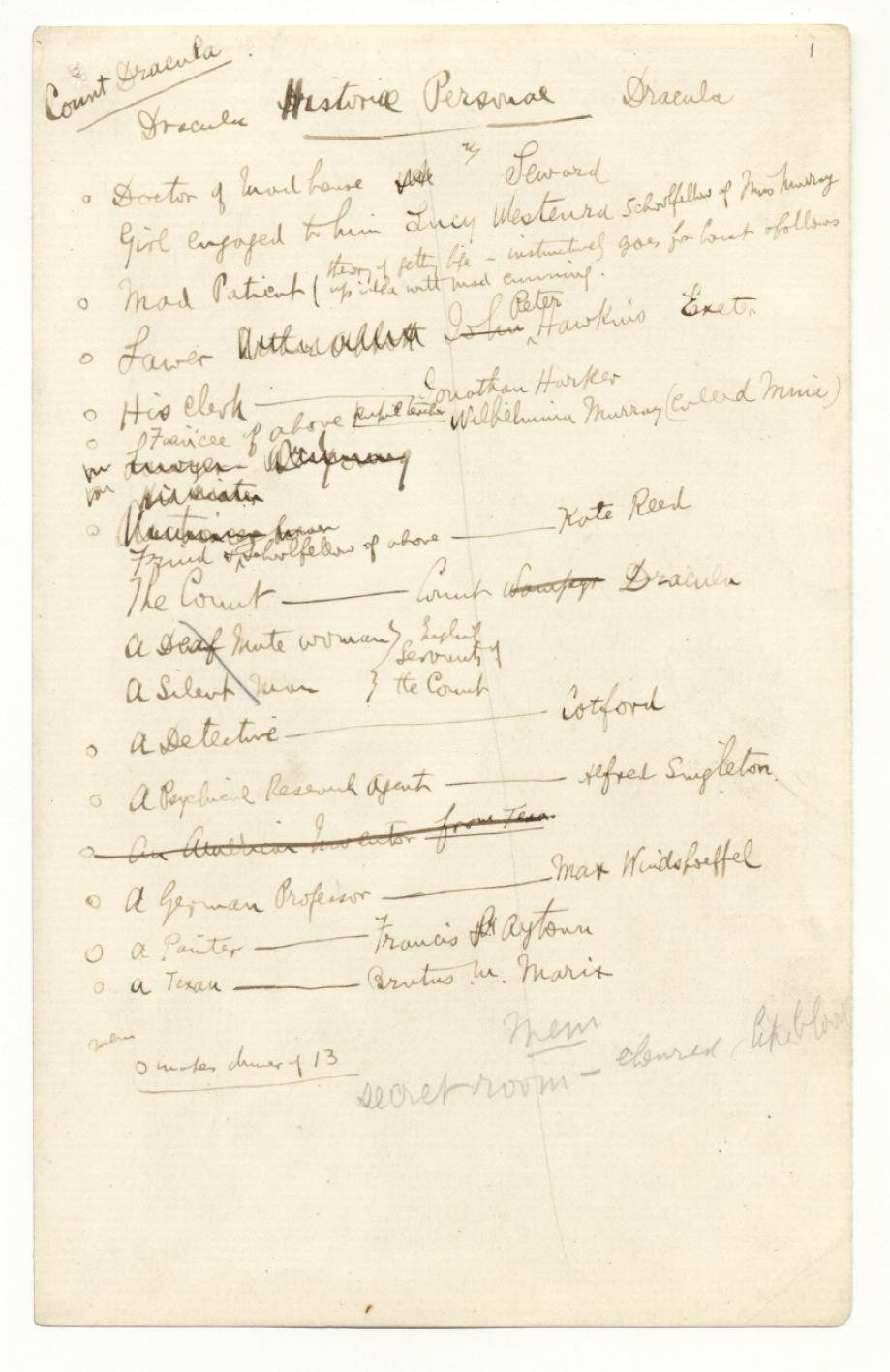
Remember the German professor, Max Windschoeffel, in Dracula? No? That's because there wasn't one. Bram Stoker wrote him out or, rather, let his character be absorbed into the Dutch vampire hunter, Van Helsing, along with other characters, including a detective.


Stoker's "Historiae Personae," pictured above, resides at the Rosenbach Museum & Library in Philedelphia. It likely arrived in the United States through one of Stoker's many visits or when his wife, Florence, moved to the US, after his death.

The "Historiae Personae" shows the way that characters' roles changed and evolved during the writing and research process. Upon close examination, you can see how characters were changed and renamed throughout.

I also love how it problematizes the question of who the real-life inspiration for Dracula was. Scholarship on the question has speculated it could have been Oscar Wilde or Henry Irving.

If Van Helsing was originally supposed to be a German professor, a detective, a physical research agent, and even possibly a painter, it's likely that the vampire's character had many sources of inspiration as well. Henry Irving, Oscar Wilde, Jack the Ripper, and even Stoker himself are tossed around as inspiring Dracula all the time, but it's likely more true that parts of Dracula came from all of them and others as well.

Follow me on Twitter @TinyApplePress and like the Facebook page for updates!

Monday, January 21, 2013

Talking to the Dead

Do you believe in ghosts? Sir Arthur Conan Doyle did! The idea of communicating with the dead fascinated him and leaves me puzzling over how to reconcile a personality of a person that loved logic, held scientific degrees, and still believed in ghosts.

Still married to his first wife, the creator of Sherlock Holmes met and fell in love with a spiritual medium in 1897. Her name was Jean Elizabeth Leckie. The couple married in 1907, after the death of Arthur's first wife.

Doyle had complete faith in Jean's skills as a medium. He really believed she was psychic, could predict future events, and speak with the dead. His faith was evidenced by the fact that he would later offer her services to Harry Houdini to help him contact his deceased mother.

How do I reconcile Doyle's mysticism from the logic based aspects of his personality, that I believed helped him to write Sherlock Holmes, when they seem like an utter abandonment of rational thought?

It's difficult to understand anything when you take it out of context. Many of our respected writers of the 1890s belonged to the Hermetic Order of the Golden Dawn. This was a decade when the public wanted the assistance of psychic Robert James in solving the case of Jack the Ripper. What interests me about this aspect of Arthur Conan Doyle is that none of his spiritualism worked into the solutions of Sherlock Holmes' cases; instead, Arthur preferred to write about problems that could be solved in this world.

Upon reflection, and after a visit to Wonders & Marvels, I would add that, maybe, Sherlock Holmes does hold the key to understanding his author's belief in the unbelievable.

The character, Sherlock Holmes, was based on a professor that Arthur knew in school, who had amazing powers of deduction. Arthur was captivated by the way that he could see things no one else could see just by looking at what was right in front of him. Maybe Arthur was fascinated by all unbelievable things, but saw that the most unbelievable things are right in front of us!

Follow me on Twitter @TinyApplePress and like the Facebook page for updates!