Showing posts with label 1890s problems. Show all posts

Thursday, August 11, 2016

Victorian False Eyelashes

"The beauty of the eye lies in its expression, whether it has borrowed its color from the corn flower, or shines like the black diamond, or reflects the blue of a May sky, or is veiled under long dark eyelashes." - Baronne Staffe, "My Lady's Dressing Room" (1892).
Source.
Victorian ladies typically kept their beauty regimes top secret, making everyone believe that everything, from their tiny waists to their pink cheeks to their long fluttery eyelashes were un-manipulated eternal truths. Long eyelashes were certainly a part of those regimes.  Women have wanted long eyelashes since Ancient Rome. Pliny the Elder claimed that excessive love-making caused eyelashes to fall out, making long eyelashes a symbol of chastity. The question here is: how did the 1890s woman lengthen her lashes?

In his book The National Encyclopaedia of Business and Social Forms (1879), James D. McCabe recommends trimming eyelashes to make them grow longer, suggesting that the sooner in life one begins the process, the more effective it will be. The process is in keeping with the Victorian ideal of encouraging natural beauty, rather than resorting to quicker artificial fixes. Baronne Staff's My Lady's Dressing Room (1892) additionally recommended applying Pomade Trikogene to grow longer eyelashes.

Pomade Trikogene was believed to improve hair growth wherever it was applied. I found a recipe for it in A Practical Guide for the Perfumer (1868).


I don't know what "nerval balsam" is, but I wouldn't put pure veal grease anywhere near my skin! Croton oil is worse. It causes diarrhea, if ingested. When applied to the skin, it causes irritation and swelling. Because it is so awful, researchers use it on lab animals to study how pain works. It has been found to promote the growth of tumors, but does nothing for eyelashes. If rubbing it around the edges of your eyelids sounds bad, some hairdressers thought up an even more painful alternative in France.
Source.
"The Parisans have found how to make false eyelashes. I do not speak of the vulgar and well-known trick of darkening the rim around the eye with all kinds of dirty compositions, or the more artistic plan of doing so to the inside of the lid. No, they actually draw a fine needle, threaded with dark hair, through the skin of the eyelid, forming long loops, and after the process is over -- I am told it is a painless one -- a splendid dark fringe veils the coquette's eyes." Henry Labouchère (1882). Source.
If I was thinking of getting eyelash extensions when I started writing this, I'm no longer considering it! Labouchère was only the first to tell anglophones about this terrifying method. In July 1899 the Dundee Courier announced that“Irresistible Eyes May Be Had by Transplanting the Hair.”

While I've never liked the idea of gluing hair to my eyelids, it seems like the safest method for creating longer lashes. There are many claims to inventing stick-on lashes, including the 1911 patent below that was filed by a Canadian, Anna Taylor.


Her patent was for:
...an artificial eyelash, a strip of material substantially crescent shaped with the ends clipped [off], short lengths of hair projecting outwardly from the convex side of the crescent shape in the form of eyelashes and fixedly secured adjacent to said edge on the under side of the strip, and an adhesive spread over the under side of said strip.
Taylor wished "to improve the personal appearance of the wearer, without adding discomfort, and. generally to provide in such articles the natural efi'ect at a minimum cost," but while so many women endured torture to lengthen their lashes, Taylor was by no means the first to invent such a convenience.

False eyelashes (at least similar to Taylor's) were so ubiquitous in the late 1870s that the Royal Cornwall Gazette complained about them in 1879:
"False eyelashes are not the perfect inventions they are represented to be. I saw one floating in a cup of tea the other evening, and the lady went on toying with the saucer and conversing, and never for a moment suspected that the left side of her face, by contrast with the right looked rather as if it were slowly recovering from a small explosion of gunpowder." Source.
Before investors, I mean... inventors, like Taylor, began packaging and patenting false eyelashes around the turn of the century, false eyelashes were like any other hair piece. The woman mentioned in the Royal Cornwall Gazette would have got hers from her hairdresser, who likely visited her at her house, the way that dressmakers did.


Because these transactions were so private, there is little we can use to know how popular false eyelashes were before they became a highly marketed consumer product in the 20th century. Still, it is safe to assume that they are more popular now than they were then.

Follow me on Twitter @TinyApplePress and like the Facebook page for updates!

Tuesday, April 26, 2016

Jobs for Women: the Angel in the Workforce


For 465 years, from 1377 to 1835 [the Ship and Turtle Tavern] was run by a succession of widows. During the Victorian era, the Ship and Turtle Tavern even supplied several of the West-end clubhouses. Source.
And yet we speak of working women as the exception in the Victorian era. Was that the case?

During the Industrial Revolution in the UK, young people (including women) were moving to cities at an unprecedented rate. Usually, a young person would arrive and stay with, or in the neighbourhood of, a person who knew their family, which resulted in regional concentrations of religious and cultural groups. It also created large households of people who were loosely connected.

In these households, everyone did their part (including women and children). Family economics of this type had long been the norm in rural populations, but in cities, women’s work was frequently downplayed, or entirely overlooked, as the emphasis increasingly focused on the male as breadwinner.


Victorian culture’s emphasis on separate spheres overplays the “Angel in the Household” motif, which simply doesn't describe the reality for many Victorian women and families. The obvious example being female heads-of-house, such as widows.

Moreover, the industrial revolution increased the demand for female and child labour, who could be paid less than their adult male counterparts. Still, forty percent of female occupations listed on the census of 1851 were in domestic service, with textiles and clothing services in a near second place. Women did much of the delicate work in factories that produced household goods and participated in trades that suited ideals of femininity, such as kitchen work, sewing, laundry, and retail.

Dore's Woman Pedlar.
While 'upper' working class women rented shops, the 'lower' hawked on the streets and beaches. They sold flowers, toffee apples, ice cream, cold drinks, shrimps, oysters and whelks, and offered donkey and goat rides and even fortune-telling, sometimes by budgerigar. Source.
Even in the middle- and upper-classes, the ideal of the Angel in the Household doesn’t adequately describe all that was taking place. Not only were women, like Rachel Beer, dominating the world of journalism, but many widowed and single-women had no choice, but to earn money to support their standard of living. Some, like Marie Corelli and Lady Jane Wilde (Speranza), did so by writing, but many widows carried on the family business after the death of their spouse. Many middle- and upper-class women could be found working as governesses, running boarding houses, or managing properties for income. Many of these women also played important roles in family businesses as silent partners, bookkeepers, administrative workers, and more.

Three fully-clothed women hiking their skirts at the
shoreline of the beach in Averne, Wallace G. Levison, 1897
By the 1890s, stories of the New Woman, who was educated and independent, began to emerge. Many of these women resented the stereotypes that depicted all women as seeking a husband to support them.

For more information, two excellent sources are the BBC and the Economic History Association.

Follow me on Twitter @TinyApplePress and like the Facebook page for updates!

Monday, November 23, 2015

Victorian Teenagers Gone Wild

The girl in the top left corner
has a mischievous face.
Throughout history, teenagers have rebelled against their parents. Popular psychology maintains that youthful rebellion helps young people build their own identity, separate from their parents. It happens in every class, culture, and race, so of course it happened in the Victorian Era.

You may say: "but Victorians were so proper!"
"Myths about the Victorian family are almost as numerous as those about the American West. Many regard the institution as a model for modern life, full of dutiful children and loving parents. Others see it as an example to avoid -- rigidly patriarchal, unloving, and riddled with class and gender restrictions. Both views, though too generalized, contain some truth, partly because of the tremendous variety of family lives during Queen Victoria's reign. Good or bad, families were the most important factor in a child's success in life" - Ginger S Frost.
 Even today, we tend to attribute the tendency to rebel with trouble in the individual, sometimes linking rebellious behaviour with the early signs of a psychopathic personality. Though teen rebellion often seems selfish, fed by boredom and glib, it generally has nothing to do with those traits in the person, but more to do with what one is rebelling against.


Young middle and upper-class Victorians became social reformers, committed to mending the injustices perpetrated by their society and sometimes within their own families. Young Victorians, like Bram Stoker, became aware of the problems associated with alcoholism and other addictions. The era saw the rise of the suffragette and educational reforms to help the poor. Of course, some young women started smoking and drinking to irritate their parents and some young men dressed below their station, so they could sneak into the poorer neighbourhoods for a bit of slumming - not all rebels are altruistic. We all had that friend who made us aware of broader social problems by personifying them.

1909 woman smoking opium.
Although teen rebellion was wide-spread, two particular people come to mind, when I think of 1890s writers, who were rebellious teenagers: Edmund Gosse and Constance Wilde.

Philip Henry Gosse with his son Edmund (1857).
Frontispiece to the first edition of Father and Son.
Obviously, Gosse comes to mind because of his memoir, Father and Son (1907), which bore the subtitle: "a study of two temperaments." His father, Philip Henry Gosse was a deeply religious scientist, who rejected the theories of his contemporary, Charles Darwin. In Father and Son, Gosse focuses on his father's rejection of the theory of evolution and his own coming of age through the rejection of his father's religion.
My own state, however, was, I should think, almost unique among the children of cultivated parents. In consequence of the stern ordinance which I have described, not a single fiction was read or told to me during my infancy. The rapture of the child who delays the process of going to bed by cajoling 'a story' out of his mother or his nurse, as he sits upon her knee, well tucked up, at the corner of the nursery fire—this was unknown to me. Never in all my early childhood did anyone address to me the affecting preamble, 'Once upon a time!' I was told about missionaries, but never about pirates; I was familiar with hummingbirds, but I had never heard of fairies—Jack the Giant- Killer, Rumpelstiltskin and Robin Hood were not of my acquaintance; and though I understood about wolves, Little Red Ridinghood was a stranger even by name. So far as my 'dedication' was concerned, I can but think that my parents were in error thus to exclude the imaginary from my outlook upon facts. They desired to make me truthful; the tendency was to make me positive and sceptical. Had they wrapped me in the soft folds of supernatural fancy, my mind might have been longer content to follow their traditions in an unquestioning spirit.
As Gosse grew up to be a poet, it's safe to say that his life was formed through his parents' teachings - though not in the ways that they intended.

Constance Lloyd
(before she married Oscar Wilde).
Constance Wilde had a terrible relationship with her mother. Franny Moyle, Constance's biographer, called Constance's mother "a selfish and difficult woman." Her mother's conduct toward Constance may be characterized as abusive. It was a relationship that Constance survived through forming a rich internal life and getting away to school by taking classes at the University of London. The 1871 and 1881 censuses describe Constance as a scholar. As was the case with Gosse, Constance's rebellion was ideological, but also deeply personal.

The outfit that Constance is pictured in above was typical of young aesthetes in her day, which was viewed as both a fashion and an intellectual movement - almost the way that hippies, or people who only wear vegan clothing can be viewed as participating in both a fashion and intellectual (or moral) movement. Constance's brother mocked her dresses and the rest of her family, including an eventual step-sister, encouraged her to dress more like them. But Constance married the Prince of the Aesthetic Movement and realized her independence through marriage - a trope in young Victorian women's lives.

Gosse and Constance's stories critique the Victorian Era as a whole and represent examples of positive social changes (women's education and learning in general), but not all teenage rebellions go so well.

Teen pregnancies are often used as a symbol of teenagers gone wild, so it is worth noting here that during Queen Victoria's reign the rate of premarital pregnancies hovered around 20%, according to Eurostat. It's likely that number was much higher. Yet, there is something twisted about viewing sex as an act of rebellion.

Boys marching out of the London Foundling Hospital for the last time (1926).
For more on the London Foundling Hospital, click here.
The "fallen woman" was a blanket term that Victorians applied to any unmarried woman with sexual knowledge of any sort. This term covered rape victims, prostitutes, and unwed mothers alike; in some families, it might even be applied to a woman who read French novels.

The "new woman" represented another kind of rebellion, closer to what young Constance Wilde was up to.  This term was popularized by Henry James in the 1870s and referred to an emerging feminist ideal.
"In Victorian England, as men clung to the sanctity of the patriarchy, they were increasingly becoming more and more frightened of their own women. Bram Stoker capitalized on this fear in his iconic novel, Dracula. In 1897, a "New Woman" was emerging in Victorian society, coinciding with the women's suffrage movement throughout England. This New Woman, riddled with feminist awareness, would be the cause of fodder for Stoker's heroine, Mina Harker. Because this New Woman was aspiring to be independent of patriarchal male dominance, (or had already obtained said independence) to the old guard of Victorian society, she was viewed as perverse. The New Woman was a mutation of the woman the patriarchal society wanted her to be. The New Woman's strides towards economic and sexual changes in society as a whole should be viewed as terrifying. Stoker takes these beliefs, and applies them to his female characters in Dracula" - source.
Even Bram Stoker's wife might have been viewed in terms of the new woman for her interest in aesthetic, also called "hygienic," dress, she ran in the same circle of women as Constance and even once dated Oscar Wilde.

"New Woman — Wash Day" (1901)
Oscar Wilde's youthful romance with the future Mrs Stoker was also a kind of young rebellion because she was penniless, while he came from an upper-class family, whose fortune was waning.

There were lots of ways for young men to rebel, especially in the 1890s. Any society that oppresses one group, the way that Victorians repressed women, also represses the dominant group by making the perceived characteristics of the oppressed group taboo. Oscar Wilde rebelled by incorporating long hair and feminine characteristics into his interpretation of aestheticism.

Young people help refresh the human population, getting rid of the old ideas that aren't working anymore.

Follow me on Twitter @TinyApplePress and like the Facebook page for updates!

Thursday, September 24, 2015

How Bram Stoker Reanimated Mummies

"...the consciousness of the mummy does not rest but is to be reckoned with." - Bram Stoker

Why are mummies so scary? They don't moan and walk around in real life, the way they do in movies, but they are actual things. Mummies are the realest of all the horror movie monsters. Vampires and werewolves come from literature; trolls and ghosts from myths and folklore; but mummies actually exist. Fear of mummies is a projection of European guilt over the colonial project and embodies aspects of that project by making magical monsters out of the colonial other.

Europeans weren't the first to plunder the Great Pyramids, but late-Victorian London is the focus of this blog, so I'm not going to get side-tracked by other plunderers, especially when the influence of writers from 1890s London has such a profound influence on the development of the monster mummy narrative.

The belief that some of the antiquities were cursed had been circulating around Europe since the end of the 17th century, but that didn't stop "collectors," like Lady Meux and Sir William Wilde. Sir William, Oscar Wilde's father, collects Egyptian antiquities that he took directly from Egypt. Bram Stoker later recalled listening to Sir William's stories about Egypt "before all the archeology started." Lady Meux developed one of the largest collections with over 2,000 pieces, including mummies, which she tried to donate to the British Museum upon her death.


This was the social/political climate in which Bram Stoker wrote the first prominent work of fiction featuring mummies as supernatural antagonists: The Jewel of Seven Stars (1903). Like Stoker's vampires, his mummies became postcolonial pop-culture icons. Before the Jewel was published, mummies' curses were used to explain the deaths of anyone connected to anyone who came into contact with a mummy. After the Jewel was published, the mummies themselves could be reanimated.
"Father, in the Egyptian belief, was the power of resurrection of a mummied body a general one, or was it limited? That is: could it achieve resurrection many times in the course of ages; or only once, and that one final?" 
"There was but one resurrection," he answered. "There were some who believed that this was to be a definite resurrection of the body into the real world. But in the common belief, the Spirit found joy in the Elysian Fields, where there was plenty of food and no fear of famine. Where there was moisture and deep-rooted reeds, and all the joys that are to be expected by the people of an arid land and burning clime." 
Then Margaret spoke with an earnestness which showed the conviction of her inmost soul: 
"To me, then, it is given to understand what was the dream of this great and far-thinking and high-souled lady of old; the dream that held her soul in patient waiting for its realisation through the passing of all those tens of centuries. The dream of a love that might be; a love that she felt she might, even under new conditions, herself evoke. The love that is the dream of every woman's life; of the Old and of the New; Pagan or Christian; under whatever sun; in whatever rank or calling; however may have been the joy or pain of her life in other ways. Oh! I know it! I know it! I am a woman, and I know a woman's heart. [...]" - Bram Stoker, The Jewel of Seven Stars (1903)
The idea of a mummified Egyptian queen, not dead, but asleep and dreaming of love, was transferred directly into an episode of Buffy the Vampire Slayer in 1997, in which the 500 year-old mummy of an Inca princess is brought back to life and falls in love with Zander.

"Inca Mummy Girl," Buffy the Vampire Slayer,
7 October 1997.
Conscious willing desire is what separates pop-culture supernatural antagonistic mummies from their zombie counter parts. Zombies mindlessly wander about seeking brains, but if a mummy feeds on a human it is for strength to carry on a new life, or to maintain guardianship over their afterlife. For Stoker's mummy, it was both. In this scene of the Jewel, Stoker's protagonists are trying to interpret "ka" and "ab" from an Egyptian text:
"It means that for this night the Queen's Double, which is otherwise free, will remain in her heart, which is mortal and cannot leave its prison-place in the mummy-shrouding. It means that when the sun has dropped into the sea, Queen Tera will cease to exist as a conscious power, till sunrise; unless the Great Experiment can recall her to waking life. It means that there will be nothing whatever for you or others to fear from her in such way as we have all cause to remember. Whatever change may come from the working of the Great Experiment, there can come none from the poor, helpless, dead woman who has waited all those centuries for this night; who has given up to the coming hour all the freedom of eternity, won in the old way, in hope of a new life in a new world such as she longed for...!"
George Washington used the term "the Great Experiment" to refer to the United States of America and Stoker was a scholar of American history, so it's not a stretch to say that "the Great Experiment," in this case, refers to modernity. If the experiment is a success the modern world will be everything that the mummy ever dreamed of, and by extension the right place for all other cursed Egyptian antiquities.


The notion that preserving antiquities is the burden of the benefactors of societies great experiments is at the heart of the cursed artefact myth and permeates the views of many modern Egyptologists and museum patrons. In the words of Jasmine Day in "The Mummy's Curse: Mummymania in the English-speaking World" (2006):
Popular archeology's promise of empowerment to its audiences can thus become implicated in a regressive imperialistic fantasy. The 'Humanity Ownership Argument' frequently invoked in debates about control of cultural property, holds that a body of material culture should not be possessed solely by a single ethnic group. This resembles the demand of the Dragon Principle that valuables be ceded to those who can best utilize them. [Some people] believed that indigenous peoples' requests for reparation of their former possessions threatens archeology. They spoke as if their own property were being threatened, because they identified with the archeologists.
In other words, to some, the British Museum is a better caretaker of Egyptian artefacts than Egyptians are. In 1890s terms, British collectors felt they were better caretakers of Egyptian antiquities that Egyptians were.

Bram Stoker might not have invented the mummy, but he animated it and infused its new life with the anxieties of the emerging postcolonial era, the traces of which can still be seen today.

Follow me on Twitter @TinyApplePress and like the Facebook page for updates!

If you have enjoyed the work that I do, please support my Victorian Dictionary Project!

Tuesday, August 11, 2015

Popular Perceptions of Electricity in the 1890s


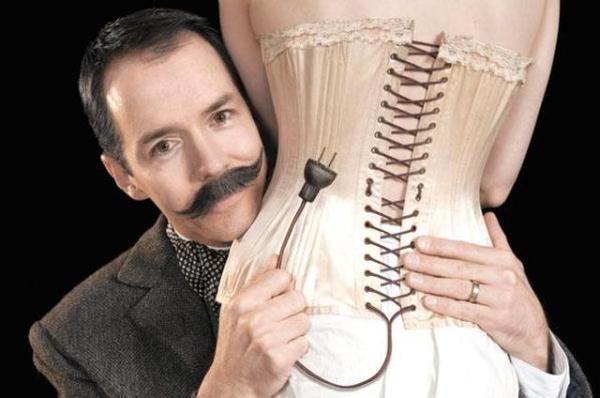
If you lived in a major city, like London, electricity had become part of your everyday life by the 1890s. You might not have it in your home, but even if you did, you might not understand what it was.

Even electrical engineers, like Nikola Tesla, used words like "energy" to describe that which was generated by electricity and that which he felt after sleeping. It's not clear that many people distinguished between the two. Tesla actually got the idea for tuning radio frequencies through his belief that he and his mother were tuned into the same frequency when she died. Still, Tesla understood more about electricity than most people do today, but the electrical revolution was spreading rapidly.

A town called Godalming, Surrey, built the first central station to provide electricity to the public in the fall of 1881. They did so because the disagreed with the rate the gas company was charging them. I understand the feeling from dealing with my internet provider. Godalming's system was first used for their street lamps, but within the year more than 80% of its homes were connected. Overall, the town wasn't happy with their new electrical system and reverted to gas (also a familiar feeling in dealing with new internet providers). However, by 1882, London had a large-scale power station at Holburn Viaduct.

The power Holburn Viaduct produced was mostly used to power public resources. In spite of widespread apprehension the rails of the London Underground were being electrified. People worried about potentially-fatal electrical short circuits and dangerous accidents. London's Bersey Cabs hit the London streets in 1897. By 1899, ninety percent of New York City's taxi cabs were electric. Electrification of the home was reserved for the most forward-thinking members of the upper class, with the Savoy Hotel being the first such establishment to run its lights and lifts on electric power. While this impressed many of its guests, the popular imagination still viewed this new power source with as much fear as it did curiosity. 


Many people believed electricity could recharge their bodies. The field of medicine was experimenting with electricity. Even rural doctors would charge for coursing low levels of electric current through the body in an effort to cure a variety of real and imaginary ailments. Of course, wherever you could find a quack Victorian doctor, you could find quack Victorian products.


I don't know what electric oil was, but it sounds like wonderful stuff. Moreover, I'm also not sure how you get electricity in a bottle.


In the midst of all this electric healing, electricity was deliberately used to kill for the first time in 1890, when a convicted murderer, William Kemmler sat in the electric chair on 6 August 1890. The first attempt left Kemmler unconsciousness, but did not stop his heart and breathing. After they recharged the generator, the second attempt ruptured blood vessels under Kemmler's skin; the areas around the electrodes singed. Kemmler's execution took about eight minutes. George Westinghouse later commented that "they would have done better using an axe," and a witnessing reporter wrote that it was "an awful spectacle, far worse than hanging." Some say Kemmler burst into flame before finally dying.

Thomas Edison horrifically played on the public's fears about the dangers of electricity when attempting to discredit his competitors by electrocuting and torturing dogs, cats, cows, horses, and most famously, an elephant in public demonstrations.


In conclusion, 1890s people thought electricity had the potential to replace gas as a fuel source; that it was deadly dangerous; but that in small amounts, electricity had magical healing powers. I've read just enough to believe the rumours that some people actually wore electric jewelry for its healing powers and will leave you with the steampunk Jem image that conjured in my mind. The reference here is, of course, to Jem's flashing earrings.

Follow me on Twitter @TinyApplePress and like the Facebook page for updates!

If you have enjoyed the work that I do, please support my Victorian Dictionary Project!

Wednesday, August 5, 2015

The Perfect Woman

"The Crush," by Charles Dana Gibson.
Perfection in humans is inarguably subjective, but as I've written a post on the perfect man of the 1890s, it has been pointed out to me that I ought to write one about the perfect woman.

Minerva
I want to write about a female bodybuilder because Eugene Sandow, the bodybuilder, was the perfect man in the 1890s, and I support gender equality, and there were female bodybuilders - even before Sandow began promoting bodybuilding for health and beauty. One of these was America's first famous strong woman, Josie Wohlford, or 'Minerva,' as she was called. Minerva held the Guinness Book World Record for the greatest weight lifted by a woman (18 men on a platform totalling over 3,000 lbs). I want to write about Katie Brumbach the same way, but the female bodybuilders of the 1890s didn't represent an ideal the way that Sandow did.

Katie Sandwina
In the Sandow ideal, form followed function. On the stage, Brumbach performed feats of strength as Katie Sandwina the feminine giantess, but feats of physical strength were not the feminine ideal in the 1890s, an era that would give rise to the Gibson girl in the United States and Lily Langtry in the UK.
[The Gibson girl's] image was unlike those of American woman that had appeared in the nineteenth century. Physically, she looked different. She was tall, with an incredibly tiny waist. She wore her hair swept up into a softly twisted bun called a chignon, revealing her long swanlike neck. What distinguished her more than any physical characteristics, however, was her attitude. [...] The lift of the Gibson girl's chin and her half closed eyes [...] suggested that she was more aloof than nurturing. Some thought her sophisticated. Others thought her haughty or conceited. She didn't stay at home, either. The images placed her on a golf course or on the beach. The media quickly labeled her "the typical American girl."
Gibson girl, 1899.
An invention of the 1890s, the Gibson girl's popularity continued to grow in the early twentieth century. Possessing similar attributes, Langtry was "introduced" in the 1877 and grew in popularity through to the 1890s.

Lily Langtry
An American in London, Langtry was literally introduced at one of Lady Sebright's evenings at home in May 1877. Her social performance there attracted comment, as well as invitations to other events with other important social figures. She had married well enough that she didn't need to work, but her great social success and personal interest in London Society led to an acting career and affairs with noblemen, including the Prince of Wales. Langtry's story encapsulates feminine ideals of the era in that her looks, and her ability to enchant were her keys to success.

Still, it wouldn't do to call Langtry the perfect woman, the way that Sandow was called the perfect man. She did after all, attract gossip by cheating on her husband. The perfect woman of the 1890s was an impossible ideal, one that I think is captured beautifully as George W.E. Russell recalls his friend, Mrs Lowther.
She possessed what men arrogantly call a "masculine understanding," trained into accuracy and thoroughness by the systematic studies of her girlhood. She could direct, organize, and control on the largest scale and in the smallest details. She was competent to deal with the toughest and most intricate problems of business, money, and, if need were, law. She could discuss, on equal terms and at a moment's notice, policies with Premiers, and Fiscal Reform with Chancellors of the Exchequer; Laws of Evidence with Judges, and Education Bills with Bishops. Yet she "bore this load of learning lightly as a flower," and could turn in an instant from the most strenuous themes to the graces and amenities, even the trivialities, of social life. Her enjoyment of that life was keen, and, in whatever phase she found herself, her talents and accomplishments were ready for the occasion.
She was, as most people know, a genuine artist; being very quick to catch an effective point, bold and rapid in execution, accurate in draughtsmanship, and endowed with that rare gift in English art - a true sense for colour. No one but an artist could have arranged the interior decoration of Lowther Lodge, where colour and form are so harmoniously combined. As to music, one who is well qualified to judge says, "She was very musical, and played the piano quite beautifully. She used to have lessons from Chopin, and up to the end remembered by heart pieces she had learnt with him, and played them very often when we were alone." Her waltzing was renowned for lightness and grace; and her familiarity with all minor accomplishments, such as painting on china, wood-carving, and embroidery, was remarkable. Nothing came amiss to her, and no one, I should think, ever spent so few idle moments in a long life.
In literature her taste was for the old than for the new, and she had a hearty contempt for that smattering of ephemeral criticism and culture which is so often used to conceal fundamental ignorance of the books really worth knowing.
Two women reading on a verandah at Ingham, ca. 1894-1903
(Harriett Petifore Brims, JOL, SLQ, Neg 132733)
Her conversational gifts were altogether exceptional. She was always perfectly natural, always in touch with those to whom she was talking, taking their points and interested in their interests. She was keenly alive to anything in her guests' conversation which struck her as important or curious or amusing, and was always ready with the apt reply which showed that she had been attending and not merely hearing. Her own copious and varied knowledge of life and society and art flowed in an easy and continuous stream, which never needed either pumping or damming. She could hit off a ludicrous situation - perhaps sometimes an absurd character - with a touch of genuine humour; and, if her moral sense was shocked or her convictions were outraged, she could express disapprobation with an emphasis all the more impressive because it was not violent.
Perhaps the only subject which did not interest Mrs Lowther, among all those which are discussed in modern society, was Health. Doctors and diseases, diets and systems, bored her to extremity; and this was natural enough, inasmuch as she had never had occasion, in her own case or in that of her family, to make herself acquainted with the dismal lore of the sick-room. She was one of the strongest women in the world; astonishingly active, and ignorant of the meaning of fatigue. In the discharge of her various duties as wife, mother, hostess, member of society, mistress of a large establishment [...] she laboured incessantly, and with no apparent loss of energy, till the last weeks of a protracted life. Energy was indeed her most striking characteristic; and by energy I mean that indefinable gift, rather spiritual than physical, which makes a man or woman live intensely in every nerve and fibre, and throw the whole being into the tasks and interests of the moment. - Sketches and Snapshots by George W.E. Russell
An interesting woman indeed, I don't use Russell's account to suggest that Mrs Lowther was the perfect woman, only that 1890s feminine perfection was the happy stuff of the eulogizing imagination. Whatever resemblance she bore with the real Mrs Lowther, the character Russell sketches for us in that passage shared characteristics with the New Woman, in that she was educated, independent, and capable. Like the Gibson girl, she might be put into practically any situation and would know how to behave. Like Langtry, she seemed capable of enchanting the people around her, so that you want to make her a friend. She would probably be a good friend to have because she listens so well. And like Minerva and Katie Sandwina, she was strong; healthy strong, but (unlike them) not lifting 3,000 pounds on her shoulders strong.

"The New Woman and her bicycle - there will be several varieties of HER!"
Women's weight lifting and bodybuilding still struggle for acceptance, the way that many women's sports are still not taken as seriously as men's. The perfect woman of the 1890s, therefore, poured her inexhaustible energy into more feminine pursuits, while ever-pressing the boundaries of what was traditionally masculine and what was traditionally feminine.

Follow me on Twitter @TinyApplePress and like the Facebook page for updates!

If you have enjoyed the work that I do, please support my Victorian Dictionary Project!

Tuesday, May 5, 2015

Poop in (Victorian) Beards

Nowadays, when you mention the long beard trend, most people immediately think of hipsters; I still think of the Victorians. With the news this week that these hipster beards harbour the kind of bacteria found in fecal matter, I rolled my eyes and thought about other problems the Victorians had with poop.


Essentially, overpopulation in the City of London caused the Times to speculate in 1894 that by 1950 the horse poop in the streets would be nine feet deep. It was the full-time occupation of the city's block boys to keep the streets free of manure. If you are worried about your beard filling up with poo as you go about your business today, imagine how crappy Bram Stoker's beard was!


In spite of the fact that Stoker took a bath every night before bed, the Victorians aren't remembered for their excellent hygiene, or medical care. Although they weren't known for their especially long life spans, walking around with poop all over their faces isn't what was killing them.

Before you throw hygiene to the wind and embrace the notion of getting poop on your face, remember that a basic understanding of science may be lacking in populations that resist learning about evolution (namely much of the Southern United States and people in the nineteenth century). It wasn't actual poop that they found in the beards of men in Albuquerque, it was the kind of bacteria found in the stomach and in poop. If you don't have enough, or the right kinds of these bacteria, you may develop ulcerative colitis and other gastrointestinal conditions, which are sometimes even treated with a fecal transplant (they take the poop bacteria from the tummy of a healthy person and put it into the tummy of a sick person).

If you are a hipster, be like Stoker. Enjoy your beard, but wash it often. Irregardless of whether you have a beard, no one is going to want to kiss you if you don't take a bath.

Follow me on Twitter @TinyApplePress and like the Facebook page for updates!

If you have enjoyed the work that I do, please support my Victorian Dictionary Project!

Monday, March 30, 2015

Lady Meux and Egyptology

Portrait by James Abbott McNeill Whistler
Lady Meux typifies the type of 1890s woman I adore most of all. She was eccentric, incredibly wealthy, and had such a shifty past that "respectable" people wouldn't talk to her, but the Prince of Wales was happy to party with her at her house. When she had her portrait done, she hired James Whistler. What I don't like about her, or any of the figures that I've uncovered from this period so far, is the inclination to horde the artifacts that England was pillaging from other parts of the world, like the Americas, but especially Egypt.
"When an artifact is stolen, it is separated from the archaeological and historical context that is an essential aspect of its value. The looting of Egypt's antiquities dates back to ancient times--there are now more standing obelisks in Rome than there are in Egypt." Source
Today, I started stumbling upon books about the collection of Egyptian antiquities that Lady Meux kept at Theobalds House. You can see one for free on archive.org. The book pays careful attention to symbolism, translation, and funeral practices because Lady Meux kept the physical remains of ancient Egyptians and their coffins at her house.

From Kurna; Coffin of An-Heru; XIth Dynasty, about 2600.
Coffin of an Unnamed Priest of Amen-Ra, with
Mythological Scenes and Explanatory Inscriptions.
Qebhsennuf, Tuamutef, Hapi, and Mestha;from Thebes;
Set of Canopic Jars; XVIIIth Dynasty, about B.C. 1550.
Lady Meux's collection was so extensive that the legendary Egyptologist Wallis Budge only managed to catalogue part of it, some 1,700 parts, and he dedicated The Book of Paradise to her.

When she died, she tried to will the collection to the British Museum, but they declined and it was sold off instead. During her lifetime, Egyptians made it known to the English that many of the things their archeologists were taking were valuable to them. In Lady Meux's defence, when she learned that five of her Ethiopic manuscripts were missed by Ethiopians, she left them in her will to Emperor Menelik.

I do not know what the legal status the items from Lady Meux's collection, but I do know that the permission of the Egyptian government has been required for all archaeological excavations since 1869. Illegally excavated antiquities are also to be considered Egypt's national property. And Oscar Wilde's father reportedly bragged about having personally acquired his antiquities "before all the archeology started."

Follow me on Twitter @TinyApplePress and like the Facebook page for updates!

If you have enjoyed the work that I do, please support my Victorian Dictionary Project!

Saturday, January 31, 2015

The Best of Writers in London in the 1890s

There's a widget tin the column on the left that lists my most popular posts. The things that appear there sometimes surprise me.

Now that it's been more than two years since I decided to blog my writing tangents, I thought it was time to compile a list of my favourite posts. They may not be my greatest hits, but these tangents represent some of my favourite ideas.

In chronological order:

1. A Bunch of Hairy Men.
Using this helpful chart, I now know that the style of Bram Stoker's beard was called 'dangle swangles.'


2. The Arminus Vanbery Myth.
It turns out the guy, who academics thought was Stoker's vampire informant, might not have known anything about vampires at all, but was, in fact, an international spy. He also totally looks like Antonio Banderas, who once played a vampire called, Armin. Coincidence? I don't think so...


3. The Top Ten Reasons Oscar Wilde Hated His Brother.
The squabbles between Oscar and Willie Wilde went beyond sibling rivalry. Willie was a danger to himself and his family. Too bad Alcoholics Anonymous wasn't popular in London yet.


4. Never Let Edmund Gosse Arrange The Seating Plan at Dinner.
This is just a little anecdote about a literary dinner party on 25 July 1888, but it is telling nonetheless.


5. 100 Random Things About Oscar Wilde.
For my 100th post, I shared 100 random things about Oscar Wilde. When it comes to the great aesthete, I just can't get enough.


6. Sherlock the Bully.
This guy's name is Charles Brookfield. He was the first actor to play Sherlock Holmes on the stage and he was a bully.


7. Immoral Essays by Bram Stoker.
For the most part, I've been disappointed with The Lost Journal of Bram Stoker, but it's nice to see that he had a sense of humour.


8. How to Curse like a Gentleman: the F-Bomb.
This post was fun to write and I liked making the images. It also inspired the Victorian Dictionary Project.


9. The Chamber of Horrors (Waxworks).
This subject was fun to research and could be the next theme for American Horror Story!


10. 20 Things You Should Know About Bram Stoker's Wife.
I love Florence Stoker. She is an important character in my novel.


In compiling this list, I've realized that most of my posts really are about Stoker and Wilde. I hope you love them as much as I do.

Follow me on Twitter @TinyApplePress and like the Facebook page for updates!

If you have enjoyed the work that I do, please support my Victorian Dictionary Project!