Showing posts with label women. Show all posts

Thursday, August 11, 2016

Victorian False Eyelashes

"The beauty of the eye lies in its expression, whether it has borrowed its color from the corn flower, or shines like the black diamond, or reflects the blue of a May sky, or is veiled under long dark eyelashes." - Baronne Staffe, "My Lady's Dressing Room" (1892).
Source.
Victorian ladies typically kept their beauty regimes top secret, making everyone believe that everything, from their tiny waists to their pink cheeks to their long fluttery eyelashes were un-manipulated eternal truths. Long eyelashes were certainly a part of those regimes.  Women have wanted long eyelashes since Ancient Rome. Pliny the Elder claimed that excessive love-making caused eyelashes to fall out, making long eyelashes a symbol of chastity. The question here is: how did the 1890s woman lengthen her lashes?

In his book The National Encyclopaedia of Business and Social Forms (1879), James D. McCabe recommends trimming eyelashes to make them grow longer, suggesting that the sooner in life one begins the process, the more effective it will be. The process is in keeping with the Victorian ideal of encouraging natural beauty, rather than resorting to quicker artificial fixes. Baronne Staff's My Lady's Dressing Room (1892) additionally recommended applying Pomade Trikogene to grow longer eyelashes.

Pomade Trikogene was believed to improve hair growth wherever it was applied. I found a recipe for it in A Practical Guide for the Perfumer (1868).


I don't know what "nerval balsam" is, but I wouldn't put pure veal grease anywhere near my skin! Croton oil is worse. It causes diarrhea, if ingested. When applied to the skin, it causes irritation and swelling. Because it is so awful, researchers use it on lab animals to study how pain works. It has been found to promote the growth of tumors, but does nothing for eyelashes. If rubbing it around the edges of your eyelids sounds bad, some hairdressers thought up an even more painful alternative in France.
Source.
"The Parisans have found how to make false eyelashes. I do not speak of the vulgar and well-known trick of darkening the rim around the eye with all kinds of dirty compositions, or the more artistic plan of doing so to the inside of the lid. No, they actually draw a fine needle, threaded with dark hair, through the skin of the eyelid, forming long loops, and after the process is over -- I am told it is a painless one -- a splendid dark fringe veils the coquette's eyes." Henry Labouchère (1882). Source.
If I was thinking of getting eyelash extensions when I started writing this, I'm no longer considering it! Labouchère was only the first to tell anglophones about this terrifying method. In July 1899 the Dundee Courier announced that“Irresistible Eyes May Be Had by Transplanting the Hair.”

While I've never liked the idea of gluing hair to my eyelids, it seems like the safest method for creating longer lashes. There are many claims to inventing stick-on lashes, including the 1911 patent below that was filed by a Canadian, Anna Taylor.


Her patent was for:
...an artificial eyelash, a strip of material substantially crescent shaped with the ends clipped [off], short lengths of hair projecting outwardly from the convex side of the crescent shape in the form of eyelashes and fixedly secured adjacent to said edge on the under side of the strip, and an adhesive spread over the under side of said strip.
Taylor wished "to improve the personal appearance of the wearer, without adding discomfort, and. generally to provide in such articles the natural efi'ect at a minimum cost," but while so many women endured torture to lengthen their lashes, Taylor was by no means the first to invent such a convenience.

False eyelashes (at least similar to Taylor's) were so ubiquitous in the late 1870s that the Royal Cornwall Gazette complained about them in 1879:
"False eyelashes are not the perfect inventions they are represented to be. I saw one floating in a cup of tea the other evening, and the lady went on toying with the saucer and conversing, and never for a moment suspected that the left side of her face, by contrast with the right looked rather as if it were slowly recovering from a small explosion of gunpowder." Source.
Before investors, I mean... inventors, like Taylor, began packaging and patenting false eyelashes around the turn of the century, false eyelashes were like any other hair piece. The woman mentioned in the Royal Cornwall Gazette would have got hers from her hairdresser, who likely visited her at her house, the way that dressmakers did.


Because these transactions were so private, there is little we can use to know how popular false eyelashes were before they became a highly marketed consumer product in the 20th century. Still, it is safe to assume that they are more popular now than they were then.

Follow me on Twitter @TinyApplePress and like the Facebook page for updates!

Tuesday, April 26, 2016

Jobs for Women: the Angel in the Workforce


For 465 years, from 1377 to 1835 [the Ship and Turtle Tavern] was run by a succession of widows. During the Victorian era, the Ship and Turtle Tavern even supplied several of the West-end clubhouses. Source.
And yet we speak of working women as the exception in the Victorian era. Was that the case?

During the Industrial Revolution in the UK, young people (including women) were moving to cities at an unprecedented rate. Usually, a young person would arrive and stay with, or in the neighbourhood of, a person who knew their family, which resulted in regional concentrations of religious and cultural groups. It also created large households of people who were loosely connected.

In these households, everyone did their part (including women and children). Family economics of this type had long been the norm in rural populations, but in cities, women’s work was frequently downplayed, or entirely overlooked, as the emphasis increasingly focused on the male as breadwinner.


Victorian culture’s emphasis on separate spheres overplays the “Angel in the Household” motif, which simply doesn't describe the reality for many Victorian women and families. The obvious example being female heads-of-house, such as widows.

Moreover, the industrial revolution increased the demand for female and child labour, who could be paid less than their adult male counterparts. Still, forty percent of female occupations listed on the census of 1851 were in domestic service, with textiles and clothing services in a near second place. Women did much of the delicate work in factories that produced household goods and participated in trades that suited ideals of femininity, such as kitchen work, sewing, laundry, and retail.

Dore's Woman Pedlar.
While 'upper' working class women rented shops, the 'lower' hawked on the streets and beaches. They sold flowers, toffee apples, ice cream, cold drinks, shrimps, oysters and whelks, and offered donkey and goat rides and even fortune-telling, sometimes by budgerigar. Source.
Even in the middle- and upper-classes, the ideal of the Angel in the Household doesn’t adequately describe all that was taking place. Not only were women, like Rachel Beer, dominating the world of journalism, but many widowed and single-women had no choice, but to earn money to support their standard of living. Some, like Marie Corelli and Lady Jane Wilde (Speranza), did so by writing, but many widows carried on the family business after the death of their spouse. Many middle- and upper-class women could be found working as governesses, running boarding houses, or managing properties for income. Many of these women also played important roles in family businesses as silent partners, bookkeepers, administrative workers, and more.

Three fully-clothed women hiking their skirts at the
shoreline of the beach in Averne, Wallace G. Levison, 1897
By the 1890s, stories of the New Woman, who was educated and independent, began to emerge. Many of these women resented the stereotypes that depicted all women as seeking a husband to support them.

For more information, two excellent sources are the BBC and the Economic History Association.

Follow me on Twitter @TinyApplePress and like the Facebook page for updates!

Monday, March 7, 2016

Margaret McMillan, Lady Meux's Paid Companion

"Men come here, distinguished men, but not their women. I am outside ... It is only right to tell you, that it isn't a good thing for you to come here. You might not get another post." Source.
According to Devon Cox, these were the words of the socialite, Lady Meux, to the Christian Socialist, Margaret McMillan. In the end, it was Meux who lost her taste for McMillan.

A member of the Fabian Society, McMillan did volunteer work in the poorer neighbourhoods of London. We remember her for the work she did to improve the lives of children to which end she wrote books on early childhood education and pioneered the play-centred approach that we use to teach our children today.

When she went to Meux that day, McMillan was looking for a job; Meux needed to hire a companion. A well-born, or well-raised, woman in England during the 18th to the mid-20th century could find work as a governess or a lady's companion -- literally a companion to a woman who had more money. This position evolved from the position of a lady-in-waiting, which were traditionally high-born women, who took the position for status of associating with higher born women thereby improving their marriage prospects. In the 1890s, women, like McMillan, applied for the job because they needed the money.

As I've mentioned before, Meux came from humble origins, but she married well, even though her in-laws couldn't stand her. Rosaleen Joyce calls Meux "a rags-to-riches barmaid." Many people disliked Meux and spread rumours that she once worked as a prostitute. During McMillan's interview, Meux told her that she was "a woman not received," by which she meant that Society women shunned her. Working for Meux, McMillan's reputation would be tainted by Meux's -- at least that was the warning.

McMillan took the job and lasted three years.
McMillan became her companion. Lady Meux saw in her the potential to become a great actress and paid for her training. She was most displeased, however, at McMillan's public display of socialist views. McMillan stood up for her principles and left Lady Meux's employment, despite her lack of financial means.
Both women went on to live amazing lives, which just goes to show that one thing not working out doesn't mean all things won't work out, even if everything turns out differently than you thought it would.

Follow me on Twitter @TinyApplePress and like the Facebook page for updates!

Wednesday, August 5, 2015

The Perfect Woman

"The Crush," by Charles Dana Gibson.
Perfection in humans is inarguably subjective, but as I've written a post on the perfect man of the 1890s, it has been pointed out to me that I ought to write one about the perfect woman.

Minerva
I want to write about a female bodybuilder because Eugene Sandow, the bodybuilder, was the perfect man in the 1890s, and I support gender equality, and there were female bodybuilders - even before Sandow began promoting bodybuilding for health and beauty. One of these was America's first famous strong woman, Josie Wohlford, or 'Minerva,' as she was called. Minerva held the Guinness Book World Record for the greatest weight lifted by a woman (18 men on a platform totalling over 3,000 lbs). I want to write about Katie Brumbach the same way, but the female bodybuilders of the 1890s didn't represent an ideal the way that Sandow did.

Katie Sandwina
In the Sandow ideal, form followed function. On the stage, Brumbach performed feats of strength as Katie Sandwina the feminine giantess, but feats of physical strength were not the feminine ideal in the 1890s, an era that would give rise to the Gibson girl in the United States and Lily Langtry in the UK.
[The Gibson girl's] image was unlike those of American woman that had appeared in the nineteenth century. Physically, she looked different. She was tall, with an incredibly tiny waist. She wore her hair swept up into a softly twisted bun called a chignon, revealing her long swanlike neck. What distinguished her more than any physical characteristics, however, was her attitude. [...] The lift of the Gibson girl's chin and her half closed eyes [...] suggested that she was more aloof than nurturing. Some thought her sophisticated. Others thought her haughty or conceited. She didn't stay at home, either. The images placed her on a golf course or on the beach. The media quickly labeled her "the typical American girl."
Gibson girl, 1899.
An invention of the 1890s, the Gibson girl's popularity continued to grow in the early twentieth century. Possessing similar attributes, Langtry was "introduced" in the 1877 and grew in popularity through to the 1890s.

Lily Langtry
An American in London, Langtry was literally introduced at one of Lady Sebright's evenings at home in May 1877. Her social performance there attracted comment, as well as invitations to other events with other important social figures. She had married well enough that she didn't need to work, but her great social success and personal interest in London Society led to an acting career and affairs with noblemen, including the Prince of Wales. Langtry's story encapsulates feminine ideals of the era in that her looks, and her ability to enchant were her keys to success.

Still, it wouldn't do to call Langtry the perfect woman, the way that Sandow was called the perfect man. She did after all, attract gossip by cheating on her husband. The perfect woman of the 1890s was an impossible ideal, one that I think is captured beautifully as George W.E. Russell recalls his friend, Mrs Lowther.
She possessed what men arrogantly call a "masculine understanding," trained into accuracy and thoroughness by the systematic studies of her girlhood. She could direct, organize, and control on the largest scale and in the smallest details. She was competent to deal with the toughest and most intricate problems of business, money, and, if need were, law. She could discuss, on equal terms and at a moment's notice, policies with Premiers, and Fiscal Reform with Chancellors of the Exchequer; Laws of Evidence with Judges, and Education Bills with Bishops. Yet she "bore this load of learning lightly as a flower," and could turn in an instant from the most strenuous themes to the graces and amenities, even the trivialities, of social life. Her enjoyment of that life was keen, and, in whatever phase she found herself, her talents and accomplishments were ready for the occasion.
She was, as most people know, a genuine artist; being very quick to catch an effective point, bold and rapid in execution, accurate in draughtsmanship, and endowed with that rare gift in English art - a true sense for colour. No one but an artist could have arranged the interior decoration of Lowther Lodge, where colour and form are so harmoniously combined. As to music, one who is well qualified to judge says, "She was very musical, and played the piano quite beautifully. She used to have lessons from Chopin, and up to the end remembered by heart pieces she had learnt with him, and played them very often when we were alone." Her waltzing was renowned for lightness and grace; and her familiarity with all minor accomplishments, such as painting on china, wood-carving, and embroidery, was remarkable. Nothing came amiss to her, and no one, I should think, ever spent so few idle moments in a long life.
In literature her taste was for the old than for the new, and she had a hearty contempt for that smattering of ephemeral criticism and culture which is so often used to conceal fundamental ignorance of the books really worth knowing.
Two women reading on a verandah at Ingham, ca. 1894-1903
(Harriett Petifore Brims, JOL, SLQ, Neg 132733)
Her conversational gifts were altogether exceptional. She was always perfectly natural, always in touch with those to whom she was talking, taking their points and interested in their interests. She was keenly alive to anything in her guests' conversation which struck her as important or curious or amusing, and was always ready with the apt reply which showed that she had been attending and not merely hearing. Her own copious and varied knowledge of life and society and art flowed in an easy and continuous stream, which never needed either pumping or damming. She could hit off a ludicrous situation - perhaps sometimes an absurd character - with a touch of genuine humour; and, if her moral sense was shocked or her convictions were outraged, she could express disapprobation with an emphasis all the more impressive because it was not violent.
Perhaps the only subject which did not interest Mrs Lowther, among all those which are discussed in modern society, was Health. Doctors and diseases, diets and systems, bored her to extremity; and this was natural enough, inasmuch as she had never had occasion, in her own case or in that of her family, to make herself acquainted with the dismal lore of the sick-room. She was one of the strongest women in the world; astonishingly active, and ignorant of the meaning of fatigue. In the discharge of her various duties as wife, mother, hostess, member of society, mistress of a large establishment [...] she laboured incessantly, and with no apparent loss of energy, till the last weeks of a protracted life. Energy was indeed her most striking characteristic; and by energy I mean that indefinable gift, rather spiritual than physical, which makes a man or woman live intensely in every nerve and fibre, and throw the whole being into the tasks and interests of the moment. - Sketches and Snapshots by George W.E. Russell
An interesting woman indeed, I don't use Russell's account to suggest that Mrs Lowther was the perfect woman, only that 1890s feminine perfection was the happy stuff of the eulogizing imagination. Whatever resemblance she bore with the real Mrs Lowther, the character Russell sketches for us in that passage shared characteristics with the New Woman, in that she was educated, independent, and capable. Like the Gibson girl, she might be put into practically any situation and would know how to behave. Like Langtry, she seemed capable of enchanting the people around her, so that you want to make her a friend. She would probably be a good friend to have because she listens so well. And like Minerva and Katie Sandwina, she was strong; healthy strong, but (unlike them) not lifting 3,000 pounds on her shoulders strong.

"The New Woman and her bicycle - there will be several varieties of HER!"
Women's weight lifting and bodybuilding still struggle for acceptance, the way that many women's sports are still not taken as seriously as men's. The perfect woman of the 1890s, therefore, poured her inexhaustible energy into more feminine pursuits, while ever-pressing the boundaries of what was traditionally masculine and what was traditionally feminine.

Follow me on Twitter @TinyApplePress and like the Facebook page for updates!

If you have enjoyed the work that I do, please support my Victorian Dictionary Project!

Wednesday, January 21, 2015

Hysteria, Highstrikes, and Hysterics

This post originally appeared on the blog of my Victorian Dictionary Project, 16 October 2014.


Though hysteria has a two thousand-year history of using women’s bodies to opress them, the term was first adopted by medical circles in 1801, as an adaptation of the latin hysteric. The concept of hysteria and hysterics profoundly influenced the lives of women throughout the nineteenth century, regulating them to asylums, and providing a source of comedy, as evidenced through the colloquialism high strikes, or highstrikes, a comedic mispronunciation of hysterics that was popularized soon after hysteria made it into medical journals.

Many people prefer to attribute hysteria’s origins to Hippocrates, but the term doesn’t show up anywhere in the Hippocratic corpus. The Hippocratic corpus did lay the ground work for wandering womb theory, which became linked to the supposed symptoms of hysteria, the way that epileptic seizures were linked to an ability to communicate directly with God. Like belief in these conversations with God, wandering womb theory hung around in Europe for centuries.

Throughout the nineteenth century, hysteria was promoted as a medical condition caused by disturbances of the uterus (from the Greek ὑστέρα hystera “uterus”). Hysteria was often used to describe postpartum depression, but could be used to diagnose any characteristic people disliked about any particular woman. Historian, Laura Briggs, demonstrated how one Victorian physician compiled a seventy-five page list of possible symptoms of hysteria, and still called the list incomplete.

Because of hysteria’s use (and abuse) as a medical catchall, and an improved understanding of the body, hysteria is no longer a legitimate medical diagnosis. When we use the term today, we usually use it as part of the phrase mass hysteria to describe the way the people who watch Fox News react to things like ebola.

However, terms, like highstrikes, currently appear in the manuscript of the Dictionary of Victorian Insults & Niceties. The inclusion of such loaded terms fills me with a sense of responsibility to instruct my readers on the appropriate use of such terms, which is an exercise that no dictionary I’ve ever read has ever participated in.


As I edit, I find myself including notes that explain the connotations of such words, but I wonder if there are some words that shouldn’t be included at all.

Follow me on Twitter @TinyApplePress and like the Facebook page for updates!

If you have enjoyed the work that I do, please support my Victorian Dictionary Project!

Sunday, November 23, 2014

1890s Literary Hostesses

The literary hostess is a figure, who pops up repeatedly in the biographies of all my 1890s writers. Married, or unmarried, she was usually, but not always a woman of means, who loved literature, and the arts. Her motivation for hosting the great writers of the day ranged from simple interest, to loving a particular writer, or even trying to advance her own writing career. A literary hostess might have also been an author in her own right, but she also helped to build the community of writers in London in the 1890s.

'A Five O'Clock Tea' (1893).
In his poem, "Slightly Foxed," William Plomer writes about the life of the husband of Gloria Jukes, an 1890s literary hostess.
Ignored in her lifetime, he paid for her fun
And enjoyed all the fuss. When she died he was done.
He sold up the house and retired from the scene
Where nobody noticed that he’d ever been.
His memoirs unwritten (though once he began ‘em)
He lives on a hundred and fifty per annum
And once in the day totters out for a stroll
To purchase the Times, two eggs and a roll.
Up to now he has paid for his pleasures and needs
With books he had saved and that everyone reads,
Signed copies presented by authors to Gloria
In the reign of King Edward and good Queen Victoria.
They brought in fair prices but came to an end,
Then Jukes was reduced to one book-loving friend [...]
Roger D. Sell accurately describes it as "a poem about the fickleness, bitchiness and transience of metropolitan literary circles." All of which are qualities the imagination, however unfairly, immediately transfers onto the literary hostess herself.

Louise Chandler Moulton
Louise Chandler Moulton was an American poet, writer, critic, and outstanding literary hostess. Willis J. Buckingham writes:
Few American women were more widely known as writers, and none was so conspicuous and active as a literary hostess, both at home and in England, as Louise Chandler Moulton. Living in each city for half the year, she presided over notable weekly salons in Boston and London for several decades. She knew everyone, from Longfellow and Emerson to Ezra Pound. Her poems, travel sketches, and literary letters, were widely admired. Her own verse was superficially like Dickinson's in being highly personal, brief, and frequently concerned with unfulfilled love and the transience of life. In its graceful, faded diction and utterly conventional pressed-rose melancholy, her verse was eminently suited to popular taste.
The life of the literary hostess, and author, as Moulton lived it, illustrates how a life of letters in the 1890s needn't be a solitary life at all. Their writers groups were fine salons in major cities, organized by women.

Some of these women have also been characterized as the "Grand Dames" of the 1890s, rich women, who served as patrons of the arts, like Annie Horniman and Lady Ottoline Morrell.

Lady Ottoline Morrell (1912)
Lady Ottoline didn't really become a literary hostess until after the turn of the century, but I couldn't resist including her sassy picture here, and taking a moment to note the kind of influence a woman like her could have on literature. She had an open marriage, and carried on many love affairs, while caring for the many children her husband had through his extramarital relationships. Among many others, her lovers included the philosopher Bertrand Russel, and the historian Roger Fry. Lady Ottoline is said to have been immortalized in literature through the characters of Mrs Bidlake in Aldous Huxley's Point Counter Point, Hermione Roddice in H.D. Lawrence's Women in Love, and as Lady Chatterly, among many others.

Lady Jane Francesca Agnes Wilde a.k.a. 'Speranza.'
Oscar Wilde was raised by one of the greatest literary hostesses of the late-nineteenth century, though his mother's salons began to peter off in the 1890s, due to her old age and failing health. It's said that once someone asked Speranza how she attracted such interesting people to her salons, and she replied: "By interesting them, of course!"

Speranza's salons were said to be crammed full of famous people from the time her sons were children. She entertained celebrities and writers by candlelight, and liked to keep the atmosphere dark because it encourage "bawdy talk."

Speranza is another one of those literary hostesses, who was an incredibly successful author in her own right. At one point in her life, she was considered Ireland's National Poetess.

I once called Hall Caine's wife, Mary, an unlikely archivist, but the truth seems to be that the women of London's literary circle in the 1890s were the keeper of records, and the organizers of events, as much, if not more than, their male counterparts. Perhaps, for some, it was because they needed these literary connections to get their work published, but so did the male writers. That's why so many attended their parties and salons.

Follow me on Twitter @TinyApplePress and like the Facebook page for updates!

If you have enjoyed the work that I do, please consider supporting my Victorian Dictionary Project!
Saturday, June 21, 2014

1890s Women's Fashion

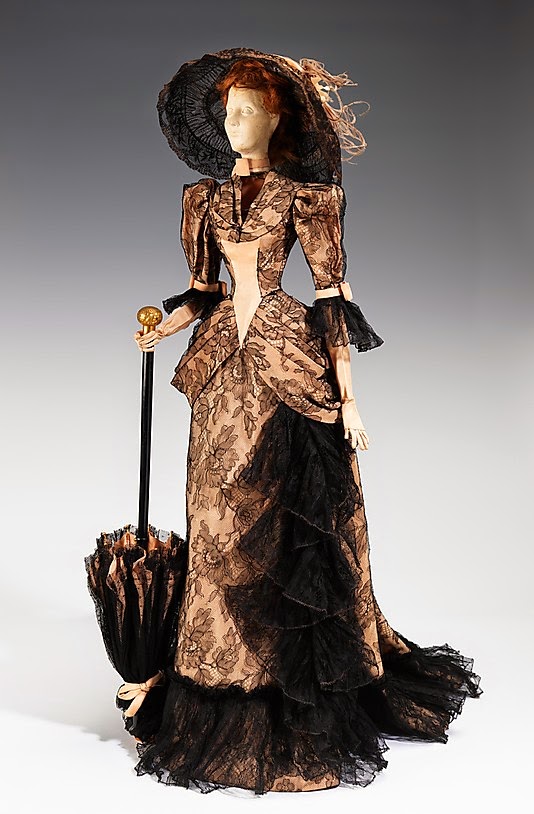
Bookmark this page, if you like 1890s dresses. I intend to keep adding to it. It is, as the title suggests, a collection of women's clothing from the 1890s.

I also strongly recommend browsing the 1890-91 H O'Neill & Co. Fall and Winter Catalogue.

Mary Harrison McKee's gown, 1889

1880s Bloomer Suit (typically used for cycling)
A Brighton Lady in a cycling costume (1889)

1889 Stern Brothers evening shoes
1889/90 evening dress
1890s cycling costume

1890 evening coat by House of Worth

1890 evening dress
1891 silk corset
1891 dress by Madame Clapham
1891 dress American
1891 dinner dress by House of Worth
1891 tea gown
Fashions for May 1891
1891 ensemble from the Metropolitan Museum of Art

Reception dress 1891/92
1892 dress
1892 evening dress by House of Worth
1892 ensemble by Germain Lecomte
1892 evening dress by House of Worth
1892 dress by House of Worth

1893 evening jacket

1893 dress by House of Worth
1893 dress
1893 House of Worth
1894 evening coat
House of Worth
1894 jacket
1894 parasol
1894 dress by Haas Brothers

1894 House of Worth
1894 afternoon ensemble
House of Worth
1894 carriage ensemble
House of Worth

1894 dress by House of Worth
1895 silk evening mantle by
House of Worth
1895 evening hat
1895 dress
1895 dress
1895 dress
1895 parasol
1895 House of Worth
1895 House of Worth
1895 jacket
House of Worth
1895 House of Worth
1896 dress (French)
French dressing gown
of Japanese silk (1896-98)
1896 evening dress
House of Worth
1896 dress by Madam Leonie Duboc
1896 evening gown by House of Worth
1896 day dress
1897 dress by House of Rouff
1897 walking dress
1897 day dress
1897 dress by Jaques Doucet
1897 day dress
1897 dress by House of Worth

1897 evening dress by House of Worth
1898 House of Worth
1898 House of Worth
1898 House of Worth
1898 dress
1898 fan by Tiffany & Co.
The Delineator June 1898

1898 evening dress by House of Worth
House of Worth evening dress (1890s)
1890s bathing suits
Follow me on Twitter @TinyApplePress and like the Facebook page for updates!