Showing posts with label Lord Alfred Douglas. Show all posts

Saturday, August 9, 2014

LGBT Writers in London in the 1890s

This short descriptive list should serve as a catalogue of LGBT writers, who were active in fin-de-siècle London - that is the London of the 1890s. The term "fin de siècle" here refers to the cultural trends of the 1880s and 1890s, including cynicism, and a rebellion against materialism, bourgeois society, liberal politics, and decadence.

This list does not include writers who were too young to be active - even if they were deeply influenced by the era, like Radcliffe Hall. Also, history has made assumptions about the sexuality of some of these writers because homosexuality - especially male homosexuality - was very taboo, especially post-1895. If there's anyone you think I should add to this list, leave a comment, or send me an email.

E.F. Benson
Edward Frederic Benson (1867-1940) was known professionally as E.F. Benson, but his friends called him Fred. He was 23 at the beginning of the decade, and wrote his first book, Dodo: A Detail of the Day (1893), while still a student at King's College. Dodo featured a portrait of the famous suffragette, Ethel Smyth.

Benson was a prolific writer and quickly followed Dodo up with a book per year for the rest of that decade, including: The Rubicon (1894), The Judgement Books (1895), Limitations (1896), The Babe, B.A. (1897), The Money Market (1898), The Vintage (1898), The Capsina (1899), and Mammon and Co. (1899).

Biographers assume that Benson was homosexual because he never married and his work is, at times, homoerotic. In addition to writing, Benson was a star athlete, who represented England at figure skating.

Samuel Butler
Samuel Butler (1835-1902) has made important contributions to the literary canon, most notably (in my opinion), his translations of the Iliad and Odyssey, which remain in use today. He was in his 50s and 60s, during the 1890s. In 1892, his first significant lover, Charles Pauli, died.

After profiting from the sale of a New Zealand farm in the 1860s, Butler began paying Pauli a regular pension, which he continued to do until Butler had spent all of his savings - even though their romance had ended. Shockingly, for Butler, when Pauli died, he learned that Pauli had similar arrangements with other men, and had died wealthy without leaving anything to Butler in his will.

Butler kept another lover on a salary as his literary assistant and travelling companion, but their relationship was not exclusive.

Butler's sentimental poem, "In Memoriam H.R.F," was written in 1895 for Hans Rudolf Faesch, a Swiss exchange student, who had stayed with him in London for two years. Butler had his aforementioned literary assistant, Henry Festing Jones, submit the poem for publication at several important English magazines, but withdrew the poem from publication when the Oscar Wilde trial began in the spring of that year, out of fear of similar persecution.

Butler believed the author of the Odyssey was a woman, and offered his evidence for this theory in The Authoress of the Odyssey (1897). His translation of the Iliad first appeared in 1898, and he published Shakespeare's Sonnets Reconsidered in 1899, in which he proposes that, if Shakespeare's sonnets are rearranged properly, they tell the story of a homosexual affair.

Edward Carpenter (right)
& George Merrill (left).
Edward Carpenter (1844-1929) was actually an early LGBT activist, as might be evidenced simply by reading a list of his 1890s writings.
From Adam's Peak to Elephanta: Sketches in Ceylon and India (1892)
A Visit to Ghani: From Adam's Peak to Elephanta (1892)
Homogenic Love and Its Place in a Free Society (1894)
Sex Love and Its Place in a Free Society (1894)
Marriage in Free Society (1894)
Love's Coming of Age (1896)
Angels' Wings: A Series of Essays on Art and its Relation to Life (1898)
Carpenter was close friends with Walt Whitman and Rabindranath Tagore. He was in his 40s and 50s during the 1890s, and travelled to Ceylon and India in 1890 to spend time with a Hindu teacher, Gnani, described in Adam's Peak to Elephanta (1892). Carpenter felt transformed by the experience, and converted to the belief that Socialism could produce a profoundly good shift in human consciousness, in which mankind would rediscover a primordial state of joy.
The meaning of the old religions will come back to him. On the high tops once more gathering he will celebrate with naked dances the glory of the human form and the great processions of the stars, or greet the bright horn of the young moon. - Edward Carpenter Civilisation: Its Cause and Cure (1889) 
Through his brand of socialism, Carpenter was inspired to campaign against air pollution, while promoting vegetarianism and opposing vivisection.

Carpenter met his life partner when he returned to London from India in 1891. Carpenter's partner, George Merrill was a working class man from Sheffield. In 1898, they moved in together defying contemporary sexual mores, as well as the British class system. Their relationship reflected Carpenter's convictions about same-sex love and his belief that gay culture would radically change their society.

Carpenter's writing is anti-capitalist. He supported Fred Charles of the Walsall Anarchists in 1892, before becoming a founder member of the Independent Labour Party in 1893.

Marie Corelli
Marie Corelli (1855-1924) was famous, like Oprah; I've mentioned her before. She was the "Idol of Suburbia," and, like many writers from the 1890s, her biographers only guess at her sexuality based on the circumstances of her life, such as her companion, Bertha Vyver.

"Vyver and Corekki may be understood as devoted companions, sexual lovers, or romantic friends, sisters, mother and daughter, or even guardian angel and inspired genius. There are so many kinds of relationships, after all," writes biographer, Annette Fredrico, "Certainly Corelli's relationship with Vyver strengthened her faith in women's self-sufficiency and limitless capabilities for achievement."

Corelli favoured spiritual themes in her writing, such as astral projection, and her work is seen as groundbreaking for contemporary New Age religion. She had four novels under her belt by the 1890s, and kept on going with: Wormwood: A Drama of Paris (1890), The Soul of Lilith (1892), Barabbas, A Dream of the World's Tragedy (1893), The Sorrows of Satan (1895), The Mighty Atom (1896), The Murder of Delicia (1896), Ziska (1897), and two short story collections.

Nine film adaptations were made from her books between 1915 and 1926.

The Young Diana (1922)
A Marie Corelli inspired film.
The Sorrows of Satan (1926) Another Marie Corelli inspired film.
Lord Alfred Douglas
Lord Alfred Douglas (1870-1945) a.k.a. "Bosie" or the bloke who ruined Oscar Wilde's life; I don't like him one little bit, but he was an active gay writer in the 1890s, so I feel I ought to mention him.

Douglas and Wilde met in 1891. Robert Hichens' novel, The Green Carnation (1894), was said to be based on Wilde and Douglas's relationship; it was one of the texts used against Wilde in court.

Douglas was editor of the Oxford magazine, The Spirit Lamp, which he used to covertly gain acceptance for homosexuality. Wilde wrote Salomé originally in French, and commissioned Douglas to translate it in 1893. Douglas's French was bad, so his translation was met with scrutiny. Douglas didn't take criticism well, and claimed the errors were in the original play, which lead to one of many temporary breakdowns in their ever turbulent romance.

One story goes, Douglas got sick with the flu and needed Wilde to nurse him. When he got better, Wilde had got the same flu. Instead of taking care of Wilde as Wilde took care of him, Dougas checked into a hotel and sent Wilde the bill.

Douglas also had a careless habit of leaving Wilde's incriminating letters in old clothes that he gave to male prostitutes, leading to blackmail. Of course, Douglas's father, the Marquess of Queensbury, soon discovered the relationship, leading to Wilde's infamous trials and eventual imprisonment.

Signed copy of Douglas's autobiography.
Still, Douglas managed to be the chief mourner at Wilde's funeral at the end of the decade. Soon after, he would meet and marry a rich poet, decide that homosexuality was evil, and persecute more gay men in court. I do not like him, not one little bit.

E.M. Forster
Edward Morgan Forster (1879-1970) is best known for his novel, A Passage to India (1924). I'm still not sure I should include him in this list because he was so young and still at school, but he was attending King's College. While at school, he joined a society called the Apostles (formally the Cambridge Conversazione Society). Its former members went on to establish the Bloomsbury Group, an influential group of associated writers, intellectuals, philosophers and artists, including Forster and Virginia Woolf (who is only three years younger than Forster, but I have to cut off who I'm including in this list somewhere).

Forster was open about his sexuality to his friends, and closed to the public. The love of his life was a married police officer.

A.E. Housman at age 35.
Alfred Edward Housman (1859-1936) was already one of the foremost classicists in the 1890s, and just in his 30s. He has also been ranked one of the greatest scholars who ever lived. He was a classicist and poet, best known for his cycle of poems, A Shropshire Lad (1896).

In the 1890s, Housman was recovering from unrequited love: his college roommate Moses jackson, who married without telling him in 1889, and died in 1892. By that time, Housman's professional reputation had grown such that he was offered professorship of Latin at University College, London, which he accepted.

He liked going to France to read books that were banned in Britain.

Mostly while living in Highgate, London, Housman worked on A Shropshire Lad, a cycle of 63 poems. After being rejected by publishers, he self-published in 1896. After a slow start, it became a lasting success, and has been in print continuously since May 1896.

W. Somerset Maugham as a medical student.
William Somerset Maugham (1874-1965) was young in the 1890s (teens and twenties), playing doctor, until his first novel, Liza of Lambeth (1897) sold out, and he decided to be a writer instead.

As a medical student, Maugham was very self-sufficient and productive, he kept his own place, loved decorating it, though it was cluttered with notebooks full of ideas, and wrote nightly while going to school. What he loved most about being in London was that he got to meet people of a different class that he wouldn't have got to meet otherwise. This was carried forward into his first novel, which is about the consequences of working-class adultery.

When Liza of Lambeth sold out in just a few weeks, he dropped medicine, and devoted his working life to writing.

Walter Pater (1890s)
Walter Horatio Pater (1839-1894) was already a literary celebrity in the 1890s, teaching at Oxford and living with his sisters in Kensington between terms. His 1893 piece on Mona Lisa is considered the most famous piece of writing about any picture in the world: "She is older than the rocks among which she sits; like the vampire, she has been dead many times, and learned the secrets of the grave..."

Pater was one of the founding thinkers of the Aesthetic Movement. Oscar paid tribute to him in The Critic as Artist (1891). Though, Pater wrote a negative review of Oscar Wilde's The Picture of Dorian Gray (1891):
A true Epicureanism aims at a complete though harmonious development of man's entire organism. To lose the moral sense therefore, for instance the sense of sin and righteousness, as Mr. Wilde's heroes are bent on doing so speedily, as completely as they can, is ... to become less complex, to pass from a higher to a lower degree of development.
To be fair, the character, Lord Henry Wonton, willfully and incessantly misquoted Pater throughout the book.

In 1893, he moved his sisters to Oxford, where he was in high demand as a lecturer. He died in that home of heart failure due to rheumatic fever at the age of 54.

Henry James (left), Edith Wharton (middle),
Howard Sturrgis (right).
Howard Overing Sturgis (1855-1920) was the kind of guy who waited until his mom died before moving in with his boyfriend, and it's safe to say that the 1890s were his glory days.

Sturgis was raised in an upper middle class family, attended Eton and Cambridge, and his brother, Julian, also became a novelist. When his mother died in 1888, he moved into a lovely country house with William Haynes-Smith, his lover. I get the sense that Sturgis finally felt free of his family's expectations of him, and he wrote his first novel, Time: A Story of School Life (1891), dedicated to "love that surpasses the love of women." Of course, it's set at a boys boarding school.

Sturgis was friends with Henry James and Edith Wharton. His first two novels sold successfully, but his third petered off. Although Wharton praised it, James called it "unsatisfactory," leading Sturgis's enthusiasm for writing to wane at the beginning of the next century.

Algernon Swinburne
Algernon Charles Swinburne (1837-1909) was a poet, playwright, novelist, and critic; he even contributed to the Eleventh Edition of the Encyclopædia Britannica. He was nominated for the Nobel Prize in Literature in every year from 1903 to 1907 and again in 1909. According to Oscar Wilde, Swinburne was "a braggart in matters of vice, who had done everything he could to convince his fellow citizens of his homosexuality and bestiality without being in the slightest degree a homosexual or a bestializer."

By the 1890s, Swinburne was a mature writer, who spent very little time in London, unlike Wilde. Swinburne had already faced an early death by alcoholism, and overcame it with the help of his mother, sister, and close friend, Theodore Watts-Dunton.

It's said that his poetry suffered after he settled down, but that has also been attributed to his age.

Renée Vivien & Natalie
Clifford Barney
Renée Vivien was born Pauline Mary Tarn (1877-1909), and although she was British, she wrote in French, adopting the mannerisms of Symbolism, as one of the last poets to claim allegiance to the school.

Pauline's father died when she was 9, leaving her everything. Consequently, he mother tried to have her declared insane, so that she could claim the money for herself, but the courts saw through her mother's scheme, and place Vivien in protective care until she reached the age of 21.

In 1898, she inherited her father's fortune, and emigrated to Paris, where it was much easier for women to be involved in the Bohemian arts movement.

It would seem that any time Vivien spent in London before inheriting her independence, was about biding her time until she could become who she truly was. In Paris, Vivien lived lavishly, as an open lesbian, and had a public affair with American heiress and writer Natalie Clifford Barney. She travelled extensively, wintering in Egypt, and exploring China and the Middle East, as well as Europe and America. Contemporaries called her beautiful and elegant, with blonde hair, brown eyes flecked with gold, and a soft-spoken androgynous presence. She wore expensive clothes and particularly loved Lalique jewelry.

Oscar Wilde
Oscar Fingal O'Flahertie Wills Wilde (1854-1900) appears at the end of this list, not because I am saving the best for last, but because I've tried to write this list alphabetically. Wilde is certainly the most famous homosexual in London in the 1890s, a decade which would encompass the best and worst years of his life.

By the time the decade started, Wilde was living in "House Beautiful" on Tite Street with his wife and two young sons. The marriage had problems, most specifically that Wilde wasn't sexually attracted to his wife, after she bore his children, so he started seeing men.

Wilde published his first and only novel in 1890, then began his theatrical career, which produced some of the most witty and quotable plays of all time.

As I mentioned before, Wilde had an affair with the reckless and spoiled Lord Alfred Douglas, whose father found out about the affair, leading to Wilde's imprisonment. The affect of this trial on the gay community and the world cannot be understated. Not only did it drive some homosexuals into hiding,  like Samuel Butler, who withdrew a homoerotic poem that he had submitted for publication, but Wilde's association with homosexuality would code homosexual culture for many years to come.

Wilde had a very identifiable personality, which ever after became associated with homosexual behaviour. Wilde was flamboyant, witty, obsessed with the most minute detail of decorating "House Beautiful," obsessed with his own clothes, as well as the clothes of women. It might be said that the more a homosexual man assimilates his behaviour to Wilde's the more likely it is that he will be identified as "flaming," even today.

Follow me on Twitter @TinyApplePress and like the Facebook page for updates!

Thursday, November 21, 2013

The Battle for Reading Gaol


The historic prison that once housed Oscar Wilde is scheduled to close today. Students of Victorian literature will forever remember the name of the place. Wilde made it the subject of his Ballad of Reading Gaol. The Oscar Wilde Society wants to save Reading Gaol. While I’m a lover of history and an admirer of the Oscar Wilde Society, I’m not sure I would like Reading Gaol to remain standing.

Wilde served two years hard labour there in the 1890s, after being found guilty of gross indecency for his relationship with Alfred Douglas. To me, this marks Reading Gaol as a historic sight of injustice and I believe there are too many of these sites in the history of homophobia already.

I do not mean to say that we should forget history that unsettles us, but I would like landmarks to lead us toward a brighter future, while celebrating the triumphs of the oppressed against certain hardship. Moreover, I can’t imagine Oscar Wilde would want that prison left standing.

I never saw a man who looked 
With such a wistful eye 
Upon that little tent of blue 
Which prisoners call the sky, 
And at every drifting cloud that went 
With sails of silver by. 

I walked, with other souls in pain, 
Within another ring, 
And was wondering if the man had done 
A great or little thing, 
When a voice behind me whispered low, 
"That fellows got to swing." 

Dear Christ! the very prison walls 
Suddenly seemed to reel, 
And the sky above my head became 
Like a casque of scorching steel; 
And, though I was a soul in pain, 
My pain I could not feel. 
- Oscar Wilde from the Ballad of Reading Gaol

Follow me on Twitter @TinyApplePress and like the Facebook page for updates!

Thursday, July 18, 2013

The Savoy Hotel


Though many writers in the 1890s were starving artists to be sure, some writers grew very wealthy. Oscar Wilde is certainly an example of that kind of success and the lifestyle that went with it, though, to some degree, that was by design when it came to the Savoy Hotel in London.


Not only is the Savoy Hotel a landmark in the history of writers in London in the 1890s, it is also an important place in the history of luxury hotels. In the hotel industry, "everything that’s happened in high-end hotels since the 1890s is arguably just a variation on a theme introduced by César Ritz, the Savoy’s original general manager, who counts electric lights and en-suite bathrooms among his hospitality innovations." I call that putting on the ritz!

Ritz's innovations attracted the rich and famous, which, despite the myth of the starving artist, included many members of the arts communities.

Claud Monet's Waterloo Bridge series was painted in room 618 in 1901.


This lithograph by James Whistler represents the view from his room at the Sovoy Hotel in 1896.


Sarah Bernhardt, H. G. Wells, George Bernard Shaw, and future Kind Edward V11 were also early guests, after the hotel opened in 1889. Though due the scandalous trial, Lord Alfred Douglas and Oscar Wilde are arguably the most well-known occupants of this period.

Ever the critic, Wilde wasn't as awe-struck or impressed with the hotel, in spite of how hard Ritz and his staff worked to accommodate its influential and often choosy guests. The Savoy Hotel kept records of guests’ particular preferences in order to provide them in advance. The staff made hospitality history as the first to photograph a guest's toiletries so they might arrange them accordingly in his washroom. The staff provided a fireproof eiderdown to another guest, who liked to smoke in bed. Wilde, however, scoffed at the very idea cold and hot indoor plumbing at the Savoy:
What is it good for? If I want hot water, I call for it.
The grounds of the Savoy Hotel have a long history of decadence, dating back to 1126 when Peter, Count of Savoy, built his palace there (also called Savoy). The Savoy Palace became the greatest house in England, during medieval times, known as a centre for art and culture. Geoffrey Chaucer began writing his Canterbury Tales, while in residence there. During its lifetime, the Savoy Palace housed the Dukes of Lancaster. The youngest son of King Edward III was living there, when it was destroyed in the peasants revolt of 1381.


Six-hundred years later, Richard D’oyly Carte opened the Savoy theatre on the site, as a showcase for the works of Gilbert and Sullivan. Gilbert and Sullivan's operas proved to be such a success, that D'oyly Carte built the Savoy Hotel next door in 1889 - enter our writers!

Wilde's connections to Gilbert and Sullivan were numerous and D'oyly Carte had organized his 1881 American Tour. They all wanted Wilde, the celebrity aesthete and socialite, as a patron at the Savoy and an all-purpose party guest. Sadly, we know so much about Wilde's days at the Savoy Hotel because they were recounted for his damning trials.

His homosexual affair with Lord Alfred ‘Bosie’ Douglas brought his flamboyant lifestyle at The Savoy to a bitter end. He had taken adjoining rooms on the third floor for himself and Lord Douglas. After a ‘wilde’ time, Douglas left the hotel and Wilde moved into a suite overlooking the river. He then wrote to Douglas: ‘Dearest of Boys, Your letter was delightful, red and yellow wine to me; but I am sad and out of sorts. I must see you soon. You are the divine thing I want, the thing of grace and beauty. My bill here is £49 for a week. I fear I must leave—no money, no credit, and a heart of lead.’
Bosie’s father took his son’s homosexual relations with Wilde as a personal affront and instituted legal proceedings. In one of the most sensational trials of the 19 century, Oscar Wilde was charged in 1895 with committing acts of ‘gross indecency’ with a string of young men. A handful of Savoy employees were among the key witnesses for the prosecution.
Wilde was found guilty and sentenced to two years’ hard labour. Thus, the hotel lost one of its most flamboyant guests. After his release from prison, Wilde left England and wandered around Europe for what were to be the last three years of his life. He died in 1900, at another hotel, the Hotel d’Alsace in Paris.
This - his last - hotel stay brought us his famous comment: “This wallpaper will be the death of me: one of us will have to go.” http://www.famoushotels.org/article/1189

Follow me on Twitter @TinyApplePress and like the Facebook page  for updates!

Tuesday, February 5, 2013

The Cigarette Case


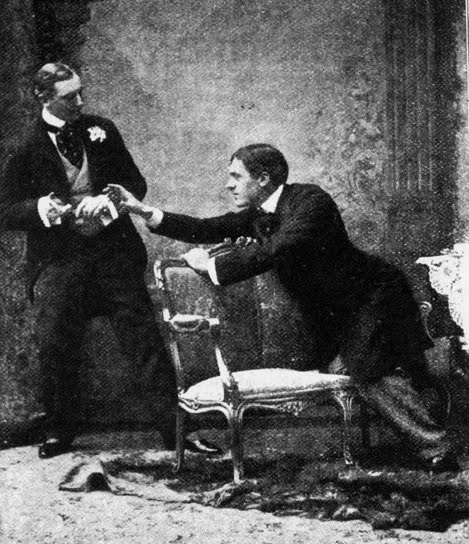
The following is one of my many favorite scenes from the Importance of Being Earnest.
Algernon. Bring me that cigarette case Mr. Worthing left in the smoking-room the last time he dined here.
Lane. Yes, sir. [Lane goes out.]
Jack. Do you mean to say you have had my cigarette case all this time? I wish to goodness you had let me know. I have been writing frantic letters to Scotland Yard about it. I was very nearly offering a large reward.
Algernon. Well, I wish you would offer one. I happen to be more than usually hard up.
Jack. There is no good offering a large reward now that the thing is found.
[Enter Lane with the cigarette case on a salver. Algernon takes it at once. Lane goes out.]
Algernon. I think that is rather mean of you, Ernest, I must say. [Opens case and examines it.] However, it makes no matter, for, now that I look at the inscription inside, I find that the thing isn’t yours after all.
Jack. Of course it’s mine. [Moving to him.] You have seen me with it a hundred times, and you have no right whatsoever to read what is written inside. It is a very ungentlemanly thing to read a private cigarette case.
Algernon. Oh! it is absurd to have a hard and fast rule about what one should read and what one shouldn’t. More than half of modern culture depends on what one shouldn’t read.
Jack. I am quite aware of the fact, and I don’t propose to discuss modern culture. It isn’t the sort of thing one should talk of in private. I simply want my cigarette case back.
Algernon. Yes; but this isn’t your cigarette case. This cigarette case is a present from some one of the name of Cecily, and you said you didn’t know any one of that name.
Jack. Well, if you want to know, Cecily happens to be my aunt.
Algernon. Your aunt!
Jack. Yes. Charming old lady she is, too. Lives at Tunbridge Wells. Just give it back to me, Algy.
Algernon. [Retreating to back of sofa.] But why does she call herself little Cecily if she is your aunt and lives at Tunbridge Wells? [Reading.] ‘From little Cecily with her fondest love.’
Jack. [Moving to sofa and kneeling upon it.] My dear fellow, what on earth is there in that? Some aunts are tall, some aunts are not tall. That is a matter that surely an aunt may be allowed to decide for herself. You seem to think that every aunt should be exactly like your aunt! That is absurd! For Heaven’s sake give me back my cigarette case. [Follows Algernon round the room.]
Algernon. Yes. But why does your aunt call you her uncle? ‘From little Cecily, with her fondest love to her dear Uncle Jack.’ There is no objection, I admit, to an aunt being a small aunt, but why an aunt, no matter what her size may be, should call her own nephew her uncle, I can’t quite make out. Besides, your name isn’t Jack at all; it is Ernest.
Jack. It isn’t Ernest; it’s Jack.
It's even a more interesting read, now that I know that Oscar Wilde really was writing about himself and his brother in this play. In writing it, Oscar saw himself as Jack and his brother, Willie, as Algernon. It's interesting, to me, that Oscar paints himself on the receiving end of a cigarette case as a present, when he was known to give them as gifts, especially to his male lovers. Interesting too that the cigarette case that he was given exposes his secret.

Before Importance of Being Earnest went on stage, Oscar had to testify about cigarette cases before the courts, during his infamous trials. 
Mr. C. F. Gill--You made handsome presents to all these young fellows?
Oscar Wilde--Pardon me, I differ. I gave two or three of them a cigarette case: Boys of that class smoke a good deal of cigarettes. I have a weakness for presenting my acquaintances with cigarette cases.
Mr. C. F. Gill--Rather an expensive habit if indulged in indiscriminately, isn't it?
Oscar Wilde--Less extravagant than giving jewelled garters to ladies. (Laughter.)
Oscar's weakness for presenting people with cigarette cases was performed as a sign of affection. It's a quiet aim of mine to keep all of this month's posts on the romantic side and I do like this idea that Oscar had a sort of trademark gift for his friends.

It's also nice to know that some people gave him cigarette cases in return. Two years ago, the cigarette case Oscar got from Bosie was displayed at the BADA Antiques and Fine Art Fair and is pictured (below).

Follow me on Twitter @TinyApplePress and like the Facebook page for updates!