Saturday, June 21, 2014

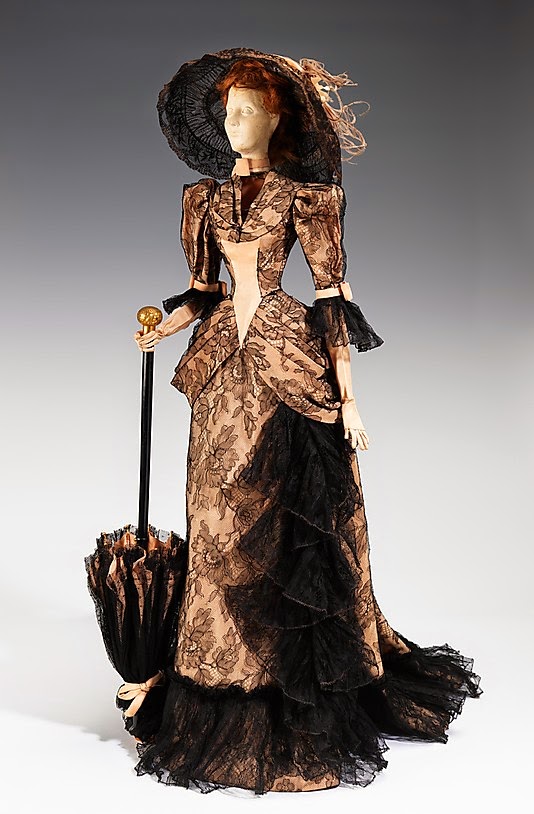
1890s Women's Fashion

Bookmark this page, if you like 1890s dresses. I intend to keep adding to it. It is, as the title suggests, a collection of women's clothing from the 1890s.

I also strongly recommend browsing the 1890-91 H O'Neill & Co. Fall and Winter Catalogue.

Mary Harrison McKee's gown, 1889

1880s Bloomer Suit (typically used for cycling)
A Brighton Lady in a cycling costume (1889)

1889 Stern Brothers evening shoes
1889/90 evening dress
1890s cycling costume

1890 evening coat by House of Worth

1890 evening dress
1891 silk corset
1891 dress by Madame Clapham
1891 dress American
1891 dinner dress by House of Worth
1891 tea gown
Fashions for May 1891
1891 ensemble from the Metropolitan Museum of Art

Reception dress 1891/92
1892 dress
1892 evening dress by House of Worth
1892 ensemble by Germain Lecomte
1892 evening dress by House of Worth
1892 dress by House of Worth

1893 evening jacket

1893 dress by House of Worth
1893 dress
1893 House of Worth
1894 evening coat
House of Worth
1894 jacket
1894 parasol
1894 dress by Haas Brothers

1894 House of Worth
1894 afternoon ensemble
House of Worth
1894 carriage ensemble
House of Worth

1894 dress by House of Worth
1895 silk evening mantle by
House of Worth
1895 evening hat
1895 dress
1895 dress
1895 dress
1895 parasol
1895 House of Worth
1895 House of Worth
1895 jacket
House of Worth
1895 House of Worth
1896 dress (French)
French dressing gown
of Japanese silk (1896-98)
1896 evening dress
House of Worth
1896 dress by Madam Leonie Duboc
1896 evening gown by House of Worth
1896 day dress
1897 dress by House of Rouff
1897 walking dress
1897 day dress
1897 dress by Jaques Doucet
1897 day dress
1897 dress by House of Worth

1897 evening dress by House of Worth
1898 House of Worth
1898 House of Worth
1898 House of Worth
1898 dress
1898 fan by Tiffany & Co.
The Delineator June 1898

1898 evening dress by House of Worth
House of Worth evening dress (1890s)
1890s bathing suits
Follow me on Twitter @TinyApplePress and like the Facebook page for updates!

Thursday, June 19, 2014

1890s Cats

Trying to write and my cat just will not leave me alone, so I'm posting some pictures of 1890s cats. Naturally, people have always loved cats. In 1893, Harry S. Miller wrote "The Cat Came Back." The world's first cat video was made in 1894, as well as the boxing cat video.

Cat and dog (1889)

A Small Girl with a Cat, 1889 Giclee Print


Jeppe the Cat by Bruno Liljefors (1889)
Mrs Armitage's Siamese cat (1890)
Little girl with two cats (1891).
Amelia Van Buren sitting with cat on shoulder (1891).
This is how I feel with my laptop today.
The Book of Pussy Cats (1891).
From the boxing cats video (1894).
Cat walking in snow (1895).
The Cat (1895).
Cosey, the winner of the first American
National Cat Show (1895).


A trio of cats (1897)
Painting by Felix Edouard (1898).
Photograph by Clara Middleton (1897).
Woman holding up cat (1897).
Reading while churning butter
(with cat taking care of splashes), 1897.
 Taken in 1898 and entitled "The Rogues Gallery."
Sailor with a ships cat aboard the cruiser Olympia, circa 1898. 
1899 Cat postcard.
Fancy Cat (1899)
Cat knitting (1899)
French Cat (1899).

If you enjoyed this post, here is another blog you will probably enjoy!

Follow me on Twitter @TinyApplePress and like the Facebook page for updates!

Wednesday, June 18, 2014

The Triumphs of a Taxidermist

I usually love the macabre, but my husband thinks taxidermy is appalling. After reading H.G. Wells' The Triumphs of a Taxidermist (1894), I have to agree with him.

The Golden Age of Taxidermy began with the Great Exhibition of 1851 in London. An English ornithologist, John Hancock created a display of birds that won much praise all around, but especially in scientific circles. The public was hooked.

Great Auk and egg, as you will read about in "The Triumphs of a Taxidermist."
Like pop art a hundred years later, taxidermy birds began popping up in middle-class homes. Queen Victoria even amassed a collection. 

Of course, taxidermy was not limited to birds. Anthropomorphic taxidermy sought to express the whimsy of the time, by dressing and posing animals as humans. Taxidermists, like Walter Potter, created dioramas that were celebrated in artistic circles... though, it appears, not by 1890s writers, critical of English society.

Walter Potter's Rabbit School
The future Wells envisions for a talented taxidermist is horrifying and certainly develops the shrinking divide between human and animal within the art form. When Oscar Wilde criticizes his contemporaries in his fiction, we laugh, but reading this story makes me feel that Wells was forced to live among some truly horrid people. Brace yourself and read on.
THE TRIUMPHS OF A TAXIDERMIST 
Here are some of the secrets of taxidermy. They were told me by the taxidermist in a mood of elation. He told me them in the time between the first glass of whisky and the fourth, when a man is no longer cautious and yet not drunk. We sat in his den together; his library it was, his sitting and his eating-room--separated by a bead curtain, so far as the sense of sight went, from the noisome den where he plied his trade. 
He sat on a deck chair, and when he was not tapping refractory bits of coal with them, he kept his feet--on which he wore, after the manner of sandals, the holey relics of a pair of carpet slippers--out of the way upon the mantelpiece, among the glass eyes. And his trousers, by-the-bye--though they have nothing to do with his triumphs--were a most horrible yellow plaid, such as they made when our fathers wore side-whiskers and there were crinolines in the land. Further, his hair was black, his face rosy, and his eye a fiery brown; and his coat was chiefly of grease upon a basis of velveteen. And his pipe had a bowl of china showing the Graces, and his spectacles were always askew, the left eye glaring nakedly at you, small and penetrating; the right, seen through a glass darkly, magnified and mild. Thus his discourse ran: "There never was a man who could stuff like me, Bellows, never. I have stuffed elephants and I have stuffed moths, and the things, have looked all the livelier and better for it. And I have stuffed human beings--chiefly amateur ornithologists. But I stuffed a nigger once. 
"No, there is no law against it. I made him with all his fingers out and used him as a hat-rack, but that fool Homersby got up a quarrel with him late one night and spoilt him. That was before your time. It is hard to get skins, or I would have another. 
"Unpleasant? I don't see it. Seems to me taxidermy is a promising third course to burial or cremation. You could keep all your dear ones by you. Bric-a-brac of that sort stuck about the house would be as good as most company, and much less expensive. You might have them fitted up with clockwork to do things. 
"Of course they would have to be varnished, but they need not shine more than lots of people do naturally. Old Manningtree's bald head...Anyhow, you could talk to them without interruption. Even aunts. There is a great future before taxidermy, depend upon it. There is fossils again...." 
He suddenly became silent. 
"No, I don't think I ought to tell you that." He sucked at his pipe thoughtfully. "Thanks, yes. Not too much water." 
"Of course, what I tell you now will go no further. You know I have made some dodos and a great auk? No! Evidently you are an amateur at taxidermy. My dear fellow, half the great auks in the world are about as genuine as the handkerchief of Saint Veronica, as the Holy Coat of Treves. We make 'em of grebes' feathers and the like. And the great auk's eggs too!" 
"Good heavens!" 
"Yes, we make them out of fine porcelain. I tell you it is worth while. They fetch--one fetched L300 only the other day. That one was really genuine, I believe, but of course one is never certain. It is very fine work, and afterwards you have to get them dusty, for no one who owns one of these precious eggs has ever the temerity to clean the thing. That's the beauty of the business. Even if they suspect an egg they do not like to examine it too closely. It's such brittle capital at the best. 
"You did not know that taxidermy rose to heights like that. My boy, it has risen higher. I have rivalled the hands of Nature herself. One of the genuine great auks--" his voice fell to a whisper--"one of the genuine great auks was made by me. 
"No. You must study ornithology, and find out which it is yourself. And what is more, I have been approached by a syndicate of dealers to stock one of the unexplored skerries to the north of Iceland with specimens. I may--some day. But I have another little thing in hand just now. Ever heard of the dinornis? 
"It is one of those big birds recently extinct in New Zealand. 'Moa' is its common name, so called because extinct: there is no moa now. See? Well, they have got bones of it, and from some of the marshes even feathers and dried bits of skin. Now, I am going to--well, there is no need to make any bones about it--going to forge a complete stuffed moa. I know a chap out there who will pretend to make the find in a kind of antiseptic swamp, and say he stuffed it at once, as it threatened to fall to pieces. The feathers are peculiar, but I have got a simply lovely way of dodging up singed bits of ostrich plume. Yes, that is the new smell you noticed. They can only discover the fraud with a microscope, and they will hardly care to pull a nice specimen to bits for that. 
"In this way, you see, I give my little push in the advancement of science. 
"But all this is merely imitating Nature. I have done more than that in my time. I have--beaten her." 
He took his feet down from the mantel-board, and leant over confidentially towards me. "I have created birds," he said in a low voice. "New birds. Improvements. Like no birds that was ever seen before." 
He resumed his attitude during an impressive silence. 
"Enrich the universe; rather. Some of the birds I made were new kinds of humming birds, and very beautiful little things, but some of them were simply rum. The rummest, I think, was the Anomalopteryx Jejuna. Jejunus-a-um--empty--so called because there was really nothing in it; a thoroughly empty bird--except for stuffing. Old Javvers has the thing now, and I suppose he is almost as proud of it as I am. It is a masterpiece, Bellows. It has all the silly clumsiness of your pelican, all the solemn want of dignity of your parrot, all the gaunt ungainliness of a flamingo, with all the extravagant chromatic conflict of a mandarin duck. Such a bird. I made it out of the skeletons of a stork and a toucan and a job lot of feathers. Taxidermy of that kind is just pure joy, Bellows, to a real artist in the art. 
"How did I come to make it? Simple enough, as all great inventions are. One of those young genii who write us Science Notes in the papers got hold of a German pamphlet about the birds of New Zealand, and translated some of it by means of a dictionary and his mother-wit--he must have been one of a very large family with a small mother--and he got mixed between the living apteryx and the extinct anomalopteryx; talked about a bird five feet high, living in the jungles of the North Island, rare, shy, specimens difficult to obtain, and so on. Javvers, who even for a collector, is a miraculously ignorant man, read these paragraphs, and swore he would have the thing at any price. Raided the dealers with enquiries. It shows what a man can do by persistence--will-power. Here was a bird-collector swearing he would have a specimen of a bird that did not exist, that never had existed, and which for very shame of its own profane ungainliness, probably would not exist now if it could help itself. And he got it. He got it. 
"Have some more whisky, Bellows?" said the taxidermist, rousing himself from a transient contemplation of the mysteries of will-power and the collecting turn of mind. And, replenished, he proceeded to tell me of how he concocted a most attractive mermaid, and how an itinerant preacher, who could not get an audience because of it, smashed it because it was idolatry, or worse, at Burslem Wakes. But as the conversation of all the parties to this transaction, creator, would-be preserver, and destroyer, was uniformly unfit for publication, this cheerful incident must still remain unprinted. 
The reader unacquainted with the dark ways of the collector may perhaps be inclined to doubt my taxidermist, but so far as great auks' eggs, and the bogus stuffed birds are concerned, I find that he has the confirmation of distinguished ornithological writers. And the note about the New Zealand bird certainly appeared in a morning paper of unblemished reputation, for the taxidermist keeps a copy and has shown it to me.
Follow me on Twitter @TinyApplePress and like the Facebook page for updates!

Tuesday, June 17, 2014

Sherlock Holmes and Retired Copyright

Thanks to a legal battle between author, Leslie Klinger, and the estate of Sir Arthur Conan Doyle, the tales of Sherlock Holmes are now in the public domain. What does that mean?


Works are moved from their protective copyright status to the public domain to balance the public’s interest in open access with the property interest of copyright holders. Overwhelmingly, works in the public domain are so old that their intellectual property rights are no longer applicable. Most of the works discussed in this blog are part of the public domain because enough time has passed since they were first published. Likewise, most of the Sherlock Holmes stories were already in the public domain before Klinger took the estate to court.

Sherlock Holmes became a literary sensation in the 1890s, the thirst for which didn’t dry up when the decade ended. To feed public demand, Conan Doyle continued writing and publishing Sherlock Holmes mysteries until 1927. While most of the Sherlock Holmes canon was moved into the public domain, appearing on public domain web sites, like Project Gutenberg, stories published between 1923 and 1927 were still protected under US copyright law.

The legal status of these last ten Sherlock Holmes stories complicated the legal status of the rest of the Sherlock Holmes stories because characters in fiction are part of a work’s intellectual property. When Klinger published his previous books, inspired by Conan Doyle, she had to pay a fee to his estate. Upon the publication of her second book, she decided to challenge the copyright status and won, thereby moving the complete set of Sherlock Holmes stories into the public domain.


These controls over intellectual property influence the portrayal of characters, who have become classic tropes throughout literature and film. For instance, the Bram Stoker estate tried, but failed to maintain the kind of control over portrayals of Dracula that Conan Doyle’s estate maintained over Sherlock Holmes. As a result, we see rich and varied interpretations of Dracula’s character in literature and film dating back to the 1920s. Conan Doyle’s heirs previously controlled and restricted the ways in which Sherlock Holmes could be interpreted. It will be fascinating to see what happens next!

Follow me on Twitter @TinyApplePress and like the Facebook page for updates!

Thursday, June 12, 2014

1890s Problems: Horse Poop


Horse poop is not something we associate as a problem of modern city life, but in 1890s London that was not the case. In 1894, the Times of London estimated that by 1950 the streets of London would be buried nine feet deep in horse manure.


In the early days of the Industrial Revolution, horses were still key to the day to day operations of most major cities. If people and goods weren't being moved around by trains or manpower, they were drawn by horses. Approximately 10,000 taxis needed horses to pull them. Thousands of buses moved Londoners around the city, and each of those needed 12 horses a day to move them. Add to that private carriages and carts used to move goods, and you can start to imagine the poop piling up.


The great horse manure crisis wasn't as bad as it seemed, though people worried about it enough to warrant a story in the Times. Removing the poop from the street kept block boys gainfully employed, and the problem was replaced with a new one horses were replaced with automobiles.


Follow me on Twitter @TinyApplePress and like the Facebook page for updates!

Thursday, May 29, 2014

Children in Prison and Other Cruelties of Prison Life by Oscar Wilde


On 25 May 1895, at the height of his career, Oscar Wilde was convicted of gross indecency and sentenced to two years' hard labour. Wilde and his fellow inmates faced a regimen of "hard labour, hard fare and a hard bed." Accustomed to all of the finest things in life and utterly shunned by the public, who once adored him, Wilde simply could not bare prison life. His health declined sharply, and that November he collapsed from illness and hunger, rupturing his right ear drum in the fall. Within a few short years this injury would lead to his death.

After serving his sentence, Wilde remained concerned for some of the younger inmates at Reading Gaol. In February 1898, he published "Children in Prison and Other Cruelties of Prison Life." The publisher's note appears as follows:


The pamphlet begins by addressing the editor of the Daily Chronicle:
Sir, - I learn with great regret, through an extract from the columns of your paper, that the warder Martin, of Reading Prison, has been dismissed by the Prison Commissioners for having given some sweet biscuits to a little hungry child. I saw the three children myself on the Monday preceding my release. They had just been convicted, and were standing in a row in the central hall in their prison dress, carrying their sheets under the arms previous to their being sent to the cells allotted to them. I happened to passing along one of the galleries on my way to the reception room, where I was to have an interview with a friend. They were quite small children, the youngest - the one to whom the warder gave the biscuits - being a tiny little chap, for whom they had evidently been unable to find clothes small enough to fit. I had, of course, seen many children in prison during the two years during which I myself was confined. Wandsworth Prison, especially, contained always a large number of children. But the little child I saw on the afternoon of Monday, the 17th at Reading, was tinier than any one of them. I need not say how utterly distressed I was to see these children at Reading, for I knew the treatment inshore for them...
Wilde published Children in Prison as an attempt to publicize and promote action to end the scandal of child prisoners incarcerated in British jails. The pamphlet was first published in letter form to the editor of the Daily Chronicle newspaper in 1897. In prison Wilde saw the many young boys locked up with adults, who posed various dangers to the young boys, causing them ‘sheer terror.’ Many children were locked away in near darkness for 23 hours each day, and fed only on water and ‘badly baked’ bread.

To draw attention to the scandal, Wilde describes the case of warden Thomas Martin, who was dismissed from his post for offering a biscuit to a child found to be ‘crying with hunger’. Wilde advocated that no child be imprisoned for any reason if they were less than 14 years old.

You can see the entire pamphlet online through the British Library. The library has introduced a wonderful new resource, "Discovering Literature: Romantics and Victorians," which makes available over 1,200 Romantic and Victorian Literary treasures.

Follow me on Twitter @TinyApplePress and like the Facebook page for updates!