Showing posts with label homosexuality. Show all posts

Saturday, January 3, 2015

Marriage Really Was The Answer To Everything


Eight posts ago, I started a series on 1890s male sexuality, and expected to wind up characterizing the 1890s gentleman and his sexy self as Dr Jekyll and Mr Hyde, but the novel itself can be read as a critique of societal expectations of male sexuality.
The strange sense of man's double being which must at times come in upon and overwhelm the mind of every thinking creature gives us the Strange Case of Dr Jekyll and Mr Hyde and its posing and eliding of the issue of man, sliding as it does between male and human, between a sexual-instinctual problematic of masculinity and an undifferentiating psychological recognition of the beyond of consciousness, of ego and id. The story starts from the exclusion of the woman which is the condition of a questioning of the man and also its limitation, the specifics of difference are pulled back into general themes. The title, in fact, is misleading or, to put it another way, is itself one of the precautions and a symptom of the problem of representation: nothing about the story is really strange other than that it should be thought strange, the strange case of male sexuality is precisely unstrange by being made into this strange case which comes out of, works with the assumptions of, the given system of representation. Male sexuality is neither the foregone conclusion of animal passion nor the horror of an unspeakable darkness but once it is envisaged within this system that is all that can be said, all that is allowed.
I love-love-love this passage in Stephen Heath's "Psychopathia sexualis: Stevenson's Strange Case." I love the essay for what it is, and love this passage for how it speaks to this series of posts. For over a month now, I've been talking about male sexuality as if there is some difference between male sexuality and human sexuality, and I've been trying to limit the discussion of female sexuality. Picturing sexuality as animal passion, is it wrong to assume that there was any difference in sexuality 120 years ago? Surely, as animals we can't have changed that much.
Eugen Sandow

I began this series by discussing 1890s male body image. The ideal male form was characterized as much by ability as it was by form. Form, they had discovered, could be sculpted, and doctors were already refusing to treat obese patients.

In my discussion on sexual orientation, I showed you how they were inventing the modern concept of homosexuality. Men having sex with other men wasn't new, but the act of letting the action define who one was was new. Identities carry power. As a heterosexist society, 1890s London mobilized to limit the power of homosexual identities by outlawing it, and redefining it as a form of mental illness.  In spite of the homophobia that this gave rise to, I think that homosexual men in the 1890s were better off than the men who had no labels because they must have felt less alone.

Which brings me to my post on masturbation: everybody did it, but Victorians worked very hard to make each other feel bad about it. The rumors about what masturbation could do to your health were almost as bad as the remedies for masturbators. It was during this post that I felt the most like I would end up with a Jekyll and Hyde conclusion because it seemed that people feared sex so much that the most reasonable personal solution was to keep it a secret.


Thankfully, that's not generally what they were doing. Homosexuality wasn't the only new identity an 1890s guy could wear. People were trying out aestheticism, being a Bohemian, they were even switching religions, and inventing new religions. In many ways, the 1890s were like the 1960s, but people dressed better. It seems that they were even beginning to understand that the identity of 'man' or 'woman' is one that we create for ourselves, but the full realization of that notion still seems a long way off.

There were both male and female prostitutes, just like there have always been, but the motivation of male prostitutes was perceived differently from the motivation of female prostitutes, much the same way the idea of being a male porn star today is quite different from the idea of being a female porn star. My discussion on prostitution made it clearer to me that the main difference between 1890s male sexuality and 1890s female sexuality was the concept of agency.


Men were perceived as having these out-of-control sex drives, whereas women weren't supposed to have a sex drive at all. What little sex education existed in the 1890s existed exclusively for young men. On the other hand, all responsibility for the transmission of STDs fell on the heads of female prostitutes.

In many ways the increase in religious and spiritual feeling at the end of the 19th century can be linked to the Darwinian Revolution and the need some people felt to differentiate themselves from animals. Sex was viewed as a baser instinct, an act they had in common with every other mammal on the planet. Morality was used to condemn anything they didn't like, and science was frequently used to back those notions up. Disease could then be read as a moral failing, linked to the degeneration (rather than upward evolution) of mankind.

I couldn't talk about 1890s male sexuality without talking about women. Women were cast into a separate sphere, dressed up as a morally-outstanding potential wife/mother, taught to refuse all sexual advances, and portrayed as the antidote to all male sexual problems.

If Eugen Sandow was the perfect man, the perfect woman knew nothing about sex and was a virgin until the horrible night that she got married. Her life's ambition was to become a mother. The perfect woman had no aspirations outside of keeping a perfect house to raise her perfect children in. She would refuse sex to her husband whenever he asked for it, and would refuse to take her clothes off when they did it.

If you were a man and were less than perfect in any way, common sense of the day suggested you find that woman and marry her straight away because she would cure your masturbating, she would reduce your sex drive, and she would shape you into the kind of man who could carry a family of six on his shoulders.

Basically, women were needed to balance out the baser instincts of male sexuality and to harness his ambitious nature, while directing him along the right path in life. That path steered clear away from pornography, masturbation, and dirty pictures, and on toward a bland diet, lots of exercise, and kids to ignore. The kids were her responsibility.

We know, of course, from the biographies of nearly every writer ever mentioned in this blog that, even if this was the ideal, it was almost never the reality, and more married couples lived apart in England and Wales than in any other part of Europe. Like Jekyll and Hyde, there were probably some men who lived double lives, just as there are today, but for the most part, people couldn't help being whoever they were, even if society was working really hard to make them feel bad about it.

Follow me on Twitter @TinyApplePress and like the Facebook page for updates!

If you have enjoyed the work that I do, please consider supporting my Victorian Dictionary Project!

Sunday, December 7, 2014

Rent Boys & Degenerate Men

From Tom Kalin's "Swoon" (1992).
Victorian sexuality can be approached from so many directions, including (but not limited to) body image, sexual orientation, masturbation, prostitution, sex education, disease, religion, marriage, and pornography. All of these aspects overlap and influence each other, creating tremendous diversity in attitudes toward sex at any given point in history. Each of these factors provide the context in which sexual identities are created. This post is the fourth in a series of posts that seek to explore that context from the 1890s with an emphasis on male sexuality.

Prostitution


Our attitudes toward women and prostitution haven't changed much since 1899, but attitudes toward men and prostitution changed dramatically between 1890 and 1899. As I explained in my post on sexual orientation, the decade began without the labels of hetero, or homosexual, society was very heterosexist.

Male prostitution existed in 1890. Homosexual prostitution, both male and female, was a common part of city life. The city had molly houses (places for men to dress in drag and meet other men), and there was an all-male brothel on Cleveland Street in 1889. Male prostitutes serviced male clients.

Without sexual orientation labels, people normalized male homosexual acts by over-sexualizing men. The idea was, and sadly sometimes still is, that men needed to have sex, masturbation was forbidden, and if he couldn't find a woman, sex with another man would do, especially a young man because they could sometimes look a little like women.

Richard Freiherr von Krafft-Ebing
with his wife, Marie Luise.
In Psychopathia Sexualis (1886; 1894 translated), Richard von Kraft-Ebing only reinforced the idea that, while abstinence in women was to be expected, abstinence in men was "sufficient to overcome re-pugnance for the unnatural act," by 'unnatural' he meant 'homosexual.'

So, it was believed that:
  • Men needed to have sex.
  • If they masturbated, they might go insane, or develop epilepsy.
  • If they couldn't find a woman to have sex with, a man would do.
  • Two men having sex was still unnatural, whatever that means.
The heterosexist society of London in the 1890s heteronormalized the male on male sex acts taking place in the streets until they were blue in the balls, but the fact was that there were more female prostitutes per capita in London in 1890, than there are today. 
Indeed, many of those who campaigned against female prostitution, both in the eighteenth century and the early twentieth, sought only to regulate the trade rather than to eliminate it, fearing that if men did not have easy access to women, they would turn to each other. - Kerwin Kaye
It might have actually been easier for these men to hire a female prostitute. None of these men were paying men to have sex with them because they couldn't find a woman who would do it; these men were paying men to have sex with them because homosexual sex was exactly the kind of sex they wanted to have.

Cleveland Street Scandal in the London Illustrated News (1889).
The Criminal Law Amendment Act of 1885, which sent Oscar Wilde to prison for two years, was a source of ongoing torment for many men, who slept with "rent boys," or male prostitutes. When the Cleveland Street brothel was discovered by police, it was rumoured that one of its clients was second in line to the throne, reinforcing a popular idea that the men who hired male prostitutes were generally rather affluent. This led to some especially seedy characters, taking up the profession of male prostitution, in order to be able to blackmail their clients after the fact. 

The practice was so common that most of the writers in my blog, who used male prostitutes at one time, or another, were at some point also victims of blackmail. Consequently, the clients were labelled as degenerate hedonists, who deserved to be blackmailed; while the male prostitutes themselves were to be viewed with suspicion.


Until the invention of homosexuality, neither of the actors in male on male prostitution were viewed as homosexuals, only as degenerate men with excessive sexual tastes that corrupted younger men into an 'easy' way of making money.

Gender played a strong role in the perception of prostitutes. More agency was read into the characters of male prostitutes. They were seen as more responsible for their own fates, and their own destinies. A male prostitute could leave it behind him, when he got too old to continue working, or simply didn't wish to carry on with it anymore. The main difference between the perception of male prostitutes versus the perception of female prostitutes was how much agency men and women had.

No one seemed to be organizing to reform male prostitutes the way that they were organizing to reform female prostitutes, often called "fallen women," out of the separate spheres ideology. Separate spheres ideology maintained that while men needed sex, women shouldn't even want it a little bit. The idea that a Victorian woman might have had sex with many men was devastating to the angel of the household mythology. Even if a female prostitute was reformed, or somehow 'saved' from her 'vile' circumstances, she would never be admitted into polite society, as was the case with Lady Meux.

Lady Meux.
Still, Victorians were mighty reformers, and a man with a questionable past could always be redeemed by marriage to a morally outstanding woman. I will write more on marriage later.

Follow me on Twitter @TinyApplePress and like the Facebook page for updates!

If you have enjoyed the work that I do, please consider supporting my Victorian Dictionary Project!

Tuesday, December 2, 2014

The Sexual Orientation of Men in the 1890s


Victorian sexuality can be approached from so many directions, including (but not limited to) body image, sexual orientation, masturbation, prostitution, sex education, disease, religion, marriage, and pornography. All of these aspects overlap and influence each other, creating tremendous diversity in attitudes toward sex at any given point in history. Each of these factors provide the context in which sexual identities are created. This post is the second in a series of posts that seek to explore that context from the 1890s with an emphasis on male sexuality.

Sexual Orientation
"Sexual orientation" is the preferred term used when referring to an individual's physical and/or emotional attraction to the same and/or opposite gender. "Gay," "lesbian," "bisexual" and "straight" are all examples of sexual orientations. A person's sexual orientation is distinct from a person's gender identity and expression. - The Human Rights Campaign
For the purposes of this post, I will be looking at the sexual orientations of self-identified men in the 1890s, especially writers. There will be little discussion of trans-men because I have little information on the lives of trans people in London in the 1890s, though they certainly existed, and likely wrote many wonderful things. I encourage all of my readers to discuss 1890s trans authors' sexual orientations in the comments of this post.

Oscar Wilde and Lord Alfred Douglas
1890s London was an extremely heterosexist place to live and be. It was also the most interesting and scary time of the century, in terms of discussing sexual orientation. Male homosexuality, as it exists today, was, in many ways, invented at this time. Of course, the history of male homosexuality dates way back before the 1890s, but at least two major events happened in 1890s London that would shape male homosexual culture for the next hundred years. Oscar Wilde's infamous trials occurred in 1895, and Havelock Ellis's translated Sexual Inversion (1897) became the first English medical textbook on homosexuality. 

Robert Ross at age 24
When I say that male homosexuality was invented, I mean that without differentiating labels of sexual orientation, we are all just sexual human beings. Men certainly didn't need the label of 'homosexuality' to be openly attracted to other men. Robbie Ross was relatively open about his sexuality before the 1890s, he was discriminated against and bullied at school, and embraced by his family. It was the ways that heterosexist society understood male homosexual attraction that were changing.

Heterosexist society is only capable of understanding homosexuality from within the context of heterosexuality. It normalizes heterosexuality, but at the beginning of the decade even heterosexuality was a problem. 

The Elder's Happy Home (1881).
'The sexual problem' and 'varietism' were a couple of the terms used in alternative journals to discuss what was most commonly being referred to as 'the marriage question.' Of course, marriage to a woman was the ideal goal of male sexuality in the 1800s. The marriage question's main focus was divorce, though it was expanded to include polyamory, and the complications involved in legalizing extramarital relationships to legitimize the children born of these relationships. Essentially, it struggled with the problem of men who were sexually attracted to people other than the woman they married.

W. Somerset Maugham's first novel, Liza of Lambeth (1897) tackles the marriage question by outlining many of the ways in which working-class Londoners struggled with the institution of marriage, and the ways in which marriage regulated heterosexual sex. At one point, Liza's lover even considers bigamy.

Hall Caine and Family (1890s).
Living as man and wife outside of marriage was more common than most people think in the Victorian Era. (George Elliott) Mary Ann Evans' partner, philosopher and critic George Henry Lewes was already married when he met Evans, but had an open marriage, and was unable to get a divorce, so he lived with Evans, as if they were man and wife. Hall Caine's wife, Mary Chandler was only 13 when they met, and too young to get married. They lived together, had children, and people assumed they were married, although they couldn't and didn't get married until she was almost of age.

Evolutionary theory provided fascinating new ways to think about those problems. The Darwinian Revolution was changing the way that people thought about life, the universe, and everything. As soon as it was published, it began to permeate fiction. By the 1890s, young writers had inherited a body of work to build off of that had created scenes and plots that adopted natural selection as part of human mating rituals. 


Darwinian courtship narratives featured, as Bert Bender put it, 'aggressive, eager, and possessive males and coy females; males participating in the "law of battle"; or scenes of music and dance that dramatized Darwin's theories on sexual attraction and biological beauty." Darwinian courtship narrative were also applied to real life.

Scientists used theories of evolution to naturalize perceived differences between men and women, especially in terms of courtship and sexual attraction. The dance floor became a metaphorical jungle for men and women's animalistic instincts. In my post on dancing, I discuss the scenes of music and dance that provided middle- and upper-class men one of the rarer opportunities to meet single women their mothers would approve of because those women occupied entirely different spheres of London life than their male counterparts. Most discussions on the separate spheres of Victorian life emphasize the restrictions that this highly gendered society imposed on women, but many Victorian men hardly ever got the chance to meet a woman they weren't related to. When they did, their were guides to help them through it, like Flirting Made Easy (1882).

From Flirting Made Easy (1882).
Although Flirting Made Easy is called a guide for girls, the text is clearly directed toward men, and echoed Darwinian courtship narratives found in fiction. Mrs. Humphry, Manners for Men (1897) describes the ideal man as the product of evolution, defined through his abilities to deal with all of the elements presented to him in the masculine spheres of society.
It was once said by a clever man that no one could be a gentleman all round who had not knocked about the world and associated with all sorts and conditions of men, high and low, rich and poor, good and bad. Experiences like these are like the processes for refining gold. The man who emerges unharmed from the fire of poverty and its associations, and who retains his independent manliness in relations with those high-place, must have within him a fibre of strength that is the true essence of manliness.
In this, we also have the idea of men knocking about with men becoming more manly men, which seems to reinforce the righteousness of a separate spheres ideology, in the midst of which a man could go to certain theatres, streets, hotel lobbies, and hire a 'rent boy.' Rent boys were young male prostitutes.

In the 1880s, 'the social purity movement' sought to contain the many manifestations of male lust, including prostitution.  In 1885, they pushed through legislation that would ruin Wilde's life ten years later.  The main intention of the legislation wasn't on regulating homosexuality (most of the movements supporters likely had little idea that such relationships existed). The legislation's main intent was to protect young girls from indecent assaults. Section 11 of the Criminal Law Amendment Act of 1885 revised the age of consent for girls from thirteen to sixteen (so until 1885, there was nothing legally wrong with Caine's relationship with Chandler).  The law was also amended to make any indecent assault punishable by making 'gross indecencies,' regardless of age, punishable as a misdemeanor.  Consequently, the vague wording was interpreted more broadly to apply to consensual same-sex acts between adults, which is what Wilde was sent to prison for in 1895.

I keep saying that most people in this heterosexist society didn't know anything about homosexuality, so that it was as if homosexuality didn't exist. Clearly, men who were interested in such encounters found them, and a dialogue was beginning to emerge. Richard von Krafft-Ebing first introduced the word 'homosexual' to the language through his English translation of Psychopathia Sexualis in 1892. A more popular word among homosexual men, at the time, was 'Uranian,' which emerged in poetry that referred to a third sex, which placed a female psyche in a male body.

The widespread belief that homosexual men are more feminine emerged during this time, and was reinforced through Ellis and Wilde.

Before Wilde was identified as a homosexual, the traits that we've grown to associate with homosexual culture were regarded as part of the culture of refined gentlemen, living an artistic life. Wilde was flamboyant, he cared about his hair, his clothes, his wife's clothes, he edited a woman's magazine, he wrote for the theatre... Ladies loved Oscar Wilde so much that he hired a guy with hair like his to travel with him on his American tour, so that he might be able to fulfill his many female fans' requests for locks of hair without having to cut any of his own. He was a masculine sex symbol at the beginning of the 1890s - not in spite of his aestheticism, but because of it.


At the end of the decade, the characteristics that made Wilde so masculine and sexy to women were associated with what Ellis called 'sexual inversion.' In his book, Ellis provided what is considered my many to be the first objective assessment of the sexual relations of homosexual men, including men with boys. Ellis didn't characterize homosexuality in terms of morality, or as a disease. It did, however, create a link between homosexuality and child abuse that has been difficult to reverse. There was no evidence then, or now, to suggest that homosexual men were, or are, more likely to abuse children than heterosexual men.

Child abuse was approached much differently in the 1880s and 90s than it is today, as illustrated through the beginning of Caine's relationship with Chandler (who eventually became his wife). Chandler's father ran a restaurant, and was called on to deliver a sandwich to Caine. After delivering the sandwich, Chandler's father (rightly or wrongly) believed that something sexually inappropriate had occurred between Caine and 13 year-old Chandler. Because he now viewed his daughter as sexually impure, he insisted that she was to be Caine's responsibility from that day forward.

Other cases in the UK and throughout the colonies, provide examples where parents sought monetary compensation in addition to an arrangement where the pedophile had access to their child victim. It was cases like this that the 1885 law sought to prevent. Pedophilia is not considered a sexual orientation today, but rather a paraphilia, or 'a condition characterized by abnormal sexual desires, typically involving extreme or dangerous activities.' It wasn't considered a sexual orientation in the 1890s either, if only, because people were still trying to figure out what sexual orientation was.

Three Yale men in drag; New Haven, CT (1880).
This photo likely had nothing to do with
sexual orientation, just some young men
dressing up as women for a photo.
Because 1890s London was such an extremely gendered and heterosexist society, anything outside of reproductive sex within a marriage was considered a vice, and needed to be repressed. Of course, the people within that society were still people with all kinds of sexual urges, as is clear through the lives of the writers presented here, like Oscar Wilde, Robbie Ross, Hall Caine, and Bram Stoker.

By today's standards, Oscar Wilde would most likely identify as bisexual because he did love women, including his wife, Violet Hunt, and Florence Balacombe (the future Mrs Stoker). He also loved Lord Afred Douglas, and Robbie Ross.

Robbie Ross was a homosexual before there was a word for it, and is perhaps one of the first gay activists. During the First World War, he even mentored a group of primarily homosexual poets and artists, which included Siegfired Sassoon and Wilfred Owen.

Hall Caine was also probably bisexual. He had many children with his young wife, but he also had many extramarital love affairs with men.

Although it's popular to insist that Bram Stoker was also into men, I would argue that he was probably a very typical heterosexual gentleman. There's no evidence that he ever cheated on his wife. He had romantic friendships with men, like Walt Whitman, which could rightly be considered an infatuation. However, he spent the majority of his married life away from his wife, which gave him ample opportunity to act on any extramarital urges he might have had, and didn't. I think that those romantic friendships were simply characteristic of a time when men weren't afraid of being considered homosexual because no one really knew what homosexuality was.


Of course, I am transposing contemporary ideas of homosexuality, bisexuality, and heterosexuality onto historical figures, which is a pretty anachronistic thing to do. In 1890s heterosexist society, if sexual orientation had anything to do with a man's identity, he most likely viewed it in a Jekyll and Hyde way, meaning he would Hyde any parts of himself that didn't fit with the heterosexist expectations of respectable life. He may still engage in those activities, but he would be very careful about letting anyone know about it.

Follow me on Twitter @TinyApplePress and like the Facebook page for updates!

If you have enjoyed the work that I do, please consider supporting my Victorian Dictionary Project!

Monday, March 24, 2014

Wilde's Last Real Friend

The Picture of Dorian Gray recently ranked 27th in the Guardian's list of the 100 best novels. Robert McCrum goes on to explain that Dorian Gray wasn't met with the warmest reception in 1891.
Of all the books in this series, Oscar Wilde's only novel enjoyed by far the worst reception on its publication. The reviews were dreadful, the sales poor, and it was not until many years after Wilde's death that this remarkable work of imagination was recognised as a classic.
While this is all true, I'm writing today to give credit where credit is due. Readers around the world didn't suddenly start rereading Dorian Gray on their own. Wilde's name was tainted by his infamous trials; his descendants still go by the name their mother assumed when she fled the country. His work became tainted by Victorian ideas of homoerotic pornography. Black market pornographers unlawfully used Wilde's name on their books in an effort to sell more copies - even after Wilde's death. Lucky for all of us, Wilde had one good friend who worked tirelessly to preserve Wilde's name as an artist, while maintaining the integrity of his Work.

That friend was Robbie Ross (May 25, 1869 – October 5, 1918), a French-born Canadian.


Ross worked as a journalist and art critic and dealer in London, but is remembered for his relationship with Oscar Wilde, to whom he was a literary executor. Ross was important in his own right as part of the London literary and arts scene in the 1890's and for the remainder of his years. He even mentored Siegfried Sassoon.

Ross grew up in Toronto and Ottawa, but moved to England to study at Cambridge. Ross began his studies in 1888 and even at that young age - in the Victorian Era too - Ross was open about his sexuality. Other students abused him for it, even with the support of one of their professors, Arthur Augustus Tiley.

After catching pneumonia from being dunked in a fountain, Ross demanded an apology. His fellow students complied, but Tiley refused. Rightfully enraged, Ross fought to have Tiley dismissed from the university to no avail. Defeated, Ross left school and came out to his family.

Robert Ross (Age 24)
Ross is widely believed to have been Wilde's first male lover. What is certain is that he became Wilde's last real friend. Ross was no stranger to homophobia, which didn't disappear when he left school. Years before Wilde went to court, the parents of a young man, who had intimate encounters with Ross and Lord Alfred Douglas, hired solicitors to take legal action, but were persuaded not to go to court.

When Wilde was released from prison, Ross was there with emotional and financial support.

Upon Wilde's death, Ross became Wilde's literary executor. Before Wilde went to prison, most of his possessions were sold off in bankruptcy, including the rights to all of Wilde's texts. Ross tracked these down and purchased them. He enlisted others, like Christopher Sclater Millard, to assist in the fight against the black-market trade in pornographic texts fraudulently published under Wilde's name.

With the definitive bibliography intact, Ross gave Wilde's sons the rights to all their father's works along with the money earned from their printing/performance while he was executor.

In 1908, he produced the definitive edition of Wilde's work. Ross hired Jacob Epstein to design Wilde's final resting place, requesting that Epstein add a small compartment to the tomb for Ross’s own ashes.


If it sounds like Ross was a little obsessed with Wilde, then I have misled you. While Ross was doing all of this he led a full and vibrant career in the arts, including management of the Carfax Gallery, a small commercial gallery in London, from 1901-1908. There, he showed artists, like Aubrey Beardsley, William Blake and John Singer Sargent. Ross went on to become the art critic for the Morning Post. During the First World War, Ross mentored a group of primarily homosexual poets and artists, which included Sassoon and Wilfred Owen.

Ross suffered for helping Wilde even in death, and was wickedly harassed by Lord Alfred Douglas (Wilde's Bosie and Ross's former friend), who tried to have him arrested for homosexual conduct.

During the German Spring Offensive (1918), Noel Pemberton Billing, a right-wing Member of Parliament, published an article called: "The Cult of the Clitoris," in which he painted Ross and his circle as the centre of a conspiracy by 47,000 homosexual traitors, who were betraying the nation to the Germans. Maud Allan, an actress who had played Wilde's Salome in a performance authorised by Ross, was identified as a member of the "cult". She unsuccessfully sued Billing for libel, causing a national sensation in Britain.

The incident brought a lot of negative publicity to Ross and his associates.

Later that year, Ross died suddenly, while preparing to travel to Australia, to open an exhibition at the National Gallery of Victoria.

In 1950, on the 50th anniversary of Wilde's death, Ross's ashes were added to Wilde's tomb in Père Lachaise Cemetery in Paris. Now, if you want to get all teared-up like I just did, go watch this video on YouTube that pays tribute to their friendship.

Follow me on Twitter @TinyApplePress and like the Facebook page for updates!

Wednesday, February 12, 2014

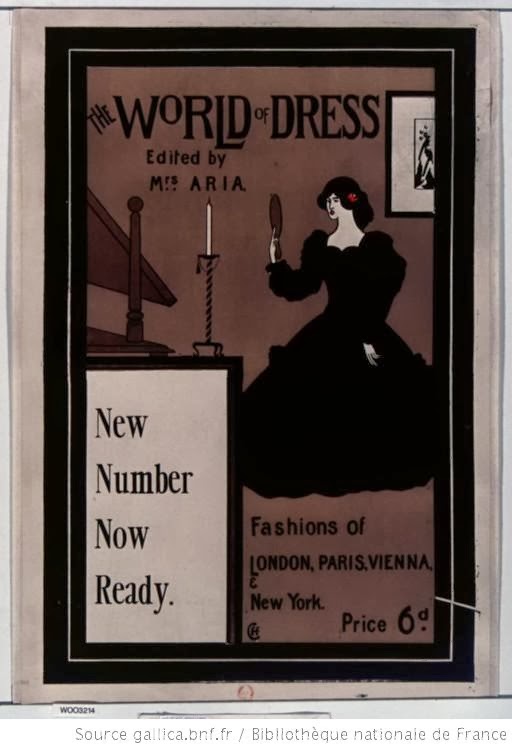
The World of Dress

"It is merely a question of head," said Percy Anderson to me one day, whilst we were discussing some easy method of solving a problem of fancy dress.
And he continued:
"Indeed, I would say that, broadly speaking, of all costume. The fashion of any period is distinguished primarily by the way its wearer dresses her hair.
"And chooses her sleeves," I suggested, and received his approval. 
Thus begins Mrs Aria and Percy Anderson’s Costume: Fanciful, Historical, and Theatrical (1906). Who better to speak on the subject of costume than the gossip columnist and editor of the World of Dress, Mrs Aria, a.k.a. Eliza Davis.

Because clothes are so fascinating, I’ve gone off on this wonderful tangent into late-Victorian fashion magazines, but I actually came across Davis through a more solemn matter. Over the weekend, a friend complained that Oscar Wilde was anti-Semitic. I’ve encountered mutterings about his terrible attitudes before and do not intend to diminish any of them, but thought I would look for his anti-Semitism. What I found was an anti-Semitic passage in The Picture of Dorian Gray, which certainly makes Dorian seem like a bit of a jerk (but he’s supposed to be. That’s the point of how he lives his life.) but it doesn’t say much about Wilde’s own views. Secondary sources defend Wilde by becoming as horrid and cliche as possible: “But... but... but, Wilde had Jewish friends!” Then, I found Davis.

Davis writes a little about Wilde and his brother in her autobiography, My Sentimental Self (1922).
Both Oscar Wilde and Willie Wilde became frequent visitors, and in a public garden which spread its ill-kept lumpish lawn behind our dwelling we often played tennis together : Willie in a shirt showing some desire to be divorced from the top of his trousers, and Oscar in a high hat with his frock-coat tails flying and his long hair waving in the breeze.
Because Willie is the real focus of my research (not that you can tell by reading my blog), I forgot all about his younger brother and started looking into the life of his fashionable, ambitious, and gossipy friend.

Davis was Julia Frankau and Owen Hall’s sister, making the Davises a very writerly family. Her niece would later recall that Davis knew loads of literary icons and collected their autographs for her and her own siblings. Really, I think, Davis was poised for success as a gossip columnist.
Whilst I was working for Hearth and Home I conceived the notion that I must possess and edit a journal of my own. Thus came into existence the monthly magazine known as The World of Dress, destined of course to show all other editors how fashion papers should be conducted. 
Other than Davis’s own opinions of it, I’m unable to find much information on the World of Dress. As is the case with most woman writers of the period, more is written about her love affairs than her work. On the other hand, gossip is gossip and gossip was Davis’s business.
The World of Dress possessed many excellent features from many excellent sources. Fashion news from Paris, Vienna and New York, interviews about dress with famous people. Sir James Linton, Sydney Grundy, Max Pemberton, Mortimer Menpes, Downey, the royal photographer, and lastly and most amusingly Dan Leno gave opinions. Casually Dan Leno declared that he of all men best understood women's clothes because he had worn them for years; and he knew all about them from the inside; the property to secure more laughter for him than anything else in his mirthful career being an old wired bonnet, tapped on and tied with strings. Every time it came off he just tapped it on a different part of his head, and the audience roared.
As illustrated throughout her autobiography and her work on dress, Davis had a healthy sense of humour. Biographers have noted that she and her sister didn’t take shots at Wilde after his tragedy in 1895, but even defended him against the homophobia of their brother.

Margaret D. Stetz wrote a lovely short essay on the relationship between Wilde and the Davises. In an effort to return to what led me along this tangent in my research, I conclude with her thoughts:
In The Picture of Dorian Gray and elsewhere, Wilde produced caricatured portraits of Jews. But in later years, his Jewish literary contemporaries also drew portraits of him, sometimes favorable and sometimes not. What all these differing representations signify about the ‘true’ social attitudes and personal views of those who populated the cosmopolitan artistic circles of late-Victorian London remains a mystery even deeper than the question of why Basil Hallward’s painting of Dorian aged and changed. 
Follow me on Twitter @TinyApplePress and like the Facebook page for updates!

Tuesday, January 14, 2014

Perverted Biographies of Marie Corelli

Like any other kind of writer, historians want to make their writing interesting. So, what is so-and-so had sex with so-and-so? That would be interesting!

Clearly, historians can be perverts too. This is one of my favourite examples of sexualized history in the blogosphere.
Because mine is an evil and a petty mind, suitable more to wallowing in the sordid sexual goings-on of literary giants than in reading their work, I take every opportunity I can to inform people who may not have known that Walt Whitman and Oscar Wilde almost certainly had sex in 1882.
We don’t have evidence that Wilde and Whitman had sex. It would be weird if we did. They had the opportunity to have sex and Wilde liked to imply that Whitman kissed him, but a kiss is just a kiss and Wilde preferred younger, less hairy men.


I bring this up to talk about Marie Corelli and her companion, Miss Bertha Vyer. Some biographers and historians like to think they were lesbians. Why?

There are lots of reasons. An early biographer (1903) wrote:
Miss Corelli’s sole companion after her convent school-life, with the exception of Dr. Charles Mackay [her father], was her devoted friend, Miss Bertha Vyver, daughter of the Countess Vyver, a not unimportant personage at the court of Napoleon III. The friendship between Miss Vyver and Miss Corelli has always been of the closest description.
The “closest description,” eh? Wink-wink, nudge, nudge!
Since Dr. Charles Mackay welcomed Miss Vyver as his “second daughter,” they have never been separated. In all her daily life, not the least the nursing of Dr. Mackay through his long illness, Miss Vyver has been by her side helping her in home difficulties and trials as help can obly be given by one with whom there is perfect sympathy. Miss Vyver has seen every detail of all the work the novelist has done, and to-day the friendship between the two is closer and dearer than ever for the years that have passed, and the sorrows and joys that have been borne in company.
Ok. The author doesn’t come out and say they had sex, but this kind of narrative led to the belief that Corelli was a lesbian, though she never self-identified as one and fell in love with a man three years later. That romance didn’t last. He was married and didn’t return her feelings, but, with the support of her good friend, Corelli gradually moved on.


Is it possible that Corelli was gay? Who cares? Is it possible that she and Vyver had sex? Certainly, but what difference does it make.

Two people can be good friends and never have sex. Look at Watson and Sherlock Homes! Wink-wink, nudge, nudge!

Follow me on Twitter @TinyApplePress and like the Facebook page for updates!